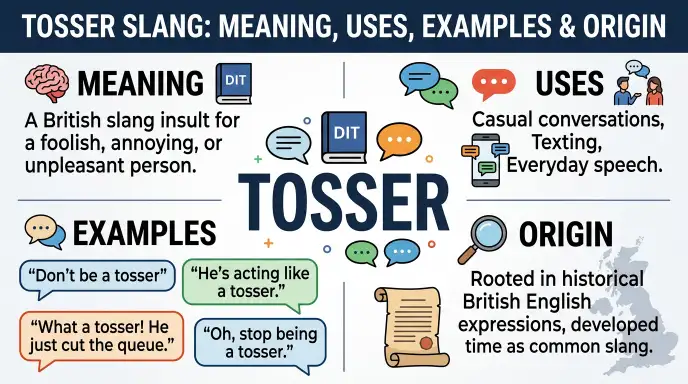
Tosser slang is a British English insult for a reckless , unpleasant, foolish, or disliked person. It is also linked to a vulgar British expression for masturbation, which explains why the word can sound stronger than a simple insult.
If you have heard someone say “you tosser” in a British TV show, movie, text, or online conversation, you may wonder if it is meant as a joke or a serious insult. The answer depends heavily on tone and context.
This guide explains the tosser slang meaning, where the word came from, how rude it is, and how British speakers use it.
You will also see realistic examples and learn whether it is suitable for school, work, texting, or social media.
Quick Answer
Tosser is British slang for a reckless, foolish, annoying, or unpleasant person. It is a vulgar insult and is probably connected to the British phrase “toss off,” meaning to masturbate.
In everyday use, however, people usually use “tosser” simply to call someone an idiot or an unpleasant person.
Example:
“That guy is such a tosser.”
Here, the speaker means that the person is acting like an idiot or being unpleasant.
What Does “Tosser” Mean in Slang?
In British English, tosser usually describes someone the speaker thinks is reckless, irritating, foolish, or unpleasant.
Cambridge labels the word UK offensive, while Oxford describes it as British slang for “a reckless or unpleasant person.” Collins also labels it British, vulgar, derogatory slang.
The word can express different levels of annoyance:
- “He is a bit of a tosser.” → Mildly insulting.
- “You absolute tosser!” → Stronger and more emotional.
- “That tosser cut me off.” → The speaker is angry or annoyed.
- “Don’t be a tosser.” → A warning that someone’s behavior is foolish or irritating.
The exact strength comes from tone, relationship, and situation.
Is “Tosser” a Bad Word?
Yes. Tosser is a vulgar and offensive British insult, although it is not usually treated as one of the strongest swear words.
Its sexual origin makes it more vulgar than words such as idiot, fool, or silly. Cambridge specifically marks it as offensive, while Collins calls it vulgar and derogatory.
That does not mean every use is extremely serious. British speakers may sometimes use insults like this jokingly with close friends.
For example:
“You forgot your keys again, you tosser!”
Two friends might laugh when saying this. But the same words said angrily to a stranger could easily cause offense.
Simple rule: treat “tosser” as an insult, not as a friendly everyday word.
Does “Tosser” Have a Sexual Meaning?
Yes. The word has a vulgar sexual connection.
British slang uses “toss off” for masturbation, and tosser is probably derived from that expression. Collins gives this as the likely origin, while Etymonline dates the use of tosser as a British term of contempt to around 1977.
However, when someone says:
“He’s a tosser.”
they usually are not literally saying that the person masturbates. The word has developed into a general insult meaning someone who is foolish, unpleasant, or contemptible.
So there are two related senses:
| Meaning | Use |
| Person who masturbates | Vulgar, sexual sense |
| reckless or unpleasant person | Common insulting sense |
The second meaning is the one most learners are likely to encounter in British conversations and media.
Where Is “Tosser” Commonly Used?
Tosser is mainly associated with British English. It may appear in British films, TV shows, books, conversations, social media posts, and online communities.
Texting
Someone might text:
“What a tosser. He canceled again.”
The meaning is simply that the person is being annoying or inconsiderate.
TikTok and Instagram
The word can appear in captions, comments, jokes, or discussions involving British speakers.
“That bloke is such a tosser 😂”
The laughing emoji can make the insult sound playful, but the word itself remains vulgar.
Discord and Gaming
British gamers may use it when reacting to another player’s behavior:
“What a tosser. He left the match halfway through.”
Again, it usually means idiot, jerk, or annoying person.
Workplace Chat
This is where you should be careful. Even if coworkers joke with each other, tosser is not professional language.
Avoid:
“The manager is a tosser.”
A safer version would be:
“The manager handled that badly.”
Is “Tosser” Rude, Offensive, or Harmless?
It is rude and can be offensive. It is not a harmless neutral word.
However, its seriousness varies.
| Situation | How “tosser” may sound |
| Close friends joking | Playful or teasing |
| Argument | Clearly insulting |
| Stranger | Rude and disrespectful |
| Workplace | Inappropriate |
| School | Usually inappropriate |
| Social media | Informal and potentially offensive |
| Family conversation | Depends on the family, but best avoided around children |
| Formal writing | Not appropriate |
One important point is that British speakers do not all use or interpret the word in exactly the same way. Tone matters.
Real Life Examples of “Tosser”
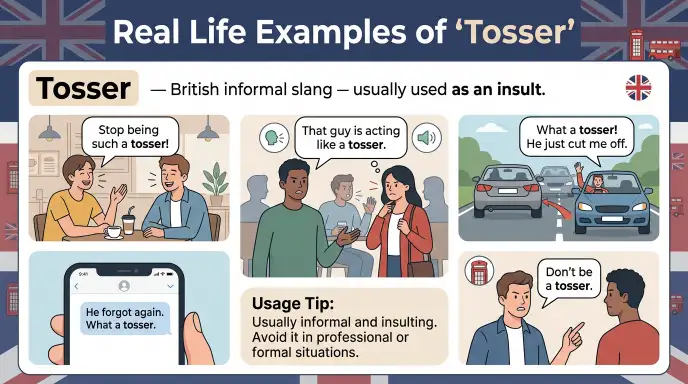
1. Everyday conversation
“He parked across both spaces. What a tosser.”
Meaning: The speaker thinks the driver behaved badly.
2. Text message
“Can you believe Tom forgot the tickets? What a tosser.”
Meaning: Tom made a foolish or annoying mistake.
3. Gaming
“That tosser quit just before the final round.”
Meaning: The player is being called annoying or foolish.
4. Social media
“Some tosser left rubbish all over the park.”
Meaning: Someone behaved inconsiderately.
5. Friendly teasing
“You absolute tosser you had the answer right in front of you!”
Meaning: A friend is teasing another friend.
6. Serious argument
“Get out of my way, you tosser.”
Meaning: This is a direct and hostile insult.
The same word can therefore sound funny, annoyed, or aggressive depending on how it is delivered.
Where Did “Tosser” Come From?
The history of tosser is older than its modern slang meaning.
Etymonline records tosser from the early 1610s in the ordinary sense of someone or something that tosses.
Its use as a British term of contempt appears much later, around 1977, and is probably connected to toss off, the vulgar expression for masturbation.
Collins also gives the likely origin as the 20th century phrase “toss off.”
The sexual expression itself is older. Historical language research summarized by Grammarphobia notes that toss off had a coarse sexual meaning recorded as early as 1735, while the phrase toss oneself off appears in a Victorian source from the late 19th century.
So the safest explanation is:
tosser → toss + er → probably influenced by “toss off” → later used as a general British insult.
The exact history should not be presented as certain because dictionaries describe the sexual connection as probable, rather than proven beyond doubt.
Tosser vs. Wanker vs. Jerk
These words can overlap, but they are not identical in tone or regional use.
| Word | General meaning | Common region | Tone |
| Tosser | reckless or unpleasant person | Mainly UK | Vulgar insult |
| Wanker | Insult linked directly to masturbation | Mainly UK | Usually stronger |
| Jerk | Annoying or selfish person | Mainly US/Canada, also understood elsewhere | Less vulgar |
| Idiot | Very foolish person | Widely used | Usually less vulgar |
| Fool | Silly or unwise person | Widely used | Mild |
| Moron | Very reckless person | Widely understood | Insulting |
“Tosser” and “wanker” are especially close because both have connections to British sexual slang. But they should not automatically be treated as exact synonyms in every conversation.
If you want a less offensive word, jerk, idiot, or fool is usually safer.
When Should You Avoid Using “Tosser”?
Avoid tosser when you need to sound polite, respectful, or professional.
Do not use it when speaking to:
- Your teacher
- Your employer
- A customer
- A stranger in a formal situation
- A job interviewer
- A client
- Someone you do not know well
It is also better to avoid it in formal emails, academic writing, business reports, and professional posts.
For example, instead of:
“The customer was a tosser.”
write:
“The customer was difficult to deal with.”
This keeps your meaning while removing the insult.
Polite Alternatives to “Tosser”
If you want to describe someone’s behavior without swearing, try:
- Idiot :still insulting, but less vulgar
- Fool :mild
- Jerk :informal but less vulgar
- Silly person :light and mild
- Annoying person :direct and neutral
- Unpleasant person :more formal
- Inconsiderate person :useful when someone behaves badly
- Rude person :clear and professional
The best replacement depends on what the person actually did.
Why Do People Say “Tosser”?
People usually use tosser to show annoyance, criticism, or contempt.
Common reasons include:
- Someone behaved selfishly.
- Someone made a foolish mistake.
- Someone acted arrogantly.
- Someone annoyed the speaker.
- Friends are teasing each other.
- A speaker wants to make a complaint sound more emotional.
The word can make a sentence feel more forceful.
Compare:
“He is annoying.”
with:
“He is such a tosser.”
The second sentence carries a much stronger informal attitude.
Common Misunderstandings About “Tosser”
It does not always literally mean a person who masturbates
Although the word has a sexual origin, its common insulting meaning is a foolish, reckless, or unpleasant person.
It is not mainly American slang
“Tosser” is strongly associated with British English. American dictionaries may list the British slang meaning, but it is not a normal everyday American insult in the same way.
It is not completely harmless
Some British speakers may use it jokingly, but major dictionaries still label it offensive, vulgar, or derogatory.
It is not a texting abbreviation
“Tosser” is a full slang word, not an acronym or abbreviation. You do not need to expand it into a “full form” like you would with words such as LOL or IMO.
Frequently Asked Questions
What does tosser mean in British slang?
In British slang, tosser means a reckless, foolish, annoying, or unpleasant person. It is a vulgar and offensive insult.
Is tosser a swear word?
It is best treated as a vulgar insult or low level swear word. It is not a neutral word, and it can offend people.
Is tosser a sexual word?
It has a sexual origin connected with the British phrase “toss off,” meaning to masturbate. In normal insulting use, however, it usually means an unpleasant or foolish person.
Is tosser worse than idiot?
Usually, yes in terms of vulgarity. Idiot is insulting, but tosser has a sexual connection and is more profane.
Can I call my friend a tosser?
You can hear friends use it jokingly, especially in British English. But it is still an insult, so only use it if you know the person is comfortable with that style of humor.
Is tosser used in America?
Americans may recognize the word from British media, but it is primarily a British slang term. American dictionaries identify the insulting sense as British slang.
Is tosser appropriate at work?
Generally, no. It is better to avoid it in professional communication because dictionaries classify it as offensive, vulgar, or derogatory. What is a polite altern
ative to tosser?
Depending on the situation, use fool, silly person, annoying person, rude person, or inconsiderate person.
Conclusion
Tosser slang is mainly a British insult meaning a reckless, foolish, annoying, or unpleasant person.
It has a vulgar connection to “toss off,” a British expression for masturbation, but speakers commonly use tosser as a general insult rather than a literal sexual description.
The word can be playful between close friends, but it can also sound rude or aggressive when directed at a stranger.
Its meaning and strength depend on the speaker’s tone, relationship with the listener, and situation.
For everyday understanding, the easiest translation is “idiot,” “jerk,” or “unpleasant person,” with the warning that tosser is more vulgar.
If you see the word in a British TV show, text, TikTok comment, Reddit post, or Discord chat, context will usually tell you if it is serious criticism or casual teasing. When in doubt, avoid using it in professional or formal settings.
Discover More Slang!
- Cute in Korean Slang Meaning in Text
- Slang in Spain: Common Terms Explained
- Slang from Early 2000s: Popular Words & Phrase

Hi, I’m Chloe Parker. I write simple and practical articles about slang, grammar, spelling, vocabulary, and commonly confused words. My goal is to make English easier to understand through clear explanations and real-life examples. Whether you’re a student, writer, or English learner, I’m here to help you build confidence and improve your everyday English.