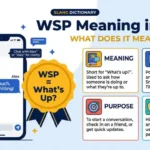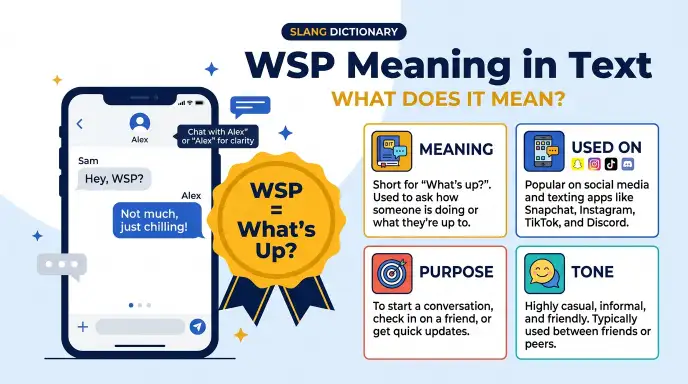
WSP usually means “What’s up?” in text messages and online chats. It is a casual way to ask someone how they are, what they are doing, or what is happening. You may see WSP in texting, Snapchat, Instagram, TikTok, WhatsApp, and other social platforms.
If someone sends you a message that simply says “wsp?”, they are usually starting a conversation. It can be similar to saying “Hey, what’s up?” or “What are you doing?”
WSP is popular because it is short and easy to type. Like many texting abbreviations, it saves time while keeping the conversation relaxed.
You might come across WSP when chatting with friends, classmates, online friends, or people you regularly talk to. If you searched for “wsp mean in text,” the simple answer is usually “What’s up?”
WSP Meaning in Text
The most common meaning of WSP in texting is “What’s up?”
“What’s up?” is a casual greeting or question. Depending on the situation, it can mean:
- How are you?
- What are you doing?
- What’s happening?
- Is everything okay?
- What are you up to?
For example:
A: Wsp?
B: Not much, just watching Netflix.
Here, WSP is simply being used as a quick way to start a conversation.
Is WSP Slang or an Abbreviation?
WSP is best described as a texting abbreviation or internet shorthand. It is commonly used in casual digital communication rather than formal writing.
It comes from the phrase “what’s up?” by taking the first letters of the words:
W = What
S = ’s
P = up
In everyday online conversations, people may type it as wsp, WSP, or sometimes wsp? The lowercase version is especially common in casual texting.
What Does WSP Mean in Everyday Chat?
In everyday chat, WSP usually works as a quick greeting.
Someone may send:
“wsp”
You could respond:
“Hey! Not much. You?”
The exact meaning can depend on the context. If a friend sends WSP after being quiet for several days, they may simply be checking in.
If someone sends WSP late at night, they could be asking what you are doing or if you are available to talk.
So, although the literal phrase is “What’s up?”, the natural meaning can be closer to “Hey, what are you doing?” or “How’s it going?”
Where Do People Use WSP?
WSP is mainly used in informal digital communication. It can appear on many social and messaging platforms.
WSP on TikTok
On TikTok, WSP may appear in comments, direct messages, or conversations between users.
For example:
“wsp bro”
This could simply mean:
“What’s up, bro?”
Someone may also use WSP to start a conversation after seeing another person’s video or profile.
Because TikTok conversations are usually casual, short forms such as WSP fit naturally into the platform.
However, not every use of WSP on TikTok has to be a greeting. Context still matters. If the abbreviation appears in a username, caption, or unrelated discussion, it may have another meaning.
WSP on Snapchat
Snapchat is another place where you may see WSP frequently.
A friend might send:
“wsp?”
They could be asking what you are doing or simply trying to start a chat.
You might reply:
“Nothing much, just chilling. Wbu?”
Here, WBU means “What about you?”
WSP is particularly natural on Snapchat because conversations between friends tend to be quick and informal.
WSP on Instagram
On Instagram, WSP can appear in DMs, comments, or casual conversations.
For example:
“wsp, are you going to the game?”
This means:
“What’s up? Are you going to the game?”
Instagram users may combine WSP with other abbreviations, emojis, or casual language.
WSP on WhatsApp
On WhatsApp, WSP can be used in private chats and group conversations.
For example:
“Wsp everyone?”
This could be a casual way of entering a group conversation.
A friend might also send:
“wsp tonight?”
Depending on context, this could mean:
“What’s up tonight?” or “What are you doing tonight?”
WSP in SMS and Text Messages
Traditional SMS texting also uses WSP.
If someone wants to send a short message without typing the full phrase, they may write:
“Wsp?”
This is especially common between friends and people who already have an informal relationship.
In professional or formal messages, however, writing the full phrase or using a more direct question is usually better.
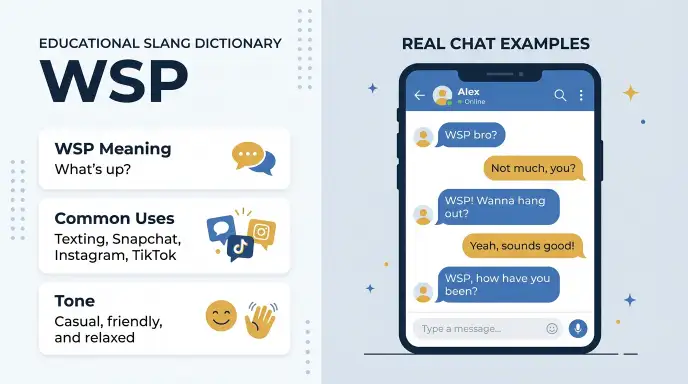
Real Chat Examples of WSP
The easiest way to understand WSP is to see how it works in natural conversations.
Example 1: Simple Greeting
A: Wsp?
B: Hey! Not much. You?
Here, WSP is simply a casual greeting.
Example 2: Checking What Someone Is Doing
A: Wisp tonight?
B: Probably staying home.
The sender is asking about the other person’s plans.
Example 3: Starting a Conversation
A: Wsp bro
B: Yo! I’m good. What’s up with you?
WSP helps start a relaxed conversation.
Example 4: Checking In
A: Hey, wsp? You disappeared lol.
B: Haha, sorry. Been super busy.
In this case, WSP is partly a way of checking in.
Example 5: Talking About Plans
A: Was this weekend?
B: I might go to the movies Saturday.
The phrase can be understood as asking what someone is doing or what their plans are.
Example 6: Group Chat
A: Esp everyone?
B: Just finishing homework.
C: Same 😭
WSP can work as a casual group greeting.
Example 7: Reconnecting
A: Wow! Been a while.
B: For real 😂 How have you been?
The sender is using WSP as a friendly way to restart a conversation.
Example 8: Asking About an Event
A: Wisp with the party tonight?
B: Still happening at 8.
Here, the wording asks about what is happening with the event.
Example 9: Late Night Chat
A: Wisp? Are you still awake?
B: Yeah lol. Can’t sleep.
WSP opens the conversation before the sender asks a more specific question.
Example 10: Casual Friendship
A: Wisp man?
B: All good. Just gaming.
This is a relaxed conversation between friends.
How to Reply When Someone Says “WSP”
There is no single correct reply to WSP. Your response depends on what you are doing and how friendly or casual you want to sound.
Here are some common options.
Funny Replies
If you are talking to a close friend, you can make the response playful.
- “The ceiling 😂”
- “My Wi Fi is struggling.”
- “Nothing except surviving Monday.”
- “Just pretending to be productive 😂”
- “You tell me 👀”
These replies are informal and work best with people who understand your humor.
Casual Replies
For a normal everyday conversation, you can keep it simple.
- “Not much, you?”
- “Just chilling.”
- “Nothing much. What about you?”
- “Just watching a movie.”
- “I’m good. You?”
These are probably the most natural replies.
Friendly Replies
If you want to sound warm and interested, try:
- “Hey! I’m good. How are you?”
- “Not much! What are you up to?”
- “Hey, doing pretty good. You?”
- “All good here. What’s going on?”
- “I’m just relaxing. How’s your day going?”
Neutral Replies
If you do not want to sound too casual, you can answer directly.
- “I’m doing well. How about you?”
- “Nothing much at the moment.”
- “I’m just finishing some work.”
- “I’m available right now. What’s up?”
- “Everything is fine. How can I help?”
Your reply can also depend on if you want the conversation to continue. If you are interested in talking, ask “you?” or “what about you?” keeps the conversation going.
Is WSP Rude or Offensive?
No, WSP is generally not rude or offensive. It is normally a casual and harmless texting abbreviation for “What’s up?”
It is commonly used between friends, classmates, online contacts, and other people who communicate informally.
However, the situation still matters.
For example:
“Wsp bro?”
sounds very casual.
But sending:
“WSP!!!”
to a teacher, manager, or professional contact could seem overly informal even though the abbreviation itself is not offensive.
Is WSP Safe to Use?
In ordinary casual conversations, yes. WSP is generally safe to use.
It is especially suitable when:
- Talking to friends
- Messaging classmates
- Chatting with online friends
- Sending casual DMs
- Talking in gaming communities
- Using informal group chats
Is WSP Appropriate at School or Work?
It depends on the situation.
In a personal conversation with a friend from school, WSP is usually fine.
In an academic email, formal assignment, job application, business email, or professional message, it is better to write normally.
Instead of:
“WSP? Can you send the report?”
a professional message could say:
“Hi, how are you? Could you please send the report when you have a chance?”
The important point is not that WSP is bad. It is simply informal.
Who Uses WSP?
WSP is mostly used by people who communicate through texting and social media.
Younger Internet Users
Teenagers and young adults are likely to recognize WSP because short forms are common in online conversations.
People who spend a lot of time on messaging apps, social platforms, gaming chats, and online communities may come across it often.
Gen Z Usage
Gen Z commonly uses abbreviations to make digital conversations faster and more relaxed. WSP fits this style because it turns a familiar phrase into three letters.
Still, it would be inaccurate to say that only Gen Z uses WSP. Older users who regularly text or use social media may recognize and use it too.
Common Platforms
You may see WSP on:
- Snapchat
- TikTok
- Discord
- SMS
- Facebook Messenger
- Other messaging apps
Its use is most natural in casual communication.
How Often Does WSP Appear Online?
WSP is a recognizable internet shorthand, but its frequency can vary between communities and individuals.
Some people prefer “what’s up?”, while others may use “sup?”, “wyd?”, or “hey.”
The meaning is usually easy to understand when the surrounding conversation is clear.
Origin of WSP
WSP comes from the casual English greeting “What’s up?”
The exact point when WSP became widely used as an internet shorthand is difficult to identify.
Like many texting abbreviations, it developed naturally from the broader habit of shortening common phrases for quick digital communication.
Text messaging helped popularize abbreviations because users often wanted to communicate quickly using fewer characters.
Internet culture then made shortened expressions even more common. Social media, instant messaging, gaming chats, and online communities all contributed to the growth of digital shorthand.
The origin of the phrase “what’s up?” itself is much older than modern texting. The shortened form WSP should therefore be understood as an internet and texting abbreviation derived from an already common spoken expression.
There is no need to assume that WSP has one specific inventor or one exact launch date. Its development is better understood as part of the broader evolution of online communication.
WSP vs. IDK, IDC, IMO, and BRB
WSP can sometimes be confusing when you are learning several texting abbreviations at once. However, these terms have very different meanings.
| Term | Meaning | Type | Usage | Popularity |
| WSP | What’s up? | Texting abbreviation | Greeting or checking in | Common in casual chats |
| IDK | I don’t know | Text abbreviation | Showing uncertainty | Very common |
| IDC | I don’t care | Text abbreviation | Showing lack of concern | Common |
| IMO | In my opinion | Text abbreviation | Introducing an opinion | Common |
| BRB | Be right back | Text abbreviation | Saying you will return soon | Common |
The main difference is that WSP is usually used to start or continue a conversation, while the others communicate a specific response or idea.
For example:
WSP? = What’s up?
IDK. = I don’t know.
IDC. = I don’t care.
IMO, it’s better. = In my opinion, it’s better.
BRB. = Be right back.
Understanding the context makes these abbreviations much easier to recognize.
Real World Usage Example
Imagine two friends who have not spoken since the afternoon.
One friend opens their messaging app and sends:
“wsp?”
The other replies:
“Not much. Just got home from work. You?”
The first friend says:
“Same. Wanna play later?”
In this situation, WSP is not being used as a serious question about a particular event. It is simply an easy way to reconnect and begin a conversation.
Another example could happen in a group chat.
Someone joins the conversation and writes:
“Wsp guys?”
Other people might answer:
“Nothing much.”
or
“Planning Saturday’s trip.”
Again, the abbreviation acts as a casual greeting and conversation starter.
This is why understanding the tone is important. WSP often has a friendly, relaxed feel rather than a formal or serious one.
WSP Can Have Other Meanings
Although “What’s up?” is the common meaning when WSP appears in casual texting, abbreviations can have different meanings in different communities.
For example, WSP might be used as an acronym for a company, organization, technical term, or other phrase outside casual messaging.
That is why context matters.
If someone sends:
“wsp?”
in a conversation with a friend, “What’s up?” is a very natural interpretation.
But if you see WSP in a business document, technical discussion, school material, or a specialized online community, it may refer to something else.
When interpreting an abbreviation, look at the words around it and the type of conversation where it appears.
How to Tell What WSP Means
If you are unsure about WSP, ask yourself a few simple questions.
Look at the Context
If WSP appears at the beginning of a message, such as:
“Wsp?”
it is probably a greeting.
Check Who Sent It
A close friend is much more likely to use WSP casually than a formal organization.
Look at the Other Words
For example:
“Wsp tonight?”
probably relates to plans.
“Wsp bro?”
is more clearly a casual greeting.
Consider the Platform
On Snapchat, Instagram DMs, WhatsApp, TikTok, and SMS, WSP is likely to be informal texting shorthand.
In a technical document, the same letters could mean something completely different.
When Should You Avoid Using WSP?
WSP is useful, but it is not suitable for every situation.
Avoid using it when writing:
- Formal emails
- Job applications
- Business proposals
- Academic assignments
- Official letters
- Professional reports
- Formal customer messages
Instead, use complete words and a more appropriate greeting.
For example, instead of:
“Wsp? Did you receive my application?”
you could write:
“Hello, I hope you are doing well. I wanted to confirm if you received my application.”
The choice depends on the relationship between you and the person receiving the message.
Frequently Asked Questions
What does WSP mean in text messages?
WSP usually means “What’s up?” in text messages. It is a casual way to greet someone, ask how they are, or ask what they are doing.
What does WSP mean on TikTok?
On TikTok, WSP generally means “What’s up?” when used in comments, DMs, or casual conversations. The exact meaning can depend on the context.
Is WSP slang?
WSP is commonly considered internet slang or texting shorthand. More precisely, it is an abbreviation of the casual phrase “What’s up?”
Is WSP rude or offensive?
No. WSP is generally not rude or offensive. It is a casual abbreviation. However, it may be too informal for professional or formal communication.
How should you reply to WSP?
You can reply with “Not much, you?”, “I’m good, what about you?”, or a direct answer about what you are doing. A funny reply can also work with close friends.
Does WSP mean “What’s up?”
Yes. In casual texting, WSP most commonly means “What’s up?”
What is the difference between WSP and WBU?
WSP means “What’s up?”, while WBU means “What about you?” They can appear together in the same conversation.
For example:
A: Wsp?
B: I’m good. Why?
Can WSP be used in formal messages?
It is better to avoid WSP in formal messages. Write “What’s up?”, “How are you?”, or another complete phrase depending on the situation.
Conclusion
WSP usually means “What’s up?” in text and online conversations. It is a short, casual abbreviation used to greet someone, check in, or ask what they are doing.
You may see WSP on Snapchat, TikTok, Instagram, WhatsApp, SMS, and other messaging platforms. It is especially common in relaxed conversations between friends and online contacts.
The abbreviation is generally not rude or offensive, but it is informal. That makes it a better choice for friends and casual chats than for teachers, employers, customers, or professional communication.
If someone sends you “WSP?”, a simple response such as “Not much, you?” is usually enough. When the context is clear, there is little mystery behind the abbreviation; it is simply a quick digital version of “What’s up?”
Learn More!

Hi, I’m Chloe Parker. I write simple and practical articles about slang, grammar, spelling, vocabulary, and commonly confused words. My goal is to make English easier to understand through clear explanations and real-life examples. Whether you’re a student, writer, or English learner, I’m here to help you build confidence and improve your everyday English.