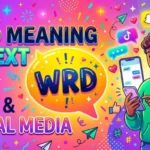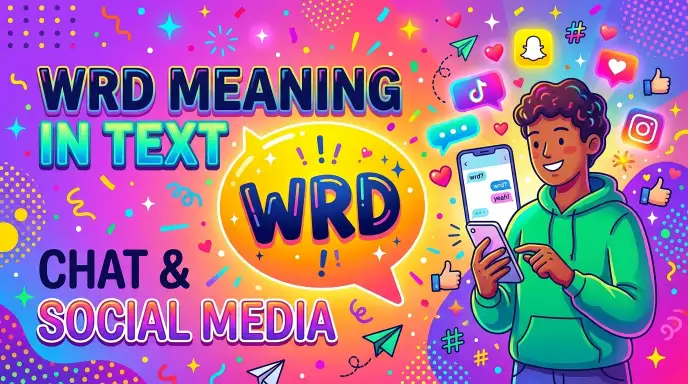
WRD usually means “word” in text messages. In casual chats, it often means “I agree,” “that’s true,” “exactly,” or “I understand.” When written as “wrd?”, it can mean “Really?” or “Are you serious?”
You may see WRD in text messages, TikTok comments, Snapchat chats, Instagram DMs, WhatsApp conversations, gaming chats, and other informal online spaces. It is a short, casual way to respond without typing a complete sentence.
At first, WRD can look like a typo. The missing vowel makes it seem incomplete, but that is usually intentional. People commonly shorten words online to make messages faster and more relaxed.
People often search for “word mean in text” after receiving a message containing only “wrd.” The good news is that the basic meaning is simple. The exact tone, however, depends on the conversation and punctuation.
WRD Meaning in Text
WRD is most commonly a shortened spelling of “word.” Unlike abbreviations such as BRB (“be right back”) or IMO (“in my opinion”), WRD is not normally an acronym made from the first letters of several words. It is a clipped version of an existing word.
In everyday online conversation, “word” can have a slang meaning beyond its dictionary definition. It can be used to show agreement, recognition, understanding, or confirmation.
For example:
A: “That new restaurant is way too expensive.”
B: “Wrd.”
Here, B is not talking about a written word. B means something like:
- “True.”
- “I agree.”
- “Exactly.”
- “For real.”
The meaning can change slightly depending on how WRD is written.
Common meanings of WRD
| Form | Likely meaning |
| WRD | I agree / True / Exactly |
| word | Casual agreement or acknowledgment |
| WRD! | Strong agreement |
| WRD? | Really? / Seriously? |
| WRD?? | Surprise or disbelief |
| wrd lol | Agreement with a playful tone |
Punctuation and surrounding messages are important. “Wrd.” and “Wrd?” can communicate very different reactions.
Is WRD slang, an acronym, or an abbreviation?
WRD is best described as a texting abbreviation or shortened slang form of “word.”
It is not normally an acronym like LOL, where the letters stand for separate words. Instead, the sender removes the vowel from WORD:
WORD → WRD
This type of shortened spelling is common in casual digital communication.
How Is WRD Used in Everyday Chat?
The most common use of WRD is to agree with another person.
Imagine someone says:
“I think we should leave early. Traffic is going to be terrible.”
You could respond:
“Wrd, let’s go before 5.”
Here, WRD means “I agree.”
It can also acknowledge someone’s experience:
“I studied all night for that exam.”
“Wrd 😭”
The second person is essentially saying, “I understand,” “I know what you mean,” or “That’s true.”
Another common use is confirmation:
“Meet me at the coffee shop at 6?”
“Wrd.”
In this situation, the response may mean “Okay,” “Got it,” or “Sounds good.”
So, while the basic source word is “word,” the conversational meaning can be broader.
Where People Use WRD
WRD is mainly associated with informal digital communication. It can appear anywhere people have quick, casual conversations.
WRD on TikTok
On TikTok, WRD may appear in comments or private messages when someone agrees with a video, another user’s comment, or a particular opinion.
For example:
“This is the most underrated song ever.”
Someone might comment:
“wrd 😭”
That means something like “Exactly” or “I agree.”
If someone writes:
“WRD??”
the tone may be different. It could mean:
“Really?”
or
“Are you serious?”
TikTok comments are often short, so context does a lot of the work.
WRD on Snapchat
Snapchat conversations are generally informal, making shortened expressions like WRD natural in chats between friends.
For example:
A: “I’m skipping the party tonight.”
B: “wrd, same.”
Here, WRD is an acknowledgment or agreement.
Snapchat users may also use punctuation and emojis to change the feeling of the message.
“wrd 😂” can sound playful.
WRD on Instagram
On Instagram, WRD may appear in comments, DMs, or group chats.
For example:
“That outfit is actually on fire.”
“WRD.”
The reply means “I agree” or “For real.”
Someone may also use it to react quickly to a friend’s statement without starting a longer conversation.
WRD on WhatsApp
WhatsApp messages often include informal abbreviations, especially between friends and family members who regularly chat.
For example:
A: “I think we should order pizza.”
B: “Wrd 😂”
The response is basically:
“Yes, I agree.”
Because WhatsApp is also used for professional and family communication, the appropriateness of WRD depends on who you are talking to.
WRD in SMS Text Messages
In ordinary SMS conversations, WRD works much like it does on social media.
It can be used to:
- agree with someone
- acknowledge information
- confirm a plan
- show understanding
- react to something surprising
For example:
A: “That test was harder than I expected.”
B: “Wrd.”
This means “I know, right?” or “That’s true.”
Real Chat Examples of WRD
Here are realistic examples showing how the meaning can change with context.
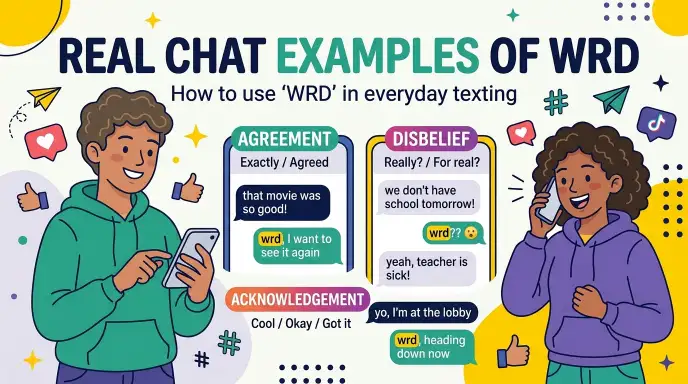
Example 1: Simple agreement
A: I think this movie is way better than the first one.
B: Ward.
Meaning: “I agree.”
Example 2: Strong agreement
A: We seriously need more sleep.
B: WRD 😭
Meaning: “Absolutely. I agree.”
Example 3: Confirming a plan
A: We met at 7?
B: Ward.
Meaning: “Yes,” “Okay,” or “Got it.”
Example 4: Showing understanding
A: I can’t come tonight. I have to finish this project.
B: Ward, no worries.
Meaning: “I understand.”
Example 5: Reacting to an opinion
A: Online classes can be exhausting.
B: Ward.
Meaning: “True” or “I agree.”
Example 6: Surprise
A: He actually quit his job today.
B: WRD??
Meaning: “Really?” or “Are you serious?”
Example 7: Asking for confirmation
A: The concert is tomorrow.
B: Word?
Meaning: “Really?” or “Is that true?”
Example 8: Casual acknowledgment
A: I’ll send you the photos later.
B: Ward
Meaning: “Okay” or “Sounds good.”
Example 9: Agreement with humor
A: Mondays should be illegal.
B: Wrd 😂
Meaning: “Seriously, I agree.”
Example 10: Supporting a friend
A: I’m tired of people judging everything I do.
B: Ward. Just do what makes you happy.
Meaning: “I understand” or “I agree with you.”
These examples show why it is not always enough to translate WRD into one fixed phrase. The message before it usually reveals the intended meaning.
How to Reply When Someone Says “WRD”
Your reply should match the context.
If the person is agreeing with you, you do not always need a long response. A short answer can keep the conversation natural.
Funny replies
If the conversation is playful, you could respond with:
- “You already know 😂”
- “Facts 😂”
- “Exactlyyy”
- “Finally, someone gets it 😭”
- “Now we’re talking 😂”
Casual replies
For an everyday conversation:
- “Fr.”
- “Exactly.”
- “I know.”
- “Right?”
- “Same.”
- “Yeah, definitely.”
Friendly replies
If you want to sound warm and positive:
- “Haha, glad you agree!”
- “I knew you’d understand.”
- “Exactly! You get it.”
- “That’s what I’m saying.”
- “For real!”
Neutral replies
If you want to keep things simple:
- “Yep.”
- “True.”
- “Got you.”
- “Okay.”
- “Sounds good.”
- “I understand.”
If the person wrote “WRD?”, answer the implied question instead.
For example:
A: “I heard the store is closing.”
B: “WRD?”
You could reply:
“Yeah, apparently.”
or
“Yep, that’s what I heard.”
Is WRD Rude or Offensive?
Generally, WRD is not considered a rude or offensive expression. It is normally a casual way to agree, acknowledge something, or react to a statement. Current slang references consistently describe it as an informal texting expression rather than an offensive term.
However, tone can change how a short reply feels.
For example:
“I had such a bad day.”
“wrd.”
The reply might be intended as understanding, but because it is so short, it could also feel dismissive if the conversation is emotional.
That does not make WRD inherently rude. It simply shows that short messages can sometimes be unclear.
Is WRD safe to use?
It is generally safe in casual conversations with people who understand internet slang.
It is more appropriate for:
- friends
- casual group chats
- social media
- gaming chats
- informal DMs
- relaxed text conversations
Is WRD appropriate at school?
For a casual conversation with classmates, it may be fine.
However, you would normally avoid WRD in:
- essays
- assignments
- formal school emails
- academic work
- applications
Use standard language instead.
Is WRD appropriate at work?
It depends on the workplace and the person receiving the message.
In a casual team chat where abbreviations are common, it may not cause a problem. But in formal emails, client communication, business documents, or professional messages, writing “I agree,” “Understood,” or “That’s correct” is clearer.
Who Uses WRD?
WRD is most closely associated with casual internet and texting culture. It is especially natural among people who frequently communicate through short digital messages.
You may encounter it among:
- teenagers
- young adults
- frequent social media users
- gamers
- people who use texting slang regularly
- online communities
That does not mean older adults never use it. Internet slang spreads across age groups, particularly when people regularly communicate through social platforms.
WRD and Gen Z
WRD fits the short, compressed style often seen in Gen Z oriented online communication.
However, it would be misleading to say that every Gen Z user uses WRD or that it belongs exclusively to Gen Z. Slang varies widely by community, platform, region, and personal preference.
A person who rarely uses abbreviations may prefer:
“I agree.”
while someone who frequently uses texting slang may simply write:
“wrd.”
How often does WRD appear online?
WRD is established enough to appear in texting and social media slang references, but there is no single reliable public measure showing exactly how often every age group or platform uses it. Its frequency can vary considerably between communities.
It is best understood as common informal shorthand in certain online conversations, rather than a term that everyone uses.
Origin of WRD
The modern texting form WRD comes from the word “word,” but the slang use of “word” is older than smartphones and social media.
The expression “word” has long been used informally to communicate agreement, truth, acknowledgment, or recognition. Expressions such as “word,” “word up,” and “say word” have appeared in American slang and popular culture.
Some sources connect the slang sense strongly with urban American speech and hip hop culture, particularly during the late 20th century.
The exact origin of the shortened spelling WRD is less certain. It is safer not to claim that one person or one website invented it.
As text messaging became popular, people increasingly shortened words to type faster. Removing vowels was one simple way to create compact spellings:
- word → word
- people → ppl
- please → pls
- message → msg
Social media later helped spread these forms across different online communities.
So the history is best understood in two parts:
- “Word” as slang for agreement or recognition existed before modern texting.
- “WRD” developed as a compact digital spelling that fits fast online communication.
The exact date when WRD became widespread is difficult to establish, so claims about one precise starting point should be treated cautiously.
WRD vs. IDK, IDC, IMO, and BRB
WRD can appear alongside other common texting abbreviations, but each one serves a different purpose.
| Term | Meaning | Type | Typical Usage | Popularity |
| WRD | Word / I agree / True | Shortened slang form | Agreement, acknowledgment, reaction | Common in casual slang |
| IDK | I don’t know | Initialism | Showing uncertainty or lack of knowledge | Very common |
| IDC | I don’t care | Initialism | Showing indifference | Very common |
| IMO | In my opinion | Initialism | Introducing a personal view | Very common |
| BRB | Be right back | Initialism | Temporarily leaving a chat | Long established and common |
The key difference is that WRD usually reacts to something someone else has said, while the other abbreviations communicate specific information.
For example:
“I think this song is underrated.”
“WRD.”
This shows agreement.
Compare that with:
“IDK if I like it.”
The sender is expressing uncertainty.
Or:
“IMO, the second album is better.”
The sender is giving an opinion.
And:
“BRB, dinner.”
The sender is saying they are temporarily leaving the conversation.
Understanding these differences makes texting slang much easier to read.
Real World Usage Example
Imagine two friends are discussing their schedules after school.
One friend says:
“I don’t think I’ll go out tonight. I have an early class tomorrow.”
The other replies:
“Wrd, you should probably get some sleep.”
In this situation, WRD works as a casual acknowledgement. It is close to “I understand,” “That makes sense,” or “I agree.”
Now imagine a different situation:
“Guess who just won the competition?”
“Who?”
“Maya.”
“WRD??”
Here, WRD has a completely different tone. The question marks suggest surprise or disbelief, roughly meaning:
“Really?”
This is why you should not automatically translate every WRD message as “I agree.” Look at the sentence before it and pay attention to punctuation.
How to Tell Which Meaning of WRD Is Intended
When WRD appears in a message, ask yourself what the sender is responding to.
If they are responding to an opinion
WRD probably means:
“I agree.”
If they are responding to information
It may mean:
“Okay,” “Got it,” or “I understand.”
If they add a question mark
“WRD?” may mean:
“Really?” or “Is that true?”
If they use multiple question marks
“WRD??” usually carries stronger surprises.
If they add laughing emojis
“wrd 😂” may be a playful way of agreeing.
If they use an exclamation point
“WRD!” can emphasize strong agreement or excitement.
The surrounding conversation is more important than the abbreviation alone.
Common Misunderstandings About WRD
WRD is not always an acronym
Some people assume every short online term is an acronym. WRD usually is not. It is a shortened form of word.
WRD is not automatically a typo
If someone intentionally writes “word” in a casual chat, it is usually slang rather than a spelling mistake.
WRD does not always mean “I agree”
Agreement is common, but “wrd?” can express surprise or ask for confirmation.
WRD does not have a special meaning based on gender
If a girl sends WRD or a guy sends WRD, there is no standard male or female specific definition. The context determines the meaning.
WRD is not the same as IDK
IDK means “I don’t know.”
WRD usually expresses agreement, acknowledgment, or a related reaction.
When Should You Avoid Using WRD?
WRD is useful when the conversation is relaxed, but there are situations where standard language is a better choice.
Avoid it in formal writing such as:
- job applications
- professional emails
- academic essays
- official documents
- formal customer communication
- business proposals
Instead of:
“Wrd, I’ll send it tomorrow.”
write:
“Understood. I’ll send it tomorrow.”
Instead of:
“WRD!”
in a formal discussion, use:
“I agree.”
The issue is not that WRD is offensive. The issue is that it is informal.
When communicating professionally, clarity usually matters more than saving a few keystrokes.
Frequently Asked Questions
What does WRD mean in text messages?
WRD usually means “word.” In casual texting, it commonly expresses agreement, truth, acknowledgment, or understanding.
What does WRD mean on TikTok?
On TikTok, WRD is generally used as casual slang for “word,” “true,” “I agree,” or “exactly.” If someone writes “WRD?”, it may instead mean “Really?” or “Are you serious?”
Is WRD slang?
Yes. WRD is commonly used as informal texting and internet slang. It is a shortened spelling of “word” rather than a traditional acronym.
Is WRD rude or offensive?
Generally, no. WRD is normally a harmless informal expression. However, a very short reply can sometimes sound dismissive depending on the situation and the relationship between the people chatting.
How should you reply to WRD?
If WRD means agreement, you can reply with “Exactly,” “For real,” “Facts,” “Right?” or simply continue the conversation. If it appears as “WRD?”, answer the implied question, such as “Yeah, seriously.”
What does WRD mean with a question mark?
“WRD?” commonly means “Really?” “Seriously?” or “Is that true?” The question mark changes the tone from simple agreement to surprise or a request for confirmation.
Is WRD the same as “word”?
Yes. WRD is a shortened spelling of a word. In slang, “word” can also function as a response meaning “I agree,” “true,” or “I understand.”
Can WRD mean “weird”?
It can potentially be interpreted differently in an unusual context, but the common texting interpretation is “word.”
If someone sends WRD as a standalone response to a statement, agreement or acknowledgment is usually the more natural interpretation.
Is WRD appropriate for school?
It can be fine in casual messages between friends or classmates. It is better to use standard language in essays, assignments, formal emails, and other academic writing.
Is WRD appropriate at work?
WRD may be acceptable in an informal workplace chat if that communication style is normal for the team.
For formal emails, clients, reports, and professional documents, use clearer wording such as “I agree,” “Understood,” or “That’s correct.”
Conclusion
WRD usually means “word” in text. In internet slang, it commonly works as a quick way to say “I agree,” “true,” “exactly,” or “I understand.” It can also show surprise when written as “WRD?”
You are most likely to see it in casual texts, TikTok comments, Snapchat chats, Instagram DMs, WhatsApp messages, gaming conversations, and other informal online spaces.
The easiest way to understand WRD is to look at the message around it. If someone writes “word” after an opinion, they are probably agreeing. If they write “wrd?”, they may be asking if something is true.
WRD is generally harmless, but it is informal. It works well with friends and casual online conversations, while standard phrases are usually better for school, work, and professional communication.
Once you understand the context, this three letter abbreviation is pretty simple: WRD = word, often carrying the casual meaning of “true,” “I agree,” or “I get you.”
Read the Full Guide!

Hi, I’m Chloe Parker. I write simple and practical articles about slang, grammar, spelling, vocabulary, and commonly confused words. My goal is to make English easier to understand through clear explanations and real-life examples. Whether you’re a student, writer, or English learner, I’m here to help you build confidence and improve your everyday English.