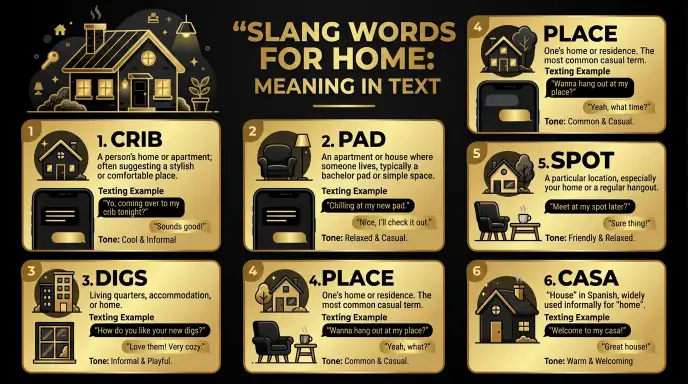
Slang words for home are casual terms people use to talk about their house, apartment, living space, or the place where they feel comfortable.
Common examples include crib, pad, digs, place, homestead, hood, and casa, although their meaning and tone can vary by region and situation.
People often use these expressions in texting, social media, music, gaming, and everyday conversation because they sound more relaxed than simply saying “home.” If someone texts, “Come over to my crib,” they usually mean, “Come over to my home.”
Quick Answer
Some common slang words for home include crib, pad, digs, place, casa, homestead, and spot. The best choice depends on the speaker, region, and context because some terms are friendly and casual while others have a stronger cultural or regional feel.
What Are Slang Words for Home?
Slang words for home are informal expressions that refer to someone’s home or living space. They can describe a house, apartment, room, or familiar place where someone lives or spends time.
Unlike the standard word home, slang terms often add personality. A person might say:
- “I’m heading back to my crib.”
- “Come chill at my pad.”
- “I’ll see you at my place.”
- “We’re hanging at his spot tonight.”
- “Welcome to my digs.”
The exact meaning is usually easy to understand from the conversation.
Some words are widely understood across English speaking communities. Others are more common in particular countries, age groups, music scenes, or cultural communities.
Common Slang Words for Home
Here are some of the most useful informal terms for “home”:
| Slang word | Meaning | Tone |
| Crib | Home or living space | Casual |
| Pad | Home or apartment | Casual |
| Digs | Someone’s home or accommodation | Informal |
| Place | Someone’s home | Very casual |
| Spot | A person’s home or usual location | Casual |
| Casa | Home or house | Playful/casual |
| Homestead | Home, especially a person’s property | Casual or humorous |
| Hood | Neighborhood or local area | Regional/cultural |
| Headquarters | A person’s main base or home | Playful |
| Castle | Home, used humorously | Playful |
| Abode | Home or residence | Informal/playful |
Not every term is slang in the strictest linguistic sense. Words such as place, abode, and homestead can also be used in ordinary English. Their informal meaning comes from how people use them in conversation.
1. Crib
Crib is one of the most recognizable slang terms for a home or living space.
For example:
“We’re having a party at my crib tonight.”
Here, crib simply means the speaker’s home.
The word is strongly associated with informal American English and popular culture. It can appear in music, movies, social media posts, texting, and casual conversations.
Tone of “Crib”
“Crib” is usually:
- Casual
- Friendly
- Informal
- Relaxed
It is not normally appropriate for a formal email or professional document.
Example
Friend: “Where are you?”
Reply: “I’m at my crib. Come over if you want.”
In this context, there is no special hidden meaning. The speaker is simply referring to their home in a casual way.
2. Pad
Pad is another informal word for a home, apartment, or personal living space.
Someone might say:
“Come check out my new pad.”
The word often focuses on someone’s living space rather than the emotional idea of “home.”
“Pad” has been used as informal English for a person’s living quarters for many years. Today, it can still appear in casual speech, writing, entertainment, and online conversations.
Examples
- “I finally got my own pad.”
- “We’re chilling at Jake’s pad.”
- “Her new pad is really nice.”
The word can sometimes sound slightly old fashioned depending on the speaker and setting, but it remains understandable.
3. Digs
Digs is an informal expression for someone’s home, room, apartment, or accommodation.
For example:
“Nice digs!”
This can mean:
“You have a nice place!”
“Digs” is often used when commenting on someone’s living space.
Examples
- “Check out my new digs.”
- “Those are some nice digs.”
- “We’re staying at his digs tonight.”
The expression is casual and can sometimes have a playful tone.
4. Place
Place is one of the easiest informal alternatives to “home.”
People commonly say:
“Come over to my place.”
In this sentence, place means the person’s home.
Unlike some slang terms, “place” is extremely common and does not sound unusual. It can work in many casual situations.
Examples
- “Want to come to my place?”
- “I’ll meet you at your place.”
- “We’re having dinner at my place.”
Because it is so widely understood, “place” is often a safer casual choice than more specialized slang.
5. Spot
Spot can refer to someone’s home, room, apartment, or another familiar location.
For example:
“Let’s hang out at my spot.”
Depending on context, spot does not always mean home. It can mean a favorite location, meeting place, or personal space.
Examples
- “Come by my spot later.”
- “We’re chilling at his spot.”
- “This is my favorite spot.”
Context matters. If someone says “my spot” while discussing where they live, it probably means their home. In another conversation, it could refer to a favorite restaurant, gaming location, or meeting point.
6. Casa
Casa is the Spanish word for “house” or “home,” but English speakers sometimes use it informally, especially in playful expressions.
For example:
“Welcome to my casa!”
This usually means:
“Welcome to my home!”
The expression can sound humorous, friendly, or playful.
Examples
- “Come over to my casa.”
- “We’re chilling at the casa.”
- “My casa is your casa.”
The final example is a playful variation of the Spanish expression “Mi casa es su casa,” meaning “My house is your house.”
7. Homestead
Homestead traditionally refers to a home and the land connected with it. In casual conversation, people may use it humorously to mean their home.
For example:
“Welcome to the homestead.”
The speaker may simply be making their house sound grand or rustic.
Tone
“Homestead” can sound:
- Humorous
- Warm
- Rustic
- Playful
It is not normally a direct replacement for “home” in every conversation.
8. Hood
Hood usually refers to a neighborhood or local area rather than the house itself.
It is commonly associated with the shortened form of neighborhood, especially in informal American English.
For example:
“I’m back in the hood.”
This does not normally mean “I’m back inside my house.” It means the speaker has returned to their neighborhood or local community.
This distinction is important when looking for slang words for home. Some expressions are connected with where someone lives without actually meaning the physical house.
9. Headquarters
Headquarters can be used humorously to describe someone’s home as their main base.
For example:
“I’ll be at headquarters all evening.”
If someone is talking casually with friends, “headquarters” might simply mean their home.
It is often used as a joke because headquarters normally refers to the main office or center of an organization.
Example
“Movie night at headquarters?”
Meaning:
“Do you want to have a movie night at my place?”
This usage is playful rather than standard slang.
10. Castle
Castle can be a humorous way to refer to someone’s home.
For example:
“Welcome to my castle!”
A person does not need to live in an actual castle. The phrase simply makes their home sound grand or important.
It can be especially common in joking or playful conversations.
Examples
- “Come over to the castle.”
- “I’ll be relaxing at my castle.”
- “Back to the castle after work.”
The tone is usually lighthearted.
Is “Crib” the Same as “Home”?
Usually, yes, when crib is being used as slang.
For example:
“I’m going back to my crib.”
This generally means:
“I’m going back to my home.”
However, context is important because crib also has other meanings in English. It can refer to a baby’s bed, and it has additional historical and informal uses.
When used in modern casual conversation about someone’s living space, the meaning is usually clear from context.
Is “Pad” Still Used as Slang for Home?
Yes, pad can still be understood as an informal word for someone’s home or apartment.
However, how natural it sounds depends on the speaker and context. Some people use it regularly, while others may find it somewhat dated.
For example:
“Come over to my pad.”
The meaning is clear, but “come over to my place” may sound more natural in many everyday conversations.
Friendly and Casual Examples
Here are several natural examples showing how these terms can appear in conversation.
Friendly
“Come over to my place after work.”
This is relaxed and friendly.
Casual
“We’re just chilling at my crib.”
This sounds informal and conversational.
Playful
“Welcome to the castle!”
This jokingly describes someone’s home.
Social Media
“New pad, new memories.”
Here, pad refers to the person’s new home or apartment.
Texting
“Are you at home?”
“Yeah, I’m at my spot.”
The word “spot” gives the message a casual tone.
Gaming
“I’ll be back at my crib after this match.”
The speaker is using “crib” casually while talking about returning home after gaming.
Slang Words for Home in Texting
Texting often encourages shorter and more relaxed language. People may use informal terms instead of repeatedly typing “home.”
Some examples include:
- Crib
- Pad
- Place
- Spot
- Casa
- Digs
For example:
“Where are you at?”
“At my crib.”
Or:
“Want to meet up?”
“Sure. Come to my place.”
These expressions can make a conversation sound more natural between friends.
Slang Words for Home on Social Media
On platforms such as Instagram, TikTok, Snapchat, Reddit, and Discord, informal home related expressions may appear in captions, comments, usernames, memes, and casual conversations.
Examples include:
“Finally back at the crib.”
“Chilling at the pad tonight.”
“My little casa.”
“Home sweet home.”
“Back at my spot.”
Social media language changes quickly, so a term that is popular in one community may not be common everywhere.
Why Do People Use Slang for Home?
People use informal words for home for several reasons.
1. To Sound Casual
Saying “my crib” can sound more relaxed than “my residence.”
2. To Show Personality
Words such as “castle” or “headquarters” can make a simple statement humorous.
3. To Build Familiarity
Friends often use casual language because it feels natural and less formal.
4. To Fit a Community
Certain slang terms are associated with particular cultural, regional, online, or social communities.
5. To Avoid Repetition
If someone has already said “home” several times, using “place” or “spot” can make the conversation less repetitive.
Are Slang Words for Home Rude?
Most common slang terms for home are not inherently rude or offensive.
Words such as crib, pad, place, and spot are generally casual rather than insulting.
However, tone and audience still matter.
For example:
“Come to my crib.”
This is perfectly normal among friends.
But in a formal business email, it would be better to say:
“Please come to my home.”
The issue is usually formality, not offensiveness.
When Should You Avoid Slang for Home?
You may want to avoid slang when speaking or writing in formal settings.
For example, use home, house, residence, or accommodation instead of “crib” or “pad” when writing:
- A professional email
- A formal letter
- A school assignment
- A legal document
- A business report
- An official application
- A formal invitation
Slang is most useful when the audience already understands the casual style.
Home vs. House vs. Place
These words are related but do not always mean exactly the same thing.
| Word | Basic meaning | Example |
| Home | Place where someone lives or feels they belong | “I’m going home.” |
| House | A type of building | “They bought a house.” |
| Place | Informal way to refer to someone’s home | “Come to my place.” |
| Crib | Slang for home | “I’m at my crib.” |
| Pad | Informal term for a home or apartment | “Nice pad!” |
| Spot | Home or familiar location, depending on context | “Meet me at my spot.” |
The difference becomes clearer when you look at context. A house is a physical structure, while home can have a stronger personal or emotional meaning.
Common Misunderstandings About Home Slang
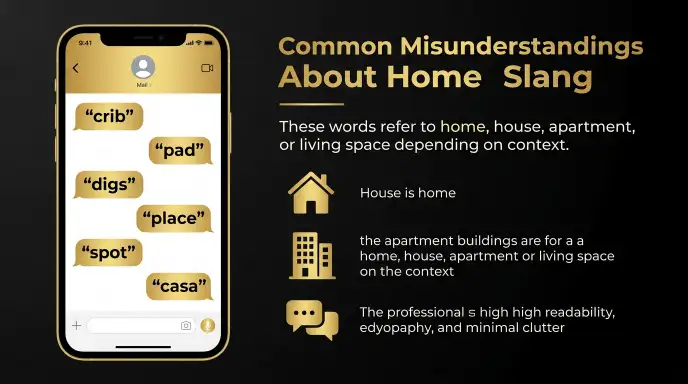
“Crib” Always Means a Baby’s Bed
Not necessarily. In casual slang, crib can mean someone’s home. Context tells you which meaning is intended.
“Spot” Always Means Home
No. A “spot” can be any particular location. “My spot” may mean someone’s home, favorite hangout, workplace, or another familiar place.
“Hood” Means House
Usually not. Hood commonly refers to a neighborhood or local area, not the physical home.
“Casa” Is English Slang
Casa is actually a Spanish word. English speakers may use it playfully in informal English, but its original meaning comes from Spanish.
All Slang Is Offensive
No. Slang can simply be informal language. Many slang expressions are friendly, humorous, or conversational without being offensive.
Polite Alternatives to Slang for Home
If you want to sound more neutral or professional, use these alternatives:
- Home
- House
- Apartment
- Residence
- Living space
- Property
- Accommodation
- Place of residence
For example:
Slang: “Come to my crib.”
Neutral: “Come to my home.”
Casual: “Come to my place.”
Formal: “Please visit my residence.”
The right choice depends on who you are speaking to and why.
How to Choose the Right Slang Word
When choosing an informal word for home, consider three things: audience, context, and tone if you’re talking with close friends, “crib,” “pad,” or “spot” may feel natural.
If you’re writing a social media caption, playful terms such as “casa” or “castle” can work well.
If you’re speaking to someone you do not know well, “home” or “place” is usually clearer.
The safest rule is simple: use slang when the situation is casual and the audience understands the style.
Frequently Asked Questions
What is the most common slang word for home?
There is no single slang word that is used everywhere. Crib, pad, place, and spot are common informal choices, especially in casual American English.
What does “crib” mean in slang?
In slang, crib can mean someone’s home or living space. For example, “Come to my crib” means “Come to my home.”
What does “pad” mean in slang?
Pad is an informal term for someone’s home, apartment, or living space. “Come to my pad” means “Come to my home.”
What does “my spot” mean?
“My spot” can mean someone’s home or another familiar location. The exact meaning depends on context.
Is “casa” slang for home?
Casa is Spanish for “house” or “home.” English speakers sometimes use it casually or humorously to refer to their home.
Are slang words for home appropriate in formal writing?
Usually, no. In formal writing, words such as home, house, residence, apartment, or accommodation are clearer and more appropriate.
Conclusion
There are many slang words for home, but they do not all have exactly the same meaning or tone. Crib, pad, digs, place, spot, and casa can all refer to someone’s home in casual conversation, while terms such as castle and headquarters are often used humorously.
The most important thing is context. A word that sounds natural between friends may feel too informal in a school assignment or professional message.
If you understand your audience and the situation, you can choose a term that sounds natural without causing confusion.
When in doubt, home or place is usually easy for everyone to understand. Slang can make conversations more relaxed and expressive, but the best expression is always the one that fits the people and setting.
Discover More Slang!

Hi, I’m Chloe Parker. I write simple and practical articles about slang, grammar, spelling, vocabulary, and commonly confused words. My goal is to make English easier to understand through clear explanations and real-life examples. Whether you’re a student, writer, or English learner, I’m here to help you build confidence and improve your everyday English.