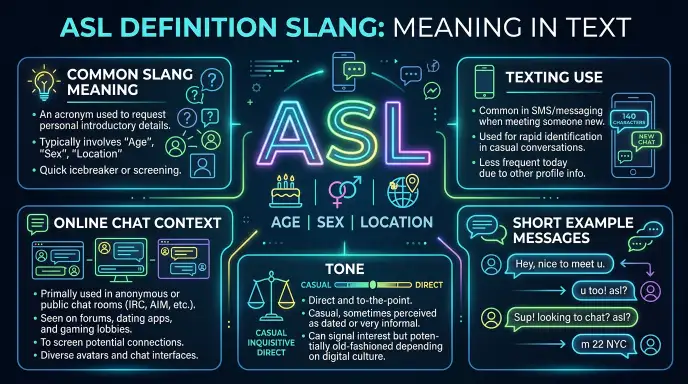
ASL definition slang can be confusing because ASL has more than one meaning online. In modern texting and social media, lowercase as often means “as hell” and is used to make a description stronger. For example, “I’m tired asl” means “I’m extremely tired” or “I’m tired as hell.”
However, ASL can also mean “age, sex, location,” an older internet chat abbreviation, or American Sign Language when the conversation is about language and communication. The sentence and context usually make the intended meaning clear.
Quick Answer
In current slang, asl usually means “as hell” and adds emphasis to a word or feeling, such as “funny asl” = “very funny.” In older chatroom usage, ASL? can mean “age, sex, location?”
What Does ASL Mean in Text?
When asl appears at the end of a description, it usually means “as hell.” It works as an informal intensifier, making the word before it sound stronger.
For example:
- “I’m hungry as well.” → I’m extremely hungry.
- “That movie was scary as well.” → That movie was extremely scary.
- “She is funny as well.” → She is very funny.
- “This game is hard as well.” → This game is extremely difficult.
- “It’s hot today.” → It is extremely hot today.
This usage is common in casual digital communication, including texts, comments, DMs, and social media conversations.
The easiest way to understand it is to look at the word before asl. If it follows an adjective or description, “as hell” is usually the intended meaning.
ASL Full Form and Definition
The slang asl has two important internet meanings.
| ASL form | Meaning | Typical context |
| asl | as hell | Modern texting and social media |
| ASL? / A/S/L? | age, sex, location | Older online chat |
| ASL | American Sign Language | Language and communication |
The lowercase also used after an adjective is generally the modern slang form. ASL? as a standalone question is associated with older chatroom culture. American Sign Language is a completely different use and is not slang.
Capitalization can provide a clue, but it should not be treated as a strict rule. People often ignore capitalization when typing quickly online.
ASL Meaning Slang: “As Hell”
The modern slang meaning of asl is short for “as hell.”
Here, “as hell” does not have a literal meaning. It simply adds strong emphasis.
Compare:
“I’m tired.”
with:
“I’m tired as well.”
The second sentence communicates a much stronger feeling.
You can think of asl as similar to:
- very
- really
- extremely
- seriously
- incredibly
However, asl is much more informal than these alternatives.
Examples
“That food was good as well.”
The food was extremely good.
“I’m nervous as well.”
The person is very nervous.
“That dog is cute asl.”
The dog is extremely cute.
“This assignment is confusing as well.”
The assignment is extremely confusing.
“He was loud as well.”
He was extremely loud.
This pattern is easy to recognize because asl usually comes after the word being emphasized.
Is ASL Rude, Offensive, or Neutral?
When asl means “as hell,” it is generally casual rather than offensive.
Still, it contains an abbreviation of the phrase “as hell,” so it may sound too informal in certain situations.
For example, this is natural in a text:
“That test was hard asl 😭”
But this would not normally be suitable for a formal business email:
“The presentation was difficult as well.”
A professional alternative would be:
“The presentation was extremely difficult.”
So the main issue is usually formality, not serious offensiveness.
When to Be Careful
Avoid using asl when speaking to:
- employers
- teachers
- customers
- clients
- people you do not know well
- professional audiences
In casual conversations with friends, the abbreviation is generally easier to understand.
Where Is ASL Commonly Used?
The “as hell” version appears in informal online communication. It can be seen in social media posts, comments, messages, group chats, and other casual digital conversations. Current slang references specifically associate this use with social media and texting.
You may encounter asl in:
- TikTok comments
- Instagram comments and DMs
- Snapchat messages
- Discord chats
- Reddit comments
- gaming chats
- group messages
- text messages
- casual online conversations
The exact frequency can vary between communities. Not every person uses the abbreviation, so context remains important.
ASL on TikTok and Social Media
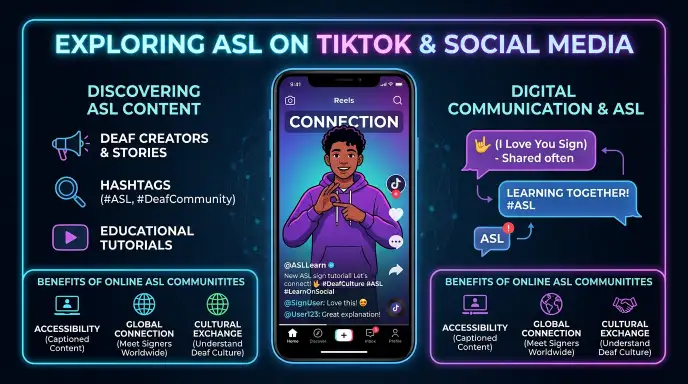
On social media, asl often appears after an adjective.
For example:
“That transition was smooth as well.”
Here, the person means the transition was very smooth.
Another example:
“I’m obsessed with this song as well.”
The speaker is strongly emphasizing how much they like the song.
Because social media favors short, quick expressions, abbreviations such as asl can fit naturally into comments and messages. Slang references also document the modern “as hell” usage on platforms such as TikTok and other social media.
ASL in Older Internet Chat: “Age, Sex, Location”
Before the modern “as hell” usage became common, A/S/L was widely known as “age, sex, location.”
It was commonly used in online chatrooms to quickly ask another person for basic personal information. The expression became especially associated with internet chat and instant messaging in the 1990s and early 2000s.
For example:
Person A: ASL?
Person B: 20, female, Texas.
In this context, ASL has nothing to do with “as hell.”
The older expression was particularly common when strangers met in online chatrooms. A 2001 Pew report on teenage internet use identified A/S/L as a common question in chatrooms.
How to Recognize This Meaning
If someone writes:
“ASL?”
as a standalone question, especially in an older style chat context, they may be asking for age, sex, and location.
If someone writes:
“I’m tired as well.”
they are almost certainly using the modern slang meaning “as hell.”
ASL and American Sign Language
There is another major meaning of ASL: American Sign Language.
American Sign Language is a natural visual language used by many Deaf people in the United States and parts of Canada. It is a language, not an internet slang term.
For example:
“I’m learning ASL.”
Here, the person means American Sign Language.
Likewise:
“She works as an ASL interpreter.”
This clearly has nothing to do with internet slang.
This is why context matters so much when interpreting ASL. The same three letters can refer to slang, an older chat abbreviation, or a real language.
Real Life Examples of ASL Usage
Here are examples showing how the meaning changes with context.
Friendly Example
“Your new profile pic is cute asl!”
Meaning: Your new profile picture is extremely cute.
The tone is friendly and complimentary.
Casual Example
“I’m hungry all right now.”
Meaning: I’m extremely hungry right now.
This is a normal casual texting use.
Excited Example
“That concert was amazing as well!”
Meaning: The concert was extremely amazing/great.
The speaker is emphasizing excitement.
Frustrated Example
“This level is difficult as well.”
Meaning: This level is extremely difficult.
The abbreviation adds emotional emphasis.
Gaming Example
“That boss is strong asl 😭”
Meaning: That boss is extremely strong.
Here, asl fits the informal style of gaming chat.
Social Media Example
“This video is funny asl 😂”
Meaning: This video is extremely funny.
The emoji reinforces the casual tone.
Older Chat Example
“Hey, ASL?”
Meaning: “What is your age, sex, and location?”
This is the older meaning of internet chat.
How to Tell Which ASL Meaning Someone Means
When you see ASL, do not automatically assume it means one thing.
Use the surrounding words.
If it comes after an adjective
“beautiful asl”
“tired asl”
“funny asl”
It most likely means “as hell.”
If it appears as a question
“ASL?”
It may mean “age, sex, location?” in an older chat context.
If the conversation is about language
“Do you know ASL?”
It probably means American Sign Language.
If You Are Still Unsure
Look at the topic of the conversation. The subject often gives you the answer more reliably than capitalization alone.
ASL vs Similar Slang
The modern asl is similar to several other slang expressions used for emphasis.
| Slang | Meaning | Example |
| asl | as hell | “tired asl” |
| af | as fuck | “tired af” |
| fr | for real | “That was good fr.” |
| rn | right now | “I’m busy running.” |
| so | very / extremely | “That was so funny.” |
| very | strong degree | “That was very funny.” |
asl and af can both intensify a statement, but they come from different phrases and may have different levels of informality depending on the speaker.
If you want a cleaner option, very, really, or extremely usually works better.
When Should You Avoid Using ASL?
You do not necessarily need to avoid ask altogether. The important thing is knowing when informal slang fits.
Avoid it in situations such as:
- job applications
- formal emails
- academic assignments
- professional reports
- official documents
- customer service messages
- formal presentations
For example:
Informal:
“The movie was boring as well.”
More appropriate for formal writing:
“The movie was extremely boring.”
The second version is clearer and more professional.
Polite Alternatives to ASL
If you want to express the same idea without slang, you can use:
- very
- really
- extremely
- incredibly
- especially
- highly
- remarkably
For example:
“That restaurant was good as well.”
can become:
“That restaurant was extremely good.”
Or:
“I’m tired as well.”
can become:
“I’m extremely tired.”
These alternatives work in a much wider range of situations.
Why Do People Use ASL?
One reason people use slang abbreviations is speed. Typing a few letters is faster than writing an entire phrase.
There is also a social element. Online slang can make messages feel more relaxed, expressive, and conversational.
In the case of asl, the abbreviation can add emphasis without making the message much longer.
For example:
“That was funny.”
is simple.
“That was funny as well.”
has a stronger, more expressive casual tone.
Slang also changes naturally over time. The older A/S/L meaning was strongly associated with chatrooms, while the modern as hell meaning developed in newer internet communication.
Impact of ASL on Communication
Using asl can make a casual message feel more natural when the audience understands the slang.
However, slang can also create confusion.
Someone familiar with older internet terminology may see ASL? and think of age, sex, location, while a younger social media user may immediately understand asl as “as hell.”
That difference shows why context is important.
The same abbreviation can have completely different meanings depending on:
- the sentence
- the platform
- the age or online background of the speaker
- the topic
- if it appears alone or after an adjective
Is ASL Safe for Social Media?
The modern asl meaning “as hell” is generally ordinary informal slang. Using it in a casual social media conversation is not inherently unsafe.
Still, remember that online posts can reach a wider audience than expected.
If you are posting for a school, business, organization, or professional audience, a clearer phrase such as “very” or “extremely” may be more appropriate.
Also, do not confuse the slang meaning with the older “age, sex, location” question. If a stranger asks “ASL?”, you do not have to provide personal information. You can simply ask what they mean or choose not to answer.
Origin and Background of ASL Slang
The older A/S/L abbreviation grew out of internet chat culture, particularly chatrooms and instant messaging. Its exact origin is uncertain, but references connect its widespread use to early internet chat and services such as AOL Instant Messenger and MSN Messenger.
The newer asl = “as hell” usage is a separate development. Modern slang references describe it as a shortened form used to intensify adjectives and descriptions in online communication.
There is no need to treat the two meanings as one continuous definition. They developed in different contexts and can still appear differently today.
Common Mistakes About ASL
Mistake 1: Assuming ASL always means “age, sex, location”
This can lead to confusion when you see:
“That song is good as well.”
Nobody is asking for personal information in that sentence.
Mistake 2: Assuming ASL always means “as hell”
If someone writes:
“I’m learning ASL.”
They are talking about American Sign Language.
Mistake 3: Thinking capitalization always solves the problem
Capitalization can help, but people frequently type slang in lowercase or uppercase without following a fixed pattern.
The surrounding sentence is usually more useful.
FAQs About ASL Definition Slang
What does ASL mean in slang?
In modern slang, asl usually means “as hell.” It is used after a word or description to add emphasis, such as “tired asl.”
What does ASL stand for in texting?
In current casual texting, asl can stand for “as hell.” In older online chat, ASL commonly meant “age, sex, location.”
What does “tired asl” mean?
“Tired asl” means “extremely tired” or “tired as hell.” It is an informal expression used in casual digital communication.
Is ASL a bad word?
Not exactly. When asl means “as hell,” it is informal slang. It may be inappropriate in formal or professional writing, but it is generally used casually rather than as a direct insult.
Does ASL mean American Sign Language?
Yes. ASL is also the standard abbreviation for American Sign Language. The correct meaning depends on the context.
What is “ASL?” mean in an online chat?
In an older internet chat context, “ASL?” means “age, sex, location?” It was used to ask someone for basic personal information.
Conclusion
Understanding ASL definition slang requires looking at the context. In modern texting and social media, it commonly means “as hell” and is used to make a description stronger. For example, “funny asl” means “extremely funny.”
However, ASL can also refer to the older internet phrase “age, sex, location” or American Sign Language. These meanings are easy to distinguish when you look at the complete sentence and conversation.
For casual texts, comments, gaming chats, and social media conversations, ask can be a natural informal expression. For school, work, or other formal situations, words such as very, really, or extremely are safer choices.
Explore This Topic!

Hi, I’m Chloe Parker. I write simple and practical articles about slang, grammar, spelling, vocabulary, and commonly confused words. My goal is to make English easier to understand through clear explanations and real-life examples. Whether you’re a student, writer, or English learner, I’m here to help you build confidence and improve your everyday English.