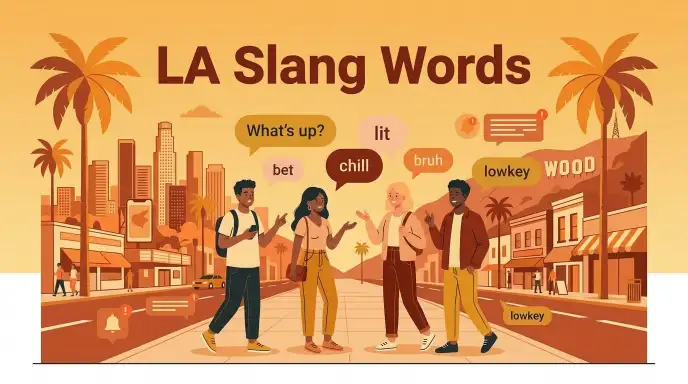
LA slang words are casual words and phrases commonly associated with Los Angeles, California. They reflect the city’s diverse communities, music, entertainment, neighborhood culture, and everyday conversations.
Some expressions are strongly associated with Los Angeles, while others are broader California or American slang that people in LA also use.
If you see LA slang in a text, TikTok caption, Instagram comment, Reddit post, or conversation, the meaning usually depends on the phrase and the context.
Words such as homie, fasho, legit, grip, fire, dude, and what’s good can make a conversation sound more relaxed and informal.
Quick Answer
LA slang words are informal expressions used in Los Angeles and associated with Southern California culture. Their meanings can range from greetings and terms for friends to words describing something exciting, impressive, authentic, or excessive.
What Does LA Slang Words Mean in Text?
When people search for LA slang words meaning in text, they are usually looking for the informal language connected with Los Angeles.
LA slang is not one fixed dictionary. Los Angeles is a large and culturally diverse city, so different neighborhoods and communities can have their own expressions.
Some terms are influenced by Black American culture, Mexican American and Chicano communities, hip hop, entertainment, surfing, skating, and wider Southern California speech.
Some LA expressions remain strongly local, while others have spread far beyond California through music, movies, television, celebrities, and social media.
For example:
- Homie = a close friend
- Fasho = for sure
- Fire = very good or impressive
- Legit = genuine, real, or impressive
- Grip = a lot
- What’s good? = a casual way to ask how someone is doing or what is happening
- Dude = a casual way to address a person or friend
The exact meaning can change depending on the speaker, situation, and surrounding words.
Common LA Slang Words and Their Meanings
Here are some commonly associated LA expressions and how they can appear in everyday communication.
| LA Slang | Common Meaning | Example |
| Homie | Close friend | “That’s my homie.” |
| Fasho | For sure / definitely | “I’ll be there, fasho.” |
| Fire | Excellent or impressive | “That song is fire.” |
| Legit | Real, genuine, or very good | “That place is legit.” |
| Grip | A lot | “I have a grip on homework.” |
| Dude | Person, friend, or casual address | “Dude, that was baffling.” |
| What’s good? | How are you? / What’s happening? | “Hey, what’s good?” |
| For sure | Definitely / okay | “For sure, I’ll come.” |
| For real | Seriously / genuinely | “For real, that was amazing.” |
| Trippin’ | Overreacting or acting irrationally | “You’re trippin’ over nothing.” |
| Bail | Leave | “I have to bail soon.” |
| Down | Willing or interested | “I’m down to go.” |
| Post up | Stay or hang around somewhere | “Let’s post up here.” |
| Fam | Close friend or trusted person | “Thanks, fam.” |
Not every term in this table is exclusive to Los Angeles. Several are widely used throughout the United States, while their frequency and cultural associations can vary by location.
LA Slang Full Form and Meaning
The LA in “LA slang” normally refers to Los Angeles when the topic is Los Angeles culture or local speech.
However, LA is not itself a special slang word with one universal full form. It is commonly used as an abbreviation for Los Angeles. Dictionaries also list other meanings for “LA,” including Louisiana in certain contexts.
So, if someone writes:
“I love LA slang.”
They are almost certainly talking about Los Angeles slang when the surrounding conversation is about California, the city, music, entertainment, neighborhoods, or local culture.
Popular LA Slang for Friends
One noticeable part of casual LA speech is the use of informal words for friends and people.
Homie
Homie refers to a friend, close companion, or someone from your social circle.
Example:
“I’m meeting my homie after work.”
It is usually friendly and casual.
Fam
Fam literally relates to family, but in slang it can refer to close friends.
Example:
“What’s up, fam?”
The speaker does not necessarily mean a biological family member.
Dude
Dude is an informal way to address another person. It can show surprise, excitement, frustration, or friendliness depending on tone.
Examples:
“Dude, that movie was incredible.”
“Dude, why did you do that?”
The same word can therefore communicate very different emotions.
LA Slang for Saying Something Is Good
LA conversations can also use casual words to praise music, clothes, food, places, ideas, or experiences.
Fire
Fire means something is excellent, exciting, or impressive.
Example:
“That new track is fire.”
Although fire is now common across online English, it is strongly connected with modern youth, music, and internet culture rather than being exclusive to Los Angeles.
Legit
Legit can mean genuine, real, trustworthy, or simply very good.
Example:
“That restaurant is legit.”
Here, the speaker is saying that the restaurant is genuinely good or worth checking out.
Solid
Solid can describe something dependable, respectable, or good.
Example:
“That was a solid performance.”
These expressions are useful in casual conversation but may sound too informal in formal writing.
LA Slang for Greetings
Some casual LA expressions are simply relaxed ways to greet someone.
What’s Good?
What’s good? can mean “How are you?” or “What’s happening?”
Example:
“Hey, what’s good?”
It is generally casual and friendly.
What’s Up?
What’s up? is much broader than LA slang, but it is commonly heard in casual conversations in Los Angeles as well.
Example:
“What’s up? Are you heading downtown?”
Sup?
Sup? is an even shorter form of “What’s up?” It is particularly natural in texts and quick messages.
Example:
“Sup? Are you free later?”
LA Slang for a Large Amount
One expression you may encounter is grip.
In casual California and LA related usage, a grip can mean a large amount of something.
Example:
“There were a lot of people at the event.”
The expression is informal, so it would normally be replaced with a lot of, many, or a large number of in formal writing.
Other Common LA Expressions
Fasho
Fasho is an informal spelling for sure.
Example:
“Are you coming tonight?”
“Fasho.”
It communicates agreement or certainty.
Down
If someone says they are down, they usually mean they are willing to do something.
Example:
“Are you down to grab food?”
“Yeah, I’m down.”
Bail
Bail can mean leaving a place or situation.
Example:
“I’m tired. I’m going to bail.”
The word is also used outside Los Angeles, so context matters.
Post Up
Post up can mean staying or hanging around in a particular place.
Example:
“Let’s post up at the park.”
Again, this is not exclusively LA slang. It is part of a broader informal vocabulary that may be heard in different American communities.
Where Is LA Slang Commonly Used?
LA slang can appear in both spoken and digital communication.
Texting
Friends may use short expressions such as:
- “fasho”
- “sup”
- “u down?”
- “What’s good?”
- “fam”
Because texting is informal, shortened words can feel natural.
TikTok and Instagram
LA related slang often appears in captions, comments, videos, and discussions about Los Angeles culture, music, fashion, food, and neighborhoods. Social media has also helped regional expressions spread beyond their original locations.
Reddit users may use LA slang when discussing Los Angeles neighborhoods, local experiences, restaurants, traffic, music, entertainment, or California culture.
Discord and Gaming
Some LA expressions can appear in gaming chats or Discord conversations, particularly when friends from California are communicating casually. However, most gaming communities also use slang that has nothing specifically to do with Los Angeles.
Everyday Conversation
Spoken conversation remains important because slang is often learned socially. A person may understand a term from hearing friends, musicians, creators, or other community members use it.
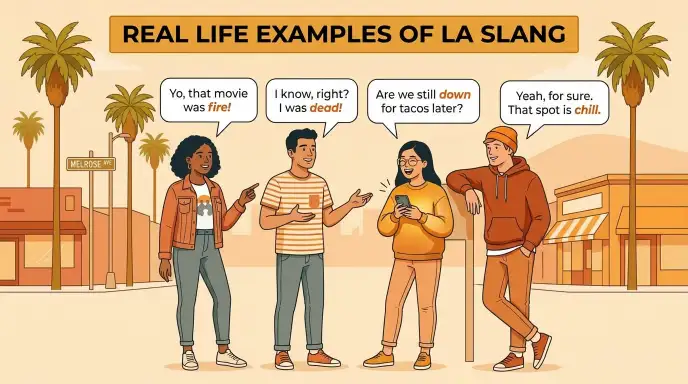
Real Life Examples of LA Slang
Here are examples showing how different expressions can sound in context.
Friendly Example
A: “What’s good, homie?”
B: “Not much. Are you down to get food?”
This is relaxed and friendly.
Casual Example
“That new restaurant is legit. We should go this weekend.”
Here, legit expresses positive approval.
Agreement Example
A: “Are you coming to the party?”
B: “Fasho.”
Here, fasho means “definitely.”
Excited Example
“That new song is fire!”
The speaker is strongly praising the song.
Argumentative Example
“Bro, you’re trippin’. That wasn’t what I said.”
Here, trippin’ suggests that the other person is overreacting or misunderstanding the situation.
Social Media Example
“LA traffic is wild today 😭”
The sentence uses ordinary informal language rather than a special slang term, but this kind of casual wording is common in social posts about the city.
Gaming Example
“I’m down for another game.”
Here, down means willing or interested.
Origin and Background of LA Slang
Los Angeles does not have one single source of slang. Its language has developed through many communities and cultural influences.
Black American communities, Mexican American and Chicano communities, hip hop culture, entertainment, street culture, surfing, skating, and wider Southern California speech have all contributed to the vocabulary associated with LA.
Music and entertainment have played an especially important role in spreading expressions beyond the city.
A phrase that starts in a particular neighborhood can become known nationally after appearing in songs, films, interviews, or social media content.
At the same time, it is important not to assume that every slang word heard in Los Angeles originated there. Many terms are shared with other American cities and online communities.
That is why LA slang words are better understood as a changing collection of expressions associated with the city rather than a fixed official vocabulary.
Is LA Slang Rude, Offensive, or Neutral?
Most everyday LA slang is informal rather than automatically offensive.
Words such as:
- dude
- homie
- fam
- fasho
- legit
- fire
- what’s good
can be harmless among friends.
However, context is important. Some expressions associated with particular neighborhoods, racial groups, or gang culture can carry cultural or social meanings that outsiders may not fully understand.
A word may also sound disrespectful if used aggressively.
For example:
“You’re trippin’.”
Between friends, this may be playful. During a serious argument, it can sound confrontational.
The safest approach is to understand the speaker, audience, and situation before copying unfamiliar expressions.
LA Slang vs. General California Slang
LA slang overlaps heavily with California slang, but the two terms are not exactly identical.
| LA Slang | General California Slang |
| More closely associated with Los Angeles | Used across different parts of California |
| Influenced by LA neighborhoods and communities | Includes regional terms from Northern and Southern California |
| Often connected with LA music and urban culture | Can include surfing, tech, beach, and statewide expressions |
| Some expressions are highly local | Some expressions are widely recognized across the state |
For example, terms such as dude, bail, dank, cruise, and stoked can appear in broader California slang discussions rather than being exclusive to Los Angeles.
Common Misunderstandings About LA Slang
Not every California word is LA slang
California is a large state with different regional speech patterns. A word used in San Francisco or San Diego does not automatically originate in Los Angeles.
Not every LA resident uses the same slang
Los Angeles has many communities and neighborhoods. People may speak differently depending on their background, age, social group, and location.
Social media slang is not always local slang
A phrase may become popular on TikTok or Instagram and then appear in LA conversations without actually originating in Los Angeles.
Slang changes over time
Some expressions become less common while others gain popularity through music and social media. Current online usage can therefore differ from older descriptions of LA speech.
When Should You Avoid Using LA Slang?
You do not need to avoid LA slang completely. The key is knowing when informal language is appropriate.
Avoid unfamiliar slang when:
- Writing a formal business email
- Preparing an academic paper
- Speaking in a professional interview
- Writing official documents
- Communicating with someone who may not understand the expression
- Using a culturally specific expression without understanding its background
For example, instead of writing:
“That idea is fire.”
A formal version could be:
“That idea is excellent.”
Instead of:
“I’m gonna bail.”
A more professional option would be:
“I need to leave.”
Why Do People Use LA Slang?
People use slang because ordinary language can feel too formal or distant for casual communication.
LA slang can help speakers:
- Show friendliness
- Express excitement
- Create a relaxed tone
- Build a sense of connection
- Reflect local culture
- Communicate quickly
- Show familiarity with a particular community
Slang can also give personality to a conversation. Compare:
“Are you interested in going?”
with:
“Are you down to go?”
The second sentence feels shorter and more casual.
Is LA Slang Safe for Social Media?
Most ordinary LA slang is fine for casual social media use. Words such as homie, dude, fire, legit, fam, and fasho are generally informal expressions rather than inherently offensive ones.
Still, social media audiences can be very broad. A word that sounds normal between close friends may be misunderstood by strangers.
Be especially careful with expressions connected to sensitive cultural, racial, or gang related contexts. Understanding a term’s background is more important than trying to sound local.
Comparison With Similar Slang
| Expression | Meaning | Tone |
| Homie | Close friend | Friendly |
| Fam | Close friend | Friendly |
| Bro | Friend/person | Casual |
| Dude | Person/friend | Casual |
| Fasho | Definitely | Casual |
| Legit | Genuine/good | Casual |
| Fire | Excellent | Enthusiastic |
| Trippin’ | Overreacting | Casual or confrontational |
| Down | Willing/interested | Casual |
These terms can overlap, but they are not interchangeable in every sentence.
For example, homie and fam can describe a close person, while fire describes something impressive. Fasho expresses agreement, and down describes willingness.
Frequently Asked Questions
What are some common LA slang words?
Commonly associated expressions include homie, fasho, fire, legit, grip, dude, fam, what’s good, down, and trippin’. Not all are exclusive to Los Angeles.
What does LA stand for in LA slang?
In the context of Los Angeles culture, LA stands for Los Angeles. The abbreviation can have other meanings in different contexts, so surrounding information matters.
What does fasho mean?
Fasho is an informal spelling for sure. It is commonly used to show agreement or certainty.
What does homie mean?
Homie usually means a close friend or companion. It is informal and generally friendly.
Is LA slang only used in Los Angeles?
No. Some expressions associated with LA have spread throughout California, the United States, and online communities through music, entertainment, and social media.
Is LA slang appropriate in formal writing?
Usually not. LA slang is mainly useful in casual conversations, texts, social media, and informal writing. Formal communication generally benefits from standard English.
Conclusion
LA slang words are informal expressions connected with Los Angeles and its diverse language communities. Words such as homie, fasho, fire, legit, dude, fam, down, and what’s good can make everyday conversations sound relaxed and natural.
However, LA slang is not a fixed list. Some expressions are strongly associated with Los Angeles, while others are common throughout California or across American internet culture.
The most important thing is context. Before using unfamiliar slang, consider who you are talking to, what the expression means, and if the situation is casual or formal. When used appropriately, slang can make communication feel more natural, personal, and expressive.
Understanding LA slang words is therefore less about memorizing a list and more about recognizing how tone, culture, community, and context shape everyday language.
More Slang Meanings!

Hi, I’m Chloe Parker. I write simple and practical articles about slang, grammar, spelling, vocabulary, and commonly confused words. My goal is to make English easier to understand through clear explanations and real-life examples. Whether you’re a student, writer, or English learner, I’m here to help you build confidence and improve your everyday English.