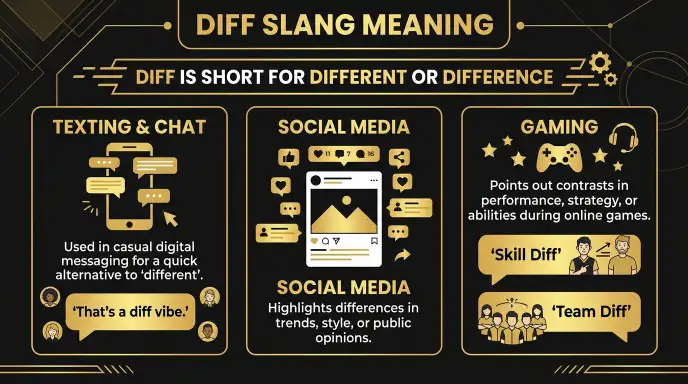
Diff slang usually means “difference,” especially in online conversations and gaming. In competitive games, it often points to a clear skill or performance gap between two players, roles, or teams. For example, “jungle diff” can mean that one team’s jungler performed much better than the other.
The meaning can change with context. In everyday text, diff may simply be a casual short form of “difference.”
In gaming chats, however, it often carries a stronger comparison and may be used to praise one player, criticize another, or explain why a team won or lost. Dictionaries also recognize diff as an informal shortening of “difference.”
If you saw diff slang on Discord, Reddit, TikTok, Twitch, or in a game chat, this guide explains what it means, how people use it, and when you should avoid it.
Quick Answer: What Does Diff Mean in Slang?
Diff is slang for “difference.” In gaming, it commonly describes a noticeable difference in skill or performance between two players, roles, or teams. “Team diff” means one team clearly performed better, while “skill diff” points to a difference in player skill.
What Does Diff Mean in Slang?
The basic meaning of diff is difference.
It is a shortened form of the word “difference,” and this informal use is recognized by English dictionaries. For example, someone might say:
- “What’s the difference?”
- “I can’t see much difference between them.”
- “There’s a big difference in price.”
In these examples, diff simply means difference.
Online gaming added another layer to the word. Players began using diff to compare the performance of players in the same role. A phrase such as “mid diff” means the mid lane matchup had a noticeable performance gap.
The gaming use became especially common in competitive multiplayer communities, including games such as League of Legends and Overwatch.
Diff Meaning in Gaming
In gaming, diff usually means that one player, role, or team was noticeably better than another.
The word is often placed after the role being compared:
| Phrase | Common meaning |
| Skill diff | A noticeable difference in player skill |
| Team diff | One team performed better than the other |
| Jungle diff | A large performance gap between junglers |
| Mid diff | One mid player outperformed the other |
| Support diff | One support player had a stronger performance |
| DPS diff | A noticeable difference between DPS players |
For example, if a player types “support diff” after a match, they may be saying that the support player on one side played much better than the opposing support.
This does not always mean the same player was solely responsible for the result. It is often a quick way for players to highlight one noticeable difference in the match.
Why Do Gamers Say “Diff”?
Gamers use diff because it is short and easy to type during or after a competitive match.
Instead of writing:
“The enemy jungler played much better than our jungler and that probably affected the game.”
Someone can simply write:
“Jungle diff.”
The shorter phrase can communicate the basic idea immediately.
However, diff can also be used as trash talk. After a frustrating loss, a player may use “diff” to blame a teammate or point out that an opponent was much stronger.
That means the tone matters. A message like “tank diff!” after a teammate carries the game may be praised. The same phrase after a teammate performs badly can be sarcastic or insulting.
Is Diff Rude or Offensive?
Diff is not automatically rude or offensive. Its tone depends on the situation.
In ordinary conversation, it can simply mean “difference.” In gaming, it can become negative when it is used to mock, blame, or embarrass another player.
For example:
Neutral:
“What’s the difference between these two versions?”
Positive gaming use:
“Tank diff. Our tank carried that fight.”
Negative gaming use:
“Jungle diff, that’s why we lost.”
The last example can sound like blame. In competitive games, players may use diff as a form of trash talk or criticism.
Diff on Discord, Reddit, TikTok, and Social Media
You may see diff slang outside an actual game.
Discord
Gaming Discord servers are one of the natural places to see terms such as:
- “team diff”
- “skill diff”
- “huge diff”
- “massive diff”
A player may post one of these immediately after a match.
Reddit users may use diff in gaming discussions, memes, or debates about player performance.
For example:
“That was clearly a support diff.”
The phrase suggests that the support matchup made a noticeable difference.
TikTok
On TikTok, diff can appear in gaming clips, esports videos, memes, and comparisons.
A creator might caption a short clip:
“The aim was baffling.”
This means the creator believes there was a large difference in aiming skill.
Twitch
Twitch chat can move quickly, so short expressions such as diff are useful. Viewers may type “diff” when they think one player or role is clearly outperforming another.
The exact meaning still depends on what is being discussed.
Real Life Examples of Diff Slang
Here are some natural examples of how diff can appear online.
Example 1: Gaming
Player A: “Why did we lose that match?”
Player B: “Huge jungle diff.”
Here, Player B is saying that the jungle performance gap played an important role.
Example 2: Team Performance
“Team diff. Their coordination was much better.”
Here, team diff refers to the difference between the two teams.
Example 3: Skill
“That was a skill difference.”
This suggests that one player or side had a clear skill advantage.
Example 4: Positive Use
“Support diff! Our support saved us.”
Here, diff is being used as praise rather than an insult.
Example 5: Everyday Text
“What’s the difference between these two phones?”
Here, diff simply means difference. There is no special gaming meaning.
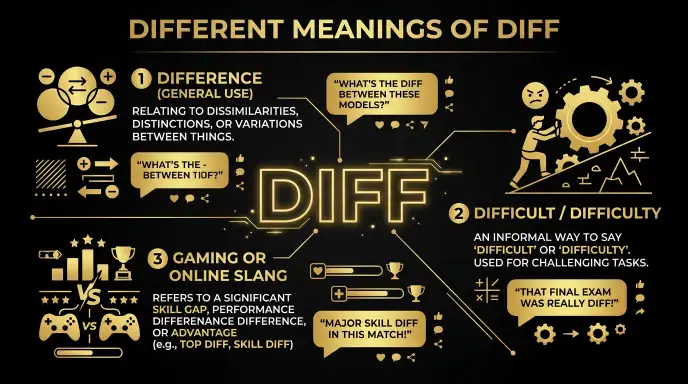
Different Meanings of Diff
Although gaming is one of the most visible uses of diff slang, the word has more than one meaning.
1. Difference
The most basic meaning is a short form of difference.
Example:
“What’s the difference between these plans?”
2. Skill Difference
In gaming, diff can point to a skill gap.
Example:
“There was a huge skill difference.”
This means one player appeared much more skilled than another.
3. Role or Position Difference
Players may attach diff to a role.
Examples include:
- “mid diff”
- “jungle diff”
- “top diff”
- “support diff”
- “DPS diff”
These phrases compare players who perform the same role.
4. Team Difference
Team diff compares overall team performance.
Example:
“It wasn’t one player. It was a team diff.”
This suggests that teamwork or overall performance separated the two sides.
5. Computing Meaning
Outside slang, diff is also a computing term. A “diff” can refer to a comparison showing differences between files or versions of data. Cambridge and Collins both list this technical computing meaning separately from the informal slang meaning.
Where Did Diff Slang Come From?
The word diff has a longer history than its current gaming use.
As an informal English word, diff is a shortened form of difference. Dictionary sources document this general meaning.
The modern gaming sense developed within online competitive gaming communities. Evidence commonly traces the role based slang use to League of Legends communities, where expressions such as “jungle diff” and “mid diff” became part of competitive chat culture.
Know Your Meme documents examples from the League of Legends community going back to at least 2017.
The term later became common across other competitive games and online communities. Its exact origin as a general gaming expression is harder to reduce to one single moment, so it is more accurate to describe gaming communities as an important part of its spread rather than claim one definitive invention story.
Similar Slang Terms to Diff
Several gaming and internet terms are related to diff.
| Term | Meaning |
| Skill gap | Difference in ability between players |
| Gap | A large difference between two sides |
| Carry | A player who has a major positive impact on a team’s result |
| Outplayed | Someone was beaten through better play |
| Clapped | Informal slang for being beaten badly |
| Better player | A direct way to say someone performed better |
These terms are not exact replacements in every situation.
For example, “outplayed” focuses on the action or result, while “diff” often highlights the gap between two players or roles.
When Should You Avoid Using Diff?
You can use diff in casual online conversations when the people involved understand the slang. Still, there are situations where a clearer or more polite phrase is better.
Avoid using it when:
- You are speaking to someone who may not understand gaming slang.
- You are writing a formal email or report.
- You are communicating with a teacher or professional audience.
- You are criticizing another player personally.
- The conversation is already tense.
- You are using it mainly to blame a teammate.
Instead of saying:
“Skill diff. You’re terrible.”
you could say:
“They played that matchup better.”
The second version communicates the same basic comparison without turning it into a personal attack.
Can You Use Diff at Work?
In professional communication, diff can be appropriate when you are discussing technical file comparisons or other established computing terminology.
However, using gaming style phrases such as “team diff” or “skill diff” in a formal workplace message may sound overly casual.
For example:
Professional:
“There is a difference between the two reports.”
Casual:
“There’s a big difference between these reports.”
For a work email, the first option is usually clearer.
If you work in software development, however, diff may have a specific technical meaning. In that setting, it is not necessarily slang at all.
Common Misunderstandings About Diff
One common mistake is assuming that diff always means someone is bad.
That is not true.
The word mainly signals a difference or gap. The tone determines if that difference is being praised, criticized, or simply observed.
For example:
“Team diff!”
could be praised if your team played extremely well.
But:
“Team diff, uninstall.”
is clearly being used as an insult.
Another misunderstanding is thinking diff only belongs to gaming. Gaming made the slang especially visible, but diff is also an ordinary informal shortening of “difference,” and it has a separate technical meaning in computing.
Frequently Asked Questions About Diff Slang
What does diff mean in slang?
Diff usually means difference. In gaming, it often describes a noticeable difference in skill or performance between players, roles, or teams.
What does “skill diff” mean?
Skill diff means there is a noticeable difference in skill between two players or sides. It is especially common in competitive gaming.
What does “team diff” mean?
Team diff means one team performed better than the other. It may refer to teamwork, coordination, strategy, or overall performance.
What does “jungle diff” mean?
Jungle diff compares the performance of the junglers on the two teams. It can suggest that one jungler had a much bigger impact on the match.
Is diff a bad word?
No. Diff is not inherently offensive. It is an informal shortening of “difference.” In gaming, however, it can be used negatively as trash talk or blame.
Does diff always mean “difference”?
Usually, yes, but context matters. In everyday English, it means “difference.” in gaming, it often refers to a performance gap. In computing, it can refer to a tool or comparison showing differences between files.
Is diff used on Discord?
Yes. Diff is common in gaming related Discord conversations, especially when users discuss match performance or compare players.
What does “diff” mean on TikTok?
On TikTok, diff can refer to a noticeable difference or comparison. Gaming videos often use it in phrases such as “skill diff” or “team diff,” while broader posts may use it more loosely.
Conclusion
Diff slang is a short and flexible way to talk about a difference. In ordinary text, it can simply replace the word “difference.” In gaming, it often describes a clear performance or skill gap between players, roles, or teams.
Phrases such as skill diff, team diff, jungle diff, and mid diff are especially common in competitive gaming. The word can be positive, neutral, or negative depending on the situation and tone.
The easiest way to understand diff is to look at the words around it. If you see “jungle diff,” think about the difference between junglers. If someone says “what’s the difference?”, they probably just mean “what’s the difference?”
See Related Terms!

Hi, I’m Chloe Parker. I write simple and practical articles about slang, grammar, spelling, vocabulary, and commonly confused words. My goal is to make English easier to understand through clear explanations and real-life examples. Whether you’re a student, writer, or English learner, I’m here to help you build confidence and improve your everyday English.