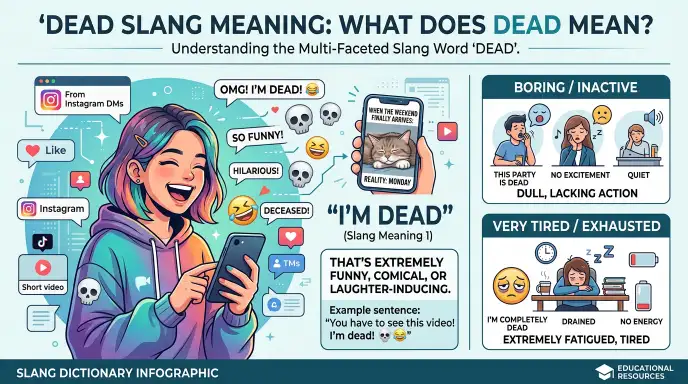
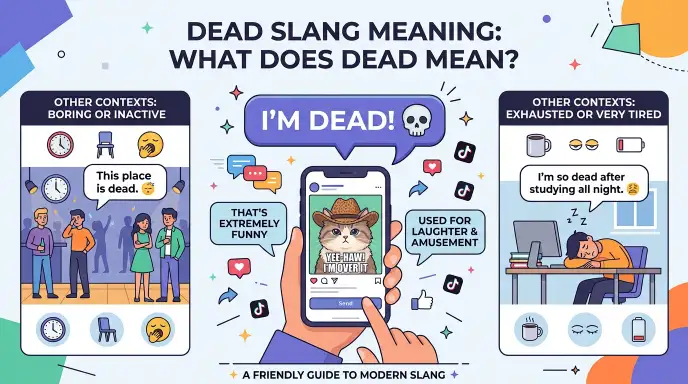
The dead slang meaning can change depending on the conversation. In online chats and social media, “I’m dead” often means something is extremely funny or hilarious.
However, “dead” can also describe something that is boring, quiet, inactive, or finished. Because the same word can have different meanings, context is important.
In this guide, we’ll explain the most common dead slang meanings with simple examples to help you understand how people use it in texting and everyday conversations.
Quick Answer
In internet slang, “dead” or “I’m dead” often means “that is extremely funny” or “I’m laughing very hard.” It is a dramatic, non literal expression. However, “dead” can also mean boring, inactive, empty, or extremely tired, so the sentence around it matters.
Example:
“That video was so funny. I’m dead 💀.”
Here, the person is not saying they actually died. They are saying the video made them laugh a lot.
What Does Dead Mean in Slang?
The meaning of dead changes with context.
The most common online use is a reaction to something funny. Someone may simply type “dead”, “I’m dead,” or “I’m deceased” after seeing a funny post, meme, comment, or video.
The idea is based on exaggeration. The joke is described as being so funny that the person has “died” from laughter.
For example:
“You really sent that email to the wrong person? I’m dead 😂.”
The speaker is expressing strong amusement.
But dead has other informal meanings too. It can describe a place with very little activity, or something that feels boring and lifeless. Cambridge also records “dead” as meaning very quiet or uninteresting when describing a place.
Different Meanings of Dead in Slang
Because dead slang meaning is not always the same, it helps to separate the common uses.
1. “Dead” Means Very Funny
This is one of the most common meanings in online conversations.
When someone says:
“I’m dead.”
They usually mean:
“That is incredibly funny.”
The phrase is especially common in comments, texts, memes, and social media reactions. Slang references describe “dead” as a humorous way to say that something made the person laugh hard.
Examples:
- “That reply was perfect. I’m dead.”
- “Your brother’s reaction 😂 I’m dead.”
- “This meme has me dead.”
- “Dead 💀 that was hilarious.”
2. “Dead” Means Boring or Empty
Another established informal use is describing a place or situation as quiet, empty, or lacking excitement.
For example:
“The mall is dead today.”
This means the mall is unusually quiet and has few people.
You may also hear:
“This party is dead.”
That means the party is boring, quiet, or lacking energy.
This use is not limited to internet slang. Cambridge lists “dead” as an informal description for a place where nothing interesting is happening.
3. “Dead” Means Extremely Tired
In casual speech, people can also use dead as an exaggeration for being very tired.
For example:
“I worked all day. I’m dead.”
The person usually means:
“I’m extremely tired.”
This is different from the humorous “I’m dead” reaction. The surrounding words make the meaning clear.
Compare:
| Example | Meaning |
| “That meme killed me. I’m dead.” | Very funny |
| “I worked 12 hours. I’m dead.” | Extremely tired |
| “This party is dead.” | Boring or empty |
| “The battery is dead.” | No power |
| “The plant is dead.” | Literally no longer alive |
Where Is Dead Slang Commonly Used?
The humorous meaning appears most often in informal online communication.
You may see it in:
- Text messages
- TikTok comments
- Instagram comments
- Snapchat chats
- Reddit discussions
- Discord conversations
- Meme pages
- Gaming chats
- Group chats
On social media, the word is often paired with the 💀 skull emoji. In this context, the skull usually adds the idea of “I’m dead from laughing,” rather than referring to actual death.
Texting
A friend might send:
“Did you see what Mark posted? 💀”
The response could be:
“I’m dead.”
This means the post was very funny.
TikTok and Instagram
Someone may comment:
“The ending 😭💀 I’m dead.”
Again, this is a humorous reaction.
Discord and Gaming
Players may use it after something unexpected happens:
“Bro missed the easiest shot 💀”
A reply such as:
“I’m dead.”
means the situation is hilarious.
Is Dead Slang Rude or Offensive?
Usually, “dead” is harmless slang when it means something is funny, boring, or extremely tiring.
It is not normally an insult by itself.
However, context matters. The literal word dead is connected to death, so using it around someone who is discussing a real death, serious illness, grief, or another sensitive event can sound insensitive.
For example, jokingly writing:
“I’m dead 💀”
under a funny meme is very different from using the same phrase in response to someone’s real life loss.
When the subject is serious, use clear and respectful language instead.
Real Life Examples of Dead Slang
Here are natural examples showing how the meaning changes.
Funny Conversation
A: “I accidentally called my teacher ‘Mom.’”
B: “I’m dead 😂.”
Meaning: B thinks the situation is very funny.
Text Message
“That voice note was the funniest thing I heard today. Dead 💀.”
Meaning: The voice note was extremely funny.
Social Media
“Her facial expression at the end 😭 I’m dead.”
Meaning: The expression was hilarious.
Gaming
“He walked into the same wall three times. I’m dead.”
Meaning: The player found the situation funny.
Describing a Quiet Place
“The restaurant is completely dead tonight.”
Meaning: Very few people are there.
Talking About Tiredness
“I have an exam tomorrow and three hours of sleep. I’m dead.”
Meaning: The speaker is extremely tired or exhausted.
Origin and History of Dead as Slang
The literal word dead is much older than its internet slang uses. The modern humorous phrase “I’m dead” is a form of exaggeration: the speaker acts as if something was so funny that it “killed” them.
The online use became especially visible in social media and meme culture. Older slang references document “dead” as a humorous reaction, while more recent social media guides describe “I’m dead” as a way to show extreme amusement or surprise.
It is important not to claim that the expression began on one specific platform without strong evidence. The phrase has appeared across different forms of informal speech and online culture.
The 💀 emoji later became a popular visual shortcut for the same idea. A reader should therefore judge the meaning from the conversation, not from the word alone.
Dead vs. LOL vs. LMAO
These expressions can all show laughter, but their style is different.
| Expression | Common meaning | Tone |
| LOL | Laughing or amused | Casual |
| LMAO | Laughing very hard | Stronger, very informal |
| I’m dead | Something is extremely funny | Dramatic, playful |
| 💀 | “I’m dead from laughing” | Very casual, visual |
| That sent me | Something was extremely funny | Informal |
“I’m dead” often feels more dramatic than LOL.
For example:
“LOL, that was funny.”
is simple.
“I’m actually dead 💀.”
sounds like the person found it much funnier.
When Should You Avoid Using Dead Slang?
Avoid the humorous meaning when the conversation is serious.
Be careful around:
- Death or funerals
- Serious accidents
- Illness
- Grief
- Tragic news
- Sensitive personal situations
- Formal professional conversations
It is also better to avoid slang in formal writing unless you are discussing the slang itself.
For example, a school essay should normally use:
“The video was extremely funny.”
instead of:
“The video had me dead.”
The second sentence is casual internet language.
Polite Alternatives to Dead
If you want to express amusement without using slang, try:
- “That is really funny.”
- “That made me laugh.”
- “That was hilarious.”
- “I can’t stop laughing.”
- “That was so entertaining.”
For a casual conversation, “LOL”, “that sent me,” or a laughing emoji may work better.
Why Do People Say “I’m Dead”?
People use “I’m dead” because it communicates a strong reaction quickly.
Instead of writing:
“I found this extremely funny and I am laughing a lot.”
Someone can simply write:
“I’m dead 💀.”
The phrase is short, dramatic, and easy to understand in casual online conversation.
It also works well with memes and reaction based communication because the meaning is emotional rather than literal.
Common Misunderstandings About Dead Slang
“I’m dead” does not usually mean someone has died
If a friend comments “I’m dead 💀” on a funny video, they are normally expressing laughter.
“Dead” does not always mean funny
This is one of the biggest mistakes.
“I’m dead 😂” = probably very funny.
But:
“The party is dead.” = probably boring or empty.
“Dead” can be literal
Sometimes dead simply has its normal dictionary meaning. Context always matters.
The skull emoji does not always indicate danger
In meme and texting culture, 💀 can represent laughter or disbelief. The surrounding message tells you how it should be read.
Frequently Asked Questions
What does dead mean in texting?
In texting, “dead” or “I’m dead” often means something is extremely funny. It is a dramatic way of saying that the person is laughing very hard.
What does dead mean on TikTok?
On TikTok, “dead” usually shows strong amusement. A comment such as “I’m dead 💀” means the person found the video, joke, or situation very funny.
What does 💀 mean in slang?
The skull emoji can mean “I’m dead from laughing,” especially after a funny post or comment. It does not always refer to literal death.
Does dead mean boring in slang?
Yes. “Dead” can describe a place or situation that is very quiet, empty, or boring. For example, “The club is dead tonight” means there is little activity.
Can dead mean tired?
Yes. In casual speech, “I’m dead” can mean “I’m extremely tired.” The context usually makes this meaning clear.
Is dead slang appropriate at work?
It depends on the workplace and situation. In a casual team chat, “I’m dead 😂” may be understood. In formal emails, reports, or communication with clients, clear standard English is safer.
Is “I’m dead” offensive?
Usually not. It is normally a harmless expression of laughter or exhaustion. However, avoid using it as a joke when someone is discussing a real death or serious loss.
Conclusion: Dead Slang Meaning
The dead slang meaning depends heavily on context. In online conversations, “dead” or “I’m dead” most often means that something is extremely funny. It is a playful exaggeration, often paired with the 💀 emoji.
But the word can also describe something boring, empty, inactive, or extremely tiring. That is why reading the full sentence is important.
For example, “I’m dead 💀” after a meme usually means “That is hilarious,” while “The party is dead” means the party is quiet or boring.
For casual texting, TikTok, Instagram, Discord, and meme conversations, the slang is usually easy to use. In formal or sensitive situations, standard wording is a better choice.
Read More About!
- What Does HU Mean in Text and Slang?
- Flex Definition Slang: Meaning, Examples & Usage
- Guinea Slang: Meaning & Examples

Hi, I’m Chloe Parker. I write simple and practical articles about slang, grammar, spelling, vocabulary, and commonly confused words. My goal is to make English easier to understand through clear explanations and real-life examples. Whether you’re a student, writer, or English learner, I’m here to help you build confidence and improve your everyday English.