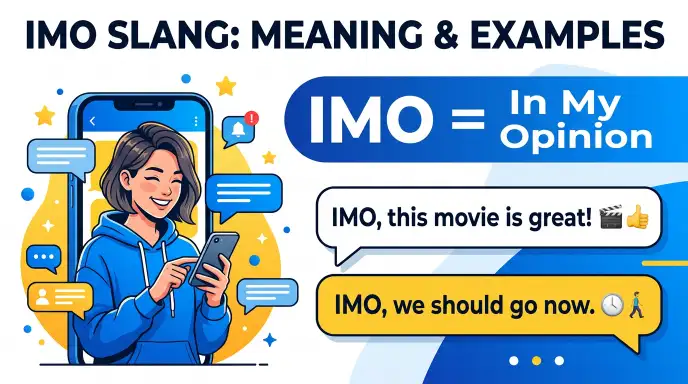
What is IMO slang? IMO means “in my opinion.” It is a common internet and texting abbreviation people use before sharing their personal view, thought, or judgment. It shows that the statement is an opinion rather than a proven fact.
If you have seen IMO in a text, social media comment, Discord chat, or online discussion, you may wonder exactly what the person means.
The good news is that it is simple. When someone writes “IMO,” they are basically saying, “This is what I think.”
For example, someone might text, “IMO, this is the best pizza place in town.” They are not saying it is objectively the best. They are simply sharing their personal view.
In this guide, we will explain what is IMO slang, what it stands for, how people use it, where it appears online, if it is rude, and when you should avoid it.
Quick Answer
IMO slang means “in my opinion.” It is used in texts, chats, comments, and social media when someone wants to introduce a personal opinion or viewpoint.
Example:
“IMO, the new update is much better.”
Here, IMO tells the reader that the statement is the writer’s personal opinion.
What Does IMO Mean in Texting?
In texting, IMO means “in my opinion.” It is mainly used to make a message shorter and faster.
Instead of typing:
“In my opinion, this movie was too long.”
Someone may simply write:
“IMO, this movie was too long.”
The meaning stays the same.
IMO is especially useful when people are discussing topics where there is no single correct answer. It can appear in conversations about movies, music, food, games, fashion, sports, technology, relationships, and everyday choices.
Simple Examples
- “IMO, that song is underrated.”
- “IMO, you should wait until tomorrow.”
- “IMO, this game is more fun with friends.”
- “IMO, the first season was better.”
- “IMO, that outfit looks great.”
In each example, the writer is clearly presenting a personal view.
What Does IMO Stand For?
IMO stands for “in my opinion.”
| Slang | Full Form | Meaning |
| IMO | In My Opinion | Sharing a personal view |
| IMHO | In My Humble Opinion | Sharing an opinion, often with a softer tone |
| IIRC | If I Recall Correctly | Indicating uncertainty about a memory |
| TBH | To Be Honest | Introducing an honest thought |
| IDK | I Don’t Know | Showing uncertainty |
IMO is one of the most widely understood abbreviations used in online communication.
How Is IMO Used in Conversations?
IMO is usually placed at the beginning of a sentence, but it can also appear later.
At the Beginning
“IMO, this is the better option.”
This is the most common format.
In the Middle
“That was, IMO, the best part of the movie.”
This style is less common in casual texting but can appear in online discussions or written posts.
At the End
“The old version was better, IMO.”
This means the same thing but places extra emphasis on the fact that the statement is personal.
The punctuation is flexible. Some people write IMO, with a comma, while others simply type IMO without punctuation.
Where Is IMO Commonly Used?
IMO is common across many forms of digital communication.
Text Messages
Friends may use IMO when discussing personal choices.
“IMO, we should order pizza tonight.”
Social Media
People often use IMO when giving opinions in comments or posts.
“IMO, this is their best album.”
Discord
Gaming communities and online groups may use IMO during discussions.
“IMO, the old map was more balanced.”
Reddit and Online Forums
IMO can help make it clear that a comment represents an individual’s view.
“IMO, the book is better than the movie.”
Workplace Chat
IMO can sometimes be used in informal workplace messaging, especially among colleagues who regularly communicate casually.
For example:
“IMO, we should move the meeting to Friday.”
However, in formal emails or professional documents, writing “In my opinion” is usually clearer and more polished.
IMO vs IMHO: What’s the Difference?
IMO and IMHO are closely related, but they are not exactly the same.
IMHO usually means “in my humble opinion.”
The main difference is tone.
| Term | Full Form | Tone |
| IMO | In My Opinion | Neutral |
| IMHO | In My Humble Opinion | Slightly softer or self aware |
| TBH | To Be Honest | Direct and personal |
For example:
“IMO, the game needs more content.”
This sounds neutral.
“IMHO, the game needs more content.”
This can sound a little more modest or conversational.
In everyday online communication, people may use IMO without thinking much about the difference.
Is IMO Rude or Offensive?
No, IMO is not normally rude or offensive. It is a neutral abbreviation used to introduce a personal opinion.
However, the opinion itself can be rude, even if it starts with IMO.
For example:
“IMO, your idea needs more work.”
This may sound constructive depending on the situation.
But:
“IMO, you’re terrible at this.”
The problem is not the abbreviation. The problem is the insulting statement that follows it.
So, when judging if a message is rude, look at the full sentence and the context.
Can You Use IMO at Work?
Yes, but it depends on the workplace and communication style.
IMO is generally acceptable in casual workplace chats between colleagues. It can make a suggestion sound clearly personal rather than presenting it as an official fact.
For example:
“IMO, option B would be easier for the team.”
But for a formal email, report, presentation, or business document, it is usually better to write:
“In my opinion, option B would be easier for the team.”
Quick Guide
| Situation | IMO Appropriate? |
| Texting friends | Yes |
| Social media | Yes |
| Gaming chat | Yes |
| Discord | Yes |
| Casual workplace chat | Usually |
| Formal email | Better to avoid |
| Academic writing | Usually avoid |
| Official report | Avoid |
The more formal the setting, the more useful the full phrase becomes.
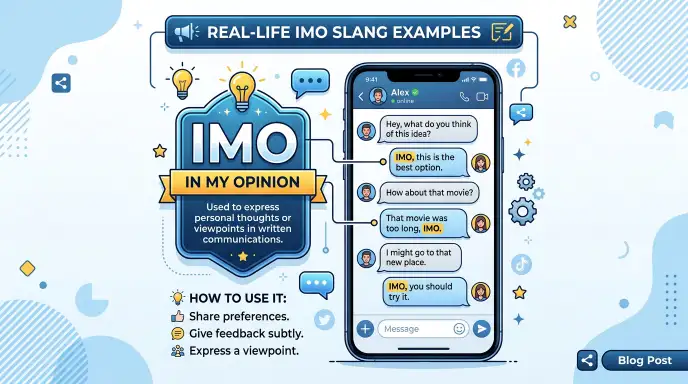
Real Life Examples of IMO Slang
Here are some natural examples showing how people might use IMO.
Example 1: Movies
Alex: “Did you like the new movie?”
Sam: “IMO, the first one was better.”
Here, Sam is simply sharing a personal preference.
Example 2: Food
Friend: “Which restaurant should we try?”
You: “IMO, the Italian place is the best choice.”
Example 3: Gaming
Player: “Which character should I use?”
Friend: “IMO, the second character is easier for beginners.”
Example 4: Music
Comment: “IMO, this is their strongest song.”
The commenter is giving a personal judgment.
Example 5: Everyday Advice
Friend: “Should I buy this phone?”
You: “IMO, you should wait for the next model.”
These examples show why IMO is useful: it quickly tells the reader that the statement is subjective.
IMO on Different Platforms
The basic meaning of IMO stays the same across platforms, but the tone can change slightly.
| Platform | Typical Use |
| Texting | Quick personal opinions |
| TikTok comments | Opinions about videos or trends |
| Discord | Opinions during group discussions |
| Personal views during debates | |
| Opinions about posts, music, or trends | |
| Gaming chats | Opinions about characters, maps, or strategies |
| Workplace chat | Informal suggestions |
On fast moving platforms, abbreviations such as IMO save time and space. In professional settings, the full phrase may be easier for everyone to understand.
Why Do People Use IMO?
People use IMO for several simple reasons.
1. It Saves Time
Typing three words as IMO is faster than typing “in my opinion.”
2. It Makes the Message Clearer
IMO tells readers that the statement is personal.
Compare:
“This is the best game.”
with:
“IMO, this is the best game.”
The second sentence makes it clear that the writer is giving a personal judgment.
3. It Fits Casual Online Communication
Internet conversations often favor short phrases and abbreviations.
4. It Can Make Opinions Sound Less Absolute
Adding IMO can show that the writer understands that other people may disagree.
For example:
“IMO, the ending was disappointing.”
This sounds more personal than:
“The ending was disappointing.”
Common Misunderstandings About IMO
One common mistake is assuming that IMO makes an opinion automatically correct or respectful.
It does not.
IMO only tells the reader:
“This is my opinion.”
It does not prove that the opinion is true.
Another misunderstanding is thinking that IMO always makes a statement polite. Tone still depends on the words surrounding it.
For example:
“IMO, you’re wrong.”
The phrase is still direct and can sound confrontational.
A softer alternative might be:
“IMO, there may be another way to look at it.”
Context matters more than the abbreviation itself.
When Should You Avoid Using IMO?
IMO is harmless in most casual conversations, but there are situations where writing the full phrase is better.
Avoid or limit IMO when:
- Writing a formal business document
- Writing an academic assignment
- Speaking to an audience unfamiliar with internet abbreviations
- Writing official instructions
- Communicating with someone who may not understand texting slang
Instead of:
“IMO, this is the best solution.”
You could write:
“In my opinion, this is the best solution.”
The full phrase is only slightly longer but sounds more professional.
Is IMO Still Popular?
Yes. IMO remains a recognizable internet and texting abbreviation. It is not limited to one social platform or one age group.
People may use it in texting, online comments, gaming communities, forums, and casual digital conversations.
However, slang changes over time. Some users prefer newer or more expressive phrases, while others continue to use familiar abbreviations such as IMO because they are short and easy to understand.
IMO is best viewed as a well established internet abbreviation, rather than a new trend.
Similar Slang Terms to IMO
If you are learning internet slang, these terms are also useful:
- IMHO :In My Humble Opinion
- TBH :To Be Honest
- IIRC :If I Recall Correctly
- AFAIK :As Far As I Know
- FWIW :For What It’s Worth
- IDK :I Don’t Know
These abbreviations can appear in similar conversations, but their meanings are different.
For example:
“IMO, this is the best option.”
means “In my opinion.”
While:
“FWIW, I think this is the best option.”
means “For what it’s worth.”
Frequently Asked Questions About IMO
What is IMO slang?
IMO slang means “in my opinion.” It is an internet abbreviation used to introduce a personal view or judgment.
What does IMO mean in texting?
In texting, IMO means “in my opinion.” It is commonly used when someone wants to share a personal thought quickly.
Is IMO rude?
No. IMO itself is not rude or offensive. However, the words that follow it can still sound rude depending on the context.
What does IMO stand for?
IMO stands for “in my opinion.”
Is IMO the same as IMHO?
Not exactly. IMO means “in my opinion,” while IMHO usually means “in my humble opinion.” Both introduce personal opinions.
Can I use IMO at work?
You can use IMO in casual workplace chats if that communication style is normal in your workplace. For formal writing, “in my opinion” is usually better.
What is the opposite of IMO?
There is no exact opposite of IMO. The phrase simply identifies something as a personal opinion rather than an objective statement.
Conclusion
So, what is IMO slang? It is a short and common way to say “in my opinion.” People use it when they want to share a personal thought, preference, judgment, or suggestion without presenting it as an absolute fact.
You may see IMO in text messages, social media comments, Discord chats, gaming communities, forums, and other casual online conversations. Its meaning normally stays the same across these platforms.
IMO is not rude or offensive by itself. The tone depends on the message around it. It is also fine for many casual conversations, although the full phrase “in my opinion” is usually a better choice for formal writing.
Discover More Slang!
- Commando Slang: Meaning, Definition, Examples & Usage
- What Does HU Mean in Text and Slang?
- Dead Slang Meaning: What Does Dead Mean?

Hi, I’m Chloe Parker. I write simple and practical articles about slang, grammar, spelling, vocabulary, and commonly confused words. My goal is to make English easier to understand through clear explanations and real-life examples. Whether you’re a student, writer, or English learner, I’m here to help you build confidence and improve your everyday English.