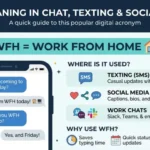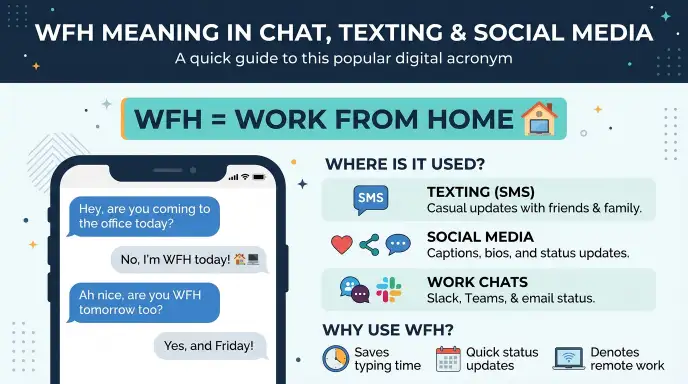
WFH in text usually means “work from home.” It is an abbreviation used when someone is talking about working remotely instead of going to an office.
You may see WFH in text messages, WhatsApp chats, Instagram captions, Snapchat messages, TikTok comments, work chats, and social media posts. People often use it as a quick way to explain where or how they are working.
The term is especially common in conversations about jobs, remote work, meetings, office schedules, and daily routines.
If you searched for “WFH mean in text,” you may have seen the abbreviation in a message and wanted to know exactly what the person meant.
WFH Meaning in Text
WFH stands for “work from home.” It is an abbreviation rather than traditional slang. People use it in casual conversations and professional communication when they want to say that they are doing their job from home.
For example:
“I’m WFH today.”
This means:
“I’m working from home today.”
Another example is:
“Are you WFH tomorrow?”
The person is asking if you will be working from home the next day.
WFH can describe a regular work arrangement or simply a single day when someone works remotely. The exact meaning is usually clear from the conversation.
Simple Definition of WFH
WFH = Work From Home
It means a person is performing their job from their home instead of traveling to their usual workplace.
The abbreviation is common because it saves time when typing. Instead of writing three words, someone can simply type “WFH.”
Is WFH Slang?
WFH is better described as an abbreviation or initialism, not slang.
It became very common in online communication because people frequently discuss remote work, office schedules, virtual meetings, and flexible jobs.
You might see:
- “WFH today”
- “I’m WFH tomorrow”
- “WFH setup”
- “WFH life”
- “WFH schedule”
- “WFH vibes”
- “WFH meeting”
The meaning remains the same in most of these situations: working from home.
What Does WFH Mean in Everyday Chat?
In everyday chat, WFH usually gives someone information about their work location.
For example:
Friend: “Can you meet for lunch?”
You: “Not today. I’m WFH.”
Here, WFH simply means you are working from home and may not be available in the same way you would be if you were at an office.
Where People Use WFH
WFH can appear on many platforms. It is not limited to workplace apps.
People may use it in private messages, social media captions, comments, and casual conversations.
WFH on TikTok
On TikTok, WFH is often connected with videos about remote jobs, home offices, productivity, daily routines, and work life balance.
For example, a creator might write:
“My WFH morning routine.”
This means the video shows their morning routine before or during a work from home day.
Another common phrase is:
“WFH setup.”
This may refer to a desk, laptop, chair, monitor, keyboard, or other items used for working at home.
The meaning does not usually change on TikTok.
WFH on Snapchat
On Snapchat, WFH may appear in short messages or captions.
Someone might send:
“WFH today 😴”
They are saying they are working from home that day. The emoji can add a casual or humorous tone, but it does not change the basic meaning.
A person might also post a photo of their laptop at home with the caption:
“WFH vibes.”
That means they are showing their work from home routine or environment.
WFH on Instagram
Instagram users often use WFH in captions, Stories, Reels, and comments.
Examples include:
- “WFH essentials”
- “Another WFH day”
- “WFH desk goals”
- “Coffee + WFH”
- “WFH Monday”
These phrases usually relate to remote work or the lifestyle surrounding it.
For example, an Instagram post showing a laptop and coffee might use the caption:
“WFH mornings.”
The phrase simply describes a morning spent working from home.
WFH on WhatsApp
WFH is very common in WhatsApp conversations, particularly when friends, coworkers, or family members discuss someone’s work schedule.
For example:
“Are you in the office today?”
“No, WFH.”
The second person is saying they are working from home.
Coworkers may also use it when arranging meetings:
“I’m WFH today. Can we do the meeting online?”
In this context, WFH is practical and direct rather than slangy.
WFH in SMS
WFH can also appear in ordinary text messages.
For example:
“I’ll be WFH tomorrow.”
This means:
“I’ll be working from home tomorrow.”
Because SMS messages are often short, abbreviations such as WFH can make communication faster.
Real Chat Examples of WFH
Here are realistic examples showing how WFH can appear in everyday conversations.
Example 1: Daily Schedule
A: Are you going to the office today?
B: Nope, I’m WFH.
A: Nice. No commute today.
Here, WFH tells A that B is working from home.
Example 2: Meeting
A: Where should we have the meeting?
B: I’m WFH today, so can we do it online?
A: Sure, that works.
WFH explains why B prefers an online meeting.
Example 3: Lunch
A: Want to grab lunch?
B: I can’t today. I’m WFH and have a meeting at 1.
A: No worries. Tomorrow?
Here, the abbreviation describes B’s work situation.
Example 4: Social Media
A: What are you up to?
B: WFH with a huge cup of coffee 😂
A: Sounds like a productive morning.
The abbreviation is used casually to describe the person’s day.
Example 5: Tomorrow’s Plan
A: Are you coming in tomorrow?
B: No, I’m WFH tomorrow.
A: Got it.
WFH means the person will work remotely from home.
Example 6: Work Chat
A: Can you join the 10 AM call?
B: Yes. I’m WFH today, but I’ll be online.
A: Perfect.
The abbreviation indicates B’s physical location, not their availability.
Example 7: Casual Conversation
A: Why are you still in pajamas? 😂
B: WFH life!
A: Fair enough.
Here, WFH is used humorously to refer to working from home.
Example 8: Office Schedule
A: What days are you in the office?
B: Monday and Wednesday. The rest are WFH.
A: That sounds flexible.
The person uses WFH to describe their regular remote work schedule.
Example 9: Family Chat
A: Can you help me with dinner tonight?
B: Maybe. I’m WFH and have a lot to finish.
A: Okay, just let me know.
WFH means the person is working from home even though they are physically at home.
Example 10: Weekend Confusion
A: Are you working tomorrow?
B: Yeah, unfortunately. WFH though.
A: At least you don’t have to commute.
The abbreviation communicates that the person is working remotely.
How to Reply When Someone Says WFH
The best reply depends on what the person is saying.
If someone simply tells you:
“I’m WFH today.”
You do not need to give a complicated response. A short, natural reply works well.
Funny Replies
If you are talking to a close friend, you could respond playfully:
- “Living the laptop life 😂”
- “Office = bedroom today?”
- “Remote worker mode activated 😂”
- “Hope your commute from bed was easy.”
- “WFH and still somehow busy?”
These are casual and should generally be reserved for people who understand your humor.
Casual Replies
For an ordinary conversation, you can say:
- “Nice!”
- “Gotcha.”
- “Same here.”
- “Sounds good.”
- “Cool, hope your day goes well.”
- “That’s convenient.”
Friendly Replies
If you want to sound warm and supportive:
- “Hope you have a good WFH day!”
- “Nice, hope work goes smoothly.”
- “Enjoy working from home!”
- “Hope you get a quiet day.”
- “Good luck with your meetings!”
Neutral Replies
A neutral response is useful when talking to a coworker or someone you do not know well:
- “Got it.”
- “Thanks for letting me know.”
- “Okay, that works.”
- “Understood.”
- “No problem.”
The important thing is to consider the context. WFH itself does not require a special type of response.
Is WFH Rude or Offensive?
No, WFH is not normally rude or offensive.
It is a common abbreviation for “work from home.” It does not contain an insult, offensive expression, or inappropriate meaning in its usual workplace context.
You can generally see it in casual conversations and work related communication.
Is WFH Safe to Use?
Yes, when the meaning is clear.
For example:
“I’m WFH today.”
is easy to understand in a conversation about work.
However, if you are writing something formal, spelling out “working from home” may be clearer.
Is WFH Appropriate at School?
It depends on the situation.
Students may understand the abbreviation because it appears frequently online, but formal school assignments should normally use standard language unless the teacher specifically allows abbreviations.
For example, in an essay, write:
“I am working from home.”
rather than:
“I am WFH.”
Is WFH Appropriate at Work?
WFH is often acceptable in informal workplace communication, especially in chat platforms and quick messages.
For example:
“I’m WFH today.”
may be perfectly normal in an internal work chat.
For formal documents, reports, or official communication, writing the full phrase can be more appropriate.
Who Uses WFH?
WFH is used by people who communicate about remote or hybrid work.
It can appear across different age groups, although people who frequently use digital communication may encounter it more often.
Age Groups
There is no strict age group that owns the term.
Adults in office based or remote jobs may use WFH regularly. Younger internet users may also recognize it from social media, workplace discussions, or conversations with family members.
Its meaning is generally straightforward once someone knows the abbreviation.
Gen Z Usage
Gen Z users may use WFH in texts, social media captions, memes, and casual online conversations.
However, WFH is not exclusively a Gen Z expression.
It is also widely understood by millennials and older working adults because remote work is a common topic across generations.
Common Platforms
You may see WFH on:
- TikTok
- Snapchat
- SMS
- Workplace messaging apps
- Social media posts
- Online forums
The exact tone changes depending on the platform, but the core meaning remains work from home.
How Often Does WFH Appear Online?
WFH is a familiar abbreviation in conversations about remote and hybrid work. It is especially likely to appear when people discuss office schedules, remote jobs, home office setups, virtual meetings, or flexible working arrangements.
It is less likely to appear in conversations unrelated to work.
Origin of the Term WFH
The phrase “work from home” existed long before people began shortening it to WFH.
The abbreviation follows a simple pattern: the first letters of the three words are combined to create W F H.
Digital communication helped make abbreviations like this practical. Short forms save typing time and work especially well in messages where people already understand the context.
The popularity of remote and hybrid work also made the abbreviation much more visible in everyday communication.
Did the Internet Create WFH?
Not exactly.
The concept of working from home existed before the modern internet. People have performed jobs from their homes in many forms for a long time.
However, internet based work made remote communication much easier. Email, video calls, online documents, project management tools, and workplace messaging allowed many employees to work away from traditional offices.
As conversations about remote work increased, WFH became a convenient short form.
Is the Exact Origin Clear?
The exact point when WFH first appeared is difficult to establish from ordinary online usage.
What is clear is how the abbreviation is formed:
W = Work
F = From
H = Home
It is therefore better to describe WFH as a straightforward abbreviation that became increasingly common in digital and workplace communication rather than claim a single confirmed inventor or starting date.
WFH vs. IDK, IDC, IMO, and BRB
These abbreviations may appear together in online conversations, but they have completely different meanings.
| Term | Meaning | Type | Typical Usage | Popularity |
| WFH | Work from home | Abbreviation | Work and remote work conversations | Common |
| IDK | I don’t know | Initialism | Casual texting and online chat | Very common |
| IDC | I don’t care | Initialism | Casual conversations | Common |
| IMO | In my opinion | Initialism | Discussions, comments, and messages | Common |
| BRB | Be right back | Initialism | Chatting when temporarily leaving | Common |
The main difference is what each abbreviation communicates.
WFH describes a work arrangement or location.
IDK expresses uncertainty or lack of knowledge.
IDC expresses a lack of concern or interest.
IMO a personal opinion.
BRB tells someone that you are temporarily leaving a conversation and expect to return.
For example:
“I’m WFH today, so I’ll join the meeting online.”
is completely different from:
“IDK if I can join.”
The first sentence explains the person’s work location. The second expresses uncertainty.
Real World Usage Example
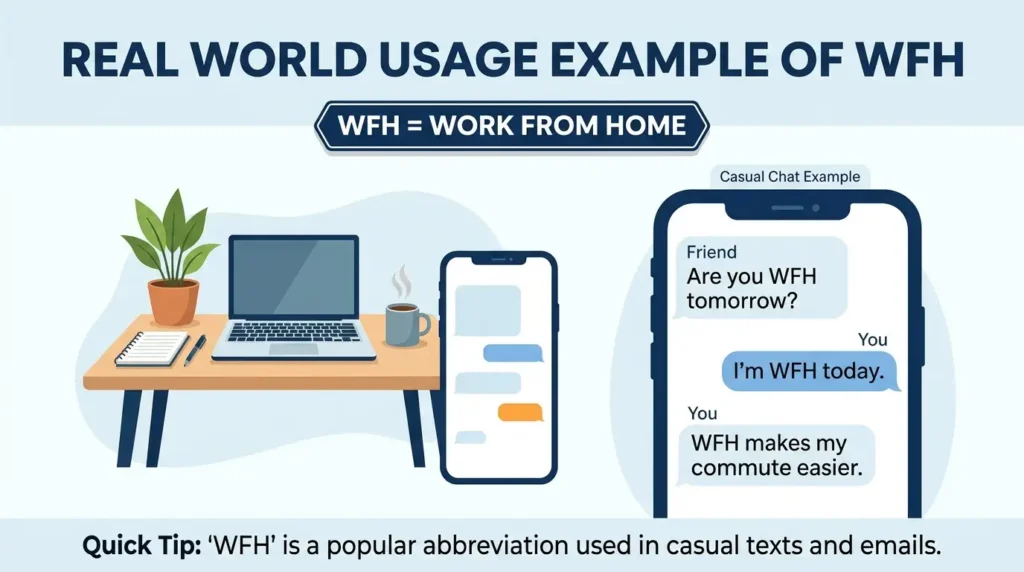
Imagine that two coworkers normally work in the same office.
One morning, one coworker sends a message:
“I’m WFH today because I’m waiting for a delivery.”
The coworker is telling the other person that they will be working from home rather than coming into the office.
Later, the coworker might say:
“I’ll still be available on chat.”
This shows an important point: WFH describes where someone is working, not if they are working.
Someone who says they are WFH may still have meetings, deadlines, calls, and regular responsibilities.
The abbreviation is also common in hybrid work arrangements. Someone might say:
“I WFH Monday and Friday.”
That means they work from home on those days and may work from an office on other days.
Common Ways WFH Is Used
WFH can appear in several common phrases.
WFH Today
“I’m WFH today.”
This means the person is working from home today.
WFH Tomorrow
“I’ll be WFH tomorrow.”
This tells someone about the person’s work location for the following day.
WFH Setup
A WFH setup is the equipment and workspace someone uses when working from home.
It might include:
- Laptop
- Monitor
- Desk
- Office chair
- Keyboard
- Mouse
- Headset
- Webcam
WFH Life
WFH life is a casual phrase describing the experience or routine of working from home.
For example:
“Coffee, laptop, and WFH life.”
This is often used in social media captions.
WFH Job
A WFH job generally means a job that allows someone to work from home, either regularly or under certain conditions.
The exact arrangement depends on the employer.
Common Misunderstandings About WFH
Although WFH is simple, a few misunderstandings can happen.
WFH Does Not Mean “Not Working”
Someone who is WFH is still working.
They may simply be doing their job from their home rather than from an office.
WFH Does Not Always Mean Fully Remote
A person can use WFH even if they have a hybrid job.
For example:
“I WFH three days a week.”
This suggests that the person works from home on some days and may go into an office on others.
WFH Does Not Describe a Job Type
WFH describes a work arrangement, not a particular profession.
A software developer, writer, designer, accountant, teacher, consultant, or other professional may work from home depending on their job and employer.
WFH Is Not Usually Slang
Some people may call WFH “internet slang” because they see it online, but technically it is more accurate to call it an abbreviation or initialism.
That distinction matters when explaining its meaning.
When Should You Avoid Using WFH?
WFH is generally easy to understand, but context matters.
If you are writing a formal document for people who may not know workplace abbreviations, spell it out the first time:
“Employees may work from home (WFH) two days per week.”
After introducing it, you can use WFH if the document continues to discuss the topic.
For casual messages, there is usually no need to explain it if the people involved already understand the abbreviation.
If the audience is unfamiliar with internet or workplace abbreviations, using “working from home” is the safer choice.
Frequently Asked Questions
What does WFH mean in text messages?
WFH means “work from home.” It tells someone that a person is working from their home instead of their usual workplace.
What does WFH mean on TikTok?
On TikTok, WFH usually means “work from home.” It often appears in videos, captions, and comments about remote jobs, home office setups, routines, and work life experiences.
Is WFH slang?
WFH is more accurately described as an abbreviation or initialism, not traditional slang. It is widely used in casual and workplace communication.
Is WFH rude or offensive?
No. WFH is normally a neutral abbreviation for “work from home.” It is not inherently rude or offensive.
How should you reply to WFH?
If someone says, “I’m WFH today,” simple replies include “Got it,” “Nice,” “Sounds good,” or “Hope work goes well.” Your reply should match the conversation.
What does “WFH today” mean?
“WFH today” means “working from home today.” The person is saying they are doing their job from home on that particular day.
What does “WFH life” mean?
“WFH life” is a casual expression describing the experience or routine of working from home. It is often used in social media posts and captions.
Does WFH mean fully remote?
Not necessarily. Someone can say they are WFH on a particular day even if they normally follow a hybrid schedule.
Is WFH used professionally?
Yes. WFH can be used in informal workplace communication, such as team chats and quick messages. Formal writing may use the full phrase “work from home.”
What is the difference between WFH and remote work?
WFH specifically means working from home. Remote work is broader and can include working from home, a coworking space, a café, or another location outside a traditional workplace.
Conclusion
WFH means “work from home.” It is a common abbreviation used in texts, workplace chats, WhatsApp messages, social media posts, and conversations about remote or hybrid work.
You may see it in phrases such as “WFH today,” “WFH tomorrow,” “WFH setup,” and “WFH life.” The meaning is usually simple: someone is doing their job from home.
WFH is not normally rude or offensive, and it is generally fine for casual and informal workplace communication.
For formal writing or audiences unfamiliar with the abbreviation, writing “work from home” in full can make the message clearer.
Once you know that WFH stands for work from home, most messages containing the abbreviation are easy to understand.
Explore This Topic!

Hi, I’m Chloe Parker. I write simple and practical articles about slang, grammar, spelling, vocabulary, and commonly confused words. My goal is to make English easier to understand through clear explanations and real-life examples. Whether you’re a student, writer, or English learner, I’m here to help you build confidence and improve your everyday English.