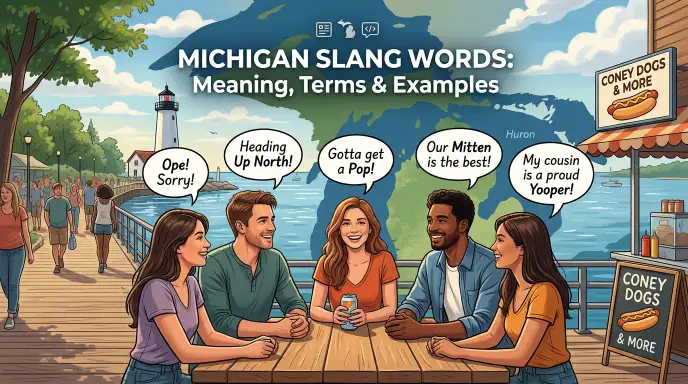
Michigan slang words are regional words, phrases, pronunciations, and nicknames commonly heard in Michigan. They include terms such as Yooper, Troll, party store, pop, Up North, The Mitten, The D, and Fudgie. Some are unique to Michigan, while others are shared with the wider Midwest.
If you are searching for Michigan slang words, you may have heard a phrase that sounded unusual or wondered why Michiganders use a different word for something familiar.
Michigan has strong regional identities, from Detroit and southeastern Michigan to the Upper Peninsula, and that shows up in everyday speech.
This guide explains common Michigan slang in simple English. You will learn what each term means, where you may hear it, how locals use it, and which expressions are better kept for casual conversations.
Some terms describe places or people rather than being true slang, but they are still important parts of Michigan vocabulary and local culture.
Quick Answer
Michigan slang words are informal regional terms and expressions associated with Michigan life and culture. Common examples include Yooper for someone from the Upper Peninsula, Troll for someone from the Lower Peninsula, party store for a convenience or liquor store, and pop for a carbonated soft drink.
What Do Michigan Slang Words Mean?
Michigan slang reflects the state’s geography, food, businesses, sports, weather, and local identity. Not every term is exclusive to Michigan, but many are strongly associated with the state.
Here are some of the most useful Michigan terms:
| Michigan term | Meaning | Typical use |
| Yooper | A person from Michigan’s Upper Peninsula | Regional identity |
| Troll | A person from the Lower Peninsula | Playful regional term |
| Party store | Convenience/liquor store | Everyday shopping |
| Pop | Carbonated soft drink | Food and drinks |
| Up North | Northern Michigan, often for vacation areas | Travel and recreation |
| The Mitten | Michigan’s Lower Peninsula | Talking about the state |
| The D | Detroit | Casual reference to Detroit |
| The Thumb | Thumb shaped eastern part of the Lower Peninsula | Location |
| Fudgie | A visitor/tourist associated with Mackinac Island | Playful local term |
| Ope | A quick reaction to surprise, interruption, or an apology | Casual conversation |
Some of these expressions are regional vocabulary rather than slang in the strictest sense. Still, they are commonly included when people talk about Michigan slang words.
Common Michigan Slang Words and Phrases
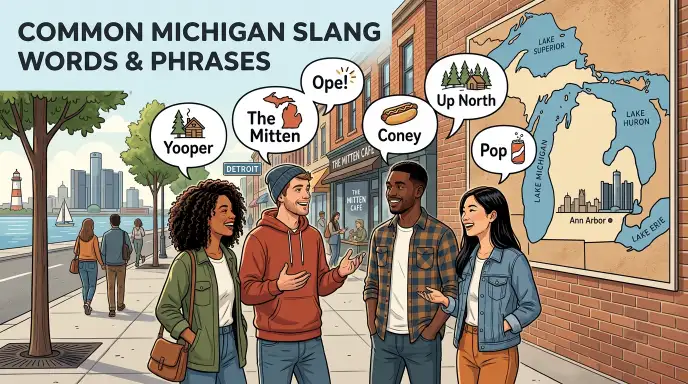
1. Yooper
Yooper is one of the best known Michigan regional terms. It means a person who lives in or comes from Michigan’s Upper Peninsula, often called the U.P.
The word comes from the pronunciation of “U.P.” followed by an er ending. Dictionary.com dates the word to the 1970–75 period, while Michigan sources connect it strongly with Upper Peninsula identity.
Example:
“My family is from Marquette, so we’re Yoopers.”
The word is generally used with pride and is not normally offensive.
2. Troll
In Michigan, Troll can be a playful name for someone who lives in the Lower Peninsula.
Why “Troll”? The joke is that Lower Peninsula residents live under the Mackinac Bridge, while Upper Peninsula residents are Yoopers. Michigan Public describes the term as a lighthearted reference to people living south of the bridge.
Example:
“I’m a Troll from downstate, not a Yooper.”
It is usually friendly regional humor.
3. Party Store
A party store in Michigan does not usually mean a shop that sells balloons and decorations.
It commonly means a small convenience or liquor store where people may buy drinks, snacks, cigarettes, lottery tickets, and other everyday items.
Example:
“I’m stopping at the party store. Need anything?”
Someone unfamiliar with Michigan may misunderstand this phrase.
4. Pop
Many Michiganders call carbonated drinks pop rather than soda.
This is also common in other parts of the Midwest, so it is not uniquely Michigan. Still, pop is a familiar part of Michigan speech. Michigan Public has also discussed the state’s long connection between the word “pop” and Michigan brands such as Faygo and Towne Club.
Example:
“Do you want a pop with your burger?”
In Michigan, asking for a “soda” may still be understood, but “pop” is the more recognizable regional choice.
5. Up North
Up North usually refers to northern Michigan, especially areas people visit for cabins, lakes, forests, camping, boating, and summer trips.
It does not always refer to one exact city or boundary. The meaning depends on where the speaker lives.
Example:
“We’re heading Up North for the weekend.”
For many Michiganders, “Up North” is as much a lifestyle idea as a location.
6. The Mitten
The Mitten is a nickname for Michigan’s Lower Peninsula because its shape looks like a mitten.
Michiganders sometimes use their hands to point out where a city is located on the “map” of Michigan.
Example:
“I’m on the west side of the Mitten.”
This is casual and easy to understand once you know Michigan’s shape.
7. The D
The D is a common nickname for Detroit.
It is especially common in casual speech, local culture, music, sports, and social media.
Example:
“I’m driving to the D tonight.”
Visit Detroit’s own local dictionary includes “The D” among Detroit expressions and explains other regional terms such as “ope” and “pop.”
8. The Thumb
The Thumb refers to the eastern section of Michigan’s Lower Peninsula that looks like the thumb of a mitten.
Places in this region include communities around Port Huron, Port Austin, and Caseville.
Example:
“We’re spending the weekend in the Thumb.”
It is mainly a geographic nickname, not slang in the same way as an internet expression.
9. Fudgie
Fudgie is a playful term associated with tourists who visit the Mackinac Island area, especially because of the island’s famous fudge.
The term appears in Michigan discussions of local vocabulary alongside Yooper and Troll.
Example:
“The island is packed with Fudgies this weekend.”
The word can be humorous, so tone matters.
10. Ope
Ope is a short Midwest expression often heard when someone bumps into another person, notices something unexpected, or needs to get past someone.
A common phrase is:
“Ope, sorry!”
Visit Detroit describes “ope” as a Michigan/Midwestern expression that can work like “oops” or “excuse me.”
It is not normally rude. It is a casual reaction.
Michigan Slang Words in Everyday Conversation
Michigan expressions often make sense from context. Here are some natural examples:
At a store
“I’m making a quick party store run. Want a pop?”
Talking about family
“My uncle is a Yooper. He grew up in the U.P.”
Talking about travel
“We’re going Up North after work Friday.”
Talking about Detroit
“She lives near the D.”
Talking about geography
“We’re staying in the Thumb this weekend.”
Meeting someone
“Ope, sorry! Didn’t see you there.”
These examples show why context matters. A person unfamiliar with Michigan may understand the individual words but miss the local meaning.
Michigan Slang vs. Standard American English
Some Michigan terms are simply regional alternatives.
| Michigan usage | More general term |
| Pop | Soda / soft drink |
| Party store | Convenience store / liquor store |
| Yooper | Upper Peninsula resident |
| Up North | Northern Michigan |
| The D | Detroit |
| The Mitten | Lower Peninsula |
| Ope | Oops / excuse me |
| The Thumb | Thumb region of Michigan |
Not every Michigander uses every expression. Language can differ by age, location, family background, and community.
Where Is Michigan Slang Commonly Used?
Michigan slang can appear in many settings, but the level of informality changes.
Everyday speech
Regional terms are most natural in conversations with friends, family, and neighbors.
Texting and social media
Terms such as Yooper, Up North, The D, and The Mitten can work well in casual posts and messages.
For example:
“Up North this weekend 🌲”
Sports and local culture
Detroit and Michigan sports communities often use local nicknames and regional language when talking about teams, cities, and fans.
Workplace conversations
Some terms are fine in casual workplace conversation, but regional slang should not replace clear language in formal writing.
For example, saying:
“I’m heading Up North this weekend.”
is perfectly understandable in casual office conversation.
But a formal report should use the specific destination instead.
Are Michigan Slang Words Rude or Offensive?
Most common Michigan slang words are harmless and informal. Terms such as pop, Up North, The Mitten, The D, and party store are generally neutral.
A few terms depend more on tone.
Yooper is usually a positive or neutral identity term. Troll can be playful, but it may sound less friendly if used as an insult. Fudgie can also be humorous rather than insulting.
The safest rule is simple: listen to how local people use the term and match the tone.
Origin and History of Michigan Slang
Michigan’s regional vocabulary developed from several influences. Geography is a major one. The state has two peninsulas, large Great Lakes coastlines, major cities, rural communities, and distinct regional identities.
The word Yooper is a good example. It comes from “U.P.” and became a recognized nickname for Upper Peninsula residents. Dictionary.com records it as dating to the 1970–75 period.
Michigan’s local businesses also helped shape vocabulary. Faygo and Vernors, both strongly associated with Michigan, helped reinforce the use of “pop” for carbonated drinks.
Geography also created terms such as Troll, The Mitten, and The Thumb. These names turn Michigan’s physical map into everyday language.
Not every Michigan expression has a single proven origin. When the history is uncertain, it is better to describe the known usage than to claim a definite origin.
Similar Regional Terms You May Hear
Michigan does not have a completely separate language. Many expressions overlap with the wider Midwest.
For example:
- Ope is heard across the Midwest.
- Pop is common across several northern and Midwestern states.
- You betcha is associated with Midwestern speech.
- Yeah, no and no, yeah can appear in casual Midwestern conversation.
- Melk is sometimes used to describe a regional pronunciation of “milk.”
This is why it can be misleading to call every Midwestern expression “Michigan slang.” Some terms are Michigan specific, while others are shared regional speech.
When Should You Avoid Michigan Slang?
Michigan slang is best used when the setting is casual and the meaning is clear.
Avoid heavy use of regional expressions when:
- Writing a formal business document
- Speaking to an audience from many countries
- Giving official directions
- Writing academic work
- Explaining something where precision matters
- Using a term you are unsure about
You do not need to remove regional language from everyday speech. Just remember that outsiders may not know what it means.
For example, instead of telling a visitor:
“Go to the party store.”
you could say:
“Go to the convenience store on the corner.”
That removes possible confusion.
Common Misunderstandings About Michigan Slang
“Party store” means a party supply shop.
Not usually. In Michigan, it commonly refers to a convenience or liquor store.
“Yooper” means any person from Michigan.
No. A Yooper specifically refers to someone from Michigan’s Upper Peninsula.
“Troll” is always an insult.
Not necessarily. In Michigan, it can be a playful term for someone from the Lower Peninsula, especially in contrast with “Yooper.”
“Pop” is only used in Michigan.
No. It is common in many Midwestern and northern parts of the United States. Michigan is simply one of the places where the term is strongly established.
Every Michigander speaks the same way.
Definitely not. Speech varies across Detroit, the Upper Peninsula, western Michigan, southeastern Michigan, and other communities.
Frequently Asked Questions
What is the most famous Michigan slang word?
Yooper is one of the most recognizable Michigan regional terms. It refers to a person from the Upper Peninsula.
What do people in Michigan call soda?
Many Michiganders call it pop. This usage is also common in other Midwestern areas.
What does “party store” mean in Michigan?
A party store usually means a small convenience or liquor store. It does not normally mean a shop selling party decorations.
What does Yooper mean?
Yooper means a person who lives in or comes from Michigan’s Upper Peninsula. The term comes from “U.P.”
What is a Troll in Michigan slang?
A Troll is a playful term for someone who lives in Michigan’s Lower Peninsula, referring to the idea that they live “under” the Mackinac Bridge.
What does “Up North” mean in Michigan?
“Up North” usually means northern Michigan, especially areas people visit for cabins, lakes, forests, camping, and vacations. It does not have one exact boundary.
Is Michigan slang used online?
Yes. Regional terms such as Yooper, The D, Up North, The Mitten, and party store can appear in texts, social media posts, forums, and casual online conversations. However, most are regional vocabulary rather than internet only slang.
Conclusion
Michigan slang words give outsiders a quick look at the state’s local culture and regional identity. Terms such as Yooper, Troll, pop, party store, Up North, The Mitten, The D, and The Thumb are useful examples of how Michigan geography and everyday life shape speech.
The key is context. Yooper identifies someone from the Upper Peninsula, while Troll can describe someone from the Lower Peninsula.
Party store means something different in Michigan than many visitors expect, and pop is the familiar local word for a carbonated drink.
You may also hear Michigan terms in texts, social media, sports conversations, and casual workplace chats. But not every expression is unique to Michigan, and not every Michigander uses the same vocabulary.
If you hear an unfamiliar Michigan phrase, do not assume it is an insult. Check the context, tone, and local meaning first. That is the easiest way to understand Michigan slang words without getting lost in regional language.
Related Slang!

Hi, I’m Chloe Parker. I write simple and practical articles about slang, grammar, spelling, vocabulary, and commonly confused words. My goal is to make English easier to understand through clear explanations and real-life examples. Whether you’re a student, writer, or English learner, I’m here to help you build confidence and improve your everyday English.