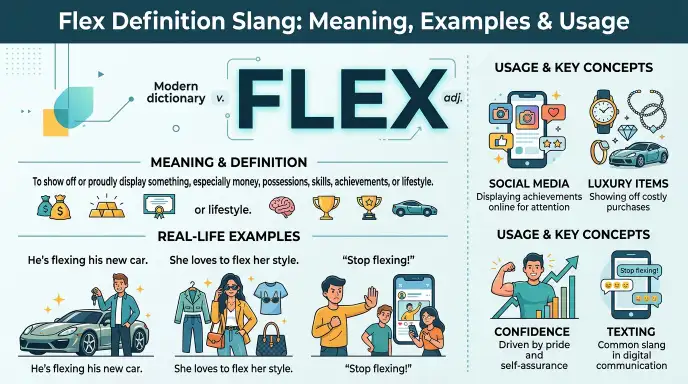
Flex definition slang means to show off, brag, or proudly display something to get attention or admiration. Someone might “flex” their new car, expensive clothes, skills, achievements, or even their lifestyle. In slang, flex is usually about making sure other people notice what you have or what you can do.
The word can sound positive, playful, or negative depending on the situation. A friend may say, “Nice flex!” as a joke or compliment. But saying, “He is always flexing,” can suggest that someone shows off too much.
People often search for the flex definition slang because they see the word in texts, comments, TikTok posts, gaming chats, or social media captions.
The meaning is easy to understand once you know the context, but it can be confusing because flex also has a normal meaning related to muscles and bending. This guide explains both meanings, shows how people use the slang today, and gives simple examples you can understand at a glance.
Quick Answer
In slang, flex means to show off, brag, or flaunt something you are proud of. It can refer to money, clothes, possessions, skills, achievements, appearance, or status.
Example:
“Bro is flexing his new car.”
This means the person is showing off his new car.
What Does Flex Mean in Slang?
The slang word flex usually describes an action where someone proudly displays something impressive.
It can be something physical, such as a new phone or designer shoes. It can also be something less visible, such as intelligence, talent, success, or social status.
For example:
- “She is flexing her new sneakers.”
- “He loves to flex his gaming skills.”
- “That was a serious flex.”
- “Stop flexing on everyone.”
- “Not trying to flex, but I got an A.”
The tone matters. Flex can be playful between friends, but it can also suggest that someone is being boastful.
Dictionary.com lists the slang sense of flex as “to boast or brag about; flaunt.” It also lists flex as a noun meaning a boast or brag.
Flex as a Slang Verb
As a verb, flex means to show off or brag.
You can use it when someone is actively displaying something they think is impressive.
Examples
“He is flexing his new watch.”
He is showing everyone his new watch.
“She keeps flexing her grades.”
She keeps talking about or showing off her good grades.
“They were flexing their skills in the game.”
They were showing how good they were at the game.
The verb can appear in different forms:
| Form | Example |
| Flex | “He likes to flex.” |
| Flexing | “She is flexing her new shoes.” |
| Flexed | “He flexed his expensive watch.” |
| Flexes | “He always flexes online.” |
Flex as a Slang Noun
Flex can also be a noun. In this use, it means a boast, brag, or impressive thing someone displays.
For example:
- “That car is a huge flex.”
- “Getting front row seats was a flex.”
- “Her new setup is such a flex.”
- “That was a humble flex.”
A flex does not always mean something expensive. Someone can flex a skill, achievement, experience, or unusual talent.
For example, if someone casually mentions that they speak five languages, another person might call that a flex.
What Does “Flex On Someone” Mean?
Flex on someone means to show off in a way that makes your superiority or advantage clear to another person.
For example:
“He flexed on his friends by showing them his new gaming setup.”
The idea is not simply showing something. It can carry the feeling of “Look what I have” or “Look what I can do.”
The phrase may be serious or playful.
Friendly example
“You really flexed on us with that homemade cake.”
This could simply mean the cake looked amazing.
More negative example
“He keeps flexing on people because he has more money.”
Here, the phrase suggests arrogance or an attempt to make others feel less successful.
Is Flex Always About Money?
No. Flex can be about almost anything someone wants to show off.
Common types of flexing include:
| Type of flex | Example |
| Money | “He is flexing his expensive car.” |
| Clothes | “She flexed her new designer jacket.” |
| Technology | “That phone is a nice flex.” |
| Skills | “He is flexing his coding skills.” |
| Fitness | “He posted a photo flexing his muscles.” |
| Success | “She is flexing her new promotion.” |
| Gaming | “He flexed his rare game item.” |
| Travel | “They keep flexing their vacation photos.” |
This is why the slang is so common online. People can display almost anything through photos, videos, comments, or posts.
Where Is “Flex” Commonly Used?
Flex is common in casual online communication and everyday conversation.
You may see it in:
- Text messages
- TikTok comments
- Instagram captions
- Snapchat messages
- Discord chats
- Gaming communities
- Reddit discussions
- Memes
- Casual conversations
The exact tone can change from one platform to another.
For example, a gaming player might say:
“Look at this skin. Huge flex.”
On social media, someone might comment:
“Okay, flex!”
In both cases, the person is pointing out that someone is showing something impressive.
Is “Flex” Rude or Offensive?
Usually, flex is not offensive. It is common informal slang.
However, it can sound negative when it suggests that someone is bragging too much or trying to make others feel inferior.
Compare these examples:
Playful:
“Nice flex! Those shoes look great.”
Negative:
“He never stops flexing his money.”
The first sounds friendly. The second criticizes the person’s behavior.
So, the word itself is not rude. The tone and context decide how it sounds.
Real Life Flex Examples
Here are some natural examples of how people may use the word.
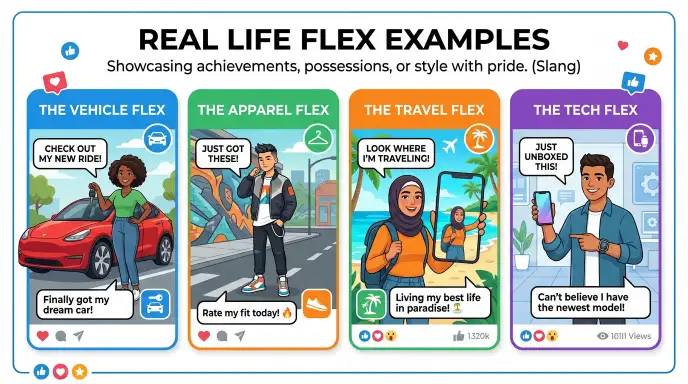
In a text message
A: “I finally bought the headphones I wanted.”
B: “Okayyy, flex 😂”
Here, “flex” is playful.
On social media
“Not trying to flex, but I finally finished the project.”
The person is jokingly saying that the achievement might look like bragging.
In gaming
“Bro is flexing that legendary skin again.”
The player is showing off a rare or valuable game item.
Between friends
“You got tickets for the final? That’s a flex.”
The speaker means the tickets are impressive.
At school
“She keeps flexing her test scores.”
Here, the speaker may be saying that the student talks about her grades too much.
At work
“He was flexing his new position during the meeting.”
This sounds more negative because the person may be acting too proud or trying to show authority.
What Does “Not a Flex” Mean?
“Not a flex” means “I am not trying to show off.”
People often use it before mentioning something impressive.
For example:
“Not a flex, but I finished the whole book in one day.”
The speaker knows the statement may sound like bragging, so they make it sound more casual.
Another example:
“Not a flex, but I have been playing guitar for ten years.”
The person is sharing an achievement while joking that they are not trying to brag.
Sometimes, however, “not a flex” is itself a playful flex.
What Does “Humble Flex” Mean?
A humble flex is when someone shows off something impressive while pretending to mention it casually.
For example:
“I just had to use my spare laptop because my main one is at the office.”
If the “spare” laptop is extremely expensive, people may call this a humble flex.
The person may not openly brag. Instead, they casually mention something impressive.
This can be used seriously or as a joke.
Flex vs. Brag vs. Show Off
These words are closely related, but they are not always used in the same way.
| Word | Basic meaning | Tone |
| Flex | Show off something impressive | Casual/slang |
| Brag | Talk proudly about achievements | Often negative |
| Show off | Display something to get attention | Neutral to negative |
| Flaunt | Display something proudly and openly | Often negative |
| Boast | Speak proudly about achievements | More formal |
Flex is the most casual and internet friendly term in this group.
For example:
- “He is flexing his new car.” :casual
- “He is bragging about his new car.” :more direct
- “He is showing off his new car.” :everyday English
- “He is flaunting his new car.” :stronger negative tone
Flex Has a Literal Meaning Too
The slang meaning is not the only meaning of flex.
In ordinary English, flex can mean to bend or tighten a muscle. For example:
“He flexed his arm.”
This means he tightened his muscle and made it visible.
The connection between the literal and slang meanings is easy to understand. Someone who flexes their muscles to show their strength is displaying something impressive.
The slang sense extends that idea to other things, such as money, possessions, skills, or status. Dictionary.com lists both the physical muscle sense and the slang meaning of boasting or showing off.
Origin and History of Flex Slang
The basic word flex is much older than its slang meaning. The ordinary English word comes from Latin and has been used for the idea of bending or turning for centuries. Dictionary.com records the traditional word as dating to the early 1500s.
The modern slang meaning developed from the idea of displaying strength or power. The phrase “flex one’s muscles” has long been used for showing strength or power, which helps explain the later slang use.
The exact point when flex became widespread as modern slang is not always easy to pin down. It is therefore better to avoid claiming one exact person, song, or year as its definite origin.
Today, the slang is widely understood in casual English, especially online.
Why Do People Say “Flex”?
People use flex because it is short, casual, and expressive.
It can quickly communicate that someone is:
- Showing off
- Proud of something
- Displaying success
- Trying to impress others
- Demonstrating a skill
- Joking about their own achievement
The word can also make a comment sound playful.
Instead of saying:
“You are displaying your expensive possessions to impress people.”
Someone can simply say:
“You’re flexing.”
That is one reason slang like this works well in texts and social media.
When Should You Avoid Using “Flex”?
Flex is informal, so it is best suited to casual communication.
Avoid it when writing:
- Formal academic papers
- Official business reports
- Formal applications
- Professional documents
- Serious workplace communication
- Formal messages to people you do not know well
For example, instead of:
“The company is flexing its success.”
A formal report might say:
“The company is highlighting its recent success.”
In casual workplace chat, however, the word may be fine if your team already uses informal language.
Common Misunderstandings About Flex
“Flex” always means showing off money.
Not true. You can flex skills, achievements, knowledge, fitness, possessions, or status.
“Flex” is always an insult.
Not necessarily. Friends often use it as a joke or compliment.
“Flex” only refers to physical muscles.
No. The slang meaning is much broader.
“Flex” is always serious.
No. Phrases such as “Okay, flex!” are often playful.
“Not a flex” means the person is not bragging.
It usually means that, but it can also be humorous because the speaker may clearly be sharing something impressive.
Frequently Asked Questions
What does flex mean in texting?
In texting, flex usually means to show off, brag, or display something impressive. For example, “Nice flex” can mean “That is impressive.”
What does flex mean on social media?
On social media, flex usually means showing off something you have, achieved, or can do. It may refer to money, clothes, travel, fitness, skills, or status.
Is flex a bad word?
No. Flex is not normally a bad or offensive word. It is informal slang. Its tone can become negative when someone is seen as bragging or showing off too much.
What does “stop flexing” mean?
“Stop flexing” means “stop showing off.” Friends may say it jokingly, but it can also be a real criticism.
What does “nice flex” mean?
“Nice flex” usually means “Nice show off” or “That is impressive.” Depending on tone, it can be a compliment, joke, or mild tease.
What does “flex on someone” mean?
Flex on someone means to show off in front of them or make your advantage, success, skill, or possession clear.
Can I use flex at work?
You can use flex in casual workplace conversations if the environment is informal. It is better to avoid it in formal documents, reports, or professional writing.
Conclusion
The simplest flex definition slang is to show off, brag, or proudly display something impressive. It can be used as both a verb and a noun.
Someone can flex their money, clothes, car, skills, achievements, gaming items, or almost anything they think is worth showing.
The tone is important. “Nice flex!” can be playful, while “He is always flexing” may criticize someone for bragging too much. The slang is generally harmless and common in casual conversations, texting, gaming, and social media.
Remember that flex also has a literal meaning connected to bending or tightening a muscle. The slang sense grew from the broader idea of displaying strength or power.
So, when you see someone write “That’s a flex,” they usually mean “That’s something impressive you are showing off.” Context will tell you if the comment is a compliment, joke, or criticism.
Read More About !
- Iowa Slang Meaning: What Does Iowa Slang Mean?
- Flamer Slang: Meaning, Uses, Examples & Context
- Korean Texting Slang: Meaning & Examples

Hi, I’m Chloe Parker. I write simple and practical articles about slang, grammar, spelling, vocabulary, and commonly confused words. My goal is to make English easier to understand through clear explanations and real-life examples. Whether you’re a student, writer, or English learner, I’m here to help you build confidence and improve your everyday English.