Korean texting slang is a big part of how people communicate online in South Korea. Korean messages often look very different from formal Korean because people use shortened words, abbreviations, numbers, repeated letters, and playful expressions to make conversations faster and more casual.
You may see these expressions in text messages, KakaoTalk chats, Instagram comments, TikTok videos, gaming chats, and online communities.
If you are learning Korean, watching Korean dramas, following Korean creators, or chatting with Korean speakers, you may notice expressions such as ㅋㅋ, ㅎㅎ, ㄱㄱ, ㅇㅇ, ㄴㄴ, ㅂㅂ, and 감사 used in unusual ways. These terms can be confusing because their meaning often depends on tone and context.
Learning these expressions can help you understand casual Korean conversations much better. It can also help you avoid sounding too formal when talking with friends.
Quick Answer
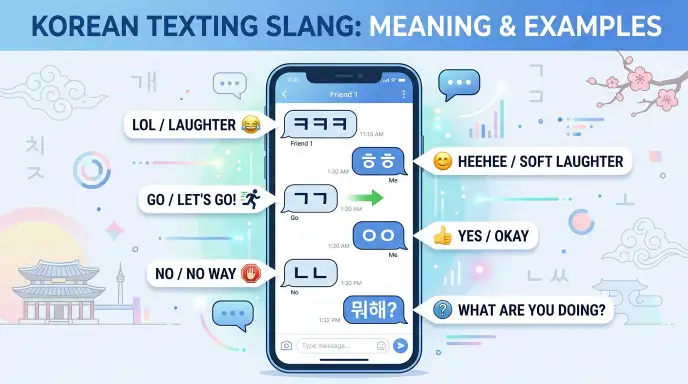
Korean texting slang refers to informal Korean words, abbreviations, symbols, and shortened expressions used in online chats and text messages. Common examples include ㅋㅋ for laughter, ㅎㅎ for a soft laugh, ㅇㅇ for “yes,” and ㄱㄱ for “go” or “let’s go.”
What Does Korean Texting Slang Mean?
Korean texting slang is informal language used in digital conversations. It is similar to English texting shortcuts such as “LOL,” “BTW,” “OMG,” and “IDK,” but Korean has its own unique system of abbreviations and expressions.
One interesting feature is that Korean speakers often shorten words to their first consonants.
For example:
- ㄱㄱ → 가자 가자 → “let’s go”
- ㅇㅇ → 응응 → “yeah” or “yes”
- ㄴㄴ → 노노 → “no”
- ㅂㅂ → bye bye → “bye”
- ㄱㅅ → 감사 → “thanks”
- ㅊㅋ → 축하 → “congratulations”
These forms save time because Korean keyboard users can type consonants quickly.
Korean texting also uses repeated characters to show emotion. For example, ㅋㅋㅋ can show laughter, while ㅎㅎㅎ can create a softer or friendlier tone.
Why Is Korean Texting Slang So Popular?
Texting slang became popular because digital communication rewards speed and simplicity.
When people chat with friends, they usually do not want to type long, formal sentences. Short expressions make conversations feel quicker and more natural.
Korean online language also reflects personality and emotion.
For example:
ㅋㅋ
may feel like a simple laugh.
ㅋㅋㅋㅋㅋㅋ
can show stronger laughter.
ㅎㅎ
may sound softer or warmer.
ㅠㅠ
can express sadness or crying.
This means Korean texting slang is not only about shortening words. It can also communicate emotion without using a complete sentence.
Common Korean Texting Slang
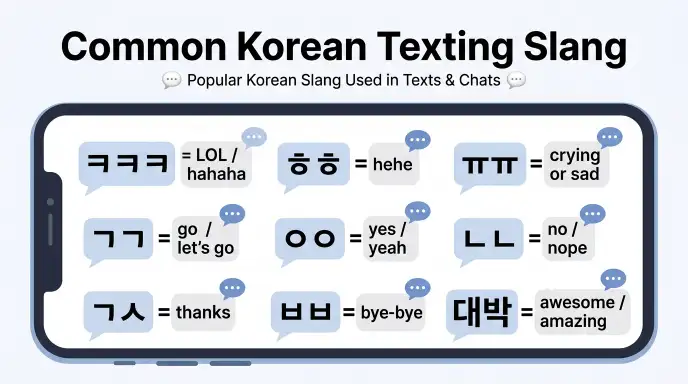
1. ㅋㅋ :Korean Texting Slang for Laughter
ㅋㅋ is one of the most common Korean online expressions.
It comes from the first consonant of 크크, which represents a laugh.
In English, it can be similar to:
- “haha”
- “lol”
- “LOL”
- “hehe”
The number of ㅋ characters can change the intensity.
Examples:
ㅋㅋ
Haha.
ㅋㅋㅋ 진짜 웃겨
Haha, that’s really funny.
ㅋㅋㅋㅋㅋㅋ
That’s hilarious.
Using only ㅋ can sometimes feel shorter or more blunt than using several characters.
2. ㅎㅎ :A Softer Korean Laugh
ㅎㅎ is another common way to show laughter.
It comes from 흐흐, an informal laugh like expression.
Compared with ㅋㅋ, ㅎㅎ often feels softer, calmer, or more gentle.
For example:
고마워 ㅎㅎ
Thanks, hehe.
알겠어 ㅎㅎ
Okay, hehe.
It can also make a message sound less serious.
However, tone still depends on the conversation. In some situations, ㅎㅎ can also sound awkward or slightly sarcastic.
3. ㅇㅇ :“Yeah” or “Yes”
ㅇㅇ is a very common Korean texting abbreviation.
It comes from 응, an informal way to say “yes” or “yeah.”
In English, it can be similar to:
- yeah
- yep
- yes
- uh huh
Example:
오늘 올 거야?
Are you coming today?
ㅇㅇ
Yeah.
It is casual, so you would normally use it with friends or people you are comfortable with.
4. ㄴㄴ :“No”
ㄴㄴ means “no” or “nope.”
It comes from the English word “no,” written using Korean pronunciation conventions.
Example:
이거 좋아?
Do you like this?
ㄴㄴ
Nope.
It is very casual and commonly seen in online conversations.
5. ㄱㄱ :“Go” or “Let’s Go”
ㄱㄱ is commonly used to mean “go,” “let’s go,” or “let’s do it.”
It comes from 고고, based on the English expression “go go.”
You might see it in gaming chats, group conversations, or plans with friends.
Example:
영화 보러 ㄱㄱ?
Shall we go watch a movie?
ㄱㄱ
Let’s go.
It is especially useful when someone wants to agree quickly.
6. ㅂㅂ :“Bye Bye”
ㅂㅂ is a shortened form of “bye bye.”
It is used when ending an informal online conversation.
Example:
나 이제 자러 감 ㅂㅂ
I’m going to sleep now. Bye bye.
It is casual and is more suitable for friends or online chats than formal communication.
7. ㄱㅅ :“Thanks”
ㄱㅅ is a shortened form of 감사, meaning thanks or gratitude.
It is often used in casual online conversations.
Example:
정보 ㄱㅅ
Thanks for the information.
It is especially common when someone wants to respond quickly.
For formal situations, use a complete polite expression such as 감사합니다 instead.
8. ㅊㅋ :“Congratulations”
ㅊㅋ is commonly used to mean “congratulations.”
It comes from 축하, which means congratulations.
Example:
시험 합격했어!
I passed the exam!
ㅊㅋㅊㅋ
Congrats!
The repeated form can make the message feel more enthusiastic.
9. ㅠㅠ :Crying or Sadness
ㅠㅠ is one of the most recognizable Korean texting symbols.
The characters look somewhat like crying eyes with tears.
It is used to express:
- sadness
- disappointment
- crying
- frustration
- emotional pain
Example:
오늘 비 와 ㅠㅠ
It’s raining today. Sad.
시험 망했어 ㅠㅠ
I messed up the exam. I’m crying.
You may also see ㅜㅜ, which has a similar emotional meaning.
10. ㅜㅜ : Sad or Crying
ㅜㅜ is another way to represent tears or sadness.
It is very similar to ㅠㅠ.
Example:
너무 피곤해 ㅜㅜ
I’m so tired.
Depending on the situation, it may express genuine sadness or playful exaggeration.
Korean Texting Slang for Friends
Korean friends often use highly informal expressions when chatting.
Some common ones include:
| Korean slang | Meaning | Tone |
| ㅋㅋ | Haha / LOL | Casual |
| ㅎㅎ | Hehe | Soft and friendly |
| ㅇㅇ | Yeah / yes | Casual |
| ㄴㄴ | No / nope | Casual |
| ㄱㄱ | Let’s go | Casual |
| ㅂㅂ | Bye bye | Casual |
| ㄱㅅ | Thanks | Very casual |
| ㅊㅋ | Congrats | Casual |
| ㅠㅠ | Crying / sad | Emotional |
| ㅜㅜ | Sad / crying | Emotional |
These expressions are especially useful for understanding casual online Korean.
Korean Texting Slang on KakaoTalk
KakaoTalk is one of the most important messaging platforms in South Korea, so it is a major place to encounter Korean texting slang.
Friends may use abbreviations instead of complete sentences.
A conversation could look like:
오늘 뭐해?
What are you doing today?
친구 만남 ㅋㅋ
Meeting a friend haha.
저녁 ㄱㄱ?
Dinner?
ㅇㅇ ㄱㄱ
Yeah, let’s go.
This style is short, fast, and casual.
Because KakaoTalk conversations are often informal, abbreviations can appear frequently between friends.
Korean Texting Slang on Social Media
You can also see Korean texting slang on platforms such as Instagram, TikTok, YouTube, X, Reddit, and gaming communities.Comments are often short, so people use abbreviations to react quickly.
For example:
ㅋㅋㅋㅋ 이거 뭐야
can express laughter or amusement.
A comment such as:
ㄹㅇ
can mean 진짜, or “really,” “for real,” depending on context.
Another common expression is:
대박
which can mean “amazing,” “wow,” or “that’s wild,” depending on the situation.
Social media slang changes quickly, so not every expression remains popular forever.
Korean Texting Slang in Gaming
Gaming communities often use very short expressions because players need to communicate quickly.
Some abbreviations may include:
- ㄱㄱ : let’s go
- ㅂㅂ :bye
- ㅇㅇ :yes
- ㄴㄴ : no
- ㄱㅅ : thanks
- ㅈㅅ : sorry
For example:
다음 판 ㄱㄱ
means:
Let’s play the next round.
Because gaming slang can be community specific, always consider the game and the players involved.
Korean Texting Slang vs. Formal Korean
One of the most important things to understand is the difference between informal texting and formal Korean.
A Korean learner might know:
감사합니다
which means “thank you.”
But in a casual chat, they may see:
ㄱㅅ
These do not have the same level of politeness.
Similarly:
안녕하세요
is a polite greeting.
A casual online message may use:
ㅎㅇ
which is a shortened greeting based on “hi.”
The short form is much more casual.
Common Korean Slang Abbreviations
Korean speakers also shorten longer phrases by taking their first consonants.
This is known as 초성체, a style of writing that uses initial consonants.
Here are some examples:
| Abbreviation | Korean phrase | Meaning |
| ㅇㅇ | 응응 | Yeah / yes |
| ㄴㄴ | 노노 | No / nope |
| ㄱㄱ | 고고 | Let’s go |
| ㄱㅅ | 감사 | Thanks |
| ㅊㅋ | 축하 | Congrats |
| ㅈㅅ | 죄송 | Sorry |
| ㅂㅂ | Bye bye | Goodbye |
| ㅎㅇ | 하이 | Hi |
| ㄹㅇ | 리얼 | For real |
| ㅇㅋ | 오케이 | Okay |
Not every abbreviation is used by every Korean speaker. Some are more common in certain age groups or online communities.
Korean Texting Slang for “Sorry”
ㅈㅅ is a common abbreviation based on 죄송, which relates to apologizing.
It can be used in casual online communication.
Example:
ㅈㅅ 늦었음
This has a very informal online style and can be understood as an apology for being late.
However, 죄송합니다 is much more polite.
If you are speaking to a teacher, customer, manager, or someone you do not know well, use a polite expression instead of slang.
Korean Texting Slang for “Okay”
ㅇㅋ is commonly used for “okay.”
It comes from the English word “OK.”
Example:
7시에 만나자
Let’s meet at 7.
ㅇㅋ
Okay.
It is short and casual.
Korean Texting Slang for “Really?”
You may also see ㄹㅇ, which comes from the Korean transliteration of “real.”
It is used to express something like:
- For real
- Seriously
- Really
- That’s true
Example:
오늘 진짜 춥다
It’s really cold today.
ㄹㅇ
For real.
The exact tone depends on the conversation.
Friendly Korean Texting Examples
Here are some natural examples of how several expressions can appear together.
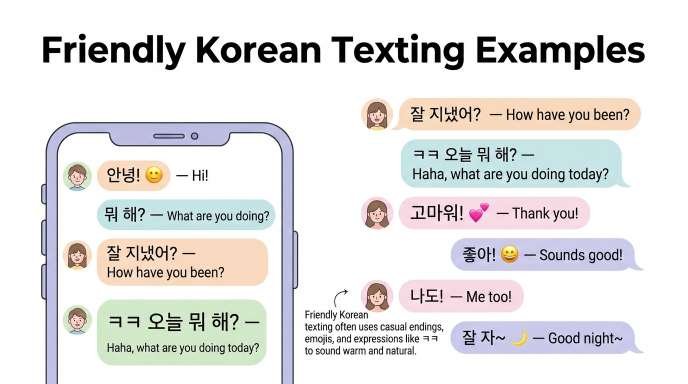
Example 1
A: 오늘 뭐해?
What are you doing today?
B: 집에 있음 ㅋㅋ
I’m at home haha.
Example 2
A: 영화 볼래?
Want to watch a movie?
B: ㅇㅇ ㄱㄱ
Yeah, let’s go.
Example 3
A: 나 먼저 갈게 ㅂㅂ
I’m leaving first. Bye.
B: ㅂㅂ ㅋㅋ
Bye haha.
Example 4
A: 시험 합격했어!
I passed the exam!
B: ㅊㅋㅊㅋ!!
Congrats!!
Korean Texting Slang and Tone
Tone is extremely important.
The same abbreviation can feel different depending on how it is written.
For example:
ㅋㅋ
can feel casual and friendly.
ㅋㅋㅋㅋㅋㅋ
can show stronger laughter.
But:
ㅋ
by itself can sometimes sound dry, dismissive, or sarcastic depending on the situation.
Likewise, ㅎㅎ can feel warm and friendly, but it may sound awkward in a serious conversation.
This is why translating slang word for word does not always give you the real meaning.
When Should You Avoid Korean Texting Slang?
Korean texting slang is mainly for informal communication.
Avoid using it when speaking or writing to:
- Teachers
- Professors
- Employers
- Customers
- Business partners
- Older people you do not know well
- Government officials
- Professional contacts
For example, sending ㄱㅅ to a close friend is normal.
Sending ㄱㅅ to a professor after receiving an important email would be too casual.
Instead, use:
감사합니다.
This is polite and appropriate in formal situations.
Is Korean Texting Slang Rude?
Most Korean texting slang is not automatically rude.
The problem is that informal language can become inappropriate when used with the wrong person.
Korean has strong distinctions between formal and informal speech. Social relationships, age, status, and familiarity can influence which style is appropriate.
Therefore, a slang expression that is perfectly normal among friends may sound disrespectful in a formal setting.
The safest approach for Korean learners is to learn the formal version first and then learn the casual slang version.
Why Do Korean People Use So Many Abbreviations?
There are several reasons.
Faster Communication
Typing a few consonants is faster than typing a full expression.
Casual Tone
Short forms make conversations feel relaxed.
Emotional Expression
Characters such as ㅋㅋ and ㅠㅠ add emotional information.
Online Culture
Internet communities have developed their own vocabulary over time.
Group Identity
Knowing popular slang can help people understand and participate in online communities.
Korean Texting Slang and Korean Culture
Korean digital communication has developed its own style because language and technology interact closely.
Mobile messaging is deeply integrated into everyday communication. As a result, people have developed ways to express laughter, sadness, surprise, agreement, disagreement, and excitement quickly.
For language learners, these expressions can be valuable because they reveal how Korean is actually used outside textbooks.
However, slang should not replace learning standard Korean. It works best as an additional layer of language knowledge.
Korean Texting Slang Comparison
| Expression | Meaning | Formality | Common Context |
| ㅋㅋ | Haha / LOL | Very casual | Friends, social media |
| ㅎㅎ | Hehe | Casual | Friends, texting |
| ㅇㅇ | Yeah | Very casual | Chats |
| ㄴㄴ | Nope | Very casual | Online chats |
| ㄱㄱ | Let’s go | Very casual | Friends, gaming |
| ㅂㅂ | Bye | Very casual | Chats |
| ㄱㅅ | Thanks | Very casual | Online communities |
| ㅈㅅ | Sorry | Very casual | Texting, gaming |
| ㅊㅋ | Congrats | Casual | Social media, chats |
| ㅠㅠ | Sad / crying | Casual | Texting |
| ㅜㅜ | Sad / crying | Casual | Texting |
| ㅇㅋ | Okay | Casual | Texting |
| ㄹㅇ | For real | Casual | Social media |
How to Learn Korean Texting Slang
If you are learning Korean, do not try to memorize every abbreviation at once.
Start with the most common expressions:
ㅋㅋ, ㅎㅎ, ㅇㅇ, ㄴㄴ, ㄱㄱ, ㅂㅂ, ㅠㅠ, ㅜㅜ
Then learn how they appear in complete sentences.
For example:
진짜 웃겨 ㅋㅋ
Really funny haha.
Then compare it with:
진짜 웃겨 ㅋㅋㅋㅋ
That’s really hilarious.
This helps you understand not only vocabulary but also tone.
Watching Korean content can also help. Pay attention to subtitles, comments, and casual conversations, and notice which expressions appear repeatedly.
Tips for Using Korean Texting Slang Correctly
Learn the Formal Version First
Knowing the standard Korean phrase helps you understand where the abbreviation comes from.
Pay Attention to Age and Relationship
Do not assume a slang style is appropriate for everyone.
Watch the Context
The same expression can sound friendly, funny, or sarcastic depending on the conversation.
Do Not Overuse Slang
Using too many abbreviations can make your Korean look unnatural if you are still learning.
Read Before You Use
Understanding how native speakers use an expression is better than translating it directly from a dictionary.
Is Korean Texting Slang Safe for Social Media?
Most common Korean texting slang is harmless and widely used in casual online communication.
However, Korean internet culture also contains offensive expressions, insults, and community specific language. Not every slang term you see online is appropriate to repeat.
Before using unfamiliar slang, find out:
- What does it mean?
- Who normally uses it?
- Is it polite?
- Is it joking or insulting?
- Is it suitable for the platform?
- Could it offend someone?
This is especially important when communicating with native speakers because a literal translation may hide the real tone.
Korean Texting Slang vs. English Texting Slang
Korean and English both use shortcuts, but they use different systems.
English texting often uses abbreviations such as:
- LOL
- OMG
- IDK
- BTW
- BRB
- TBH
Korean texting often uses:
- ㅋㅋ
- ㅎㅎ
- ㅇㅇ
- ㄴㄴ
- ㄱㄱ
- ㅂㅂ
- ㅠㅠ
- ㄱㅅ
The biggest difference is that Korean online communication can use individual Korean consonants as shorthand.
That makes Korean texting slang especially interesting for learners who are used to alphabet based English abbreviations.
FAQs About Korean Texting Slang
What is the most common Korean texting slang?
Expressions such as ㅋㅋ, ㅎㅎ, ㅇㅇ, ㄴㄴ, and ㄱㄱ are widely recognized in casual Korean online communication.
What does ㅋㅋ mean in Korean texting?
ㅋㅋ is used to express laughter. Depending on context, it can mean “haha,” “lol,” or simply show that something is funny.
What does ㅎㅎ mean in Korean?
ㅎㅎ is a soft laughter expression. It can be similar to “hehe” and often creates a friendly or gentle tone.
What does ㅇㅇ mean in Korean texting?
ㅇㅇ is a casual way to say “yeah,” “yes,” or “yep.” It is generally used in informal conversations.
What does ㄱㄱ mean in Korean?
ㄱㄱ means “go,” “let’s go,” or “let’s do it.” It is commonly used in casual chats and gaming conversations.
What does ㅠㅠ mean in Korean texting?
ㅠㅠ represents crying or tears. People use it to express sadness, disappointment, frustration, or sometimes playful exaggeration.
Is Korean texting slang appropriate for formal situations?
Usually, no. Korean texting slang is mainly used with friends and in informal online settings. Formal situations call for standard polite Korean.
Why do Korean people use consonants in text messages?
Using initial consonants can make messages much faster to type. These abbreviations also create a casual online style that is widely understood in Korean digital communication.
Final Thoughts
Korean texting slang gives you a useful look at how Korean is used in everyday digital communication. Expressions such as ㅋㅋ, ㅎㅎ, ㅇㅇ, ㄴㄴ, ㄱㄱ, ㅂㅂ, and ㅠㅠ can make messages shorter while also adding emotion and personality.
The most important thing is to understand the difference between casual and formal Korean. A short expression may be perfectly natural between friends but inappropriate when speaking to a teacher, employer, customer, or someone older whom you do not know well.
If you are learning Korean, start with a few common expressions and learn them through real examples. Pay attention to the tone, the relationship between the speakers, and the platform where the expression appears.
Once you understand these patterns, Korean online conversations become much easier to follow. Instead of trying to translate every abbreviation literally, you can recognize the emotion and intention behind the message.
The best way to use Korean slang is simple: learn the standard Korean expression first, understand the context, and then use the informal version when the situation is appropriate.
Read More About!
- Flamer Slang: Meaning, Uses, Examples & Context
- TLS Meaning Slang: What Does TLS Mean in Text?
- Boston Slang Terms: 25 Boston Words & Phrases

Hi, I’m Chloe Parker. I write simple and practical articles about slang, grammar, spelling, vocabulary, and commonly confused words. My goal is to make English easier to understand through clear explanations and real-life examples. Whether you’re a student, writer, or English learner, I’m here to help you build confidence and improve your everyday English.