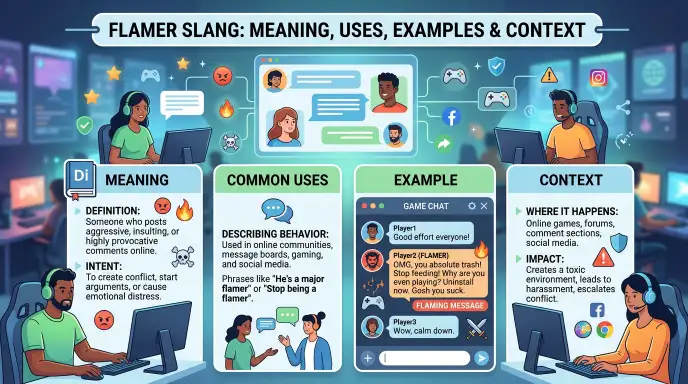
Flamer slang can have two very different meanings. In online communities, a flamer is someone who posts angry, insulting, or provocative comments to start arguments. In another, older slang use, flamer has been used as a derogatory term for a flamboyant or effeminate gay man. The second meaning can be offensive, so context matters.
If you saw flamer in a comment, forum, game chat, or social media post, the online meaning may be the one intended. If you saw it in a discussion about LGBTQ+ history or older slang, it may have the other meaning.
This guide explains flamer slang in simple English, including its meanings, history, tone, examples, and when you should avoid using it. It also explains the difference between a flamer, a troll, and someone who simply disagrees with you.
Quick Answer
Flamer slang usually refers to a person who posts angry, insulting, or provocative messages online to start or intensify an argument.
In older slang, flamer can also refer to an openly flamboyant or effeminate gay man, but this use is often derogatory and should generally be avoided unless discussing its historical or reclaimed use.
The meaning depends on the setting:
| Context | Meaning | Tone |
| Online forums | Someone who attacks or insults others | Negative |
| Gaming chat | Someone who starts angry arguments | Negative |
| Social media | Someone posting inflammatory comments | Negative |
| LGBTQ+ historical context | A derogatory term for a flamboyant gay man | Offensive in many contexts |
| Reclaimed LGBTQ+ use | A self description used by some queer people | Context dependent |
So, if someone says “Stop being a flamer” during an online argument, they are probably criticizing the person’s hostile behavior.
What Does Flamer Slang Mean?
The most common slang meaning today is connected to flaming.
In internet language, flaming means sending or posting angry, insulting, or hostile comments. A flamer is the person doing it.
For example:
“Every time someone disagrees with him, he becomes a flamer.”
Here, the speaker is not talking about fire. They mean that the person responds with insults or aggressive comments.
A flamer may:
- insult other users
- attack someone’s opinion
- post angry replies
- provoke arguments
- use harsh language
- turn a normal discussion into a fight
- keep an argument going after others want to stop
The important point is intent and behavior. A person who politely disagrees with you is not automatically a flamer.
A disagreement becomes more like flaming when the person uses personal attacks, hostile language, or provocative comments instead of having a normal discussion.
Does Flamer Have a Full Form?
No. Flamer is not an abbreviation, so it does not have a traditional full form.
The online meaning comes from the verb flame, with the suffix er, meaning a person who performs an action. In simple terms:
flame + er = flamer
The word flaming became associated with aggressive communication on computer networks in the 1980s. A person who repeatedly engaged in that behavior could therefore be called a flamer.So if you search for “flamer full form,” there is no standard expansion like there is for terms such as LOL or BRB.
Different Meanings of Flamer
Because flamer has more than one meaning, it is important not to treat every use as the same.
1. Flamer as an Online Argument Starter
This is the meaning most relevant to internet slang.
A flamer is someone who posts hostile, insulting, or inflammatory messages online.
You might see the word in:
- online forums
- gaming communities
- comment sections
- group chats
- social media discussions
- older internet communities
- message boards
Example:
“Ignore him. He’s just a flamer looking for a reaction.”
The speaker means that the person is trying to provoke other users.
This use is negative, but it is not normally a serious slur. It describes someone’s online behavior.
2. Flamer as an Offensive LGBTQ+ Slang Term
There is also an older slang meaning.
Historically, flamer has been used as a derogatory term for a gay man who was seen as very flamboyant or effeminate. LGBTQ+ language resources classify this use as problematic or derogatory, although some queer people have reclaimed the word and may use it about themselves.
This meaning is much more sensitive than the internet meaning.
If someone uses flamer to insult a gay person, it can be offensive. You should not assume that the term is acceptable simply because you have seen some LGBTQ+ people use it positively.
Context matters.
For example:
“The article discusses the history of the word flamer.”
This is a historical discussion.
But:
“He’s such a flamer.”
directed at a gay person can be insulting.
For general conversation, it is safer to avoid this meaning.
Where Is Flamer Slang Commonly Used?
The online meaning is most strongly connected with arguments on the internet.
Online Forums
Older forums and message boards used terms such as flaming, flame war, and flamer to describe heated online disputes.
A flamer might repeatedly post angry replies until a discussion becomes a personal fight.
Gaming
In gaming, a flamer may insult teammates, opponents, or other players.
For example:
“Don’t listen to that flamer. He’s blaming everyone for the loss.”
Gaming communities also use words such as toxic, troll, and griefer. These terms overlap, but they do not mean exactly the same thing.
Social Media
The word can also describe someone who repeatedly leaves hostile comments.
For example:
“That account is full of flamers arguing under every post.”
However, flamer is less common in everyday social media speech than words such as troll, hater, or toxic commenter.
Discord and Group Chats
In a Discord server or group chat, a flamer may keep provoking other members.
For example:
“The mods removed him because he kept flaming people.”
The related verb flaming is often more natural than the noun flamer.
Flamer vs. Troll: Are They the Same?
No. A flamer and a troll can behave in similar ways, but their main goals can differ.
| Term | Basic meaning | Typical behavior |
| Flamer | Someone who attacks or insults others online | Starts or intensifies arguments |
| Troll | Someone who deliberately provokes people | Tries to get reactions |
| Hater | Someone who strongly dislikes or attacks someone | Posts negative comments |
| Toxic player | A player who behaves badly in a gaming community | Insults, blames, or harasses others |
| Griefer | Someone who deliberately ruins an online game or experience | Disrupts gameplay |
A troll may post something ridiculous just to make people angry.
A flamer is more closely associated with angry or insulting communication.
Still, one person can fit more than one label.
Is Flamer Slang Rude or Offensive?
For the online meaning, flamer is usually rude or negative, but not normally a severe slur.
It is used to criticize someone’s behavior.
For example:
“You’re being a flamer.”
That is an insult, even if it is not a highly offensive word.
The LGBTQ+ meaning is different. When flamer is used as a derogatory label for a gay man, it can be offensive. Some LGBTQ+ people have reclaimed the term, but that does not make it universally acceptable.
A good rule is:
If you are talking about online arguments, use “flamer” carefully. If you are talking about someone’s sexual orientation or gender expression, avoid the term unless you are specifically discussing its history or a person’s own chosen self description.
Real Life Flamer Slang Examples
Here are natural examples of the online meaning.
Example 1: Online Forum
Person A: “Why is everyone arguing about this post?”
Person B: “A flamer joined the discussion and started insulting people.”
Example 2: Gaming
Player A: “We lost the match.”
Player B: “Yeah, but that flamer kept blaming the whole team.”
Example 3: Social Media
Person A: “Did you read the comments?”
Person B: “Yes. There are a few flamers fighting under the video.”
Example 4: Discord
Moderator: “Please stop flaming other members.”
This example uses flaming rather than flamer. It means attacking people with hostile or insulting messages.
Example 5: Texting
Friend A: “Why did you leave the group chat?”
Friend B: “It turned into a fight. I didn’t want to deal with the flamers.”
Example 6: Normal Disagreement
Person A: “I don’t agree with your opinion.”
Person B: “That’s fine. We can disagree.”
This person is not necessarily a flamer. A calm disagreement is different from hostile personal attacks.
Flamer Slang in Different Online Platforms
The meaning stays similar, but the word may feel more natural in some places than others.
| Platform or setting | How it may be used |
| Forums | Common in discussions about heated arguments |
| Gaming | Used for players who insult or blame others |
| Discord | Can describe aggressive members |
| May describe users who attack others in debates | |
| TikTok | Less common than “troll” or “hater” |
| Less common in casual comments | |
| Snapchat | Not a major common use |
| Workplace chat | Usually best avoided |
The word has roots in older internet culture, so it may sound more natural to people familiar with forums and early online communities than to people who mainly use newer social platforms.
Origin and History of Flamer
The word flamer comes from flame plus the ending er.
The basic word flame is much older than the internet. English has used the word for fire and burning for centuries. The figurative sense of someone or something being highly conspicuous is also old. The internet meaning developed later.
According to etymological research, the sense of flame meaning to unleash angry or insulting criticism on a computer network dates to the 1980s. This led to related terms such as flaming, flame war, and flamer.
A flame war is a long or intense online argument in which participants trade hostile messages.
The word therefore belongs to the history of early online communication, especially forums, message boards, and computer networks.
The Older LGBTQ+ Meaning
The LGBTQ+ use has a separate history.
Etymological sources record flamer as homosexual slang from the 1970s, describing a conspicuously homosexual or flamboyant man.
This history is important because the two meanings are related to the same English word but developed in different social settings.
Do not assume that the online meaning came directly from the LGBTQ+ meaning, or vice versa. The histories should be kept separate.
Is Flamer Still Common Today?
The online meaning is understandable, but it is not one of the most common modern slang terms.
Words such as troll, toxic, hater, rage baiter, and keyboard warrior may be more familiar to many current internet users.
Still, flaming remains a useful term when discussing online arguments, especially in gaming, forums, moderation, and internet culture.
The noun flamer can sometimes sound a little old fashioned because it is strongly connected to older online communities.
So if someone uses it today, the meaning is usually clear from context, but the word may feel less current than some newer terms.
When Should You Avoid Using Flamer?
There are two important situations where you should be careful.
Avoid Using It as a Label for a Gay Person
Do not use flamer to describe a gay person simply because you think they look, speak, dress, or behave in a flamboyant way.
That use has a derogatory history and may be deeply offensive.
If you are discussing LGBTQ+ history, you can explain the word without using it as a personal insult.
Avoid It in Professional Communication
Even when you mean the online definition, flamer is informal and negative.
Avoid writing:
“That customer is a flamer.”
in a professional report.
A clearer alternative would be:
“The customer posted several hostile comments.”
This explains the behavior without relying on slang.
Avoid Calling Someone a Flamer During a Serious Argument
If you are already in a heated conversation, calling someone a flamer may make the argument worse.
Instead, describe the behavior:
“Let’s keep the discussion respectful.”
That response is usually more useful than adding another insult.
Polite Alternatives to Flamer
If you mean the online behavior, several neutral phrases can work better.
Instead of flamer, you can say:
- hostile commenter
- aggressive commenter
- provocative user
- argumentative user
- someone who starts online fights
- someone posting insulting comments
- toxic commenter, when appropriate
The best choice depends on what the person actually did.
For example, if someone deliberately tries to make people angry, provocative user may fit.
If someone is simply insulting people, hostile commenter is clearer.
Why Do People Use the Word Flamer?
People use flamer because it gives a short label to a certain type of online behavior.
Instead of saying:
“That person keeps posting angry comments and trying to start arguments.”
someone can simply say:
“He’s a flamer.”
The term can also be useful when discussing internet culture.
Moderators, gamers, forum users, and writers about online communities may use terms such as flaming and flame war because they describe a recognizable type of online conflict.
However, labeling someone does not prove their intentions. A person may write an angry comment once without being a habitual flamer.
Context and repeated behavior matter.
Common Misunderstandings About Flamer
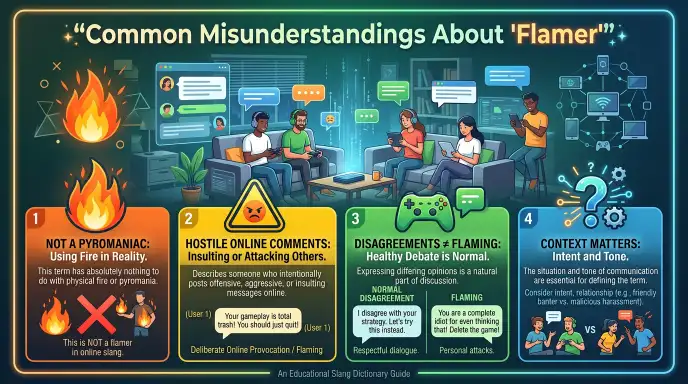
“Flamer always means someone who is gay.”
No.
In online communities, flamer commonly refers to someone who posts hostile or insulting messages.
There is also an older LGBTQ+ slang meaning, but the two meanings should not be confused.
“Anyone who disagrees with me is a flamer.”
No.
Disagreement is not the same as flaming.
Someone can strongly disagree with you while remaining polite.
“Flamer is just another word for troll.”
Not exactly.
The two can overlap, but flaming focuses more on angry, insulting, or hostile communication. Trolling focuses more on deliberately provoking a reaction.
“The LGBTQ+ meaning is always acceptable because some people reclaimed it.”
No.
Some queer people have reclaimed the term, but a reclaimed use does not make it safe for everyone to use. When used by outsiders as a label, it can still be offensive.
“Flamer is a new TikTok word.”
No.
The internet meaning is much older. The term is connected to the history of online flaming, with the relevant computer network sense of flame dating to the 1980s.
Frequently Asked Questions About Flamer Slang
What does flamer mean in texting?
In texting, flamer can describe someone who sends angry, insulting, or provocative messages, especially when they are trying to start an argument.
What does flamer mean on the internet?
On the internet, a flamer is someone who posts hostile or insulting comments to attack others or intensify an argument. This meaning is associated with flaming and flame wars.
Is flamer a bad word?
It depends on the meaning. The online meaning is a negative label for aggressive behavior. The older LGBTQ+ meaning can be derogatory and offensive, so it should be avoided when referring to someone’s sexual orientation.
Is flamer a swear word?
No. Flamer is not normally classified as a swear word. However, it can be insulting, and one of its historical meanings is offensive.
What is a flame war?
A flame war is a heated online argument in which people exchange angry, insulting, or hostile messages.
Is a flamer the same as a troll?
Not exactly. A troll usually tries to provoke a reaction, while a flamer is more specifically associated with hostile or insulting online arguments. A person can be both.
Can I use flamer at work?
It is better to avoid it in workplace communication. Use clear phrases such as hostile commenter, aggressive participant, or someone posting inappropriate comments instead.
Does flamer have a full form?
No. It is a word formed from flame + er, not an abbreviation.
Is the LGBTQ+ meaning of flamer offensive?
It can be. The term has a history as a derogatory label for flamboyant or effeminate gay men. Some LGBTQ+ people have reclaimed it, but that use is personal and context dependent.
Is flamer still used today?
Yes, but the online noun flamer is less common than related terms such as troll, toxic commenter, or hater in many modern online spaces. The related word flaming remains useful when describing hostile online arguments.
Flamer Slang: Quick Usage Guide
If you want a simple way to understand the word, remember these points:
- Flamer = an aggressive or insulting online commenter.
- Flaming = posting hostile or insulting messages.
- Flame war = a heated online argument.
- Troll = someone who deliberately provokes reactions.
- Flamer can also have an older LGBTQ+ meaning.
- The LGBTQ+ meaning can be offensive.
- Context determines which meaning is intended.
- The online meaning is informal and usually negative.
- It is not a good choice for professional writing.
The safest approach is to look at the surrounding conversation before deciding what flamer means.
Conclusion
Flamer slang has two distinct meanings, so context is essential. In online communication, a flamer is generally someone who posts angry, insulting, or provocative messages to start or intensify an argument.
The term is connected to flaming and flame wars, which became part of internet culture in the early days of computer networks.
There is also an older slang meaning for flamer that refers to a flamboyant or effeminate gay man.
That use has a derogatory history, although some LGBTQ+ people have reclaimed the word for themselves. Because of this, using it to describe another person can be offensive.
For everyday internet use, the easiest meaning to remember is “someone who starts or fuels online arguments with hostile comments.” If you need a neutral or professional term, choose hostile commenter, aggressive user, or provocative commenter instead.
Final takeaway: if you see flamer in a gaming chat, forum, or online argument, it probably refers to an aggressive commenter.
If the conversation is about LGBTQ+ people, check the context carefully because the word can carry a very different and potentially offensive meaning.
Discover More Slang!
- Iowa Slang Meaning: What Does Iowa Slang Mean?
- What’s Up Spanish Slang: Meanings & Examples
- Slang OP: Meaning, Uses, Examples & Context

Hi, I’m Chloe Parker. I write simple and practical articles about slang, grammar, spelling, vocabulary, and commonly confused words. My goal is to make English easier to understand through clear explanations and real-life examples. Whether you’re a student, writer, or English learner, I’m here to help you build confidence and improve your everyday English.