Iowa slang refers to the informal words, phrases, expressions, and local sayings used by people in Iowa, a Midwestern state known for its friendly communities, farming culture, small towns, and strong regional identity. If you have heard someone from Iowa use an unusual phrase, you may have wondered what it means or if it is common across the United States.
Iowa does not have one single slang vocabulary. The words people use can vary by age, city, rural community, family, and social group.
Some expressions are strongly connected to the wider Midwest, while others reflect Iowa’s farming traditions and local culture.
You may hear these terms in everyday conversations, online posts, social media, texting, or casual conversations with friends.
Quick Answer
Iowa slang means informal words and expressions commonly associated with people and culture in Iowa. Many Iowa expressions overlap with general Midwestern slang, but some have strong local or cultural connections.
What Does Iowa Slang Mean?
Iowa slang is not one specific word. It is a broad term for the casual language associated with Iowa.
People in Iowa generally speak American English, but regional vocabulary can make everyday speech sound different from English used in other parts of the country.
For example, someone in Iowa might use a Midwestern expression that sounds completely normal locally but unfamiliar to someone from California, New York, or another country.
Iowa slang can include:
- Rural expressions
- Farm related vocabulary
- Midwestern sayings
- Local nicknames
- Friendly expressions
- Food related terms
- Weather expressions
- Small town phrases
- Informal pronunciations
- Words shared with neighboring states
Not every expression listed as “Iowa slang” is exclusive to Iowa. This distinction matters because many Midwestern expressions cross state borders.
Popular Iowa Slang Words and Phrases
Here are some words and expressions you may hear in Iowa or the wider Midwest.
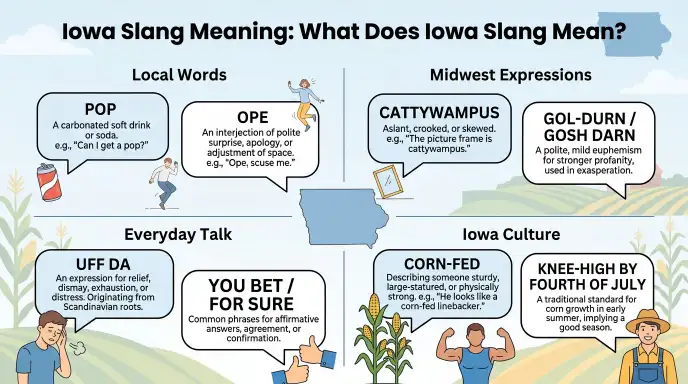
1. Pop
Pop is a common Midwestern word for a carbonated soft drink.
Someone might say:
“Do you want a pop?”
Instead of:
“Do you want a soda?”
The word is not exclusive to Iowa, but it is common throughout parts of the Midwest.
2. You Guys
You guys is a casual way to address a group of people.
For example:
“Are you guys coming over tonight?”
It can be used regardless of the gender of the people being addressed.
Although this expression is used throughout the United States, it is very common in everyday Midwestern conversation.
3. Ope
Ope is one of the expressions strongly associated with Midwestern speech.
It is often used when someone suddenly notices something, makes a small mistake, or needs to move around another person.
For example:
“Ope, sorry! Didn’t see you there.”
You might hear it when someone drops something, bumps into someone lightly, or reaches for an object.
The expression is usually harmless and humorous.
4. You Bet
You bet can mean “you’re welcome,” “definitely,” or “sure.”
Example:
“Thanks for helping me.”
“You bet!”
It can also show agreement:
“Are you coming with us?”
“You bet.”
This expression fits naturally into friendly Midwestern conversation.
5. No Problem
No problem is often used instead of “you’re welcome.”
Example:
“Thanks for bringing that over.”
“No problem.”
Although this is not uniquely Iowa slang, it fits the friendly conversational style associated with the region.
6. Hotdish
Hotdish refers to a baked casserole style meal and is especially associated with the Upper Midwest.
The term is more strongly connected with states such as Minnesota and North Dakota, but it can be understood in Iowa and other Midwestern communities.
Example:
“We’re having hotdish for dinner.”
Depending on the family and region, people may simply call the same type of meal a casserole.
7. Casserole
In Iowa, casserole is a very familiar word because baked one dish meals are common in Midwestern home cooking.
Examples include:
- Chicken casserole
- Tater tot casserole
- Green bean casserole
- Hamburger casserole
The word itself is not slang, but it is closely connected to Midwestern food culture.
Iowa Slang and Farming Culture
Agriculture is an important part of Iowa’s identity, so some everyday vocabulary is connected to farming and rural life.
Iowa is widely known for corn, soybeans, livestock, and farming communities. This cultural background influences conversations, especially outside larger cities.
You may hear casual terms related to:
- Cornfields
- Barns
- Harvest
- Tractors
- County fairs
- Livestock
- Farm work
- Rural roads
- Small towns
However, farming vocabulary should not automatically be labeled slang. A word such as tractor is standard English, even though it may appear frequently in Iowa conversations.
The difference is important: regional vocabulary is not always slang.
Iowa Slang vs. Midwest Slang
One of the biggest misunderstandings about Iowa slang is assuming that every Midwestern expression originated in Iowa.
Iowa shares borders with:
- Minnesota
- Wisconsin
- Illinois
- Missouri
- Nebraska
- South Dakota
People across these states often share similar speech patterns and expressions.
For this reason, many phrases associated with Iowa are better described as Midwestern slang rather than slang exclusive to Iowa.
| Expression | Associated With | Meaning |
| Ope | Midwest | Small reaction to an unexpected situation |
| Pop | Midwest | Soft drink |
| You bet | Midwest and beyond | Sure, definitely, or you’re welcome |
| You guys | American English | Informal way to address a group |
| Hotdish | Upper Midwest | Casserole style meal |
| No problem | American English | You’re welcome / that’s okay |
This overlap makes Iowa slang part of a larger regional language pattern.
Is Iowa Slang Rude or Offensive?
Most Iowa slang is neutral, friendly, or humorous.
Expressions such as “ope,” “you bet,” and “pop” are not offensive.
However, any slang expression can become inappropriate depending on how it is used.
Tone matters.
For example:
“Ope, sorry!”
sounds friendly.
But an insulting nickname or stereotype about a person can obviously be offensive even if it is presented as “local slang.”
It is also important not to confuse regional accents, dialects, and slang with negative stereotypes about people from Iowa.
Where Is Iowa Slang Commonly Used?
Iowa expressions can appear in many everyday settings.
Everyday Conversations
Regional expressions are most noticeable when people speak casually with friends, relatives, coworkers, or neighbors.
Texting
People may shorten expressions or write them exactly as they speak.
For example:
“Ope lol, forgot my keys.”
Social Media
Iowa residents may use local expressions in Facebook posts, Instagram captions, TikTok videos, Reddit discussions, and other online communities.
Gaming
Local slang can also appear in Discord servers and gaming chats, although gaming communities often have their own internet slang.
School and College
Students may use a mixture of Iowa expressions, general American slang, and internet language.
The important point is that Iowa slang is not restricted to one platform.
Real Life Iowa Slang Examples
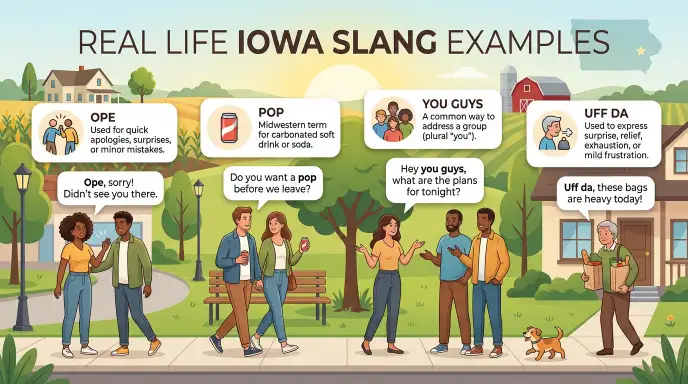
Friendly Example
“Ope, sorry! I’ll move over.”
Here, ope expresses a small reaction and apology.
Casual Example
“Want to grab a pop after work?”
Here, pop means a soft drink.
Agreeing Example
“Can you help me move this?”
“You bet.”
Here, you bet means “sure.”
Rural Example
“The harvest is coming up soon.”
This is not technically slang, but it reflects vocabulary commonly heard in agricultural communities.
Social Media Example
“Ope, Iowa weather changed again 😂”
This uses “ope” in a humorous online context.
Friendly Response
“Thanks for picking me up!”
“You bet!”
The phrase creates a casual, friendly tone.
Iowa Slang in Texting
Modern Iowa speech is influenced by the same internet culture that affects language across the United States.
A person from Iowa might use traditional Midwestern expressions while also using common internet slang such as:
- LOL
- OMG
- BTW
- TBH
- FR
- NGL
- IDK
- BRB
This means Iowa slang and internet slang can appear together.
For example:
“Ope 😂 I forgot to send that lol.”
The word ope provides a regional flavor, while lol is general internet slang.
Regional language and online language often mix naturally.
Iowa Slang on TikTok and Social Media
TikTok and other social platforms have made regional expressions easier to share.
A person may post a video about growing up in Iowa and use expressions associated with Midwestern culture. Viewers from other states may then ask what a particular word means.
This is one reason regional slang can become more visible online.
However, seeing a word in an Iowa themed TikTok does not prove that everyone in Iowa uses it. Social media often exaggerates regional differences for humor or entertainment.
The safest approach is to treat these expressions as associated with Iowa or the Midwest, rather than claiming they are used by every resident.
Why Does Iowa Have Its Own Slang?
Regional slang develops naturally over time.
Several factors influence Iowa’s vocabulary.
Geography
Iowa sits in the center of the United States and shares cultural connections with many neighboring Midwestern states.
Agriculture
Farming has played a major role in Iowa’s history and economy.
Community
Small towns and close communities can preserve local expressions for generations.
Migration
People move between states, bringing words and phrases with them.
Media
Television, music, movies, social media, and online communities continually introduce new expressions.
Because of these influences, Iowa speech is always changing.
Iowa Slang and the Midwest Accent
Slang and accent are different things.
Slang refers to informal words and expressions.
Accent refers to how words are pronounced.
Dialect is broader and can include pronunciation, grammar, and vocabulary.
Someone can have a Midwestern accent without using much slang. Likewise, someone can use Iowa slang while having an accent that sounds similar to speakers from another state.
Understanding this difference helps explain why there is no single “Iowa language.”
Common Misunderstandings About Iowa Slang
Myth 1: Every Iowa expression is unique to Iowa
Not true.
Many expressions associated with Iowa are also used elsewhere in the Midwest.
Myth 2: All Iowans talk the same way
No.
Speech can differ between rural communities, cities, age groups, and individuals.
Myth 3: Regional slang never changes
It does.
Young people often combine traditional regional expressions with internet slang.
Myth 4: Slang and dialect mean the same thing
They do not.
Slang is only one part of informal language.
Myth 5: You can identify every Iowan by their slang
Not reliably.
People’s speech is influenced by many factors, including where they grew up and the communities they interact with.
Iowa Slang Compared With Other Regional Slang
| Region | Example Expression | General Meaning |
| Iowa / Midwest | Ope | Small reaction or apology |
| Midwest | Pop | Soft drink |
| Southern U.S. | Y’all | You all |
| Northeast | Wicked | Very / extremely |
| West Coast | Hella | Very / a lot |
| Pittsburgh | Yinz | You all |
| Minnesota / Upper Midwest | Uff da | Expression of surprise, exhaustion, or frustration |
These expressions demonstrate how American English changes from region to region.
Some terms are strongly associated with one area, while others spread across several states.
When Should You Avoid Iowa Slang?
There is usually no problem with using harmless regional expressions, but context still matters.
Avoid unfamiliar slang when:
- Writing a formal business email
- Preparing an academic paper
- Speaking in a professional presentation
- Communicating with someone who may not understand it
- Explaining something that requires precise language
For example, instead of relying on a regional phrase in a formal document, use standard English.
Casual:
“You bet!”
Formal:
“Certainly.”
Both can communicate agreement, but the second fits a more formal setting.
Why Do People Like Regional Slang?
Regional slang can create a sense of identity.
When people share an expression, it can remind them of:
- Home
- Family
- Childhood
- Local traditions
- Friends
- Community
- Regional culture
Words can carry cultural meaning beyond their dictionary definitions.
For someone who grew up in Iowa, hearing a familiar Midwestern expression may immediately feel comfortable or familiar.
For someone from outside the region, the same expression may sound unusual or amusing.
That difference is part of what makes regional language interesting.
Is Iowa Slang Safe for Social Media?
Most Iowa slang is safe for social media because it consists of ordinary regional expressions.
Words such as ope, pop, and you bet are generally harmless.
Still, context is important. Some phrases may be used differently by different communities, and not every expression labeled “Iowa slang” is universally accepted or commonly used throughout the state.
If you are creating content for a broad audience, explain unfamiliar expressions rather than assuming everyone knows them.
How to Sound More Natural When Using Iowa Slang
If you want to use Iowa or Midwestern expressions naturally, moderation is best.
Do not put several regional expressions into every sentence.
Instead, use them where they fit naturally.
For example:
“Ope, I almost forgot my coffee.”
sounds more natural than forcing several regional terms into one sentence.
The goal is to communicate naturally, not to imitate a stereotype.
Iowa Slang: Quick Reference Table
| Word or Phrase | Meaning | Tone |
| Ope | Small reaction to something unexpected | Friendly |
| Pop | Soft drink | Casual |
| You bet | Sure / definitely / you’re welcome | Friendly |
| You guys | Informal group address | Casual |
| Hotdish | Casserole style dish | Regional |
| No problem | You’re welcome / that’s okay | Casual |
| Casserole | Baked one dish meal | Everyday |
Remember that these terms are not necessarily exclusive to Iowa.
FAQs About Iowa Slang
What is Iowa slang?
Iowa slang refers to informal expressions, words, and sayings associated with Iowa and its Midwestern culture.
What is a famous Iowa slang word?
“Ope” is commonly associated with Midwestern speech, including Iowa. It is often used when someone has a small unexpected moment, such as accidentally bumping into someone.
Do people in Iowa say “pop” instead of “soda”?
Many Midwestern speakers use pop for a carbonated soft drink. Usage varies by person and region, so it is not universal.
Is Iowa slang the same as Midwest slang?
Not exactly. Iowa is part of the Midwest, so many Iowa expressions overlap with slang used in neighboring Midwestern states.
Is Iowa slang offensive?
Most common Iowa and Midwestern expressions are neutral or friendly. However, any word should be considered in context before using it.
Do young people in Iowa still use regional slang?
Yes, but usage varies. Younger Iowans may combine regional expressions with national internet slang from platforms such as TikTok, Instagram, Discord, and texting.
Conclusion
Iowa slang is best understood as a mixture of regional expressions, Midwestern vocabulary, rural language, and everyday informal speech. Iowa does not have a completely separate slang system, and many expressions associated with the state are also heard across the wider Midwest.
Words such as “ope,” “pop,” and “you bet” are useful examples of expressions that can sound distinctly Midwestern, although none should automatically be treated as exclusive to every person in Iowa. Regional language changes over time, and social media has also mixed local expressions with modern internet slang.
The most important thing is context. A phrase that sounds natural between friends may not belong in a formal email or academic paper. Likewise, an expression seen in an Iowa themed social media post may not represent how every Iowan speaks.
If you are learning Iowa slang, focus on understanding the meaning, tone, and regional background rather than trying to force the expressions into your own speech. That approach will help you use regional language naturally and respectfully.
Read More About!
- Helicopter Slang: Meaning, Uses & Examples
- WPS Slang Meaning: Definition, Uses, and Examples
- TLS Meaning Slang: What Does TLS Mean in Text?

Hi, I’m Chloe Parker. I write simple and practical articles about slang, grammar, spelling, vocabulary, and commonly confused words. My goal is to make English easier to understand through clear explanations and real-life examples. Whether you’re a student, writer, or English learner, I’m here to help you build confidence and improve your everyday English.