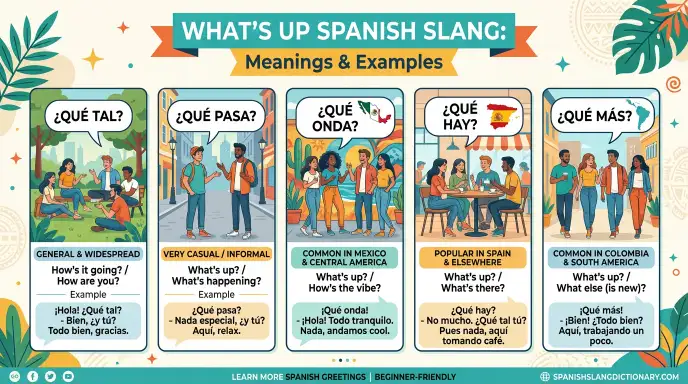
What’s up Spanish slang usually refers to casual Spanish phrases used to say “What’s up?”, “How are you?”, or “What’s going on?” Common choices include ¿Qué onda?, ¿Qué tal?, ¿Qué pasa?, and ¿Qué hay? The best phrase depends on the Spanish speaking country and the level of informality.
If you searched for what’s up Spanish slang, you may have noticed that there is no single Spanish phrase that works everywhere. Spanish changes by country, region, age group, and social setting.
A phrase that sounds natural in Mexico may sound less common in Spain or another Latin American country.
This guide explains the most common casual ways to say “what’s up” in Spanish. You will learn what each phrase means, where it is commonly used, how formal or informal it sounds, and how to use it in real conversations. You will also see examples so you can choose a phrase that fits the situation.
Quick Answer
The most common casual Spanish equivalent of “What’s up?” is ¿Qué onda?, especially in Mexico and some other parts of Latin America. Other common choices include ¿Qué tal?, ¿Qué pasa?, ¿Qué hay?, and regional phrases such as ¿Qué más?.
| Spanish phrase | Basic meaning | Tone |
| ¿Qué onda? | What’s up? / What’s going on? | Very casual |
| ¿Qué tal? | How are you? / How’s it going? | Casual to neutral |
| ¿Qué pasa? | What’s happening? / What’s up? | Casual |
| ¿Qué hay? | What’s up? / What’s new? | Casual |
| ¿Qué más? | What’s up? | Regional |
| ¿Qué hubo? | What’s up? / What happened? | Regional and casual |
What Does “What’s Up” Mean in Spanish?
In English, “what’s up?” can have several meanings. It can be a simple greeting, a way to ask how someone is doing, or a question about what is happening.
Spanish uses different expressions for these ideas.
For example:
- ¿Qué tal? can mean “How are you?” or “How’s it going?”
- ¿Qué onda? can mean “What’s up?” in a very casual way.
- ¿Qué pasa? can mean “What’s happening?” or “What’s going on?”
- ¿Qué hay? can work like “What’s new?” or “What’s up?”
So, when translating “what’s up,” you should focus on the meaning and context, not just the individual English words.
¿Qué Onda? :A Popular Spanish Slang Greeting
¿Qué onda? is one of the closest casual equivalents of “What’s up?” It is especially associated with Mexican Spanish.
The word onda literally means “wave,” but in this expression it does not mean a physical wave. The phrase is a casual way to ask what is happening or how things are going.
For example:
A: ¡Hola! ¿Qué onda?
B: Todo bien. ¿Y tú?
English:
A: Hey! What’s up?
B: All good. You?
It is friendly and informal. You might use it with friends, classmates, cousins, or people you know well.
Because it is strongly associated with Mexican and some Latin American usage, it is better not to treat ¿Qué onda? as the universal Spanish phrase for “what’s up.”
¿Qué Tal? :Casual and Widely Useful
¿Qué tal? is another excellent way to greet someone.
It can mean:
- How are you?
- How’s it going?
- How are things?
- What’s up?
Unlike some stronger regional slang expressions, ¿Qué tal? is widely understood across Spanish speaking communities.
For example:
¡Hola! ¿Qué tal?
This can simply mean:
“Hi! How’s it going?”
It is casual but not extremely slangy. That makes it a useful choice when you want to sound natural without using a very regional expression.
¿Qué Pasa? :“What’s Going On?”
¿Qué pasa? literally relates to “What is happening?” or “What is going on?”
It can also be used as a casual greeting.
For example:
¡Hey! ¿Qué pasa?
Depending on the speaker’s tone, this could mean:
“Hey! What’s up?”
But context matters.
If someone says ¿Qué pasa? with a worried or serious tone, they may genuinely be asking what is wrong.
For that reason, it is not always identical to the relaxed English “What’s up?” A friendly tone makes the difference clear.
¿Qué Hay? :A Casual “What’s Up?”
¿Qué hay? can be used as a casual greeting meaning something close to “What’s up?” or “What’s new?”
It is short and informal.
Example:
¡Hola! ¿Qué hay?
A natural English translation could be:
“Hey! What’s up?”
However, this expression is not equally common in every Spanish speaking country. Regional preference matters, so you may hear other greetings more often depending on where you are.
Regional Ways to Say “What’s Up” in Spanish
Spanish is spoken across many countries, so slang and casual greetings vary.
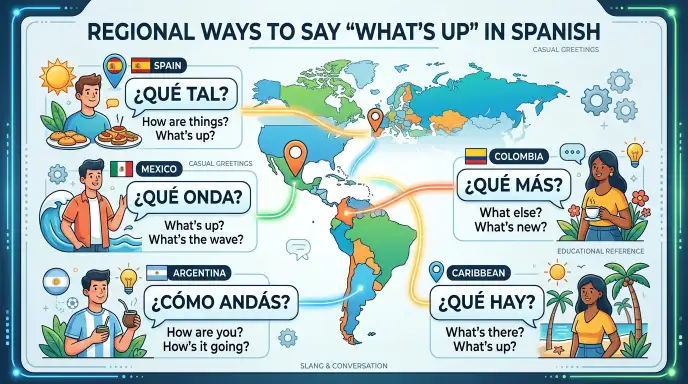
Mexico
Some casual options include:
- ¿Qué onda?
- ¿Qué rollo?
- ¿Qué tranza?
These are informal expressions and are best used with people who are comfortable with casual language.
Colombia
You may hear:
- ¿Qué más?
- ¿Qué hubo?
For example:
¡Hola! ¿Qué más?
This can work much like:
“Hey! What’s up?”
Spain
In Spain, common casual greetings can include:
- ¿Qué tal?
- ¿Qué pasa?
- ¿Qué hay?
- ¿Qué cuentas?
¿Qué cuentas? literally relates to “What are you telling?” but naturally means something like “What’s new?” or “What’s happening with you?”
The key point is that there is no single Spanish slang phrase used by everyone.
Where Is Spanish “What’s Up” Slang Used?
These expressions are mainly used in casual communication.
You may see them in:
- Text messages
- Chats
- Social media
- Conversations with friends
- School conversations
- Informal online communities
- Casual gaming chats
- Family conversations
- Movies and TV shows
The exact phrase can change based on the country.
For example, a Mexican speaker may naturally use ¿Qué onda?, while another Spanish speaker may prefer ¿Qué tal?
This regional difference is one reason direct word for word translations can sound unnatural.
Is “What’s Up” Spanish Slang Rude or Offensive?
Most common Spanish equivalents of “what’s up?” are not rude or offensive. The main issue is formality.
Expressions such as ¿Qué onda? are casual. They are suitable for friends and relaxed conversations, but they may not be the best choice in a formal business setting.
For professional situations, a safer option is:
¿Cómo está?
This means:
“How are you?”
With someone you know well, you could use the informal:
¿Cómo estás?
A simple rule is:
Casual situation → casual greeting.
Formal situation → polite greeting.
Real Life Examples of “What’s Up” in Spanish
Example 1: Texting a Friend
A: ¿Qué onda?
B: Nada, aquí descansando. ¿Y tú?
Meaning:
A: What’s up?
B: Nothing, just relaxing. You?
Example 2: Meeting Someone
¡Hey! ¿Qué tal?
Meaning:
“Hey! How’s it going?”
Example 3: Asking What Happened
¿Qué pasa? ¿Todo bien?
Meaning:
“What’s going on? Everything okay?”
Here, the phrase is more about checking if something is wrong.
Example 4: Casual Colombian Greeting
¡Hola! ¿Qué más?
Meaning:
“Hey! What’s up?”
This is a regional expression, so it should not be treated as the standard greeting in every Spanish speaking country.
Example 5: Asking What’s New
¿Qué cuentas?
Meaning:
“What’s new?” / “What have you been up to?”
This can sound friendly and conversational.
Origin and History
The English expression “what’s up?” developed as an informal way to ask what is happening or how someone is doing. Spanish does not have one direct slang equivalent because Spanish speaking communities developed their own casual greetings.
Expressions such as ¿Qué onda? and ¿Qué más? are examples of regional conversational language rather than a single worldwide Spanish slang system.
It is also important not to claim that one phrase is the “official Spanish translation” of “what’s up.” The natural choice depends on location, relationship, and tone.
When learning Spanish slang, regional context is often more useful than a simple dictionary translation.
Similar Spanish Slang and Casual Greetings
If you want alternatives to ¿Qué onda?, consider these:
| Phrase | Approximate English meaning | Style |
| ¿Qué tal? | How’s it going? | Casual/neutral |
| ¿Qué pasa? | What’s going on? | Casual |
| ¿Qué hay? | What’s up? / What’s new? | Casual |
| ¿Qué más? | What’s up? | Regional |
| ¿Qué hubo? | What’s up? | Regional |
| ¿Qué cuentas? | What’s new? | Casual |
| ¿Cómo estás? | How are you? | Casual/neutral |
When Should You Avoid Spanish Slang?
You do not need to avoid these expressions completely. Just use them in the right setting.
Avoid very regional slang when:
- You are writing a formal email.
- You are speaking to a customer.
- You are in a job interview.
- You are speaking to someone in a formal role.
- You are unsure iff the person understands the regional expression.
For example, ¿Qué onda? may sound friendly with a close friend but too casual in a formal workplace conversation.
When unsure, ¿Qué tal? or ¿Cómo está? can be safer choices depending on the level of formality.
Polite Alternatives to “What’s Up” in Spanish
If you want a more neutral greeting, try:
- ¿Cómo estás? :How are you?
- ¿Cómo está? :How are you? (formal)
- ¿Cómo te va? :How are things going?
- ¿Qué tal? :How’s it going?
- ¿Cómo ha estado? :How have you been?
These phrases are useful when you want to sound friendly without relying heavily on regional slang.
Why Do People Use These Expressions?
People use casual Spanish greetings because they make conversations feel relaxed and natural.
A phrase like ¿Qué onda? can sound warmer and more informal than a formal greeting. Regional expressions can also show familiarity with a particular Spanish speaking culture.
Slang and casual language can also create a sense of belonging. However, using regional slang does not automatically make someone sound like a native speaker. Using the expression in the correct situation matters just as much.
Common Misunderstandings About “What’s Up” in Spanish
1. There is only one translation
There is not. ¿Qué onda?, ¿Qué tal?, and ¿Qué pasa? can all work in different contexts.
2. Every Spanish speaking country uses the same slang
Spanish varies by region. A phrase that is very common in one country may be less common somewhere else.
3. “¿Qué pasa?” always means something is wrong
Not necessarily. It can be a casual greeting, but tone and context can also make it sound like a serious question.
4. Slang is always better than standard Spanish
Not at all. Casual slang works best when the situation is casual. Formal settings usually call for more neutral language.
Frequently Asked Questions
What is the Spanish slang for “what’s up”?
¿Qué onda? is a popular casual way to say “What’s up?”, especially in Mexico. Other options include ¿Qué tal?, ¿Qué pasa?, and regional expressions such as ¿Qué más?
How do Mexicans say “what’s up”?
A common Mexican expression is ¿Qué onda? It is informal and is often used between friends or people who are comfortable with casual conversation.
Is “¿Qué tal?” the same as “what’s up”?
It can be. ¿Qué tal? usually means “How’s it going?” or “How are you?” but it can work naturally as a casual equivalent of “What’s up?”
Is “¿Qué onda?” rude?
No. It is generally friendly and informal. However, it may be too casual for formal or professional situations.
How do you say “what’s up” in Spanish texting?
In texting, you might see ¿Qué onda?, ¿Qué tal?, ¿Qué pasa?, or a regional expression such as ¿Qué más? The best choice depends on the speaker’s country and style.
Can I use “¿Qué onda?” in Spain?
You may be understood, but it is strongly associated with Mexican and some Latin American usage. If you want a broadly understood casual greeting, ¿Qué tal? is often a safer choice.
What is a polite way to say “what’s up” in Spanish?
¿Cómo estás? or ¿Qué tal? are good choices. In formal situations, ¿Cómo está? is more appropriate.
Conclusion
What’s up Spanish slang does not have one universal answer. The phrase you choose depends on the country, relationship, and situation. ¿Qué onda? is a popular informal choice, especially in Mexico, while ¿Qué tal? is a more widely useful casual greeting. ¿Qué pasa?, ¿Qué hay?, ¿Qué más?, and ¿Qué hubo? can also work in the right regional context.
If you are talking with a close friend, regional slang can make your Spanish sound relaxed and natural. If you are speaking with someone you do not know well, ¿Qué tal? is a simple and flexible option.
The most important lesson is to learn the context, not just the translation. Spanish slang changes across countries, so understanding who uses a phrase and where it is common will help you communicate more naturally.
Read More About!
- Tosser Slang: Meaning, Uses, Examples & Origin
- Slang for Family: Meaning, Popular Terms & Examples
- Boston Slang Terms: 25 Boston Words & Phrases

Hi, I’m Chloe Parker. I write simple and practical articles about slang, grammar, spelling, vocabulary, and commonly confused words. My goal is to make English easier to understand through clear explanations and real-life examples. Whether you’re a student, writer, or English learner, I’m here to help you build confidence and improve your everyday English.