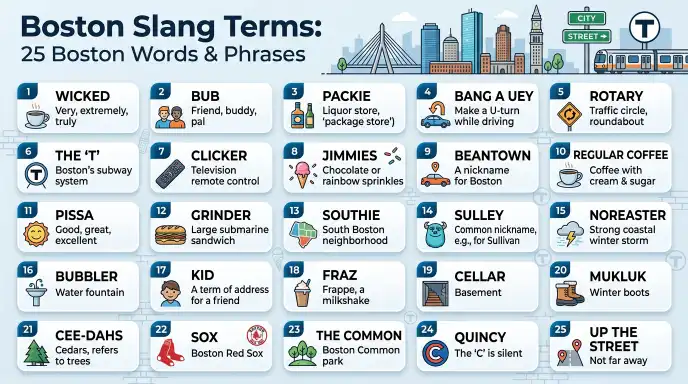
Boston slang terms are local words and phrases used in Boston and the wider Massachusetts/New England area. Some are tied closely to Boston, while others are shared across New England. Common examples include wicked for “very,” packie for a liquor store, the T for Boston’s public transit system, and bang a U ey for making a U turn.
If you are visiting Boston, watching a show set in Massachusetts, or talking with someone from the area, these expressions can be confusing at first.
Boston slang is also closely linked with local pronunciation, but slang and accent are not the same thing.
This guide explains the most useful Boston slang terms, what they mean, where you may hear them, and which ones are best avoided in formal settings.
Quick Answer
Boston slang terms are regional words and expressions used by people in Boston and nearby parts of Massachusetts.
They include everyday terms such as wicked, pissa, packie, bubbler, tonic, the T, Southie, townie, and bang a U ey.
Here are some of the most useful ones:
| Boston term | Meaning |
| Wicked | Very or extremely |
| Pissa/Pissah | Awesome or excellent |
| Packie | Liquor store |
| The T | Boston area public transit |
| Bang a U ey | Make a U turn |
| Tonic | Soda |
| Bubbler | Drinking fountain |
| Frappe | Milkshake |
| Jimmies | Chocolate sprinkles |
| Townie | Local resident |
| Southie | South Boston |
| The Pike | Massachusetts Turnpike |
| The Cape | Cape Cod |
| Rotary | Traffic circle |
| Space saver | Object used to hold a shoveled parking spot |
These meanings are documented in Boston area guides from sources including WBUR and Time Out Boston.
What Does “Boston Slang” Mean?
Boston slang is the informal vocabulary associated with Boston and the surrounding region. It reflects local habits, neighborhoods, food, transportation, sports, and the way people talk about everyday life.
One important point: not every word on a “Boston slang” list is used only in Boston. Some terms are common across Massachusetts or New England. For example, bubbler is also heard elsewhere in New England, while wicked has a particularly strong association with Massachusetts.
Boston speech is also famous for its accent. The accent may change how words sound, such as the familiar pronunciation of “car” without a strong final “r.” But writing slang and copying the accent are two different things.
You do not need to imitate the accent to understand Boston slang.
25 Common Boston Slang Terms
1. Wicked
Meaning: Very or extremely.
This is probably the best known Boston associated slang word. It is commonly used as an intensifier before an adjective.
Example:
“It’s wicked cold today.”
“Wicked” can also appear in phrases such as “wicked good” or “wicked expensive.” WBUR notes that the word is normally used as an adverb in this regional usage.
2. Pissa or Pissah
Meaning: Awesome, excellent, or great.
You may hear pissa or pissah, depending on how the word is represented in writing.
Example:
“That concert was wicked pissa.”
The expression is strongly associated with Boston speech, although some locals use it jokingly or sarcastically.
3. Packie
Meaning: A liquor store.
“Packie” is a shortened form of package store.
Example:
“We’re out of beer. Can you stop at the packie?”
This is common regional vocabulary, but it is not a word you need to use yourself simply to sound local. WBUR specifically notes that its pronunciation can resemble a British slur, so visitors should be careful with it outside its intended local context.
4. The T
Meaning: Boston’s public transportation system.
Example:
“I’ll take the T downtown.”
The T refers to the MBTA, Boston’s public transit system. Locals commonly use “the T” rather than saying the full name.
5. Bang a U ey
Meaning: Make a U turn.
Example:
“Bang a U ey at the next light.”
This is one of the more recognizable Boston expressions. It is informal and often appears in humorous descriptions of Boston driving.
6. Tonic
Meaning: Soda.
In Boston area usage, tonic can mean a soft drink or soda.
Example:
“Do you want a tonic with your lunch?”
The meaning can confuse visitors because “tonic” usually means something different in many other parts of the United States.
7. Bubbler
Meaning: Drinking fountain or water fountain.
Example:
“There’s a bubbler down the hall.”
This is a regional New England term rather than a word that belongs exclusively to Boston.
8. Frappe
Meaning: Milkshake.
In Massachusetts usage, a frappe is generally a milkshake made with ice cream, milk, and flavoring.
Example:
“I’ll have a chocolate frappe.”
This is one reason a visitor may be confused when ordering a drink in Massachusetts.
9. Jimmies
Meaning: Chocolate sprinkles, especially on ice cream.
Example:
“Can I get chocolate jimmies on that?”
The term is common in New England, not just Boston. The history of the word is disputed, so it is better not to repeat unsupported claims about its exact origin.
10. Townie
Meaning: A local person, especially someone strongly connected to the neighborhood or city where they grew up.
Example:
“He’s a lifelong Boston townie.”
The word can be neutral, friendly, or slightly teasing depending on the speaker and context.
11. Southie
Meaning: South Boston.
Example:
“She grew up in Southie.”
Southie is a widely used nickname for the Boston neighborhood of South Boston.
12. The Pike
Meaning: The Massachusetts Turnpike, or Mass Pike.
Example:
“Traffic on the Pike is terrible this morning.”
The Pike is also associated with Interstate 90 across Massachusetts.
13. The Cape
Meaning: Cape Cod.
Example:
“We’re going down the Cape this weekend.”
“Down the Cape” is a familiar Massachusetts expression for traveling toward Cape Cod.
14. Rotary
Meaning: A traffic circle or roundabout.
Example:
“Take the second exit at the rotary.”
Boston area speakers commonly use rotary where many Americans would say “roundabout” or “traffic circle.”
15. Space saver
Meaning: An object placed in a shoveled parking space to claim it after a snowstorm.
Example:
“Someone left a chair there as a space saver.”
This term comes from the practical problem of finding street parking after heavy Boston area snow.
16. Regular
Meaning: A traditional coffee order with cream and sugar.
Example:
“I’ll take a regular.”
The exact coffee order can vary by shop and person, so visitors should not assume that every Boston coffee shop defines “regular” in precisely the same way. Time Out describes the term as a coffee with cream and sugar, especially in the local Dunkin’ context.
17. Statie
Meaning: A state police officer.
Example:
“Watch your speed. There might be a statie ahead.”
The word often appears in conversations about highways and driving.
18. The Pru
Meaning: The Prudential Center or Prudential complex in Boston.
Example:
“Let’s meet near the Pru.”
It is a shortened local name for a major Boston landmark in Back Bay.
19. The Hub
Meaning: Boston.
Example:
“She moved back to the Hub after college.”
“The Hub” has a long history as a nickname for Boston. WBUR traces the phrase to Oliver Wendell Holmes’s 1858 description of Boston as the “hub” of the world.
20. Triple decker
Meaning: A three story residential building, often with one apartment on each floor.
Example:
“They bought a place in a triple decker.”
Triple deckers are an important part of the built environment in several Boston neighborhoods and surrounding communities. WBUR notes that many date to the 19th and early 20th centuries and were built to house immigrant families.
21. Ripper
Meaning: A wild or very large party.
Example:
“That was a ripper of a party.”
The term is less familiar to some locals than famous expressions such as “wicked,” and Boston.com reported that readers were divided about it.
22. Supper
Meaning: The evening meal or third meal of the day in this regional usage.
Example:
“We’re having supper at six.”
This word is not exclusive to Boston, but it appears on lists of regional Boston vocabulary.
23. Clicker
Meaning: TV remote control.
Example:
“Can you pass me the clicker?”
This is another regional word that may be familiar outside Massachusetts but is commonly included in Boston area slang guides.
24. So don’t I
Meaning: “So do I” or “Me too.”
Example:
“I have a dog.”
“So don’t I.”
It sounds unusual to many outsiders, but it is a documented Greater Boston expression.
25. Yah no / Yah huh
Meaning: “No way” / “Yes, definitely.”
These expressions can be used to strongly agree or disagree.
Example:
“Did he really finish the whole pizza?”
“Yah huh.”
Time Out Boston lists yah no as “no chance” and yah huh as “yes way” or “indeed.”
Where Are Boston Slang Terms Used?
Boston slang is most likely to appear in casual conversation, local media, sports talk, neighborhood conversations, and social settings.
You may also see these words online. However, not every Boston term is equally common on every platform.
| Setting | What you may notice |
| Texting | Wicked, pissa, the T, Southie |
| TikTok | Boston accent jokes and regional expressions |
| Local captions, neighborhood references, food terms | |
| Discussions about Boston life and local vocabulary | |
| Discord | Casual regional slang among Boston area users |
| Workplace chat | Some mild terms, such as “wicked,” but not all slang |
| Formal writing | Usually better to use standard English |
A person from Boston does not necessarily use every term on every list. Regional slang changes by neighborhood, age, family, and personal style.
Is Boston Slang Rude or Offensive?
Most Boston slang is harmless and informal. Words such as wicked, bubbler, frappe, the T, the Pike, and Southie are not inherently offensive.
However, tone matters.
Some terms can sound teasing, sarcastic, or stereotypical when used by someone who is trying too hard to imitate a Boston accent. You also should not assume that every Boston resident likes exaggerated “Boston talk.”
Masshole is a good example. It is an informal and insulting term for a Massachusetts resident, often referring to someone behaving badly, especially while driving. Boston.com reported mixed reactions to the term in its reader poll.
The safest approach is simple: understand the slang first, then use it naturally if the situation fits.
Boston Slang vs. Boston Accent
These are related, but they are not the same thing.
Boston slang refers to vocabulary and expressions.
The Boston accent refers to pronunciation and speech patterns.
For example:
- Wicked = slang meaning “very.”
- Packie = regional term for a liquor store.
- Pronouncing “car” without a strong final r = an accent feature.
You can understand Boston slang perfectly without trying to imitate the accent.
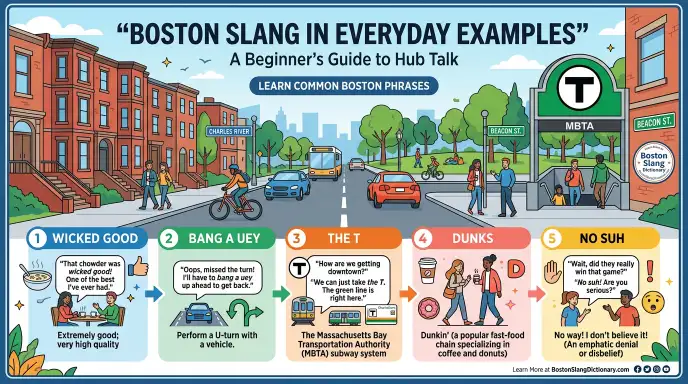
Boston Slang in Everyday Examples
Here are a few natural examples:
At a coffee shop:
“I’ll take a regular, please.”
Talking about the weather:
“It’s wicked cold today.”
Giving directions:
“Take the T downtown.”
Talking about travel:
“We’re going down the Cape this weekend.”
Talking about traffic:
“Bang a U ey at the next intersection.”
Ordering dessert:
“Can I get jimmies on my ice cream?”
Talking about a neighborhood:
“My cousin lives in Southie.”
These examples show why context matters. A word may sound strange outside Massachusetts but completely normal in a local conversation.
Origin and History of Boston Slang
Boston slang developed from a mix of regional speech, local history, immigration, neighborhoods, food culture, transportation, and everyday life.
There is no single date when “Boston slang” began. Different expressions have different histories.
For example, The Hub has a documented 19th century connection to Oliver Wendell Holmes, while triple decker reflects the housing history of Boston area immigrant communities.
Other terms have less certain origins. That is especially true for words such as jimmies and wicked, where popular explanations do not always agree.
It is better to describe those origins as uncertain than to present a popular story as proven fact.
Boston slang is also not frozen in time. Some expressions remain common, while others are more likely to appear in jokes, older speech, local media, or exaggerated Boston stereotypes.
Similar Slang and Related Boston Terms
If you are learning Boston vocabulary, you may also encounter these names:
- Beantown :a nickname for Boston, though not every local uses it affectionately.
- Dunks :informal name for Dunkin’.
- The Garden :TD Garden, the major sports and entertainment arena.
- The C’s :the Boston Celtics.
- The B’s :the Boston Bruins.
- The Pats :the New England Patriots.
- The Revs :the New England Revolution.
- The Charles :the Charles River.
- Eastie :East Boston.
- The Dot :Dorchester.
Boston.com and other Boston area guides use several of these local names when explaining Boston vocabulary.
When Should You Avoid Using Boston Slang?
You do not need to avoid Boston slang completely. Just match the setting.
Avoid heavy slang in:
- Job interviews
- Formal emails
- Academic papers
- Professional reports
- Applications
- Official documents
- Conversations where the listener may not understand the term
Even harmless slang can make formal writing sound too casual.
There is also no reason to force several Boston expressions into one sentence. A sentence like “Wicked pissa, kid, let’s bang a U ey and hit the packie” may sound more like a stereotype than natural speech.
Use slang because it fits the conversation, not because you want to prove that you know Boston vocabulary.
Common Misunderstandings About Boston Slang
“Is all Boston slang exclusive to Boston?”
No. Some terms are used across Massachusetts or New England. Bubbler, jimmies, and several other expressions have broader regional use.
“Does every Bostonian say wicked?”
No. “Wicked” is strongly associated with Massachusetts, but people have different vocabularies and speech styles.
“Is Boston slang the same as the Boston accent?”
No. Slang concerns words and expressions. An accent concerns pronunciation.
“Are Boston slang lists completely accurate?”
Not always. Online lists often mix Boston terms with wider New England vocabulary, old expressions, jokes, and stereotypes. That is why context and reliable local sources matter.
“Are these terms still used?”
Some are very familiar, while others are less common or may be used humorously. Boston.com, for example, found that local readers disagreed about some less familiar terms such as hosie and ripper.
Frequently Asked Questions
What are the most common Boston slang terms?
Some of the best known are wicked, pissa, packie, the T, bang a U ey, bubbler, tonic, frappe, jimmies, Southie, townie, and the Pike.
What does “wicked” mean in Boston slang?
In Boston and Massachusetts speech, wicked commonly means very or extremely. For example, “wicked cold” means “very cold.”
What does “pissa” mean in Boston slang?
Pissa or pissah means something is awesome, excellent, or very good. “Wicked pissa” is a well known regional phrase.
What does “packie” mean in Boston?
Packie is a shortened form of package store, meaning a liquor store.
What does “the T” mean in Boston?
The T refers to the MBTA, Boston’s public transportation system.
What does “bang a U ey” mean?
It means make a U turn. It is one of the expressions most strongly associated with Boston area speech.
Is Boston slang used on TikTok or social media?
Yes. Boston slang and Boston accent features often appear in social media posts, jokes, videos, and local content. However, online creators may exaggerate regional speech for entertainment, so social media is not always a reliable picture of how every Boston resident talks.
Can I use Boston slang at work?
Some mild terms, such as wicked, may fit casual workplace conversation if the people around you use them. More regional or potentially confusing expressions are better avoided in formal workplace writing.
Conclusion
Boston slang terms give you a useful window into the city’s local vocabulary and culture. Words such as wicked, pissa, packie, bubbler, tonic, frappe, the T, Southie, and bang aey can sound confusing if you have never heard them before, but their meanings are usually simple once you know the context.
The biggest thing to remember is that Boston slang is not one fixed dictionary. Some expressions are strongly associated with Boston, while others belong to the wider Massachusetts or New England region. Some are still common, while others are more likely to appear in jokes or older local speech.
If you are visiting Boston or chatting with someone from the area, focus on understanding the words rather than trying to imitate the accent.
A little local vocabulary can help you follow the conversation without making your speech sound forced.
Discover More slang!
- Vixen Meaning Slang: What Does Vixen Mean in Text?
- Slang OP: Meaning, Uses, Examples & Context
- 90’s Slang: Meaning, Terms, Examples & History

Hi, I’m Chloe Parker. I write simple and practical articles about slang, grammar, spelling, vocabulary, and commonly confused words. My goal is to make English easier to understand through clear explanations and real-life examples. Whether you’re a student, writer, or English learner, I’m here to help you build confidence and improve your everyday English.