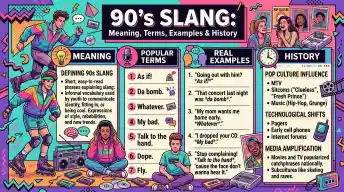
90’s slang refers to informal words, phrases, and expressions that were popular in the 1990s, especially in American English and youth culture. Terms such as “as if,” “phat,” “all that,” “talk to the hand,” “da bomb,” and “whatever” became strongly linked with the decade.
Some 90’s slang came from movies, TV shows, music, hip hop, sports, and regional speech. Other expressions were already older but became widely popular during the decade.
Today, many of these terms sound nostalgic or dated, while a few are still understood and used for humor.
If you are searching for 90’s slang, you may want to understand an old message, remember words from the decade, write realistic dialogue, or learn how 1990s youth culture influenced modern slang.
This guide explains the most common terms, where they were used, what they meant, and which ones still make sense today.
What Does 90’s Slang Mean?
90’s slang is the casual language associated with the culture of the 1990s. It was not one fixed vocabulary.
Different groups had their own expressions, and many terms came from specific communities or became popular through entertainment.
For example:
- Phat :excellent, attractive, or impressive.
- Da bomb :extremely good or exciting.
- As if! :a sarcastic way to reject an idea.
- All that :very impressive or attractive.
- Talk to the hand :a dismissive way of saying, “I do not want to listen.”
- Whatever :used to show indifference or dismissal.
- My bad :a casual way to admit a mistake.
- Word :an informal way to show agreement.
- Homey/homeboy :a friend or someone from one’s social circle.
- Bling bling :flashy jewelry or wealth related style.
The exact meaning could depend on the speaker, location, age group, and social setting.
Popular 90’s Slang Terms and Their Meanings
Here are some well known examples of 90’s slang:
| 90’s slang | Meaning | Example |
| As if! | No way; I strongly disagree | “You think I like that? As if!” |
| Phat | Very good, cool, or attractive | “That jacket is phat.” |
| Da bomb | Excellent or impressive | “This pizza is da bomb.” |
| All that | Very impressive or desirable | “She thinks she’s all that.” |
| My bad | My mistake | “My bad, I forgot your book.” |
| Whatever | I do not care / dismissive response | “Whatever. Do what you want.” |
| Talk to the hand | Stop talking to me | “Talk to the hand!” |
| Word | I agree / understood | “We meet at eight?” “Word.” |
| Bling bling | Flashy jewelry | “He showed off his bling bling.” |
| Homey | Friend or familiar person | “What’s up, homey?” |
| Da bomb | Extremely good | “That song is da bomb.” |
| Fly | Stylish or attractive | “Those shoes are fly.” |
| Chill | Relax or calm down | “Just chill for a minute.” |
| Diss | Insult or disrespect | “He tried to diss me.” |
| Props | Respect or credit | “Give her props for finishing first.” |
Not every term was used by every person in the 1990s. Some were strongly tied to particular music scenes, communities, movies, or television shows.
90’s Slang From Movies and TV
Movies and television helped spread many expressions during the 1990s.
A famous example is “As if!”, strongly associated with Cher Horowitz in Clueless (1995). The phrase was not invented by the movie, but the character helped make it a recognizable part of 1990s pop culture.
Another popular expression was “Talk to the hand,” which became closely associated with dismissive humor in 1990s popular culture.
Teen movies, sitcoms, music videos, and comedy shows made slang easier to repeat across different parts of the country. A phrase could move from a particular social group into mainstream entertainment and then become widely recognized.
This is one reason some 90’s slang feels strongly connected to the decade even when the expression itself was older.
90’s Slang in Music and Youth Culture
Music was another major source of popular slang during the 1990s.
Hip hop, R&B, pop, rock, and other music scenes helped spread words and expressions. Some terms had roots in African American English and hip hop culture rather than being created by “the internet,” as modern slang sometimes is.
Expressions such as “phat,” “diss,” “props,” “word,” and “bling” became familiar to wider audiences through music and entertainment.
It is important not to treat all 90’s slang as generic language. Some expressions have cultural histories connected to particular communities. Their popularity in mainstream culture does not erase those origins.
Was 90’s Slang Only Used by Teenagers?
No. Teenagers used a lot of 1990s slang, but adults also used some expressions.
Usage depended on the word.
A phrase such as “my bad” could appear in casual conversation between adults. Words connected to youth culture, however, were more likely to be used by teenagers and young adults.
Age also affected tone. An adult deliberately using a teenage expression could sound playful, humorous, or dated.
For example:
“That movie was da bomb!”
A person saying this today may be using the phrase for nostalgia rather than speaking in a typical 1990s style.
How 90’s Slang Was Used in Everyday Life
Unlike modern internet slang, much 1990s slang spread through face to face conversation, music, television, movies, magazines, school, and telephone conversations.
The internet existed in the 1990s, but it did not have the same reach or social media culture people know today.
Common places for slang included:
- School conversations
- Friend groups
- Music communities
- Television shows
- Movies
- Sports culture
- Malls and youth culture
- Phone conversations
- Letters and notes
- Early online communities
This difference matters when comparing 90’s slang with terms used on TikTok, Snapchat, Discord, or other modern platforms.
Is 90’s Slang Rude, Offensive, or Harmless?
Most common 90’s slang is informal rather than inherently offensive, but context matters.
Words such as “my bad,” “chill,” “fly,” and “whatever” are generally easy to understand. However, “whatever” can sound dismissive or rude depending on how it is said.
Some slang from the 1990s may also reflect cultural language that should not be copied casually without understanding its background.
A good rule is:
Understand the history of a term before using it, especially if it comes from a specific cultural community.
Slang can also change meaning over time. A word that once sounded normal may now sound dated, sarcastic, or insensitive.
90’s Slang Examples in Real Conversations
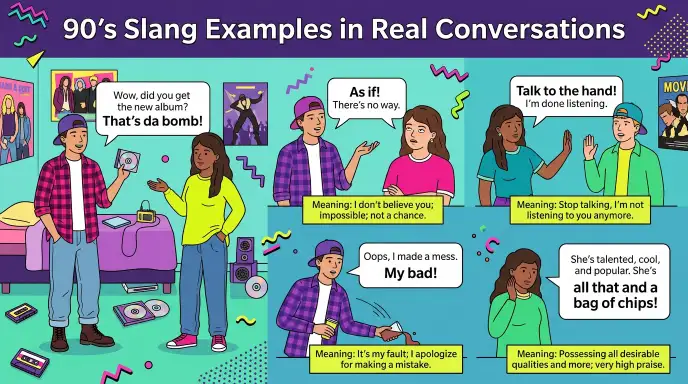
Friendly Conversation
Alex: “Did you see Mike’s new car?”
Jamie: “Yeah. That thing is phat.”
Here, phat means very cool or impressive.
Admitting a Mistake
Sam: “You took my charger.”
Chris: “My bad. I thought it was mine.”
My bad is a casual apology or admission of fault.
Showing Agreement
Taylor: “We should meet at the mall at six.”
Jordan: “Word.”
Here, word means something like “I agree” or “understood.”
Showing Disbelief
Friend: “I heard you are going to quit your job tomorrow.”
Alex: “As if!”
The expression shows strong disbelief or rejection.
Modern Nostalgic Use
“That old game was da bomb!”
A modern speaker may use da bomb humorously to imitate or reference 1990s speech.
90’s Slang vs. Modern Internet Slang
The biggest difference is how slang spreads.
| 1990s slang | Modern slang |
| Spread through TV and music | Spreads through social media |
| Face to face conversation was central | Online communication is central |
| Movies influenced youth language | TikTok, memes, and creators influence language |
| Phone calls were common | Messaging and group chats dominate |
| Slang often spread more slowly | A phrase can become viral very quickly |
| Regional differences could be stronger | Online communities spread terms globally |
This does not mean modern slang is completely different. People still use slang to show humor, identity, friendship, and belonging.
Which 90’s Slang Is Still Used Today?
Some expressions survived beyond the 1990s.
My bad is still widely understood and commonly used in casual speech.
Chill also remains common, although it is not uniquely a 1990s expression.
Diss and props are still recognizable, but their popularity varies by age and context.
Other terms, such as da bomb and talk to the hand, are more likely to sound intentionally retro.
A Quick Guide
| Term | Common today? | Modern feeling |
| My bad | Yes | Natural/casual |
| Chill | Yes | Natural |
| Diss | Yes | Still understood |
| Props | Sometimes | Casual/older |
| Phat | Less common | Dated/nostalgic |
| Da bomb | Less common | Retro |
| Talk to the hand | Rare | Very dated |
| As if! | Recognizable | Often nostalgic or humorous |
Why Do People Still Use 90’s Slang?
People use 90’s slang today for several reasons.
Nostalgia
People who grew up in the 1990s may use old expressions because they remind them of childhood or teenage years.
Humor
Using a dated phrase can be funny because it sounds exaggerated or old fashioned.
Pop Culture
Movies, television shows, music, and social media can bring older expressions back into attention.
Character Writing
Writers may use 90’s slang to make a character sound like they grew up during that period.
Style
Some people simply enjoy retro language and 1990s culture.
When Should You Avoid Using 90’s Slang?
Avoid 90’s slang when a professional or formal tone is expected, especially if the expression is strongly dated.
For example, avoid phrases like “da bomb” or “talk to the hand” in:
- Formal reports
- Academic papers
- Job applications
- Professional emails
- Business proposals
- Official documents
Even familiar expressions such as “my bad” may be too casual for some workplace situations.
In a casual chat with friends, however, older slang can work well if everyone understands the tone.
Common Misunderstandings About 90’s Slang
Not every 1990s expression started in the 1990s
A phrase can become popular during a decade without originating in that decade.
Not everyone used the same slang
Regional culture, music preferences, age, and social groups all affected language.
90’s slang is not the same as internet slang
Some 1990s expressions appeared online, but most mainstream slang spread through offline culture and mass media.
Old slang does not always disappear
Some terms remain part of everyday English even after their peak popularity.
Similar Terms and Related 1990s Expressions
If you are exploring 90’s slang, you may also come across:
- Retro slang :older informal expressions used for a vintage feel.
- Millennial slang :slang associated with the generation that grew up around the late 1990s and 2000s.
- Hip hop slang :informal language connected with hip hop culture.
- Teen slang :informal language commonly used by young people.
- Pop culture slang :expressions spread through entertainment.
- Internet slang :informal language that develops and spreads online.
These categories can overlap, but they are not identical.
Frequently Asked Questions
What is the most popular 90’s slang?
There is no single official “most popular” term. As if, my bad, phat, da bomb, all that, and whatever are among the expressions strongly associated with 1990s popular culture.
What did “phat” mean in the 90s?
Phat was used to describe something excellent, cool, attractive, or impressive. It was especially associated with youth and music culture.
What did “da bomb” mean?
Da bomb meant something was extremely good, exciting, or impressive. Today, it often sounds deliberately retro.
Is “my bad” 90’s slang?
“My bad” became widely familiar in American informal speech during the 1990s, although the expression has roots that predate the decade. It remains common today.
What did “as if” mean in 90’s slang?
As if! was a sarcastic way to reject an idea or show disbelief. It became especially famous through Clueless.
Is 90’s slang still used today?
Some expressions remain common, while others mainly appear in nostalgic or humorous contexts. Chill and my bad feel much more current than expressions such as talk to the hand.
Can I use 90’s slang at work?
It depends on the term and workplace. Mild expressions may be fine in relaxed conversation, but strongly dated slang can sound unprofessional. Formal writing should generally avoid it.
Why does 90’s slang sound old today?
Language changes quickly. Expressions that were common among young people in the 1990s may now signal a specific era. Using them today can therefore sound nostalgic, humorous, or intentionally retro.
Conclusion
90’s slang gives us a useful look at the language and pop culture of the 1990s. Words such as phat, da bomb, as if, my bad, all that, and talk to the hand became recognizable through different combinations of youth culture, music, television, movies, and everyday conversation.
Not every expression began in the 1990s, and not everyone used the same slang. Some terms came from specific cultural communities before becoming popular with wider audiences. Others simply became strongly associated with the decade.
Today, some 90’s slang remains part of everyday English, while other expressions are mainly used for nostalgia or humor.
The safest approach is to consider the meaning, audience, tone, and history of a term before using it.
If you want to sound naturally 1990s, context matters more than filling every sentence with old slang. A few well chosen expressions usually feel more authentic than a long list of dated phrases.
Read More About!
- FLR Slang Meaning in Text: What Does FLR Mean?
- What Is Gen Gay Slang? Meaning, Uses & Examples
- Wet Slang: Meaning, Uses, Examples & Context

Hi, I’m Chloe Parker. I write simple and practical articles about slang, grammar, spelling, vocabulary, and commonly confused words. My goal is to make English easier to understand through clear explanations and real-life examples. Whether you’re a student, writer, or English learner, I’m here to help you build confidence and improve your everyday English.