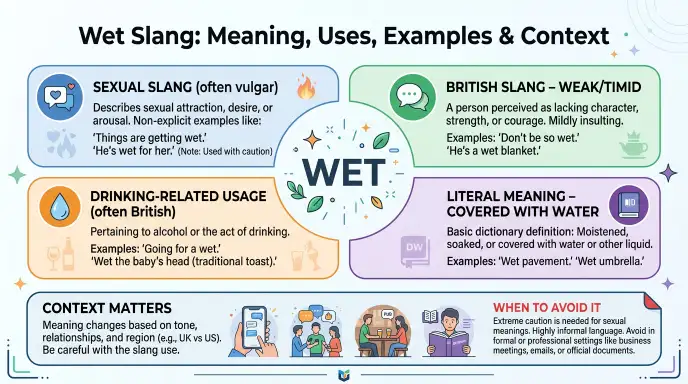
Wet slang can have several meanings, depending on the situation. In sexual slang, “wet” usually refers to sexual arousal and genital lubrication. In British slang, “wet” can also describe someone as weak, timid, or lacking confidence. Older and regional uses connect the word with drinking, while some slang communities use “wet” in violent contexts.
People often search for wet slang because the word can look confusing in texts, social media posts, songs, or online conversations. A sentence such as “she’s wet” can mean something very different from “it’s wet outside.”
This guide explains the main meanings clearly. You will learn how wet is used in sexual slang, British English, drinking related language, and other slang contexts.
You will also see realistic examples, learn when the word can sound rude, and find out when it is better to avoid using it.
Quick Answer
Wet slang most commonly refers to sexual arousal, especially when describing a woman becoming physically lubricated. However, wet can also mean weak or foolish in British slang, drunk or related to drinking in older usage, and “bloody” or seriously injure someone in some regional slang. Context is essential.
| Context | Meaning | Tone |
| Sexual slang | Sexually aroused | Vulgar/sexual |
| British slang | Weak, timid, or feeble | Insulting |
| Drinking | Drunk or involving alcohol | Informal/older |
| Some regional slang | Seriously injure or “bloody” someone | Violent |
| Literal English | Covered with liquid | Neutral |
What Does “Wet” Mean in Slang?
The meaning of wet changes with context.
The most common modern slang meaning is sexual. If someone says a person is “wet” in a sexual conversation, they are referring to physical arousal.
This usage is generally considered vulgar and explicit, so it is not suitable for polite or professional conversation.
There is also a British slang meaning. Calling someone “wet” can mean that the person is weak, timid, ineffectual, or lacking a strong character. Cambridge and Oxford both record this British informal use.
So, if someone writes:
“Stop being so wet.”
They may not be talking about water at all. They could be calling the other person weak or overly timid.
Does “Wet” Have a Full Form?
No. “Wet” does not have a standard slang full form.
It is an ordinary English word that has developed several informal and slang meanings over time. It is different from texting abbreviations such as “LOL” or “IMO,” which stand for longer phrases.
If you see WET written in capital letters, do not automatically assume it is an acronym. The meaning still depends on the conversation.
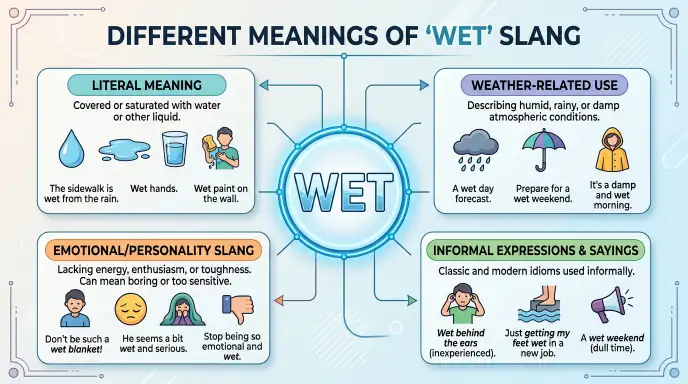
Different Meanings of Wet Slang
1. “Wet” as Sexual Slang
This is one of the most common slang meanings people are looking for today.
When wet describes a sexually aroused woman, it refers to natural vaginal lubrication caused by sexual arousal. Dictionaries and slang references record this meaning.
For example:
- “That comment was meant to get her wet.”
- “He was making sexual jokes about getting someone wet.”
These examples are explicit, even when the word itself is short.
You may see this meaning in adult conversations, sexual jokes, explicit music, pornography, or NSFW online posts.
Important: A person saying “I’m wet” does not always mean sexual arousal. The surrounding words are needed to understand the intended meaning.
2. “Wet” as British Slang for Weak
In British English, wet can be an informal and disapproving way to describe someone who seems weak, timid, or lacking confidence. Oxford gives “feeble” and “wimpish” as close meanings.
Example:
“Don’t be such a wet. Just ask him.”
Here, wet means something like “wimp” or “weak person.”
This meaning is different from the sexual meaning. Nothing sexual is intended.
It can also describe an attitude or approach that someone thinks is too soft or weak.
3. “Wet” and Alcohol
Wet has a long connection with alcohol and drinking.
Historical English uses included wet for drunkenness and drinking. Dictionary.com notes that “wet” was associated with getting drunk as far back as the 15th century, while phrases involving a “wet” or a “wet night” developed later.
Today, this sense is less likely to appear in everyday texting than the sexual or British “weak” meanings.
You may still encounter wet in expressions involving places where alcohol can legally be sold. A “wet” area or county can refer to one that permits alcohol sales, contrasted with a “dry” area.
4. “Wet” in Violent Slang
There is another, much less common meaning in some U.S. and British slang traditions.
To “wet” someone can mean to seriously injure or “bloody” them. Dictionary.com describes this use as appearing in Black U.S. and British slang by at least the 1990s and notes that it is less common today.
This meaning is important when reading lyrics, crime related conversations, or certain regional slang.
For example:
“They said they would wet him.”
In a violent context, this may be a threat of serious physical harm rather than anything sexual.
Because this meaning is highly context dependent and less common, you should not assume it whenever you see the word.
Where Is “Wet” Slang Commonly Used?
The meaning can change by platform and audience.
| Place | Likely meaning/context |
| Private sexual chat | Sexual arousal |
| TikTok comments | Usually depends heavily on surrounding text |
| Sexual jokes or ordinary “wet” meaning | |
| Snapchat | Sexual meaning may appear in private messages |
| Discord | Depends on the community and conversation |
| Can appear in sexual, British, gaming, or niche slang | |
| British conversation | Weak/timid person |
| Workplace chat | Usually literal; slang uses should be avoided |
| Music/lyrics | May have sexual or violent meanings |
On social media, one short word can have several meanings. A commenter saying “wet” under a rain video probably means wet literally, while the same word in a sexual discussion may have an entirely different meaning.
Is “Wet” Rude, Offensive, or Harmless?
It depends on the meaning.
The literal word is completely harmless:
“My shoes are wet.”
The British slang sense can be insulting:
“He’s such a wet.”
The sexual sense is vulgar and explicit:
“She’s wet.”
The violent slang sense can be serious because it may describe or imply physical harm.
So there is no single answer to if wet slang is rude. You need to identify the context first.
Can You Use “Wet” at Work?
Usually, use the literal meaning only in professional settings.
For example:
“The floor is wet.”
That is perfectly normal.
Avoid using the sexual, insulting, or violent slang meanings at work. They can easily offend someone or create a serious misunderstanding.
Real Life Examples of Wet Slang
Friendly Conversation
Alex: “Why are your clothes wet?”
Sam: “I got caught in the rain.”
Here, wet has its normal literal meaning.
British Slang
Tom: “Just tell them you disagree.”
Ben: “I don’t want to cause trouble.”
Tom: “Don’t be such a wet.”
Here, wet means weak or timid.
Sexual Context
Person A: “That message was clearly sexual.”
Person B: “Yeah, he was trying to get her wet.”
Here, wet refers to sexual arousal. This is an adult and explicit use.
Online or Music Context
“The rapper said he would wet his rival.”
If the surrounding lyrics discuss violence, wet may refer to seriously injuring someone. This meaning should not be confused with the sexual sense.
Origin and History of “Wet” Slang
The basic word wet is very old. Oxford traces it to Old English wǣt, related to words connected with water.
Its slang meanings developed at different times rather than coming from one single source.
The drinking related meaning is particularly old. Dictionary.com records “wet” in connection with drunkenness from centuries ago.
The British meaning of wet = weak or feeble is also not new. Oxford records it as a British informal use, and sources show the sense was established well before modern social media.
The sexual meaning is also much older than the internet. Dictionary.com notes evidence of this usage dating back centuries.
This matters because wet slang is not simply a new TikTok or Gen Z expression. Different meanings developed over a long period and are still used in different today.
Similar Slang and Related Terms
The best alternative depends on which meaning you mean.
| Wet meaning | Related term |
| Sexually aroused | Turned on |
| Weak/timid | Wimp |
| Weak person | Softie |
| Drunk | Wasted |
| Literal moisture | Damp |
| Serious injury | Attack/hurt |
Be careful with these alternatives. They are not exact replacements in every sentence.
For example, “wasted” can mean very drunk, but it does not mean “wet” in every alcohol related context.
When Should You Avoid Using “Wet”?
Avoid slang uses of when the meaning could be.
You should especially avoid the sexual meaning:
- At work
- In school
- Around children
- In formal writing
- With teachers or employers
- In professional emails
- In public posts where the audience is unclear
Also avoid using wet as an insult unless you know the audience and context well. Calling someone “a wet” can sound rude or mocking in British English.
If you are unsure which meaning someone intended, look at the words around it instead of guessing.
Polite Alternatives to Wet Slang
If someone uses wet and you want to express the same idea more politely, choose a clearer word.
The British slang meaning:
- Weak
- Timid
- Unsure
- Inexperienced
- Too cautious
For the sexual meaning:
- Use a neutral medical term as sexually aroused when a clear explanation is needed.
For the literal meaning:
- Damp
- Moist
- Soaked
- Covered in water
Clear wording is usually better than slang when the audience may not understand the intended meaning.
Why Do People Use “Wet” as Slang?
People use wet because slang often gives a short, expressive way to communicate an idea.
In sexual contexts, it is a blunt and explicit way to describe arousal.
British slang, calling someone “wet” quickly suggests that the person is being weak, timid, or overly soft.
In older drinking language, it became connected with alcohol and drunkenness.
The same spelling can therefore carry very different social meanings. Tone and context matter more than the word alone.
Common Misunderstandings About Wet Slang
Does “wet” always mean sexually aroused?
No. It can mean physically covered with liquid, weak in British slang, or have other informal meanings.
Is a texting abbreviation?
No. It is normally a word, not a standard abbreviation.
Is always sexual on TikTok?
No. The meaning depends on the video, caption, comment, and surrounding conversation.
Does “wet” mean weak everywhere?
No. The weak or timid meaning is associated with British informal English.
Can “wet” mean drunk?
Yes, but this is an older or less common informal use today. Historical English has used “wet” in connection with drinking and drunkenness.
Can “wet” refer to violence?
In some slang contexts, yes. “To wet someone” has been recorded as meaning to injure or bloody someone, but this use is less common and strongly depends on context.
Is wet slang at work?
Generally, no. Stick to the literal meaning or use clear, professional wording.
Frequently Asked Questions
What is the most wet slang meaning?
In modern slang searches, wet often refers to sexual arousal. However, this is not the only meaning. British English also uses “wet” for someone who is weak or timid.
What does “she is wet” mean in slang?
In a sexual context, it usually means that the woman is sexually aroused and has genital lubrication. It is a vulgar expression and should not be used in formal settings.
What does “don’t be wet” mean?
In British slang, “don’t be wet” can mean “don’t be weak,” “don’t be timid,” or “don’t be a wimp.”
Is wet a Gen Z slang word?
Not originally. The slang uses of wet existed long before Gen Z and social media. Some meanings may still appear in modern online conversations, but the word itself is much older. What does wet mean in British slang?
In British slang, wet can describe a person who is weak, feeble, timid, or lacking a strong character. It is informal and usually disapproving.
Is “wet” a bad word?
Not by itself. The normal meaning is completely harmless. Some slang meanings, especially the sexual and violent ones, can be vulgar or serious.
Conclusion
Wet slang does not have one fixed meaning. In modern sexual slang, it commonly refers to sexual arousal, while British English can use wet to describe someone who is weak or timid.
Older English also connects the word with drinking and drunkenness, and some regional slang uses it in violent contexts.
The safest way to understand wet is to look at the full sentence and the conversation around it. A message about rain is probably literal.
A British speaker calling someone “a wet” is likely criticizing their character. A sexual conversation may use it in an explicit sense.
If you are writing for work, school, or a public audience, avoid the slang meanings unless you are specifically explaining them.
When the context is unclear, choose a more direct word. That prevents the kind of misunderstanding that makes a simple three letter word surprisingly complicated.
Read More About!
- Honey Slang: Meaning, Uses, Examples & More
- IMS Meaning Text Slang: What Does IMS Mean in Text?
- What Is Gen Gay Slang? Meaning, Uses & Examples

Hi, I’m Chloe Parker. I write simple and practical articles about slang, grammar, spelling, vocabulary, and commonly confused words. My goal is to make English easier to understand through clear explanations and real-life examples. Whether you’re a student, writer, or English learner, I’m here to help you build confidence and improve your everyday English.