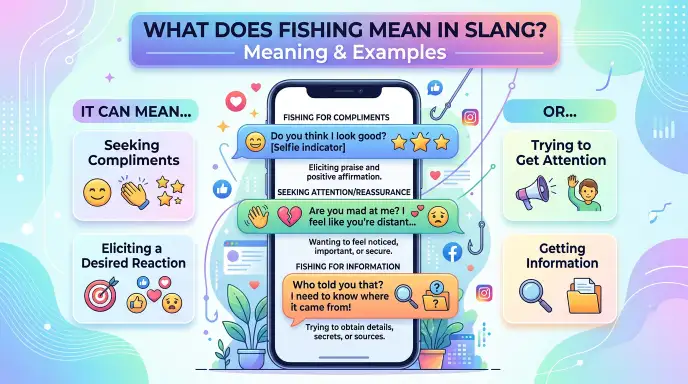
What does fishing mean in slang? If you have seen someone say “Are you fishing?” on TikTok, Instagram, Snapchat, Reddit, or in a text, the person may not be talking about catching fish. In slang, fishing can describe someone who is trying to get a reaction, attention, information, compliments, or a specific answer from another person.
The meaning depends heavily on the situation. Someone might be “fishing for compliments” by saying something negative about themselves just to receive praise.
A person can also be “fishing for information” by asking questions without directly saying what they really want to know.
Online, the term may describe someone who posts something mainly to provoke reactions or engagement.
Quick Answer
In slang, fishing usually means trying to get something indirectly, such as attention, compliments, information, sympathy, or a reaction. The exact meaning depends on the context.
What Does Fishing Mean in Slang?
In everyday slang, fishing describes a person who is trying to get something from someone without asking for it directly.
The “something” could be:
- Compliments
- Attention
- Information
- Sympathy
- A reaction
- Agreement
- Confirmation
- Romantic interest
For example, imagine someone says:
“I look terrible today.”
If they clearly look fine and are expecting others to say, “No, you look great,” someone might respond:
“Stop fishing for compliments.”
Here, fishing means deliberately creating an opportunity for someone else to give you praise.
The word can be playful, teasing, neutral, or negative. Tone matters a lot.
Fishing Meaning in Text
When someone uses fishing in a text message, it usually means they think another person is trying to get a particular response.
For example:
Friend: “Nobody ever invites me anywhere.”
You: “Are you fishing for an invite?”
The second person suspects that the first person is indirectly asking to be invited.
Another example:
“You keep asking who I was with last night. Are you fishing for information?”
In this case, fishing means trying to obtain information without asking directly.
Texting gives people many opportunities to use this slang because indirect questions and hints are common in casual conversations.
Fishing for Compliments
One of the most common uses of fishing is fishing for compliments.
This happens when someone says or does something designed to encourage another person to compliment them.
Example
“I look so bad in every picture.”
If the person is hoping someone will reply:
“What? You look amazing!”
they may be fishing for compliments.
Another example:
“I don’t think I’m very good at this.”
If someone clearly wants another person to respond:
“You’re actually really talented,”
they may be fishing for reassurance or praise.
Is fishing for compliments always bad?
Not necessarily.
Sometimes people use the phrase jokingly between friends. A person may simply want reassurance and not realize they are being indirect.
However, if someone repeatedly makes negative statements only to receive praise, others may view it as attention seeking.
Fishing for Information
Fishing can also mean trying to get information indirectly.
Instead of asking a direct question, someone may ask several smaller questions to discover something.
For example:
“What time did you get home?”
“Who were you with?”
“Was anyone else there?”
The person being questioned might say:
“Why are you fishing for information?”
This does not necessarily mean the questions are inappropriate. It simply suggests that the person asking them may have a hidden reason for wanting the information.
Example in a relationship
“So, you were at that party last night? Who else was there?”
The other person might respond:
“Are you fishing to find out if Sarah was there?”
Here, the speaker suspects that the real question has not been asked directly.
Fishing for a Reaction
Another common meaning is trying to make someone react.
A person may say something provocative, dramatic, or unexpected because they want to see how others respond.
For example:
“I knew you’d get angry if I said that. I was just fishing for a reaction.”
Here, fishing means deliberately trying to produce an emotional response.
This use is common in arguments and online discussions.
On social media, someone may make a controversial statement because they know it will attract comments.
Fishing for Attention
Sometimes people use fishing to describe someone who is trying to attract attention.
For example:
“She keeps posting dramatic stories. I think she’s fishing for attention.”
The speaker believes the posts are designed to make people ask questions, send messages, or show concern.
This use can sound judgmental, so it is important to consider the context before labeling someone’s behavior as attention seeking.
A person posting about a difficult experience may genuinely need support. Calling it “fishing” could therefore come across as insensitive.
Fishing on Social Media
The slang meaning of fishing is especially common in online conversations.
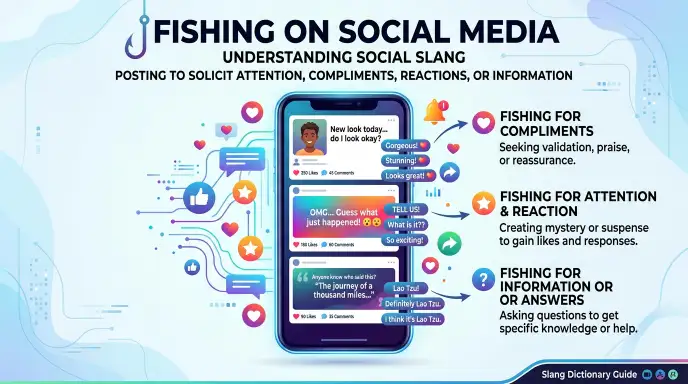
You may see it used on:
- TikTok
- Snapchat
- X
- Discord
- YouTube comments
- Group chats
For example:
“Bro posted that just to fish for compliments.”
Or:
“She’s fishing for comments.”
Or:
“That question is definitely fishing.”
In social media culture, people often use indirect posts to encourage engagement. However, not every post seeking attention is necessarily “fishing.”
The term usually suggests that the person is deliberately trying to produce a particular response.
Fishing in Dating and Relationships
In dating conversations, fishing can have several meanings.
Someone may fish for:
- Romantic interest
- Confirmation of someone’s feelings
- Information about another person
- Reassurance
- A date invitation
- Jealous reactions
Example
“Do you think I’m attractive?”
If the person already knows the other person is interested and is asking mainly to hear them say it, someone might call this fishing for compliments.
Another example:
“So, are you talking to anyone these days?”
If the person asking is secretly trying to find out if you are single, they could be described as fishing for information.
The term is often used playfully in dating conversations, but it can also suggest that someone is being indirect or manipulative.
Is “Fishing” Rude or Offensive?
Fishing is not normally offensive slang. However, calling someone out for “fishing” can sound critical.
Compare:
“Are you fishing for compliments? 😂”
This can sound playful between friends.
With:
“You’re always fishing for attention.”
This sounds much more negative.
The word itself is harmless. The accusation behind it can be uncomfortable because you are suggesting that another person has a hidden motive.
If you do not know someone well, it is usually better to avoid making strong assumptions about why they said something.
Fishing vs. Asking Directly
The main difference between fishing and asking directly is the approach.
| Fishing | Direct asking |
| Indirect | Straightforward |
| Often hints at what someone wants | Clearly states what someone wants |
| May seek a specific reaction | Makes the purpose obvious |
| Can be playful or manipulative | Usually clearer |
| Depends heavily on context | Easier to understand |
For example:
Fishing:
“I guess nobody thinks I’m good at this.”
Direct:
“Do you think I’m good at this?”
The first statement may be trying to encourage reassurance. The second simply asks for an opinion.
Common Examples of “Fishing” in Slang
Friendly example
“Are you fishing for compliments again? 😂”
The speaker is teasing a friend.
Casual example
“He’s fishing for an invite.”
The person appears to be indirectly asking to be invited.
Argumentative example
“Stop fishing for a reaction. I’m not arguing with you.”
Here, the term has a negative tone.
Social media example
“That post feels like fishing for comments.”
The speaker believes the post was created to generate engagement.
Dating example
“She’s fishing to see if he’s single.”
The person is indirectly trying to discover someone’s relationship status.
Information example
“Why are you asking all these questions? Are you fishing?”
The speaker suspects the questions have a hidden purpose.
Why Do People Use “Fishing” as Slang?
The slang comes from the basic idea of fishing with a hook.
When you fish literally, you put bait into the water and wait for something to take the bait.
The slang idea works in a similar way.
A person may say something that acts like “bait” and then wait for someone to respond.
For example:
“I don’t think anyone likes my new haircut.”
The person may be waiting for someone to say:
“I love your haircut!”
The statement is the “bait,” while the compliment is the desired response.
This metaphor helps explain why the word fishing is used for indirect attempts to get something from other people.
Origin and Background of “Fishing” as Slang
The slang use of fishing comes from the literal act of fishing. When someone fishes, they put bait in the water and wait for a fish to bite.
The figurative meaning developed from this same idea: a person puts out a “baited” statement, question, or post and waits for someone to respond.
For example, someone might say:
“I haven’t had a compliment all day.”
If they are hoping another person will say, “You look great,” they are metaphorically “fishing” for a compliment.
The same idea can apply to information. Someone might ask indirect questions to see if another person reveals something.
The metaphor is useful because the person does not always openly state what they want. Instead, they “cast a line” and wait to see what response they get.
Fishing for Attention vs. Fishing for Compliments
These two phrases are closely related, but they are not exactly the same.
Fishing for compliments
This specifically means trying to get praise or positive comments.
Example:
“I look awful in this outfit.”
If the person wants others to say they look good, they may be fishing for compliments.
Fishing for attention
This is broader. The person may want people to notice them, ask questions, react to them, or show concern.
Example:
“Nobody ever checks on me.”
If the person posts this mainly to make others send messages asking what is wrong, someone might describe it as fishing for attention.
Simple difference
Fishing for compliments = trying to get praise.
Fishing for attention = trying to get people’s attention or engagement.
A person can sometimes be doing both at the same time.
Fishing for Information vs. Fishing for a Reaction
Another useful distinction is between getting information and getting an emotional response.
Fishing for information
The goal is to make someone reveal something.
“So, who were you with last night?”
If the person already knows the answer they want but is trying to get you to reveal it, they may be fishing for information.
Fishing for a reaction
The goal is to make someone respond emotionally.
“I guess you don’t care about me anyway.”
If the speaker expects the other person to become defensive or reassuring, they may be fishing for a reaction.
The first focuses on what someone knows. The second focuses on how someone responds.
Is Fishing the Same as Baiting?
Not always, although the two ideas overlap.
Baiting usually means deliberately saying or doing something to provoke a particular reaction. It can be especially common in arguments and online discussions.
Fishing is broader. Someone can fish for:
- Compliments
- Information
- Attention
- Sympathy
- Reassurance
- A reaction
For example:
“Do I look okay?”
This could be fishing for a compliment.
But:
“I know this opinion will make everyone angry.”
could be baiting if the person intentionally wants people to argue.
Quick comparison
| Term | Main idea |
| Fishing | Indirectly trying to get something |
| Baiting | Deliberately provoking a response |
| Attention seeking | Trying to attract notice |
| Probing | Carefully trying to discover information |
| Fishing for compliments | Trying to get praise |
These terms can overlap, but they are not perfect synonyms.
Is Fishing the Same as Attention Seeking?
No.
Attention seeking is a broader term for behavior intended to attract attention.
Fishing usually suggests a more specific attempt to get a particular response.
For example:
“Look at my new shoes!”
may simply be someone sharing something.
But:
“I guess nobody even noticed my new shoes.”
could be interpreted as fishing for attention or compliments.
The second statement gives people a stronger hint about the response the speaker wants.
Fishing in Gaming and Online Communities
The word fishing can also appear in gaming communities, forums, and Discord chats.
A player might say:
“He’s fishing for a reaction.”
This means another player may be deliberately saying something provocative to make others respond.
For example:
“Your team is terrible.”
If someone says this repeatedly because they know other players will become angry, they may be trying to fish for reactions.
Gaming communities can also use the term when someone asks questions designed to get other players to reveal information.
However, gaming slang changes from one community to another. The surrounding conversation should always be considered.
Fishing on TikTok and Instagram
On platforms such as TikTok and Instagram, people sometimes use fishing when discussing posts that appear designed to generate comments, compliments, or attention.
For example:
“This is definitely fishing for compliments.”
A creator might post:
“I tried making this video, but I’m terrible at editing.”
If viewers respond with:
“No, it’s actually amazing!”
someone could describe the post as fishing for compliments.
Another example is:
“She’s fishing for comments with that caption.”
Here, the person believes the caption was written to encourage people to comment.
That does not automatically mean the person is being dishonest. Sometimes people genuinely want reassurance or interaction. “Fishing” simply describes the suspected strategy.
Fishing on Reddit
On Reddit, the term can appear when users think a question or post has a hidden purpose.
For example:
“Are you asking this because you’re genuinely curious, or are you fishing for opinions?”
Someone might also say:
“This post feels like fishing for validation.”
In this context, validation means reassurance that someone’s opinion, decision, appearance, or behavior is acceptable.
Reddit discussions can be direct, so users may openly call out what they believe is fishing.
How Tone Changes the Meaning
One of the most important things to understand about fishing is that the word does not automatically sound negative.
Its tone depends on the situation.
Playful
“Fishing for compliments again? 😂”
This may simply be friendly teasing.
Neutral
“I think he’s fishing for information.”
This sounds like an observation.
Suspicious
“Why are you asking me all these questions? Are you fishing?”
The speaker suspects a hidden motive.
Negative
“Stop fishing for attention.”
This is clearly critical.
Aggressive
“You’re just fishing for a reaction because you want to start an argument.”
This suggests deliberate provocation.
The same word can therefore move from playful to insulting depending on the wording.
When Should You Avoid Calling Someone a Fisher?
Although fishing itself is not offensive, accusing someone of fishing can create tension.
Be careful when:
- You do not know the person’s intentions.
- They are discussing a sensitive subject.
- They may genuinely need emotional support.
- You are speaking in a professional setting.
- The person has clearly asked for help or reassurance.
For example, if a friend says:
“I’ve been having a really difficult week.”
responding with:
“You’re just fishing for attention.”
could be hurtful if they were genuinely struggling.
A better approach is to ask what they need.
Intent matters.
When Is Fishing Manipulative?
Fishing can become manipulative when someone deliberately uses indirect statements to control another person’s response.
For example:
“Fine. Go hang out with them. I know I’m not important anyway.”
If the speaker is intentionally trying to make someone feel guilty so they will cancel their plans, this could be viewed as emotional fishing or manipulation.
Another example:
“I guess you don’t love me anymore.”
If the speaker already knows that this statement will force the other person to provide reassurance, it may be an indirect way of getting that reassurance.
Not every indirect statement is manipulation. Sometimes people communicate indirectly because they are nervous, insecure, or unsure how to ask for what they need.
That is why context and intent matter.
How to Respond When Someone Is Fishing
If you believe someone is fishing for compliments, attention, or information, you do not have to respond negatively.
You can answer directly.
If they are fishing for compliments
Instead of teasing them:
“You look great. Stop worrying.”
If they are fishing for information
You can simply say:
“If you want to know, just ask me.”
If they are fishing for a reaction
You can avoid escalating the situation:
“I’m not going to argue about that.”
If they seem to need reassurance
Try:
“If something is bothering you, you can tell me directly.”
This keeps communication clear and reduces unnecessary misunderstandings.
Common Phrases With “Fishing”
Here are some expressions you may see in casual conversations:
“Fishing for compliments”
Trying to get someone to praise you.
Example:
“You’re fishing for compliments again.”
“Fishing for attention”
Trying to attract attention or engagement.
Example:
“That post seems like she’s fishing for attention.”
“Fishing for information”
Trying to make someone reveal information.
Example:
“He’s fishing for information about your plans.”
“Fishing for a reaction”
Trying to make someone react emotionally.
Example:
“Don’t give him a reaction. He’s fishing for one.”
“Are you fishing?”
A short way to ask if someone is indirectly trying to get something.
Example:
“You keep asking about my weekend. Are you fishing?”
More Real Life Examples
Friendly
Friend: “I think my new haircut looks weird.”
You: “You’re fishing for compliments, aren’t you? 😂”
Casual
“She’s fishing for an invite without actually asking.”
Dating
“He kept asking if I was seeing anyone. I think he was fishing.”
Argument
“You’re only saying that to fish for a reaction.”
Social media
“That caption is definitely fishing for comments.”
Gaming
“Ignore him. He’s fishing for a reaction in chat.”
Information
“Don’t answer every question. She might be fishing for information.”
What Does “Fishing” Mean When Someone Says “Are You Fishing?”
When someone asks:
“Are you fishing?”
they usually mean:
“Are you indirectly trying to get something from me?”
The exact thing could be a compliment, answer, reaction, invitation, information, or reassurance.
For example:
A: “I wish someone would invite me to the concert
B: “Are you fishing for an invitation?”
Person B believes Person A is not simply making a statement. They may actually be hoping Person B will invite them.
This is one of the clearest examples of how the slang works.
Can Fishing Be a Compliment?
Usually, fishing itself is not a compliment.
If someone says:
“You’re fishing for compliments.”
they are pointing out that they believe you want praise.
However, it can be playful or affectionate between friends.
For example:
“Stop fishing for compliments. You already know you look amazing.”
The first part sounds teasing, while the second part actually gives the compliment.
So, if the phrase feels positive or negative depends on the relationship and tone.
Key Takeaway
In slang, fishing means indirectly trying to get something from another person. The target may be a compliment, reaction, piece of information, invitation, attention, or reassurance.
The word is not automatically negative. It can be playful among friends, neutral when describing behavior, or critical when someone believes the other person is being manipulative.
The safest way to understand it is to ask:
“What response does this person seem to be trying to get?”
That answer usually reveals what “fishing” means in the conversation.
Why People Use “Fishing” in Slang
People use fishing because it gives them a simple way to describe indirect behavior. Instead of explaining a long situation, someone can say:
“He’s fishing for compliments.”
That short phrase tells you that the person believes someone is trying to get praise without directly asking for it.
The word is also useful because it can describe many different situations. Someone can fish for attention, information, sympathy, reassurance, an invitation, or a reaction.
In casual online conversations, short expressions like this make it easier to describe social behavior quickly.
Fishing and Validation
A related use of fishing involves seeking validation.
Validation means receiving reassurance that your feelings, choices, appearance, or opinions are acceptable.
For example:
“I don’t think I did a good job on this.”
If the person is hoping others will say:
“You did a great job!”
they may be fishing for validation.
This does not always mean the person is being dishonest. Someone may genuinely feel insecure and want reassurance. The word fishing simply suggests that they are seeking that reassurance indirectly.
Fishing for Sympathy
Someone can also fish for sympathy.
For example:
“I guess nobody really cares what happens to me.”
If the person is saying this mainly to make others comfort them, someone might describe it as fishing for sympathy.
However, this is an area where context is very important.
A person who talks about feeling lonely or upset may genuinely need support. It would be unfair to automatically assume they are fishing.
A better approach is to consider the situation before judging the person’s intentions.
Fishing for an Invitation
Another common form is fishing for an invitation.
Imagine a group of friends is planning a trip.
One person says:
“Wow, that trip sounds fun. I wish I could go.”
They might simply be expressing interest. But if they are hoping someone will say:
“You should come with us!”
then they could be fishing for an invitation.
The key idea is that the person does not directly ask:
“Can I come?”
Instead, they make a statement that encourages someone else to offer.
Fishing for Confirmation
People sometimes fish for confirmation when they already have an idea but want someone else to verify it.
For example:
“You think she likes me too, right?”
If the speaker already suspects the answer and mainly wants reassurance, someone might describe this as fishing for confirmation.
Another example:
“So you agree that I was right?”
If the person is trying to get you to confirm their opinion, the behavior could be described as fishing.
This use is especially common in friendships, dating conversations, and group discussions.
Fishing vs. Seeking Help
It is important not to confuse fishing with simply asking for help.
For example:
“I’m struggling with this assignment. Can you help me?”
This is a direct request.
There is no need to call it fishing.
But:
“I guess I’m just too ignorant to understand this.”
may be fishing for reassurance if the speaker actually wants someone to say:
“No, you’re not ignorant. I’ll help you.”
The difference is directness.
A direct request clearly states the person’s need. Fishing usually involves a hint, suggestion, or indirect statement.
Fishing in Online Arguments
The term is often used during online arguments.
Someone may intentionally make a provocative statement because they want others to respond.
For example:
“Anyone who likes that game has terrible taste.”
If the person knows the statement will upset fans and is posting it mainly to generate angry replies, others might say:
“He’s fishing for reactions.”
This is closely related to baiting.
However, simply expressing an unpopular opinion does not automatically mean someone is fishing. You need some indication that provoking a response was the person’s purpose.
Fishing and Engagement Farming
On social media, fishing can sometimes overlap with attempts to increase engagement.
A person might write:
“Nobody will agree with me on this.”
The statement may encourage people to comment and disagree.
Someone could describe that as fishing for engagement.
Similarly, a creator might ask a question designed to produce many comments:
“Which one is better: A or B?”
That alone is not necessarily manipulative. It could simply be a normal way of encouraging discussion.
The word fishing usually carries the idea that the person is deliberately trying to get a particular response.
Fishing vs. Clickbait
Fishing and clickbait are related but different.
Clickbait is designed to make people click on content.
Fishing is broader and can involve trying to get a person to:
- Comment
- Reply
- Compliment you
- Reveal information
- Become angry
- Offer help
- Give reassurance
For example:
“You won’t believe what happened next…”
could be clickbait.
But:
“I guess nobody cares about my opinion.”
could be fishing for reassurance or engagement.
Is “Fishing” a Bad Thing?
Not necessarily.
The word can describe completely harmless behavior.
For example:
“Are you fishing for compliments?”
between close friends may simply be playful teasing.
It becomes more negative when the person believes someone is deliberately manipulating others or trying to provoke them.
A useful way to think about it is:
Fishing describes a method, not automatically a moral judgment.
The same behavior can be harmless in one situation and problematic in another.
How to Tell If Someone Is Fishing
You cannot always know another person’s intentions, but certain patterns may suggest fishing.
Look for:
Indirect statements
The person hints at what they want rather than asking directly.
Repeated questions
They keep asking until they get the response they want.
Leading questions
The question seems designed to produce a particular answer.
Dramatic statements
They make exaggerated comments that invite reassurance or concern.
Provocative comments
They say something controversial mainly to make people react.
Strong reactions to silence
They may become more dramatic when people do not respond.
None of these signs proves that someone is fishing. They simply provide context.
How to Avoid Accidentally Fishing
If you want clear communication, ask directly for what you need.
Instead of:
“I guess nobody wants me there.”
say:
“Can I come with you?”
Instead of:
“I look terrible today.”
say:
“Do you think this outfit works?”
Instead of:
“Nobody cares about my opinion.”
say:
“Can I get your honest opinion?”
Direct communication reduces confusion and makes it easier for people to respond appropriately.
Fishing in Different Generations
Internet slang can vary between age groups.
Younger users may understand fishing through social media, gaming, memes, and online conversations.
Older users may already understand the phrase through traditional expressions such as:
- Fishing for compliments
- Fishing for information
- Fishing for answers
- Fishing for sympathy
The metaphor itself is not new. Social media has simply expanded the situations where people use it.
This is why the phrase can appear in both everyday conversation and modern online slang.
Does Fishing Have a Different Meaning in Dating?
The meaning can shift slightly in dating conversations because people often want to know another person’s feelings without asking directly.
For example:
“Would you ever date someone like me?”
This could be a genuine question. But if the speaker already likes the other person and is hoping they will say yes, someone might describe it as fishing for romantic interest.
Another example:
“Are you seeing anyone?”
Depending on the situation, the question could simply be friendly curiosity. It could also be a way of finding out if someone is available.
That is why fishing is always context dependent.
Fishing in Group Chats
Group chats provide many opportunities for this slang.
For example:
“Guess I’m not invited then.”
Someone might respond:
“Are you fishing for an invitation?”
Or:
“Who wants to hang out this weekend?”
Someone might answer:
“I guess nobody wants me there.”
Friends could interpret this as fishing for attention or an invitation.
Because group chats are informal, the phrase is often used jokingly.
Fishing in Comments
You may also see comments such as:
“Bro is fishing for compliments.”
or:
“They’re fishing for engagement.”
These comments usually suggest that someone believes a post or comment was intentionally designed to produce reactions.
The tone can range from humorous to critical.
An emoji such as 😂 can make the comment feel playful, while words like “desperate” or “pathetic” can make it openly insulting.
Common Mistakes When Understanding “Fishing”
Mistake 1: Assuming it always means fishing for compliments
It does not.
Someone can fish for information, attention, sympathy, reactions, or invitations.
Mistake 2: Assuming it is always negative
It can be playful or neutral.
Mistake 3: Assuming every question is fishing
People ask questions for many legitimate reasons.
Mistake 4: Confusing fishing with baiting
Baiting usually focuses on provoking a reaction. Fishing has a wider range of meanings.
Mistake 5: Ignoring context
The same sentence can have different meanings depending on the conversation.
Quick Comparison of Fishing Slang Meanings
| Phrase | What the person wants |
| Fishing for compliments | Praise |
| Fishing for attention | Notice or engagement |
| Fishing for information | Facts or details |
| Fishing for a reaction | Emotional response |
| Fishing for sympathy | Comfort or concern |
| Fishing for an invitation | An offer to join |
| Fishing for validation | Reassurance |
| Fishing for confirmation | Agreement or verification |
This table makes one thing clear: the word “fishing” describes an indirect attempt to get something.
Frequently Asked Questions
What does fishing mean in slang?
In slang, fishing usually means trying to get something indirectly from another person. This could be attention, compliments, information, sympathy, or a reaction.
What does “fishing for compliments” mean?
It means saying or doing something that encourages another person to praise you without directly asking for a compliment.
Is fishing for attention bad?
Not always. The phrase can be used casually or critically. if it is negative depends on the person’s intentions and the situation.
What does “are you fishing?” mean?
It usually means “Are you indirectly trying to get something from me?” The person may be fishing for information, compliments, an invitation, or a reaction.
Is fishing the same as baiting?
No. Baiting usually means deliberately provoking a reaction, while fishing can involve trying to get many different things, including compliments or information.
Is fishing offensive slang?
No. Fishing is generally not offensive. However, accusing someone of fishing can sound judgmental if you suggest they are being manipulative or attention seeking.
Conclusion
So, what does fishing mean in slang? It usually means trying to get something from someone indirectly. The person may be looking for compliments, attention, information, sympathy, reassurance, an invitation, or an emotional reaction.
The expression comes from the idea of putting out bait and waiting for something to bite. In the same way, a person may make a statement, ask a leading question, or post something online and wait for the response they want.
You may see fishing in texts, social media comments, dating conversations, gaming chats, and everyday speech. It can be playful, neutral, or negative depending on the context.
The most important thing is not to assume someone’s intention too quickly. A person who seems to be fishing may simply be nervous, looking for reassurance, or struggling to ask directly.
When you see “fishing” in slang, look at the surrounding conversation and ask: What response is this person trying to get? That usually reveals the intended meaning.
Discover More Slang!
- Mouth in Slang Crossword Clue: Common Answers
- ETA Definition Slang: Meaning, Uses & Examples
- What Is Gen Gay Slang? Meaning, Uses & Examples

Hi, I’m Chloe Parker. I write simple and practical articles about slang, grammar, spelling, vocabulary, and commonly confused words. My goal is to make English easier to understand through clear explanations and real-life examples. Whether you’re a student, writer, or English learner, I’m here to help you build confidence and improve your everyday English.