Slang in Spain can sound confusing if you are learning Spanish from textbooks. People in Spain often use informal words and expressions that you may not find in a basic Spanish course. These expressions appear in everyday conversations, text messages, social media posts, TV shows, music, and chats between friends.
Spanish slang in Spain is also different from slang used in many Latin American countries. A word that sounds normal in Spain may have a different meaning somewhere else.
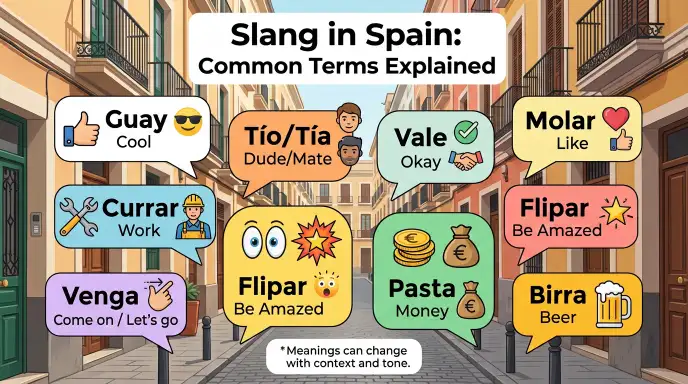
For example, expressions such as “guay,” “tío,” “vale,” “currar,” and “flipar” are common in informal Spanish from Spain.
If you are chatting with Spanish friends or watching Spanish content online, knowing these expressions can help you understand the real meaning behind the words.
Quick Answer: Slang in Spain refers to informal words and expressions commonly used in everyday Spanish conversations.
Many Spanish slang terms are friendly or casual, but some can be rude depending on context and tone.
What Does Slang in Spain Mean?
Slang in Spain means informal vocabulary and expressions used by people in Spain, especially in relaxed conversations. Spanish speakers may use slang with friends, family members, classmates, coworkers, or people they know well.
Unlike formal Spanish, slang is usually more relaxed and expressive. It can make a conversation sound more natural, humorous, emotional, or local.
For example:
- Guay = cool / great
- Tío = dude / mate
- Tía = girl / woman, often used like “dude” or “mate” among friends
- Vale = okay / alright
- Currar = to work
- Flipar = to be amazed or shocked
- Molar = to like / think something is cool
- Pasta = money
- Chaval = kid / young person
- Birra = beer
The exact meaning can change with the situation. A slang word may be friendly in one sentence but sound rude or disrespectful in another.
Common Slang in Spain
There is no single list that covers every informal expression used throughout Spain. Slang can vary by age, city, region, social group, and situation.
Here are some widely recognized informal Spanish expressions.
1. Guay
Guay means cool, great, or nice.
It is a common informal word and is usually positive.
Example:
“¡Tu coche es muy guay!”
Meaning:
“Your car is really cool!”
You might also hear guay in conversations about plans, clothes, places, movies, or experiences.
2. Tío and Tía
Tío literally means “uncle,” while tía literally means “aunt.” In informal speech in Spain, however, they can also mean something like “dude,” “guy,” “girl,” or “mate.”
Example:
“Tío, ¿qué haces?”
This can mean:
“Dude, what are you doing?”
Among friends, these words are very natural. However, they are informal and are not suitable for every professional situation.
3. Vale
Vale is one of the most recognizable informal expressions in Spain. It generally means “okay,” “alright,” or “got it.”
Example:
“Nos vemos a las ocho.”
“Vale.”
Meaning:
“See you at eight.”
“Okay.”
If you watch Spanish movies or shows, you may hear vale frequently.
4. Currar
Currar is an informal way to say “to work.”
The standard verb is trabajar, but currar is common in casual speech.
Example:
“Tengo que currar mañana.”
Meaning:
“I have to work tomorrow.”
It can also appear in related forms such as curro, which can refer informally to a job or work.
5. Molar
Molar is an informal verb meaning to like something or think something is cool.
Example:
“Me mola esta canción.”
Meaning:
“I really like this song.”
You may also hear:
“¿Te mola?”
Meaning:
“Do you like it?”
This expression is casual, so it is better suited to relaxed conversations than formal writing.
6. Flipar
Flipar is another common informal expression in Spain. Depending on the context, it can mean to be amazed, shocked, surprised, or extremely impressed.
Example:
“Vas a flipar cuando lo veas.”
Meaning:
“You’re going to be amazed when you see it.”
The related expression “fliparse” can have a different sense, such as getting carried away or exaggerating.
7. Pasta
In informal Spanish, pasta can mean money.
It is not referring to the food in this context.
Example:
“No tengo pasta.”
Meaning:
“I don’t have any money.”
This is a useful example of why context matters when learning Spanish slang.
8. Birra
Birra is an informal word for beer.
It is commonly heard in casual conversations.
Example:
“¿Vamos a tomar una birra?”
Meaning:
“Shall we go have a beer?”
Because it is informal, you would normally use it with friends rather than in a formal business setting.
9. Chaval and Chavala
Chaval can refer informally to a boy, kid, or young guy, while chavala is the feminine form.
Example:
“Ese chaval es muy simpático.”
Meaning:
“That guy is really nice.”
The precise feel depends on the speaker and context.
Is Slang in Spain Rude, Offensive, or Neutral?
Not all Spanish slang is rude. In fact, much of it is completely harmless and simply makes speech sound more casual.
You can broadly divide slang into three groups:
| Type | Examples | General Tone |
| Friendly | guay, tío, vale | Casual and positive |
| Informal | currar, molar, pasta | Relaxed |
| Potentially offensive | insults and swear words | Depends heavily on context |
The important point is context.
For example, calling a close friend “tío” can sound completely natural. Using informal language with a stranger, customer, teacher, or manager may sound too familiar.
Some Spanish swear words are also widely used casually among friends, but that does not make them appropriate everywhere.
Where Is Spanish Slang Commonly Used?
Slang in Spain appears in many informal communication settings.
Texting
Friends may use slang in WhatsApp messages, SMS, and other private chats. Informal vocabulary can make messages shorter and more natural.
Social Media
Spanish slang can appear on Instagram, TikTok, X, Snapchat, and other platforms. Young users may also combine traditional Spanish slang with internet abbreviations and memes.
Gaming
Spanis speaking gamers often use informal expressions while communicating through voice chat, Discord, or in game messages.
Everyday Conversation
This is where many Spanish slang terms are most naturally used. Conversations between friends often contain informal words that would not normally appear in formal documents.
Movies and TV Shows
Spanish language entertainment can be a useful way to hear slang in context. However, remember that characters may use stronger or more regional language depending on the story.
Real Life Examples of Slang in Spain
Understanding slang becomes easier when you see it in complete sentences.
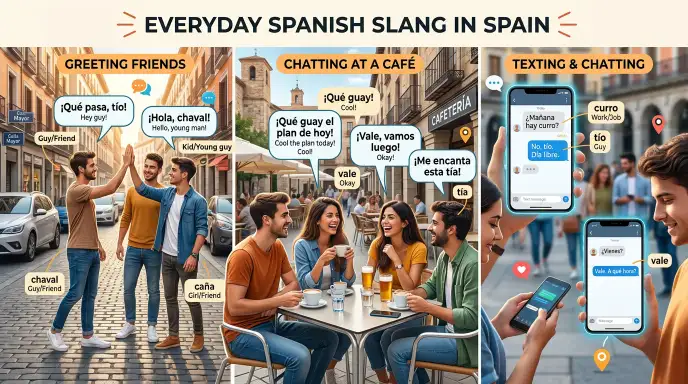
Friendly Example
“¡Tío, qué guay está tu camiseta!”
Meaning:
“Dude, your shirt is so cool!”
The tone is friendly and relaxed.
Casual Example
“Vale, nos vemos luego.”
Meaning:
“Okay, see you later.”
This is simple and informal.
Talking About Work
“Hoy tengo que currar hasta tarde.”
Meaning:
“Today I have to work until late.”
Here, currar replaces the standard trabajar.
Talking About Money
“Ese móvil cuesta mucha pasta.”
Meaning:
“That phone costs a lot of money.”
Here, pasta means money rather than food.
Talking About Something Exciting
“Vas a flipar con este sitio.”
Meaning:
“You’re going to be amazed by this place.”
The phrase expresses strong excitement or surprise.
Gaming or Social Media Context
“Tío, ese jugador es muy bueno.”
Meaning:
“Dude, that player is really good.”
A word like tío can make an online conversation sound more natural among friends.
Slang in Spain vs. Latin American Spanish
One of the biggest sources of confusion for Spanish learners is the difference between Spanish spoken in Spain and Spanish spoken across Latin America.
Spanish is a global language, but vocabulary changes from country to country.
For example, vale is strongly associated with everyday Spanish in Spain, while many Latin American speakers are more likely to use bueno, está bien, or another expression depending on the country and situation.
Likewise, tío can have a different feel outside Spain because its informal “dude/guy” use is especially characteristic of Spain.
This does not mean one form is correct and the other is wrong. They are simply different varieties of Spanish.
Why Do People Use Slang in Spain?
People use slang for many of the same reasons people use informal language in English.
To Sound Natural
Using only textbook vocabulary can sometimes make a conversation sound overly formal. Local slang can help speech feel more natural.
To Show Friendship
Words such as tío and tía can create a sense of familiarity between friends.
To Express Emotion
Informal words often communicate excitement, surprise, approval, frustration, or humor more strongly than formal vocabulary.
To Fit Into a Social Group
Young people, gamers, online communities, and local groups may develop expressions that help create a shared style of communication.
To Make Conversations More Relaxed
Slang can make ordinary conversations feel less formal and more personal.
Origin and Background of Spanish Slang
Spanish slang does not come from one single source. It develops over time through everyday speech, regional traditions, youth culture, popular entertainment, migration, music, and contact with other languages.
Some expressions have been used for generations, while others become popular for a shorter period.
This is why slang can change quickly. A word that is popular among young speakers today may become less common in the future, while another expression may spread through social media and become widely recognized.
Regional differences also matter. Spain has many linguistic communities and regional varieties, so an expression that is common in Madrid may not have exactly the same popularity in Andalusia, Catalonia, Galicia, the Basque Country, or other areas.
When Should You Avoid Spanish Slang?
If you are learning Spanish, it is usually safer to understand slang before actively using it.
Avoid unfamiliar slang when:
- Speaking in a formal job interview
- Writing a professional email
- Talking to an important client
- Speaking to a teacher or official
- Writing an academic paper
- You are unsure if a word is offensive
- You do not understand the regional meaning
A good rule is simple: listen first, then use it when you understand the context.
Polite Alternatives to Informal Spanish Slang
You do not always need slang to sound natural. Standard Spanish is often the safest choice.
| Informal Expression | More Neutral Alternative | Meaning |
| Guay | Genial / estupendo | Cool / great |
| Currar | Trabajar | To work |
| Molar | Gustar | To like |
| Pasta | Dinero | Money |
| Birra | Cerveza | Beer |
| Tío / tía | Persona / hombre / mujer | Person / man / woman |
The neutral alternatives are generally more appropriate for formal communication.
Common Mistakes When Using Slang in Spain
Assuming Every Spanish Speaking Country Uses the Same Slang
Spanish varies widely by country. Do not assume that a phrase common in Spain is equally common in Mexico, Argentina, Colombia, Chile, or other Spanish speaking countries.
Using Slang in Formal Situations
Even harmless slang can sound unprofessional in a formal setting.
Translating Slang Word for Word
A direct translation may not communicate the same feeling in English.
For example, translating tío literally as “uncle” can be completely wrong when it is being used as an informal form of address.
Using Strong Words Without Understanding Them
Some expressions that sound funny to learners may actually be vulgar or insulting. Always check the context before using unfamiliar slang.
Is Slang in Spain Safe for Social Media?
Most harmless Spanish slang is fine for social media. Words such as guay, vale, and molar are generally casual rather than offensive.
However, social media has a wide audience. A phrase that friends consider funny may be interpreted differently by strangers.
Before posting slang publicly, consider:
- Who will see the post?
- Is the word regional?
- Could it be insulting?
- Is it appropriate for your audience?
- Are you using the expression correctly?
This is especially important when slang contains insults, profanity, or culturally sensitive language.
Slang in Spain: Quick Comparison
| Spanish Slang | English Meaning | Tone |
| Guay | Cool / great | Friendly |
| Tío | Dude / mate | Very informal |
| Tía | Girl / mate | Very informal |
| Vale | Okay / alright | Casual |
| Currar | To work | Informal |
| Molar | To like / be cool | Informal |
| Flipar | Be amazed / shocked | Informal |
| Pasta | Money | Informal |
| Birra | Beer | Informal |
| Chaval | Kid / young guy | Informal |
FAQs About Slang in Spain
What is the most common slang in Spain?
There is no single “most common” slang word across every age group and region. Expressions such as vale, guay, tío, tía, currar, and molar are widely recognized in informal Spanish from Spain.
What does “guay” mean in Spain?
Guay usually means cool, great, or nice. It is informal and generally has a positive tone.
What does “tío” mean in Spanish slang?
In informal Spanish from Spain, tío can mean dude, guy, or mate when addressing or talking about someone. Its literal meaning is “uncle,” so context is important.
Is Spanish slang different in Spain?
Yes. Spain has many expressions that are especially associated with Spanish from Spain. Other Spanishspeaking countries have their own slang and informal vocabulary.
Is “vale” Spanish slang?
Vale is an informal everyday expression meaning “okay” or “alright.” It is especially common in Spain.
Can I use Spanish slang with native speakers?
Yes, but start with expressions you understand well. Friendly words such as vale and guay are generally easier for learners than regional expressions or strong insults.
Conclusion
Slang in Spain adds personality and natural expression to everyday Spanish. Words such as guay, tío, vale, currar, molar, flipar, pasta, and birra can help learners understand conversations that go beyond textbook Spanish.
The most important thing to remember is that slang depends heavily on context, region, age, relationship, and tone.
A word that sounds perfectly normal between close friends may be too informal for a workplace or formal conversation.
If you are learning Spanish, focus first on understanding how slang is used. Listen to native speakers, notice the situation, and then introduce informal expressions gradually.
This approach will help you sound more natural without accidentally using a word in the wrong situation.
Spanish slang is not simply a collection of unusual words. It reflects how people communicate in real life, build friendships, express emotions, and identify with their communities. Once you understand that context, informal Spanish becomes much easier to follow.
Discover More Articles!
- Welding Slang: 20 Terms Welders Commonly Use
- Honey Slang: Meaning, Uses, Examples & More
- IMS Meaning Text Slang: What Does IMS Mean in Text?

Hi, I’m Chloe Parker. I write simple and practical articles about slang, grammar, spelling, vocabulary, and commonly confused words. My goal is to make English easier to understand through clear explanations and real-life examples. Whether you’re a student, writer, or English learner, I’m here to help you build confidence and improve your everyday English.