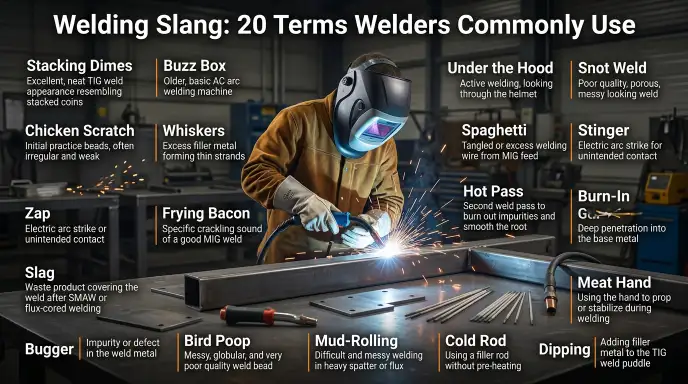
Welding slang is the informal language welders use to describe welding tools, techniques, weld quality, people, and common shop situations. Terms such as “stacking dimes,” “buzz box,” “stinger,” “snot weld,” and “under the hood” are examples of welding slang or shop talk.
If you are new to welding, these phrases can sound confusing at first. A welder may say “grab the stinger” instead of “electrode holder” or call a good looking bead a “stack of dimes.” The meaning usually becomes clear from the welding context.
This guide explains common welding slang, what each term means, where you may hear it, and if it is suitable for professional communication.
It also explains why some welding words are slang while others are simply shortened technical terms.
What Does Welding Slang Mean?
Welding slang means informal words and phrases used by welders in shops, fabrication areas, construction sites, and welding communities.
It is not one official vocabulary. Different shops, trades, regions, and generations may use different terms. Some expressions are widely recognized, while others may be local nicknames or workplace jokes.
For example:
- Stacking dimes = a weld bead with a regular, rippled appearance.
- Buzz box = an informal name for a small stick welder.
- Stinger = an electrode holder.
- Under the hood = actively welding with the helmet down.
- Snot weld = an ugly or poorly controlled weld.
- Zap = an informal way to describe striking or starting an arc.
Some of these terms are more widespread than others, so context matters.
20 Common Welding Slang Terms
Here are some of the most useful terms for beginners.
| Welding slang | Meaning | Typical tone |
| Stacking dimes | A neat weld bead with a regular ripple pattern | Positive |
| Buzz box | Small stick welder | Informal |
| Stinger | Electrode holder | Informal |
| Under the hood | Welding with a helmet down | Casual |
| Snot weld | Rough or ugly weld | Negative/joking |
| Chicken scratch | Sloppy or uneven weld | Negative |
| Whiskers | Thin wires sticking from a poor MIG weld | Negative |
| Spaghetti | Tangled MIG wire | Informal |
| Zap | Start or strike an arc | Casual |
| Frying bacon | Sound of a MIG welding arc | Casual |
| Hot pass | A weld pass made after the root pass | Shop/technical |
| Burn-in | Deep penetration into the base metal | Informal/technical |
| Slag | Flux-related material left over from some welds | Common shop term |
| Golden arm | Highly skilled welder | Positive |
| Meat hand | Skilled root-pass welder in some pipeline settings | Trade-specific |
| Bugger | Welder’s helper in some trade usage | Regional |
| Bird poop | Lumpy, poor-quality weld | Negative/joking |
| Mud-rolling | Excessive filler or poor welding technique | Negative |
| Cold rod | Electrode being used with too little heat/current | Informal |
| Dipping | Touching the tungsten into the weld pool during TIG | Casual/technical |
1. Stacking Dimes
“Stacking dimes” describes a weld bead with a regular, overlapping ripple pattern that resembles a row of stacked coins.
The phrase is especially associated with attractive TIG welds. MillerWelds also uses the expression for a good looking weld bead.
Example:
“That TIG bead looks like you’re stacking dimes.”
This is usually a compliment.
2. Buzz Box
A buzz box is an informal name for a small AC stick welder. The name comes from the buzzing sound often associated with these machines.
Example:
“The buzz box is in the garage.”
You may hear this term more in casual shop talk than in formal documentation.
3. Stinger
A stinger is a common informal name for an electrode holder used in stick welding.
Example:
“Pass me the stinger.”
A beginner may hear this and wonder what tool the speaker means. In formal instructions, electrode holder is clearer.
4. Under the Hood
Under the hood means someone is actively welding with their welding helmet down.
Example:
“Mike is under the hood right now.”
It can also simply mean that someone is busy welding and should not be interrupted.
5. Snot Weld
A snot weld is an informal and usually insulting description of a rough, messy, or poorly controlled weld. It is similar to other humorous shop terms for ugly welds.
Example:
“That looks more like a snot weld than a finished bead.”
This is shop slang, not a professional quality term.
6. Chicken Scratch
Chicken scratch describes a weld that looks uneven, uncontrolled, or messy.
Example:
“Clean that up; it looks like chicken scratch.”
It is normally negative and may be used as teasing between experienced and inexperienced welders.
7. Whiskers
Whiskers are thin wires that stick out from a MIG weld. They can occur when wire feeding or welding settings are not right.
Example:
“You’ve got a few whiskers sticking out of that weld.”
8. Spaghetti
In welding shop talk, spaghetti can refer to tangled MIG wire caused by a feeding problem.
Example:
“The wire turned into spaghetti again.”
This is informal and easy to understand once you see the problem.
9. Zap
A welder may use zap casually to mean starting or striking an arc or making a quick tack.
Example:
“Just zap it here for now.”
The exact meaning can depend on the shop and the speaker.
10. Frying Bacon
Frying bacon describes the sizzling, popping sound associated with a MIG welding arc. MillerWelds notes that this sound can be a familiar sign of a properly set-up MIG process, although sound alone should not be treated as a complete quality check.
Example:
“I like that frying-bacon sound.”
This is more of a colorful comparison than a formal welding term.
11. Hot Pass
Hot pass is a welding term used for a pass made after the root pass in certain multi-pass welds. It is often used in pipe and structural welding conversations.
Unlike some slang terms, hot pass has a technical meaning, so do not assume every welding phrase is pure slang.
Example:
“The root is done. Get ready for the hot pass.”
12. Burn-In
Burn-in can refer to deep penetration into the base material. The term can be used casually when welders discuss how deeply a weld is penetrating.
Example:
“That setting gives you good burn-in.”
The exact meaning can vary with the welding process and context.
13. Slag
Slag is the solid material left on top of certain welds after welding. It is commonly associated with flux based welding processes and must often be removed between passes or after welding.
Although welders commonly say slag, it is better described as a welding term than as internet style slang.
Example:
“Chip the slag before the next pass.”
14. Golden Arm
A golden arm is informal praise for a welder who produces excellent welds. The expression appears in welding slang lists describing people and their skill levels.
Example:
“She’s got a golden arm when it comes to pipe welding.”
This is positive shop talk.
15. Meat Hand
Meat hand is a more specialized term associated with pipeline welding. It can refer to a skilled welder who performs root passes, particularly in production pipeline work.
Because this term is trade-specific, a beginner should not assume everyone uses it.
16. Bugger
In some welding and fabrication settings, a bugger refers to a welder’s helper who prepares or cleans work and may assist with additional passes.
The meaning can vary by workplace, so context is important.
17. Bird Poop
Bird poop is humorous shop slang for a lumpy, ugly weld that looks like blobs dropped onto the metal.
Example:
“That bead looks like bird poop.”
It is clearly informal and should not be used in a formal inspection report.
18. Mud Rolling
Mud-rolling is used in some welding communities to criticize poor technique or excessive filler metal.
Example:
“Stop mud rolling and work on your control.”
It is usually negative and may sound insulting.
19. Cold Rod
A cold rod can refer informally to a stick electrode being used with insufficient heat/current for the job.
Example:
“That looks like a cold rod. Check your settings.”
The underlying issue is technical, even though the phrase may be casual.
20. Dipping
In TIG welding, dipping can mean accidentally touching the tungsten electrode to the weld pool or filler material.
This can contaminate the tungsten and require the welder to stop and regrind it. Welders also use the word casually in online welding discussions.
Example:
“I dipped the tungsten. Give me a minute to sharpen it.”
Welding Slang vs. Technical Welding Terms
Not every word welders use casually is actually slang.
This distinction is useful:
| Type | Example | What it means |
| True shop slang | Buzz box | Casual nickname for equipment |
| Informal description | Stacking dimes | Describes weld appearance |
| Humorous slang | Bird poop | Describes an ugly weld |
| Trade-specific slang | Meat hand | Used in some pipeline settings |
| Technical shorthand | Hot pass | Has a defined welding meaning |
| Technical term | Tack weld | A real welding technique |
| Technical term | Spatter | Molten droplets expelled during welding |
For example, spatter is a standard welding term for droplets of molten material expelled from the weld area.
This matters because beginners sometimes call every welding word “slang.” In reality, welding has a mix of formal terminology, abbreviations, shorthand, nicknames, and workplace slang.
Where Is Welding Slang Commonly Used?
Welding slang is most common in places where welders communicate informally.
Welding Shops
Shop floor conversations often use short terms because workers already understand the context.
“Grab the stinger.”
“Clean the slag.”
“I’m under the hood.”
Construction Sites
Construction crews may use welding slang when discussing equipment, weld passes, fit up, or job conditions.
Pipeline Welding
Pipeline welding has its own specialized vocabulary. Terms such as root pass, hot pass, and trade specific nicknames may appear more often here than in a small hobby shop.
Online Communities
Welding communities on Reddit, YouTube, Facebook, TikTok, and other platforms often use shop slang when discussing projects, mistakes, techniques, and equipment.
However, online usage is less standardized. One welder may use a phrase that another has never heard.
Workplace Chat
Slack, Microsoft Teams, and other workplace chats may contain informal welding language between coworkers.
For formal communication, technical terms are usually safer.
Is Welding Slang Rude or Offensive?
Most welding slang is harmless, but some terms can sound insulting.
Words such as stacking dimes and golden arm are positive. Terms such as snot weld, chicken scratch, bird poop, and mud rolling criticize poor work.
The tone matters.
Calling a close coworker’s weld “bird poop” may be friendly teasing. Saying the same thing to a customer or trainee in a serious meeting could sound disrespectful.
Some slang terms describing workers can also vary by region and workplace. Do not assume that a term used casually by one crew will be welcomed by another.
Can You Use Welding Slang at Work?
Yes, but use it carefully.
Informal welding slang is generally fine in casual conversations with coworkers who understand it.
For drawings, inspection reports, customer emails, procedures, certifications, and safety documents, use standard technical terminology.
For example:
Casual:
“That weld is a little ugly.”
Professional:
“The weld has visible irregularities and should be evaluated against the applicable acceptance criteria.”
The second version is clearer for formal communication.
Welding Slang on Different Platforms
| Platform | Typical use |
| Texting | Short shop terms and jokes |
| TikTok | Humorous welding phrases and visual demonstrations |
| YouTube | Mix of slang and technical explanations |
| Heavy use of community and shop language | |
| Discord | Casual conversation among welding communities |
| Workplace chat | Informal shorthand between coworkers |
| Reports | Standard technical language is preferred |
Online welding communities also show how meanings can vary. A term that seems obvious to one welder may be unfamiliar to someone trained in a different process or region.
Origin and History of Welding Slang
There is no single documented origin for welding slang.
Much of it developed naturally inside welding shops, fabrication trades, construction crews, and pipeline work. Workers created short, visual, or humorous names for tools, weld appearances, mistakes, and people.
For example, “stacking dimes” comes from the visual similarity between a rippled weld bead and a row of coins. “Buzz box” is a nickname associated with the sound and type of a small stick welder.
Other terms are more specialized. Pipeline welding, for example, has developed its own workplace vocabulary over time.
Because these expressions spread through spoken workplace culture, their exact first use dates are often difficult to prove.
A reliable welding source may document a term’s current use without being able to establish who coined it.
Similar Welding Slang and Related Terms
If you are learning welding vocabulary, you may also encounter:
- Burner :informal term sometimes used for a welder.
- Tacker : someone making tack welds.
- Stick : common informal name for stick welding.
- Stinger :electrode holder.
- Heliarc :older trade term associated with TIG/GTAW welding.
- Arc eye :informal name for painful eye injury caused by excessive UV exposure.
- Spatter :molten droplets expelled during welding.
- Tack weld : small weld used to hold parts in position.
- Stringer bead : a relatively narrow weld bead made with little or no weaving.
- Weave :side to side movement used during some welding operations.
For example, “stick” is widely used as a short name for SMAW, or shielded metal arc welding, because the electrode is stick-shaped.
When Should You Avoid Welding Slang?
Avoid welding slang when clarity, safety, or professionalism matters more than casual conversation.
Use standard terminology when:
- Writing safety instructions.
- Communicating with customers.
- Preparing inspection records.
- Writing welding procedures.
- Taking a certification exam.
- Speaking with someone new to welding.
- Describing a defect that needs formal evaluation.
- Communicating across different countries or trades.
For example, saying “clean the snot weld” may make sense among coworkers, but a formal report should describe the actual weld condition.
This is especially important for safety related communication. A nickname should never replace a clear instruction when misunderstanding could cause an accident.
Common Misunderstandings About Welding Slang
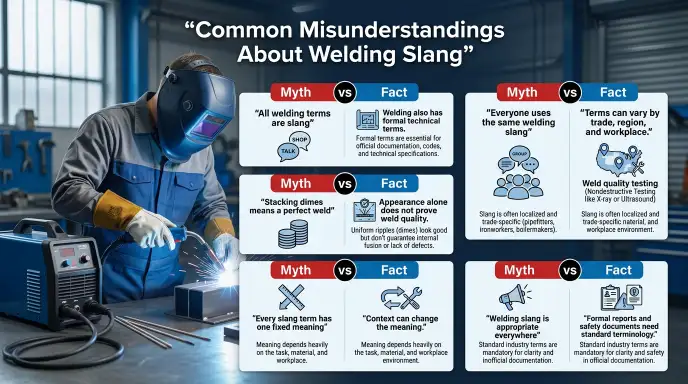
“All welding terms are slang.”
Not true. Welding has formal technical terminology as well as informal shop language.
“Everyone uses the same welding slang.”
Not true. Terms can vary by trade, location, employer, experience, and generation.
“Stacking dimes always means a perfect weld.”
Not necessarily. It usually praises the appearance of a weld bead, but visual appearance alone does not prove that a weld meets technical or structural requirements.
“A slang term has one fixed meaning.”
Not always. Some expressions have different meanings in different welding communities.
“Slang is appropriate in every workplace.”
No. Casual shop talk and formal welding documentation have different communication needs.
Frequently Asked Questions
What is welding slang?
Welding slang is informal language used by welders to describe tools, techniques, welds, people, mistakes, and everyday situations. Examples include stinger, buzz box, stacking dimes, and under the hood.
What does “stacking dimes” mean in welding?
“Stacking dimes” describes a weld bead with a regular, rippled appearance that resembles a row of stacked coins. It is usually a positive comment, especially when discussing TIG welds.
What is a stinger in welding slang?
A stinger is an informal name for the electrode holder used in stick welding.
What does “under the hood” mean in welding?
“Under the hood” means a welder is actively welding with their helmet down. It can also simply mean that the person is busy welding.
What does “buzz box” mean?
A buzz box is a nickname for a small stick welder, particularly an AC stick machine.
What does “snot weld” mean?
A snot weld is informal slang for an ugly, rough, or poorly controlled weld. It is not a formal weld quality classification.
Is welding slang used on social media?
Yes. Welding slang appears in online welding communities, videos, comments, and discussions. However, not every term is understood by every welder.
Is welding slang professional?
Some welding slang is normal in casual shop conversations, but formal documents, reports, customer communication, and safety instructions should use clear technical language.
Why do welders use slang?
Slang makes shop communication quick, familiar, and sometimes humorous. Many terms describe what something looks or sounds like, making them easy to remember.
Conclusion
Welding slang is the informal language that grows around welding shops, construction crews, fabrication work, pipeline jobs, and online welding communities.
Terms such as stacking dimes, buzz box, stinger, under the hood, and snot weld can make conversations much easier to understand once you know what they mean.
The key point is that welding slang is not one universal dictionary. Some expressions are widely known, while others are specific to a trade, region, or workplace.
Even terms that sound like slang, such as hot pass, spatter, or tack weld, may have established technical meanings.
If you are new to welding, learn both kinds of language. Use slang to understand casual conversations, but use standard welding terminology whenever safety, inspection, certification, or professional communication is involved.
Read more about!
- What Does PH Mean in Slang Meaning in Text?
- British Slang for Weight Person Meaning in Text
- KMT Slang Meaning: What It Means in Text, Social Media & Chat

Hi, I’m Chloe Parker. I write simple and practical articles about slang, grammar, spelling, vocabulary, and commonly confused words. My goal is to make English easier to understand through clear explanations and real-life examples. Whether you’re a student, writer, or English learner, I’m here to help you build confidence and improve your everyday English.