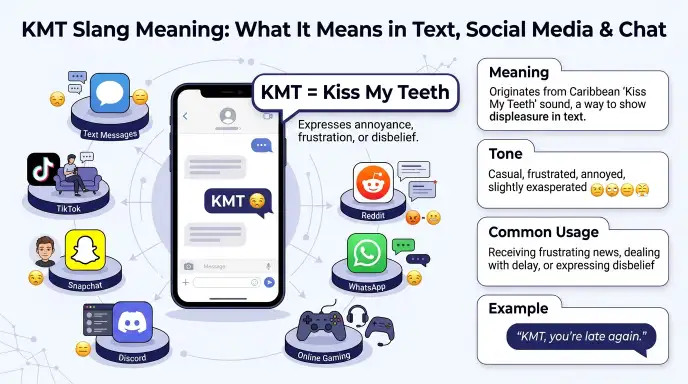
KMT slang meaning is “Kiss My Teeth,” a popular British slang expression used to show annoyance, frustration, disappointment, or disbelief. Instead of literally kissing their teeth, many people simply type KMT in messages or social media posts to express how they feel.
Many people search for KMT slang meaning after seeing it on TikTok, Snapchat, Instagram, Discord, Reddit, or in text messages.
If you’re unfamiliar with British internet slang, the abbreviation can be confusing because its meaning changes depending on the conversation.
In this guide, you’ll learn the exact KMT slang meaning, what it stands for, where it came from, when people use it, if it’s considered rude, and how to understand it in real-life conversations. By the end, you’ll know when KMT fits naturally and when it’s better to avoid using it.
Quick Answer
KMT means “Kiss My Teeth.” It is a British slang abbreviation used to express irritation, disappointment, disbelief, or annoyance. Online, people type KMT instead of making the actual “kiss teeth” sound.
For example:
“KMT… the bus left without me.”
The writer isn’t telling someone to kiss their teeth. They’re simply showing frustration.
What Does KMT Slang Meaning?
The KMT slang meaning is “Kiss My Teeth.” It describes both:
- A real gesture where someone makes a sucking or clicking sound with their teeth.
- An internet abbreviation people type in chats and social media.
The expression usually communicates emotions like:
- Annoyance
- Frustration
- Disappointment
- Disbelief
- Mild anger
- Feeling fed up
Unlike insults, KMT often expresses the speaker’s feelings rather than directly attacking another person.
Simple examples
- KMT, I forgot my homework again.
- KMT… why is the train delayed?
- KMT, that’s so unfair.
In each example, KMT replaces a sigh or an eye roll.
What Does KMT Stand For?
KMT stands for:
Kiss My Teeth
The phrase comes from the physical action of “kissing” or sucking the teeth, a well-known expression in several cultures. The sound is often used to show irritation without saying anything.
Online, people shorten the phrase to KMT because it’s quicker to type.
Full Form Table
| Abbreviation | Full Form | Meaning | Tone |
| KMT | Kiss My Teeth | Showing frustration or annoyance | Informal |
| KMT | Internet slang | Expresses disappointment | Casual |
| KMT | Text abbreviation | Similar to saying “Seriously?” | Emotional |
Although some people may suggest other meanings based on context, “Kiss My Teeth” is by far the most common slang definition used in texting and social media.
Different Meanings of KMT
Most people use KMT to mean Kiss My Teeth, but context always matters.
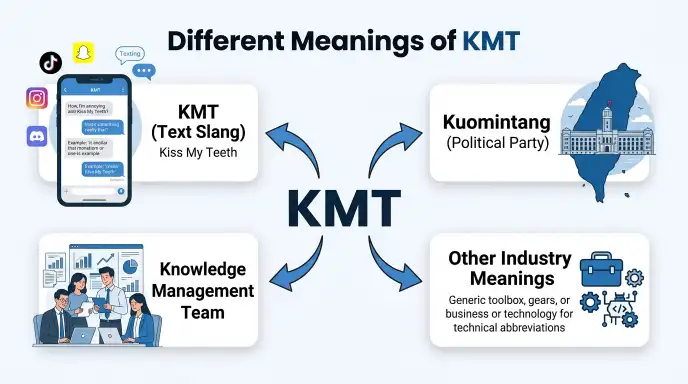
1. KMT as “Kiss My Teeth” (Most Common)
This is the meaning you’ll see most often in:
- Text messages
- TikTok comments
- Instagram replies
- Snapchat chats
- Discord conversations
- Reddit discussions
- X (formerly Twitter)
Example:
“KMT, I stayed up all night for nothing.”
Here, the person is expressing disappointment.
2. KMT in Non-Slang Contexts
Outside internet slang, KMT can represent completely different things.
For example, it may be used as an abbreviation for:
- Company names
- Organizations
- Technical terms
- Academic subjects
These meanings depend entirely on the topic being discussed and are not related to internet slang.
If you’re reading a social media comment or text message, KMT almost always means “Kiss My Teeth.”
Where Is KMT Commonly Used?
KMT is most closely associated with British English, especially among younger people and online communities.
You’ll often see it on:
| Platform | How KMT Is Used |
| TikTok | Reacting to frustrating videos or comments |
| Snapchat | Casual conversations with friends |
| Commenting on annoying situations | |
| Discord | Gaming chats and group discussions |
| Sharing reactions to stories or opinions | |
| X (Twitter) | Quick emotional responses |
| Everyday texting with friends |
Because internet slang spreads quickly, people outside the UK may also use or recognize KMT, though it remains much more common in British online culture.
Who Uses KMT?
KMT is especially popular among:
- Teenagers
- Young adults
- Social media users
- Gamers
- Students
- Friends chatting online
Parents, teachers, and older adults may not recognize the abbreviation unless they’re familiar with modern internet slang.
Is KMT Used Outside the UK?
Yes, but not as often.
The abbreviation has spread through social media platforms like TikTok, Instagram, Snapchat, and Discord. As a result, people in countries such as Canada, the United States, Australia, and other English-speaking regions may understand it.
However, KMT remains much more common in the UK, particularly in communities influenced by London slang and Caribbean cultural expressions.
When Do People Type KMT?
People usually type KMT when they want to react quickly without writing a long sentence.
Common situations include:
- Missing the bus
- Losing a game
- Receiving bad news
- Being ignored
- Seeing something unfair
- Feeling disappointed
- Reacting to a friend’s mistake
Instead of writing:
“I’m really annoyed.”
Someone may simply type:
“KMT.”
It immediately tells readers how they feel while keeping the conversation short.
Is KMT Rude, Offensive, or Harmless?
KMT is usually considered mildly rude rather than highly offensive. It expresses irritation or frustration, but it is generally less aggressive than using swear words.
IF it sounds harmless or rude depends on who you’re talking to, your tone, and the situation.
When KMT is harmless
People often use KMT jokingly with close friends.
Examples:
- KMT, you beat me again! 😂
- KMT… I forgot my charger.
- KMT, it’s raining on my day off.
In these cases, it simply shows annoyance.
When KMT may sound rude
KMT can seem disrespectful if you use it:
- With a teacher
- In a workplace chat
- During a serious discussion
- When speaking to someone older who may not understand slang
- As a reply to someone trying to help you
Example:
Manager: “Can you send the report today?”
Reply: “KMT.”
This response could appear dismissive or unprofessional.
Is KMT offensive?
Usually no. Most people see it as a casual expression of frustration.
However, because it comes from a gesture that signals disapproval, some people may interpret it as disrespectful if directed at them. It’s best to use it with friends who understand the expression.
Real Life Examples of KMT
Here are realistic examples showing how KMT is used in different situations.
Text Message
Friend: “The movie starts in five minutes.”
You: “KMT… I’m still stuck in traffic.”
TikTok Comment
“KMT, why does this always happen to me?”
Snapchat
Friend: “I forgot your birthday.”
Reply: “KMT 😂”
The emoji softens the message and makes it playful.
Discord Gaming Chat
Player 1: “We lost again.”
Player 2: “KMT, we were winning!”
Instagram Comment
“KMT… my package got delayed again.”
Reddit Discussion
“KMT, I spent hours fixing this problem and it came back.”
Everyday Conversation
Although KMT is usually typed online, some people may also say “kiss my teeth” aloud.
Example:
“Kiss my teeth… I can’t believe that happened.”
Origin and History of KMT
KMT comes from the expression “kiss my teeth,” which refers to making a sucking or clicking sound with the teeth to show annoyance or frustration.
The gesture has long been used in several Caribbean cultures, especially Jamaica and Trinidad and Tobago, as well as in other parts of the Caribbean.
Through migration and cultural influence, it became part of everyday speech in many multicultural communities in the United Kingdom, particularly in London.
As texting and social media became more popular in the 2000s and 2010s, people began shortening “kiss my teeth” to KMT in online conversations.
Today, KMT is commonly seen across platforms such as:
- TikTok
- Snapchat
- Discord
- X (formerly Twitter)
While KMT is now recognized in many countries, its strongest connection remains with British online slang influenced by Caribbean speech and culture.
Similar Slang and Related Terms
If you understand KMT, you’ll probably come across these similar expressions too.
| Slang | Meaning | Similar to KMT? |
| SMH | Shaking My Head | Yes, shows disappointment |
| Ugh | Frustration or annoyance | Yes |
| Seriously? | Disbelief | Yes |
| Bruh | Frustration or surprise | Sometimes |
| Facepalm | Embarrassment or disbelief | Yes |
| FFS | Shows stronger frustration | More intense than KMT |
| Eye roll | Silent annoyance | Very similar in meaning |
KMT vs SMH
| KMT | SMH |
| More common in British slang | Used worldwide |
| Comes from a real gesture | Describes a head movement |
| Expresses annoyance or disbelief | Expresses disappointment or disbelief |
| Less common in American English | Common across many English-speaking countries |
When Should You Avoid Using KMT?
Although KMT is common in casual conversations, it isn’t suitable everywhere.
Avoid using KMT in:
- Business emails
- Job applications
- Professional meetings
- School assignments
- Academic writing
- Formal customer service messages
- Conversations with people who may not understand internet slang
It’s also best to avoid using KMT if someone has shared serious or upsetting news. In those situations, a respectful response is more appropriate.
Better choices in formal settings
Instead of writing:
“KMT, this project is taking forever.”
You could say:
“I’m feeling frustrated because the project is taking longer than expected.”
This sounds more professional and respectful.
Polite Alternatives to KMT
If you want to express frustration without using slang, try one of these phrases:
| Instead of KMT | You Can Say |
| KMT | That’s frustrating. |
| KMT | I can’t believe it. |
| KMT | That’s disappointing. |
| KMT | Seriously? |
| KMT | Oh no. |
| KMT | What a shame. |
| KMT | That’s unfortunate. |
These alternatives are suitable for:
- School
- Work
- Emails
- Speaking with teachers
- Talking to customers
- Professional communication
Using clear language instead of slang helps avoid misunderstandings, especially when your audience may not be familiar with internet abbreviations.
Why Do People Use KMT?
People use KMT because it is a quick way to show emotions without typing a full sentence. It adds personality to messages and lets others know the writer feels annoyed, disappointed, or surprised.
Common reasons people use KMT include:
- To express frustration quickly
- To react to bad news
- To show disbelief
- To make chats feel more natural
- To join in with internet slang and online culture
- To replace longer phrases like “I’m so annoyed” or “Seriously?”
For example:
KMT, my phone battery died right before the concert.
A single abbreviation communicates the speaker’s mood without needing a long explanation.
Common Misunderstandings About KMT
Because KMT is an abbreviation, people sometimes misunderstand what it means. Here are some common misconceptions.
| Myth | Reality |
| KMT is an insult. | Not usually. It mainly expresses the speaker’s frustration. |
| KMT is only used on TikTok. | No. It’s common on WhatsApp, Snapchat, Instagram, Discord, Reddit, and X. |
| Everyone uses KMT. | No. It’s much more common in the UK than in many other countries. |
| KMT always means the same thing. | In slang, it usually means “Kiss My Teeth,” but in other fields it can have unrelated meanings. |
| KMT is appropriate everywhere. | No. It’s best reserved for casual conversations. |
Understanding the context is the easiest way to interpret KMT correctly.
Frequently Asked Questions
What does KMT slang mean?
KMT means “Kiss My Teeth.” It is a British slang abbreviation used to show annoyance, disappointment, frustration, or disbelief in texts and online conversations.
What does KMT stand for?
KMT stands for Kiss My Teeth, referring to a gesture and expression that shows irritation.
Is KMT a bad word?
No. KMT is not a swear word, but it can sound slightly rude or dismissive depending on the situation and tone.
Is KMT used in texting?
Yes. KMT commonly used in:
- Text messages
- Snapchat
- TikTok
- Discord
- X (formerly Twitter)
Is KMT British slang?
Yes. KMT is primarily British slang and is especially common in London and other parts of the UK. Its widespread use influenced by Caribbean cultural expressions.
Can I use KMT at work?
It’s generally not recommended. KMT is informal slang and may seem unprofessional in workplace conversations, emails, or meetings.
Is KMT popular among teenagers?
Yes. Teenagers and young adults are among the most frequent users of KMT, particularly on social media and messaging apps.
Does KMT always mean “Kiss My Teeth”?
In internet slang, almost always yes. However, in business, education, or technical fields, KMT may represent different organizations or terms, so context is important.
Conclusion
The KMT slang meaning is “Kiss My Teeth,” a popular British internet expression used to show frustration, disappointment, annoyance, or disbelief.
Instead of typing a long explanation, people simply write KMT to let others know how they feel.
Although KMT is widely recognized on platforms like TikTok, Snapchat, Instagram, Discord, Reddit, WhatsApp, and X, it remains most closely associated with British English and communities influenced by Caribbean culture.
It’s a useful abbreviation in casual chats but should generally be avoided in professional or formal communication.
Whenever you see KMT in a message, look at the surrounding conversation. In most cases, it’s simply someone reacting to an annoying or disappointing situation not trying to insult anyone.
Understanding the context will help you interpret the expression correctly and decide if it’s appropriate to use yourself.
Read more about!
- What’s Up in French Slang Meaning in Text
- Slang in Spain: Common Terms Explained
- British Slang for Weight Person Meaning in Text

Hi, I’m Chloe Parker. I write simple and practical articles about slang, grammar, spelling, vocabulary, and commonly confused words. My goal is to make English easier to understand through clear explanations and real-life examples. Whether you’re a student, writer, or English learner, I’m here to help you build confidence and improve your everyday English.