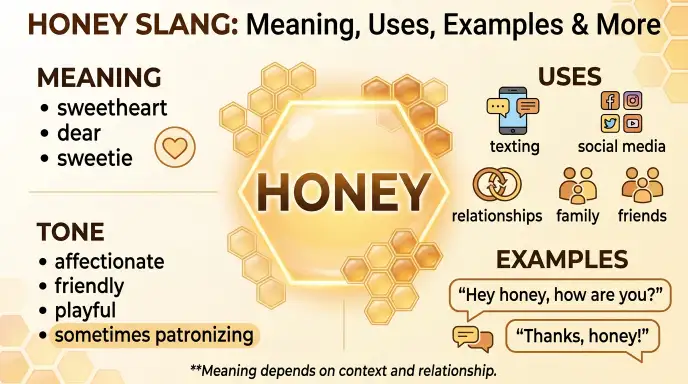
Honey slang usually means using “honey” as a friendly, affectionate, or romantic way to address someone. It can mean something like “dear,” “sweetheart,” “darling,” or “sweetie.”
You may see honey slang in text messages, conversations, social media comments, movies, and everyday speech.
Depending on the relationship and tone, it can sound loving, friendly, playful, or even slightly patronizing.
That is why the same word can feel warm in one conversation and uncomfortable in another.
This guide explains the honey slang meaning, where it comes from, how people use it in texting and social media, if it is rude, and when you should avoid it.
You will also find realistic examples and simple alternatives such as dear, sweetie, darling, and babe.
Quick Answer
Honey slang is an informal term of affection used to call someone “dear,” “sweetheart,” or “sweetie.”
It is commonly used with romantic partners, family members, close friends, and sometimes strangers. Its meaning depends heavily on the relationship, situation, and tone. For example:
“Hey honey, how was your day?”
Here, honey shows warmth or affection. It does not refer to the food made by bees.
What Does Honey Mean in Slang?
In slang and informal speech, honey is mainly a term of endearment. A term of endearment is a word used to show affection or closeness.
When someone says:
- “Good morning, honey.”
- “Thanks, honey!”
- “Are you okay, honey?”
- “I love you, honey.”
they are usually expressing warmth rather than giving the word its literal meaning.
The word can be used for different kinds of relationships:
| Context | Meaning | Tone |
| Romantic partner | Sweetheart or loved one | Loving |
| Parent to child | Dear or sweetie | Caring |
| Close friend | Dear or sweetie | Friendly |
| Older person to someone else | Friendly form of address | Warm or familiar |
| Stranger | Casual term of address | Depends on tone |
| Sarcastic comment | Can sound patronizing | Negative |
Merriam Webster also lists “sweetheart” and “dear” as meanings of honey and notes that it can refer to an attractive woman.
Is Honey a Slang Word or a Nickname?
Honey is better described as an informal term of endearment than as modern internet slang.
This distinction matters. Unlike abbreviations such as “LOL” or newer slang such as “rizz,” honey has been used as an affectionate form of address for centuries. It is still common today, especially in spoken English.
You may also see shortened forms such as:
- Hon
- Hun
These are informal spellings or shortened forms used in messages and casual conversation. However, “hun” can have its own regional or social associations, so it should not always be treated as exactly the same word.
Different Meanings of Honey Slang
The meaning of honey slang can change with context. Here are the main uses.
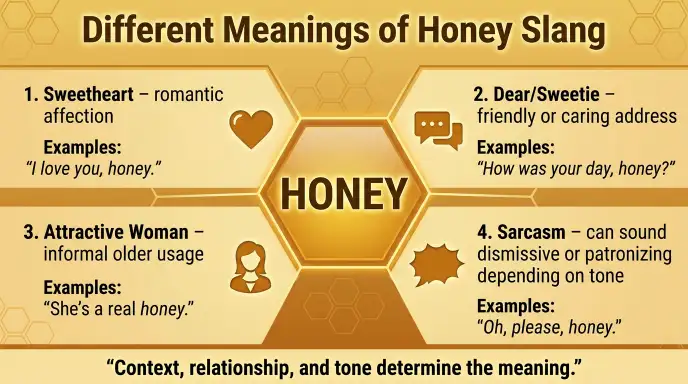
1. Honey Means “Sweetheart”
This is the most common affectionate meaning.
Example:
“I missed you, honey.”
The speaker is talking to someone they care about, often a romantic partner.
2. Honey Means “Dear” or “Sweetie”
It does not always indicate romance.
A parent may say:
“Come here, honey.”
A friend might say:
“Honey, you forgot your phone.”
In these cases, the word can show care or friendliness without romantic meaning.
3. Honey Can Refer to an Attractive Woman
Merriam Webster includes an informal sense of honey meaning an attractive woman. For example:
“He said she was a real honey.”
This use is different from directly calling someone “honey” as a term of affection. It can also sound old fashioned today.
4. Honey Can Be Used Sarcastically
Context can completely change the feeling.
For example:
“Sure, honey. Whatever you say.”
This might sound affectionate between close friends, but it could also sound dismissive or patronizing.
That is one reason you should pay attention to tone, relationship, and situation instead of assuming that “honey” is always positive.
Where Is Honey Slang Commonly Used?
Honey appears in many forms of communication, including speech, texting, and online conversations.
Text Messages
In texts, honey often sounds warm and personal:
“Goodnight honey ❤️”
“Thanks for helping me, honey!”
The meaning is usually clear when the people already know each other well.
TikTok and Instagram
On social platforms, people may use honey in captions, comments, or replies.
For example:
“You look amazing, honey!”
Depending on the relationship, this may be sincere, playful, or simply a casual way of speaking.
Discord and Online Communities
In gaming or community chats, someone might write:
“You got this, honey!”
However, it is not a special gaming term. The same affectionate meaning applies outside gaming.
On Reddit and other discussion forums, “honey” can appear in friendly replies, but it may also be used sarcastically. Community discussions show that some people find the word warm while others interpret it as condescending when used by strangers.
Workplace Chat
This is where caution is useful.
Calling a close partner or longtime friend honey is different from calling a coworker honey. In a professional setting, the word may feel overly personal or patronizing.
For workplace communication, using the person’s name is usually safer.
Is Honey Slang Rude or Offensive?
Honey is not inherently rude or offensive, but it can sound inappropriate depending on who says it and how it is said.
Among romantic partners, it is usually affectionate.
Between family members, it can sound caring.
Between strangers, reactions can vary.
For example:
“Thanks, honey!”
A friendly speaker may mean this warmly. But another person may feel that the speaker is being too familiar.
The issue is not normally the word itself. The issue is social distance and tone.
A gentle voice can make “honey” sound caring. A sarcastic voice can make the same word sound insulting.
Honey Slang: Real Life Examples
Here are examples showing how the meaning changes by situation.
Romantic
“Honey, do you want to order pizza tonight?”
Meaning: A loving way to address a partner.
Family
“Honey, remember to take your lunch.”
Meaning: A caring way for a parent or family member to address someone.
Friends
“Honey, you seriously need to see this video.”
Meaning: Playful or affectionate friendship.
Customer Service
“Your table is ready, honey.”
Meaning: A friendly form of address in some speaking styles or regions.
Social Media
“Honey, that outfit looks amazing!”
Meaning: A warm compliment.
Sarcasm
“Oh, honey, you really believed that?”
Meaning: Potentially teasing, dismissive, or patronizing.
The surrounding words and tone tell you which meaning is intended.
Where Did Honey Slang Come From?
The affectionate use of honey is much older than modern texting or social media.
The literal word comes from Old English hunig, from Proto Germanic *hunang. The exact deeper origin is uncertain.
The term of endearment meaning dates back to at least the 14th century. Cambridge research on English terms of endearment lists honey around 1375, showing that its affectionate use is centuries old.
The connection is easy to understand: honey is sweet, so the word developed an affectionate association with people considered sweet or loved.
This means it would be inaccurate to describe honey as a slang word that started with Gen Z, texting, TikTok, or another recent online trend. Its affectionate meaning is far older than the internet.
Honey in American vs. British English
Usage can vary by region.
In American English, honey is a familiar term of endearment and is especially common in informal speech. Collins labels the affectionate sense mainly US and Canadian.
In British English, honey is understood, but other terms such as love, dear, or darling may be more natural in some situations.
This does not mean British speakers never use honey. It simply means the word can have different levels of familiarity depending on the speaker and region.
Similar Slang and Terms of Endearment
If you understand honey, you will probably also recognize these words:
| Term | Common meaning | Typical tone |
| Sweetie | Dear or loved person | Warm |
| Sweetheart | Loved or cherished person | Affectionate |
| Darling | Dear person | Affectionate |
| Babe | Romantic partner or attractive person | Casual |
| Dear | Person you care about | Warm or polite |
| Hun | Short form of honey | Casual |
| Love | Affectionate address | Regional/casual |
| Baby | Romantic term or affectionate address | Intimate |
Cambridge lists words such as sweetheart, darling, dear, sweetie, and beloved among terms related to honey.
When Should You Avoid Using Honey?
Although honey is usually harmless, there are situations where another word is a better choice.
Avoid using it when:
- You are speaking to a stranger who may dislike familiar language.
- You are writing a formal business email.
- You are addressing a teacher or professor in a professional setting.
- You are talking to a customer and do not know their preference.
- The relationship is new and you are unsure how the person feels.
- The word could sound sarcastic or patronizing.
- The person has already indicated that they dislike terms of endearment.
A simple rule works well:
If you are unsure, use the person’s name instead.
Polite Alternatives to Honey
If you want to sound friendly without being overly familiar, try:
- Dear
- Friend
- Everyone
- Hi [name]
- Thanks, [name]
- My friend
For romantic relationships, alternatives include:
- Sweetheart
- Darling
- Babe
- Sweetie
- Love
The best choice depends on your relationship and the level of closeness you want to show.
Why Do People Use Honey?
People use honey because it adds emotional warmth to a sentence.
Compare:
“Are you okay?”
with:
“Are you okay, honey?”
The second version can sound more caring and personal.
People may use it to:
- Show affection.
- Make a conversation feel warmer.
- Comfort someone.
- Address a romantic partner.
- Show friendliness.
- Add playful emotion.
- Create a familiar or caring tone.
Its meaning is therefore more about relationship and emotion than about slang itself.
Common Misunderstandings About Honey Slang
“Honey always means a romantic partner.”
Not true. Parents, relatives, friends, and even strangers may use it affectionately.
“Honey is new internet slang.”
No. Its use as a term of endearment dates back to the Middle English period, centuries before social media.
“If someone calls me honey, they are flirting.”
Not necessarily. It can be friendly, caring, regional, or romantic.
“Honey is always polite.”
Not always. Depending on the speaker and tone, it can feel patronizing or overly familiar.
“Honey means the same thing everywhere.”
No. Regional speech habits and personal preferences affect how the word is received.
Frequently Asked Questions
What does honey mean in slang?
Honey usually means dear, sweetheart, sweetie, or someone you care about. It is an informal term of affection.
Is honey a romantic word?
It can be romantic, but it is not always romantic. Parents, friends, relatives, and other speakers may use it without romantic intent.
What does honey mean in texting?
In texting, honey usually shows affection, warmth, or friendliness. The exact meaning depends on who sent it and the surrounding message.
Is honey rude?
Usually not. However, calling a stranger or coworker “honey” can sometimes feel too personal, patronizing, or unwelcome.
Is honey appropriate at work?
Usually, it is better to avoid it in professional communication. Use the person’s name or a neutral greeting instead, especially if you do not know them well.
Is honey an abbreviation?
No. Honey is not an abbreviation or acronym, so it does not have a “full form.” Words such as “hon” or “hun” can be shortened forms used informally.
What is another word for honey slang?
Common alternatives include sweetie, sweetheart, darling, dear, babe, and love. The best alternative depends on the relationship and region.
Is honey used on TikTok and Instagram?
Yes, people can use honey in comments, captions, and messages. However, it is not a platform specific TikTok or Instagram abbreviation. It keeps its general meaning as an affectionate or familiar form of address.
Conclusion: What Does Honey Slang Mean?
Honey slang usually refers to using honey as an affectionate way to address someone, similar to “dear,” “sweetheart,” or “sweetie.” It can appear in romantic conversations, family speech, friendly chats, texts, comments, and everyday conversation.
The most important thing to remember is that context controls the tone. “Honey” can sound loving when used by a partner, caring when used by a parent, friendly when used by someone familiar, or patronizing when used by a stranger.
It is also not a new internet expression. The affectionate meaning of honey goes back to at least the 14th century, long before texting and social media.
So, if someone calls you honey, do not automatically assume they are flirting. Look at the relationship, message, tone, and situation first. When you are unsure if it is appropriate to use yourself, a person’s name is the safest choice.
Read more about!
- IMS Meaning Text Slang: What Does IMS Mean in Text?
- What Is Gen Gay Slang? Meaning, Uses & Examples
- It Is What It Is in Spanish Slang Meaning in Text

Hi, I’m Chloe Parker. I write simple and practical articles about slang, grammar, spelling, vocabulary, and commonly confused words. My goal is to make English easier to understand through clear explanations and real-life examples. Whether you’re a student, writer, or English learner, I’m here to help you build confidence and improve your everyday English.