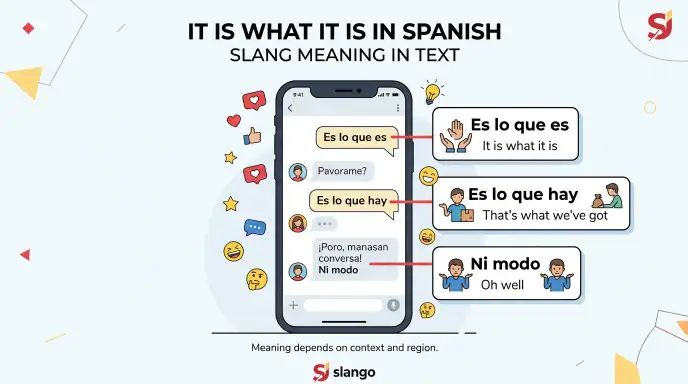
It is what it is in Spanish slang can be expressed in several natural ways, depending on the country and situation. If you are texting a Spanish speaking friend, watching a TikTok, reading a Reddit comment, or translating a conversation, you may see phrases such as “es lo que hay,” “es lo que es,” “así son las cosas,” or “ni modo.”
These expressions share the same basic idea: something happened, you cannot easily change it, and you have to accept the situation. However, they are not perfect substitutes in every context. Some sound more neutral, while others feel more casual, regional, resigned, or even humorous.
Quick Answer
The closest common Spanish expressions for “it is what it is” are “es lo que es” and “es lo que hay.” In Mexican Spanish, “ni modo” can also express the same resigned feeling: “Oh well,” “Nothing can be done,” or “It is what it is.”
What Does “It Is What It Is” Mean in Spanish Slang?
In English, “it is what it is” is usually said when someone accepts an unpleasant, disappointing, or unavoidable situation.
For example:
“The tickets are sold out. It is what it is.”
The speaker is not necessarily happy about the situation. They simply recognize that there is little they can do about it.
Spanish does not have one single slang phrase that works identically in every Spanish speaking country. Instead, speakers choose different expressions according to their region and the exact feeling they want to communicate.
Some of the most useful options are:
- Es lo que es : “It is what it is.”
- Es lo que hay :roughly, “It is what there is / This is what we have.”
- Así son las cosas : “That’s how things are.”
- Así es :“That’s how it is.”
- Ni modo : “Oh well / Nothing can be done.”
- Qué se le va a hacer : “What can you do?”
- Así es la vida :“That’s life.”
The best choice depends heavily on the country, relationship, and situation.
“It Is What It Is” Full Form and Definition
There is no special acronym or shortened full form for this expression. It is a complete English phrase.
In Spanish, the closest direct translation is:
Es lo que es.
The phrase literally means “It is what it is.” SpanishDictionary also lists “las cosas son como son” and “es lo que hay” as natural ways to convey the same general idea.
However, a literal translation is not always the most natural choice in conversation.
For example:
English:
“I wanted to go, but the event was canceled. It is what it is.”
Spanish:
“Quería ir, pero cancelaron el evento. Es lo que hay.”
Here, es lo que hay can sound more conversational than simply repeating the English structure word for word.
Es Lo Que Es: The Direct Translation
Es lo que es is the most straightforward translation of “it is what it is.”
It works well when you want to sound neutral and clear.
Example
“No podemos changear la decisión. Es lo que es.”
A more naturally written version would be:
“No podemos cambiar la decisión. Es lo que es.”
English: “We can’t change the decision. It is what it is.”
This expression does not automatically sound rude. Its tone depends on the situation and the speaker’s voice.
It can express:
- Acceptance
- Resignation
- Realism
- Mild disappointment
- Emotional detachment
It can also be used humorously when someone accepts a minor problem.
Es Lo Que Hay: A More Conversational Option
Es lo que hay is especially useful when the intended meaning is closer to “this is what we’ve got,” “that’s the situation,” or “it is what it is.”
SpanishDictionary gives es lo que hay as one of the common translations for the English expression.
For example:
“The hotel isn’t great, but es lo que hay.”
Meaning:
“The hotel isn’t great, but it is what it is.”
The phrase can carry a stronger sense of accepting the available circumstances.
It is particularly associated with everyday conversational Spanish in Spain, although the exact preference varies among speakers and regions. Spanish speaking communities elsewhere may choose other expressions.
Ni Modo: The Mexican Style “Oh Well”
If you are looking for Spanish slang rather than a literal translation, ni modo is important to know.
Ni modo is widely associated with Mexican Spanish and can express resignation when something cannot be changed.
For example:
“Perdí el autobús. Ni modo.”
This can mean:
“I missed the bus. Oh well.”
In the right context, the feeling is very close to “it is what it is.”
However, ni modo should not be treated as a universal Spanish translation. It has its own uses and can mean something closer to “there’s nothing to be done,” “oh well,” or “too bad.” Spanish speakers also point out that its meaning depends on context.
The standard expression is generally written ni modo, not ni modos, although variations can occur in speech and regional usage.
Is It Rude, Offensive, or Neutral?
Usually, these expressions are neutral.
Neither es lo que es nor es lo que hay is inherently offensive. Likewise, ni modo is not normally a swear word or insult.
However, the expression can sound dismissive if someone is talking about a serious problem.
Imagine a friend says:
“I lost my job yesterday.”
If you simply answer:
“Es lo que es.”
the words may sound cold, even though they are not offensive.
A warmer response might be:
“Lo siento. Es una situación difícil.”
Meaning:
“I’m sorry. It’s a difficult situation.”
So, the issue is often tone rather than vocabulary.
Where Is It Commonly Used?
These expressions can appear in many informal settings, including:
- Text messages
- WhatsApp conversations
- Instagram comments
- TikTok captions and comments
- Reddit discussions
- Discord chats
- Gaming conversations
- Everyday conversations
- Casual social media posts
The exact phrase can vary by country.
For example, a Mexican speaker may naturally use ni modo, while a speaker from Spain may prefer es lo que hay in a similar situation.
This is why translating slang word for word can sometimes produce an unnatural result.
Real Life Examples of Usage
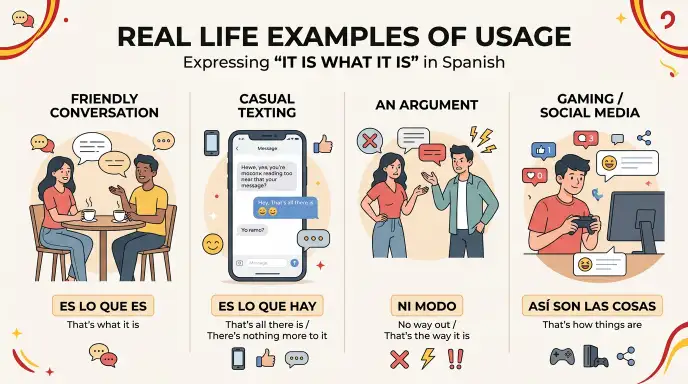
1. Friendly Conversation
Friend:
“Are you still going to the concert?”
You:
“No. My plans changed. Es lo que hay.”
Meaning:
“No. My plans changed. It is what it is.”
The tone is relaxed and accepting.
2. Casual Texting
“No quedan entradas 😭 ni modo.”
Meaning:
“There are no tickets left 😭 oh well.”
The emoji makes the message feel less serious and more playful.
3. Disappointing Situation
“Quería comprarlo, pero ya subió de precio. Es lo que es.”
Meaning:
“I wanted to buy it, but the price went up. It is what it is.”
Here, the speaker is disappointed but has accepted the situation.
4. Argumentative Context
“Ya tomaste tu decisión. Así son las cosas.”
Meaning:
“You already made your decision. That’s how things are.”
This can sound more firm than friendly.
5. Gaming Context
“Perdimos la partida. Ni modo, jugamos otra.”
Meaning:
“We lost the game. Oh well, let’s play another.”
Here, ni modo helps the speaker move on quickly.
6. Social Media
“No salió como esperaba, pero es lo que hay.”
Meaning:
“It didn’t turn out the way I expected, but it is what it is.”
This works naturally as a casual caption or comment.
Similar Spanish Expressions Compared
| Spanish expression | Approximate English meaning | Typical feeling |
| Es lo que es | It is what it is | Neutral, direct |
| Es lo que hay | It is what there is / That’s what we’ve got | Casual, accepting |
| Ni modo | Oh well / Nothing can be done | Resigned, casual |
| Así son las cosas | That’s how things are | Matter of fact |
| Así es | That’s how it is | Short, neutral |
| Qué se le va a hacer | What can you do? | Resigned, conversational |
| Así es la vida | That’s life | Philosophical, accepting |
These expressions overlap, but they are not interchangeable in every sentence.
Origin and Background
There is no single Spanish slang word that serves as the official equivalent of “it is what it is.”
Instead, Spanish has several established expressions for accepting reality.
Es lo que es follows the structure of the English expression closely. Es lo que hay uses a different structure but communicates a similar idea in many contexts. Spanish language discussions about the phrase also commonly mention así son las cosas, ni modo, and qué se le va a hacer as alternatives depending on region and context.
This is an important point for language learners: translation is about meaning, not just matching individual words.
Why Do People Use This Slang?
People use these expressions because they offer a quick way to acknowledge reality without having a long discussion.
Someone might use one after:
- Missing a bus
- Losing a game
- Getting a disappointing result
- Dealing with bad if
- Accepting a canceled plan
- Facing a decision they cannot change
- Making a small mistake
- Moving on from an argument
The expression can also signal emotional distance.
Instead of saying:
“I’m really upset, but I don’t know what else I can do.”
a person might simply say:
“Ni modo.”
That short phrase communicates a similar attitude much faster.
When Should You Avoid Using It?
Although these expressions are generally safe, context matters.
Avoid using a short “it is what it is” equivalent when someone is sharing a serious emotional problem and expects empathy.
For example, if someone tells you:
“My family member is in the hospital.”
Responding with:
“Es lo que es.”
may sound insensitive.
A better response would acknowledge their feelings first.
You should also be careful in professional communication. A phrase like “ni modo” is casual and may not fit a formal email, business report, or academic document.
For formal situations, use clearer language such as:
- “Unfortunately, this is the current situation.”
- “We will need to work with the circumstances.”
- “There are no further changes we can make at this stage.”
Polite Alternatives
If you want to express acceptance without sounding dismissive, try:
“Así son las cosas.”
This means “That’s how things are.” It can sound calm and thoughtful.
“Qué se le va a hacer.”
This is similar to “What can you do?” It recognizes that the situation cannot easily be changed.
“Así es la vida.”
This means “That’s life.” It is useful when discussing normal disappointments and unexpected events.
“No pasa nada.”
This means “It’s okay” or “No big deal.” It is better when you want to reassure someone rather than simply accept a situation.
Is “It Is What It Is” Safe for Social Media?
Yes. Expressions such as es lo que es, es lo que hay, and ni modo are generally safe for ordinary social media use.
They are not inherently vulgar or offensive.
However, social media removes much of the tone that people hear in face to face conversations. A short phrase can therefore sound colder online than the writer intended.
For example:
“You failed the test? Ni modo.”
could sound playful between close friends but insensitive between people who do not know each other well.
An emoji or a little extra context can make the intended tone clearer.
“It Is What It Is” in Spanish Texting
In texting, Spanish speakers often shorten their thoughts because the conversation is fast and informal.
You may see:
- Es lo que hay.
- Es lo que es.
- Ni modo.
- Así es.
- Qué se le va a hacer.
For example:
“Se canceló el viaje 😭 ni modo.”
This means:
“The trip got canceled 😭 oh well.”
The combination of a short phrase and an emoji can make the message feel casual rather than serious.
Regional Differences Matter
One of the biggest mistakes learners make is assuming that one expression works exactly the same across all Spanish speaking countries.
Spanish is spoken across Spain, Mexico, Central America, South America, and many other communities. Everyday vocabulary differs from place to place.
For this reason:
- Es lo que es is a direct and broadly understandable option.
- Es lo que hay is especially natural in some varieties, including Spain.
- Ni modo is strongly associated with Mexican Spanish.
- Así son las cosas is broadly understandable.
- Qué se le va a hacer can express resignation in a conversational way.
Even native speakers may choose different phrases for the same situation.
Common Mistakes
Mistake 1: Translating every word
Learners sometimes assume that a literal translation is always the most natural translation.
Es lo que es is correct, but another expression may sound more natural depending on the situation.
Mistake 2: Treating “ni modo” as “no way”
In English, “no way!” often expresses surprise or disbelief.
That is not always what ni modo means.
In many contexts, ni modo expresses resignation: “oh well,” “nothing can be done,” or “it is what it is.”
Mistake 3: Assuming all Spanish speakers use the same slang
Regional differences are important. A phrase that sounds perfectly natural in Mexico may not be the first choice for someone in Spain.
Mistake 4: Using it when empathy is needed
Acceptance does not always equal kindness. In emotional conversations, acknowledge the person’s feelings before using a resigned expression.
Frequently Asked Questions
What is “it is what it is” in Spanish slang?
Common options include “es lo que es,” “es lo que hay,” “así son las cosas,” and, in Mexican Spanish, “ni modo.” The best choice depends on context and region.
What does “ni modo” mean?
Ni modo is a casual expression commonly associated with Mexican Spanish. It can mean “oh well,” “nothing can be done,” or express the resigned feeling of “it is what it is.”
Is “es lo que es” a correct Spanish phrase?
Yes. Es lo que es is a direct Spanish equivalent of “it is what it is” and is widely understandable.
What does “es lo que hay” mean?
Literally, it is close to “it is what there is,” but in conversation it can communicate “that’s what we’ve got” or “it is what it is.”
Is “it is what it is” rude in Spanish?
The Spanish equivalents are not inherently rude. However, they can sound dismissive if used when someone is discussing a serious or emotional problem.
Which Spanish phrase should I use?
For a broadly understandable option, es lo que es is a safe choice. If you are speaking Mexican Spanish, ni modo can sound very natural in the right context. In Spain, es lo que hay is a common conversational option. Regional preferences vary.
Conclusion
Understanding it is what it is in Spanish slang requires more than finding one literal translation.
Spanish speakers use several expressions to communicate acceptance, resignation, or the idea that a situation cannot be changed.
Es lo que es is the closest direct translation. Es lo que hay can sound more conversational and is commonly associated with Spain, while ni modo is a particularly useful casual expression in Mexican Spanish.
Other choices, such as así son las cosas and qué se le va a hacer, can also communicate a similar attitude.
The most important thing is context. A phrase that sounds funny and relaxed between friends may sound dismissive in a serious conversation.
If you understand the tone and regional differences, you can use these expressions naturally in texts, social media, gaming chats, and everyday Spanish conversation.
Read more about!
- What’s Up in French Slang Meaning in Text
- Florida Slang: Complete Guide to Local Expressions
- What Is Hawaiian Slang for Brother? Meaning & Examples

Hi, I’m Chloe Parker. I write simple and practical articles about slang, grammar, spelling, vocabulary, and commonly confused words. My goal is to make English easier to understand through clear explanations and real-life examples. Whether you’re a student, writer, or English learner, I’m here to help you build confidence and improve your everyday English.