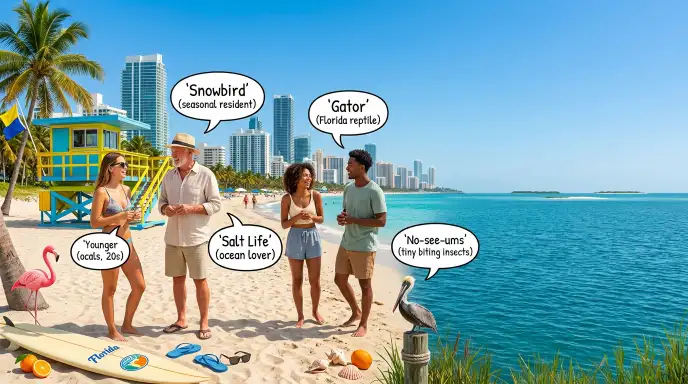
Florida slang refers to the unique words, phrases, and expressions commonly used by people in Florida. Some Florida slang comes from Southern English, while other terms are influenced by Spanish, Caribbean cultures, surfing, beach life, and local communities.
Learning Florida slang helps you better understand conversations, social media posts, and everyday life in the Sunshine State.
Many people search for Florida slang before visiting Florida, moving there, or simply because they hear unfamiliar words online.
Some expressions are common across the state, while others are popular only in certain cities or regions.
A few are also shared with nearby Southern states but may have a slightly different meaning in Florida.
In this guide, you’ll learn what Florida slang means, where it comes from, how locals actually use it, which expressions are still popular today, and when it’s best to avoid using certain terms. You’ll also find real life examples that make each phrase easy to understand.
Quick Answer
Florida slang is a collection of informal words and phrases used by people in Florida. It reflects the state’s mix of Southern, Hispanic, Caribbean, beach, surfing, and urban cultures.
Some terms are unique to Florida, while others are widely understood throughout the southern United States.
What Does Florida Slang Mean?
Florida slang includes everyday expressions that locals use in casual conversations. These words often describe:
- People
- Places
- Weather
- Driving
- Beaches
- Wildlife
- Food
- Local culture
- Lifestyle
Unlike internet abbreviations such as “LOL” or “BRB,” Florida slang is regional. It helps express local identity and often sounds natural only within the right cultural context.
Because Florida is one of the most diverse states in the U.S., its slang has many influences. You may hear Southern expressions in North Florida, Caribbean inspired phrases in South Florida, and surf slang along the Atlantic coast.
What Makes Florida Slang Unique?
Florida slang stands out because it combines several cultures instead of coming from just one.
Major influences include:
- Southern American English
- Spanish
- Cuban communities
- Caribbean English
- Surf culture
- Fishing communities
- College culture
- Tourism
- Urban communities
This mix creates expressions that may sound unfamiliar to visitors but perfectly normal to locals.
For example, someone in Miami may naturally switch between English and Spanish phrases during a conversation, while someone near the Gulf Coast may use more traditional Southern expressions.
Common Florida Slang Words and Their Meanings
| Florida Slang | Meaning | Example |
| Snowbird | A person who spends winters in Florida but lives elsewhere during warmer months. | “The snowbirds are arriving again this fall.” |
| No see ums | Tiny biting insects common near beaches and wetlands. | “Bring bug spray—the no see ums are bad tonight.” |
| Gator | Short for an alligator. | “Watch out, there’s a gator by the lake.” |
| The Panhandle | Florida’s northwestern region. | “She grew up in the Panhandle.” |
| Flip flops | Casual beach sandals commonly worn year round. | “Most people wear flip flops to the beach.” |
| Lovebug season | The time of year when lovebugs appear in large numbers. | “Your car needs washing after lovebug season.” |
| Tourist trap | A place mainly designed to attract visitors, often with high prices. | “Let’s skip the tourist traps and eat where locals go.” |
| Hurricane snacks | Food people buy before a storm. | “Everyone grabbed hurricane snacks before landfall.” |
Popular Florida Slang Expressions
Many Florida expressions describe daily life more than individual words.
“Living the salt life”
This phrase means enjoying life near the ocean through boating, fishing, surfing, or relaxing on the beach.
Example
“They moved to Florida to start living the salt life.”
“Beach day”
While people everywhere say this, Floridians use it frequently because beaches are a regular part of daily life.
Example
“It’s only 80 degrees. Perfect beach day.”
“Storm season”
Locals often use this instead of saying hurricane season in casual conversation.
Example
“Always keep extra water during storm season.”
“Lake life”
People living near Florida’s many lakes often use this phrase to describe boating, fishing, and outdoor activities.
Example
“Weekends are all about lake life.”
Where Is Florida Slang Commonly Used?
Florida slang appears in many everyday settings.
Daily conversations
Friends and neighbors use regional expressions naturally.
Example
“Let’s hit the beach before the tourists show up.”
Social media
Instagram, TikTok, Facebook, and X posts often include Florida slang with beach photos, fishing videos, and travel content.
Example
“Lovebug season is officially here.”
Travel blogs
Travel writers frequently use Florida slang to sound authentic when describing local experiences.
Schools and colleges
Students often combine local slang with popular internet slang.
Sports communities
Fans of Florida sports teams sometimes use local expressions that reflect regional pride.
Is Florida Slang Rude or Offensive?
Most Florida slang is completely harmless.
However, context still matters.
Some expressions are friendly, while others may sound disrespectful depending on how they’re used.
| Type | Safe to Use? | Notes |
| Beach expressions | ✅ Yes | Casual and friendly |
| Weather slang | ✅ Yes | Common conversation |
| Wildlife terms | ✅ Yes | Everyday language |
| Regional nicknames | ✅ Usually | Depends on tone |
| Insults | ❌ Use carefully | Can offend someone |
When speaking with teachers, employers, or clients, standard English is usually the better choice.
Who Uses Florida Slang?
Florida slang is used by many different groups.
These include:
- Lifelong Florida residents
- College students
- Beach communities
- Surfers
- Fishermen
- Outdoor enthusiasts
- Local businesses
- Social media creators
- Travel bloggers
- Sports fans
Some phrases are understood across the state, while others are mainly used in specific regions such as Miami, the Florida Keys, Jacksonville, Tampa, or the Panhandle.
Florida Slang Across Different Regions
Florida is a large and diverse state, so slang can change depending on where you are.
| Region | Common Influence | Typical Style |
| North Florida | Southern American English | Traditional Southern expressions |
| Central Florida | Tourism and college culture | Mixed regional slang |
| South Florida | Spanish and Caribbean cultures | Bilingual expressions and multicultural slang |
| Florida Keys | Island and boating culture | Relaxed coastal language |
| Atlantic Coast | Surf culture | Beach and surfing vocabulary |
| Gulf Coast | Fishing and boating | Outdoor lifestyle expressions |
Not every Floridian uses the same slang. Regional culture, age, and community all shape the words people choose.
Why People Use Florida Slang
People use Florida slang because it helps them:
- Show local identity
- Connect with their community
- Describe life in Florida more naturally
- Add personality to conversations
- Talk about beaches, weather, wildlife, and outdoor activities using familiar terms
It also creates a sense of belonging. Someone who says “lovebug season” or “snowbird” immediately signals familiarity with Florida life in a way that standard English may not.
Origin and History of Florida Slang
Florida slang did not appear overnight. It developed over many generations as different cultures, languages, and lifestyles came together in the state.
Unlike slang that starts on a single social media platform, Florida slang comes from real communities and everyday life.
Some of its biggest influences include:
- Southern American English brought by early settlers.
- Spanish, especially in South Florida due to Cuban and Latin American communities.
- Caribbean English, influenced by people from Jamaica, the Bahamas, Haiti, and other islands.
- Surf culture, which became popular along Florida’s Atlantic coast in the 1960s and 1970s.
- Fishing and boating communities, where many practical expressions became everyday language.
- Tourism, which introduced new words and helped spread local phrases beyond Florida.
Because Florida is one of the most culturally diverse states in the U.S., there is no single “Florida accent” or one official set of slang words. Local expressions continue to evolve, especially among younger generations.
Note: The exact origin of many regional slang terms is difficult to verify. Some have been used for decades through spoken language before appearing in books or online.
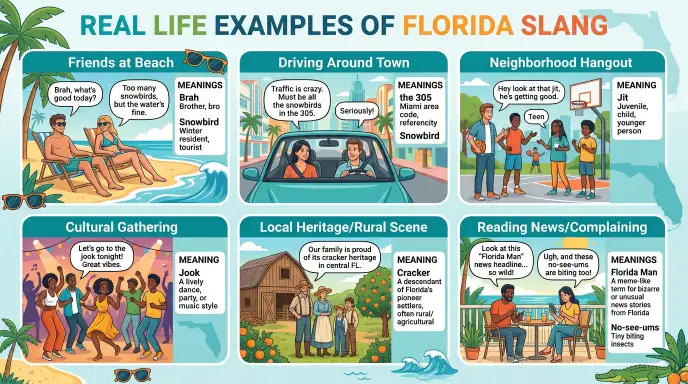
Real Life Examples of Florida Slang
Seeing slang in context makes it much easier to understand.
Friends
Alex: “Want to hit the beach?”
Jordan: “Sure. Let’s go before the tourists arrive.”
Family
Mom: “Don’t forget bug spray.”
Dad: “The no see ums are terrible tonight.”
Text Message
Emma:
“Lovebug season is back 😭 My windshield is covered again.”
At the Beach
“Bring your flip flops. The sand is already hot.”
During Hurricane Season
“Have you bought your hurricane snacks yet?”
Fishing Trip
“We spotted a gator near the boat ramp.”
Travel Conversation
“Most snowbirds head back north in the spring.”
Social Media Caption
“Weekend mood: Salt life, sunshine, and ocean views. 🌴☀️”
Florida Slang on Social Media
Florida slang is common across social media, but the style changes depending on the platform.
| Platform | How Florida Slang Is Used |
| TikTok | Funny videos, beach life, wildlife, hurricanes |
| Travel photos, beaches, sunsets, boating | |
| Local advice, moving tips, city discussions | |
| Community groups and neighborhood conversations | |
| X (Twitter) | Weather updates, memes, sports, local news |
| YouTube | Florida travel guides, fishing, wildlife, lifestyle videos |
People often mix Florida slang with internet slang such as “LOL,” “TBH,” or “NGL,” especially in casual posts.
Is Florida Slang Still Popular?
Yes. Many Florida slang terms remain popular because they describe things that are unique to life in the state.
However, popularity varies.
Still Common
- Snowbird
- Lovebug season
- Gator
- Salt life
- No see ums
- Flip flops
More Regional
Some expressions are heard mostly in:
- Miami
- Tampa
- Jacksonville
- The Florida Keys
- The Panhandle
Young people may also create new local slang through TikTok and other social media platforms, while older generations often continue using traditional regional expressions.
Similar Slang and Related Terms
Although Florida slang has its own identity, it shares some similarities with slang from nearby regions.
| Region | Similar Features |
| Georgia | Southern expressions |
| Alabama | Rural Southern slang |
| Louisiana | Coastal vocabulary |
| Texas | Southern lifestyle terms |
| California | Surf slang |
| Hawaii | Beach culture expressions |
Florida stands out because it blends Southern traditions with Hispanic, Caribbean, and coastal influences.
Florida Slang vs. Internet Slang
Many people confuse regional slang with internet slang.
| Florida Slang | Internet Slang |
| Based on local culture | Based on online culture |
| Used in everyday speech | Mostly used in texts and social media |
| Can be decades old | Changes very quickly |
| Regional | Global |
| Influenced by geography | Influenced by online communities |
For example:
- Snowbird → Florida slang
- LOL → Internet slang
- BRB → Text abbreviation
- Salt life → Florida lifestyle expression
When Should You Avoid Using Florida Slang?
Florida slang is generally friendly, but it isn’t appropriate in every situation.
Avoid using it when:
- Writing formal business emails.
- Speaking during job interviews.
- Preparing academic assignments.
- Communicating with people who may not understand regional expressions.
- Giving official presentations.
If your audience is international, plain English is usually the safest option.
Polite Alternatives
Sometimes a standard English phrase is clearer than slang.
| Florida Slang | Polite Alternative |
| Gator | Alligator |
| Snowbird | Seasonal resident |
| Tourist trap | Popular tourist attraction |
| Flip flops | Sandals |
| Salt life | Coastal lifestyle |
Using standard terms can help avoid confusion, especially in professional or educational settings.
Common Misunderstandings About Florida Slang
Many people have incorrect ideas about Florida slang.
Myth 1: Every Floridian uses the same slang.
Reality: Usage varies by city, region, age, and community.
Myth 2: Florida slang is only beach slang.
Reality: Beaches influence many expressions, but weather, wildlife, sports, food, and local culture also shape Florida slang.
Myth 3: Florida slang is the same as Southern slang.
Reality: They overlap, but Florida has strong Spanish, Caribbean, and coastal influences that make its vocabulary unique.
Myth 4: Florida slang is only for young people.
Reality: Many terms have been used by Florida residents for decades.
Myth 5: Every phrase is unique to Florida.
Reality: Some expressions are used in other Southern states, while others are widely recognized across the United States.
Tips for Using Florida Slang Naturally
If you’re visiting or moving to Florida, these tips will help you sound more natural.
- Listen to how locals use expressions.
- Learn the meaning before using unfamiliar words.
- Match the setting : casual slang works best with friends.
- Don’t force slang into every sentence.
- Use standard English in formal situations.
Remember, sounding natural is more important than trying to use every local expression.
Florida Slang Cheat Sheet
| Term | Meaning | Tone |
| Snowbird | Seasonal winter resident | Neutral |
| Gator | Alligator | Neutral |
| No see ums | Tiny biting insects | Neutral |
| Salt life | Coastal lifestyle | Positive |
| Lovebug season | Time when lovebugs appear | Neutral |
| Tourist trap | Expensive attraction for visitors | Slightly Negative |
| Flip flops | Beach sandals | Casual |
Frequently Asked Questions
What is Florida slang?
Florida slang is a collection of informal words and expressions commonly used by people in Florida. It reflects the state’s mix of Southern, Hispanic, Caribbean, beach, and outdoor cultures.
Is Florida slang different from Southern slang?
Yes. While some expressions overlap with Southern slang, Florida slang also includes influences from Spanish, Cuban, Caribbean, surfing, and coastal communities. This makes it more diverse than traditional Southern slang.
Is Florida slang rude?
Most Florida slang is friendly and harmless. However, some nicknames or expressions can sound rude depending on the speaker’s tone and the situation. If you’re unsure, use standard English.
Who uses Florida slang?
Many people use Florida slang, including:
- Lifelong Florida residents
- College students
- Beachgoers
- Surfers
- Fishermen
- Tourists who spend time in Florida
- Social media creators
- Local businesses
Can I use Florida slang at work?
It depends on your workplace.
Casual conversations with coworkers may be fine, but business meetings, presentations, and professional emails usually call for standard English.
Is Florida slang used on social media?
Yes. You’ll often see Florida slang on:
- TikTok
- X (Twitter)
- YouTube
Many creators use local expressions in travel videos, beach content, wildlife clips, fishing posts, and Florida memes.
What is the most famous Florida slang word?
There isn’t one official “most famous” term, but some of the best known Florida expressions include:
- Snowbird
- Gator
- No see ums
- Salt life
- Lovebug season
- Tourist trap
These words are widely recognized because they describe everyday life in Florida.
Is Florida slang still changing?
Yes. Like all regional language, Florida slang continues to evolve. New expressions appear through social media, while older local terms remain popular in many communities.
Conclusion
Florida slang is more than a collection of catchy words—it reflects the state’s unique culture, geography, and diverse communities.
From beach towns and fishing villages to large cities like Miami and Tampa, local expressions help people describe everyday life in ways that standard English sometimes cannot.
Many Florida slang terms come from real experiences, such as dealing with hurricanes, spotting alligators, enjoying the coast, or welcoming seasonal visitors.
Others show the influence of Southern traditions, Spanish speaking communities, Caribbean cultures, and surfing lifestyles.
If you’re visiting Florida, moving there, or simply curious about local language, learning a few common expressions can make conversations easier to understand and help you connect. .with locals.
Just remember that slang works best in casual settings. In schools, workplaces, and formal writing, standard English is usually the better choice.
Language changes over time, and Florida slang is no exception. New phrases continue to appear, but many classic local expressions remain part of everyday conversations across the Sunshine State.
Read More About!
- KMT Slang Meaning: What It Means in Text, Social Media & Chat
- Slang from Early 2000s: Popular Words & Phrase
- What Is Gen Gay Slang? Meaning, Uses & Examples

Hi, I’m Chloe Parker. I write simple and practical articles about slang, grammar, spelling, vocabulary, and commonly confused words. My goal is to make English easier to understand through clear explanations and real-life examples. Whether you’re a student, writer, or English learner, I’m here to help you build confidence and improve your everyday English.