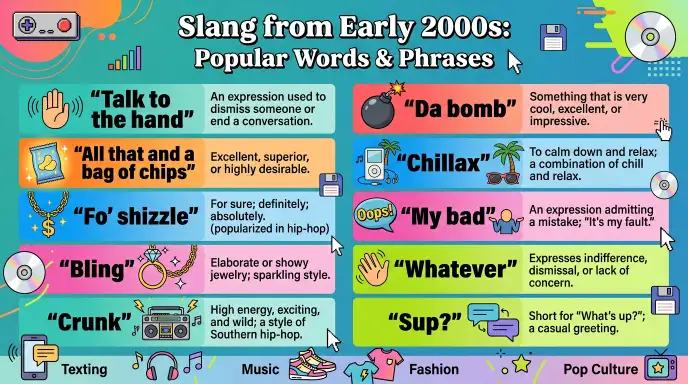
Slang from early 2000s refers to the casual words, phrases, and texting shortcuts that became popular around 2000–2004. Some came from music and TV, while others grew through instant messaging, gaming, and early social media.
If you hear phrases like “fo’ shizzle,” “bling,” “crunk,” “pwned,” “da bomb,” or “BFF,” you may be hearing language strongly linked with the early 2000s. Not every word started during this period, though.
Some became popular in the early 2000s after already existing in another community or culture.
People search for slang from early 2000s to understand old movies, songs, messages, online posts, and the Y2K-era style of speaking.
This guide explains what these terms meant, where people used them, which ones feel dated today, and how early internet culture helped spread them.
Quick Answer
Slang from early 2000s means informal words and expressions that were especially popular during the first few years of the 2000s. Examples include bling, crunk, fo’ shizzle, da bomb, BFF, pwned, and home skillet.
Some were spoken slang, while others were common in texting, instant messaging, forums, and gaming.
The early 2000s were also a bridge between older spoken slang and the internet language that later became normal on social media.
What Does “Slang from Early 2000s” Mean?
The phrase slang from early 2000s does not describe one specific word. It is a broad label for informal language associated with the beginning of the decade.
The early 2000s are usually understood as roughly 2000–2004, although people sometimes use “early 2000s” more loosely. That means not every popular 2000s expression belongs to the same period.
For example:
| Slang | Basic meaning | Common setting |
| Bling | Flashy jewelry or style | Music, fashion |
| Crunk | Very excited or energetic | Parties, music |
| Fo’ shizzle | For sure | Casual speech |
| Da bomb | Excellent or amazing | Everyday speech |
| Pwned | Completely defeated | Gaming |
| BFF | Best friend forever | Texting, school |
| Home skillet | Close friend | Casual speech |
| Newbie | New or inexperienced person | Internet, gaming |
This mix is important because early 2000s slang did not come from one place. Music, television, youth culture, gaming, and the growing internet all played a role.
Popular Slang from Early 2000s
1. Bling
Bling referred to flashy, eye catching jewelry, especially jewelry associated with wealth and status.
The term was already present in hip hop culture before becoming widely recognized in mainstream culture during the late 1990s and early 2000s. So, it is more accurate to say that bling became strongly mainstream in the early 2000s, rather than claiming the decade invented it.
Example:
“He showed up wearing serious bling.”
Today, “bling” is still understandable, but it often sounds more nostalgic or playful than modern everyday slang.
2. Crunk
Crunk described being highly energetic, excited, or wild. It became closely associated with Southern hip hop and party culture in the early 2000s.
Artists such as Lil Jon helped bring the term into mainstream popular culture. Depending on context, crunk could describe a person, party, song, or general high energy mood.
Example:
“That party was getting crunk.”
The word can still be understood, but it strongly carries an early 2000s feel.
3. Fo’ Shizzle
Fo’ shizzle was a playful way of saying “for sure.”
It became strongly associated with Snoop Dogg and early 2000s hip hop culture. The expression spread beyond music and became a recognizable part of mainstream slang.
Example:
“Are you coming with us?”
“Fo’ shizzle!”
It is easy to recognize today, but using it seriously in normal conversation can sound deliberately retro.
4. Da Bomb
Da bomb meant something was excellent, impressive, or very good.
It was especially common in casual speech among young people in the early 2000s.
Example:
“That new game is da bomb.”
The phrase is now mostly associated with older slang. If someone uses it today, it may be intended as a joke or nostalgic reference.
For more examples of older expressions, see your related [90’s Slang] page.
5. Pwned
Pwned became popular in gaming and online communities. It means that someone was completely defeated, dominated, or outplayed.
The spelling looks unusual because “pwn” became an internet-era variation of “own.” It became especially recognizable in gaming culture during the early 2000s.
Example:
“You got pwned in that match.”
Unlike some spoken slang, pwned belongs strongly to internet and gaming culture.
It could appear in gaming chats, forums, multiplayer communities, and early online discussions.
6. BFF
BFF stands for “best friends forever.”
It became extremely common in texting, instant messaging, school culture, and early social networking.
Example:
“She has been my BFF since sixth grade.”
Unlike some early 2000s slang, BFF did not completely disappear. People can still understand it today, although its popularity and tone have changed.
7. Home Skillet
Home skillet was a playful term for a close friend.
It belongs to the group of exaggerated friendship terms that became recognizable in American popular culture around the 1990s and 2000s.
Example:
“What’s up, home skillet?”
It is very informal and now sounds strongly dated. Most people would not use it in professional communication.
8. Newbie
Newbie means a person who is new to something or has little experience.
The word became especially common in early internet and gaming communities. It was often used for someone who had just joined a website, game, forum, or online group.
Example:
“I’m a newbie, so I’m still learning the game.”
Unlike many early 2000s expressions, newbie has survived and is still easy to understand.
Slang from Early 2000s in Texting
The early 2000s were important for texting language because mobile phones and instant messaging encouraged people to type quickly.
People used short forms to save time and space. Early online communication also had its own style, including abbreviations, unusual capitalization, and short messages.
Some common examples include:
- LOL : laughing out loud
- OMG : oh my God
- BRB : be right back
- BFF : best friends forever
- TMI : too much information
- LYLAS : love you like a sister
These terms were not necessarily invented in the early 2000s. Some existed earlier, but the growth of texting and instant messaging helped make them highly visible.
For a deeper look at internet abbreviations, you can internally link to your [TS Text Slang] article.
Example Text Conversation
A: “OMG, did you see that?”
B: “LOL yes!”
A: “BRB, my mom is calling.”
This style feels simple now, but these abbreviations helped shape the short form texting language people still use today.
Early 2000s Internet Slang
The early 2000s were very different from today’s social media environment.
People were using:
- Instant messaging
- Online forums
- Chat rooms
- Gaming communities
- MySpace
- Early social networking sites
- SMS texting
This created new places for slang to spread.
One interesting example is “unfriend.” The word became useful as social networking platforms made it possible to remove someone from a digital friends list. Early social platforms helped turn actions that were once offline into simple online terms.
Gaming also had its own vocabulary. Terms such as pwned could move from gaming communities into wider internet culture.
That is one reason the slang of this period feels different from older slang.
Slang from Early 2000s vs. Late 2000s
It is easy to put every 2000s expression into one group, but the decade was not linguistically uniform.
Early 2000s slang generally refers to the first part of the decade, while terms that became popular around 2007–2009 belong more accurately to the late 2000s.
For example, da bomb is strongly associated with the early part of the decade, while some internet expressions became more common later as social media and online culture expanded.
| Period | Typical influence |
| 2000–2004 | Hip hop, TV, texting, instant messaging, gaming |
| 2005–2006 | Social networking, YouTube, blogs, online communities |
| 2007–2009 | Wider social media, memes, smartphones, viral internet culture |
This distinction matters when researching slang from early 2000s because a word that became popular in 2009 should not automatically be labeled early 2000s slang.
Why Did Early 2000s Slang Become So Popular?
Several different forces helped these expressions spread.
Music
Hip hop and pop music had a major influence on mainstream slang. Terms connected to music culture could quickly move into everyday speech.
Television and Movies
TV shows and movies introduced catchphrases to huge audiences. A phrase could become popular simply because people heard it repeatedly from a favorite character.
Text Messaging
Texting encouraged short forms such as LOL, OMG, BRB, and BFF.
Gaming
Online games created communities where players needed quick ways to communicate. Words such as pwned became part of this culture.
Early Social Media
Platforms such as MySpace helped slang travel between online friends and larger communities. The early 2000s therefore helped connect offline slang with digital communication.
Are These Slang Words Still Used Today?
Some are still common, while others mainly sound nostalgic.
Still recognizable or occasionally used
- BFF
- LOL
- OMG
- Newbie
- Unfriend
- TMI
Mostly dated or nostalgic
- Fo’ shizzle
- Da bomb
- Home skillet
- Crunk
- Pwned
This does not mean every older word is completely dead. Slang can return through memes, movies, music, nostalgia, and social media.
A person may also use an old expression intentionally because it sounds funny or retro.
When Should You Avoid Using Early 2000s Slang?
Most of these expressions are harmless, but context still matters.
Avoid using very dated slang when:
- Writing a formal work email
- Speaking to a client
- Writing an academic paper
- Applying for a job
- Communicating in a serious professional setting
There is also a difference between understanding old slang and using it naturally.
For example, knowing what “fo’ shizzle” means can help you understand a movie or song. That does not mean you need to use it in a business meeting.
The safest rule is simple: use slang when the setting and audience make it appropriate.
Origin and History of Slang from Early 2000s
Slang from early 2000s did not come from one single source. Music, Black American speech communities, television, gaming, instant messaging, and early social networking all helped different expressions reach wider audiences.
It is also important not to say that every popular 2000s term was invented in the 2000s. For example, bling had roots in rap culture before the decade and became widely mainstream around the early 2000s. Pwned, on the other hand, is strongly connected with online gaming culture.
Music and Pop Culture
Hip hop had a major effect on mainstream slang during this period. Terms such as bling, crunk, and fo’ shizzle became familiar to audiences outside their original cultural or music contexts.
This is an important cultural point: slang can spread into mainstream use after developing within a particular community. That does not mean the mainstream audience created the term.
Gaming and the Internet
Online gaming created its own vocabulary. Pwned is a good example. It became a way for gamers to describe someone being completely defeated or dominated.
Early forums, chat rooms, and instant messaging also allowed slang to move quickly between online communities.
How Slang from Early 2000s Was Used
The same slang could feel different depending on where it appeared.
| Setting | Examples | Typical style |
| Texting | BFF, LOL, OMG, BRB | Short and fast |
| Gaming | Pwned, newbie, noob | Competitive |
| Music culture | Bling, crunk, fo’ shizzle | Expressive |
| School | BFF, da bomb, cool | Casual |
| Online forums | Pwned, newbie, LOL | Informal |
| Workplace | Usually avoided | Too casual |
A word that worked between friends did not automatically work in professional communication.
For example, saying “That game was da bomb” to a friend is casual. Writing “Our new product is da bomb” in a formal business report would sound dated and unprofessional.
Real Life Examples of Early 2000s Slang
Here are some natural examples showing how these expressions could work.
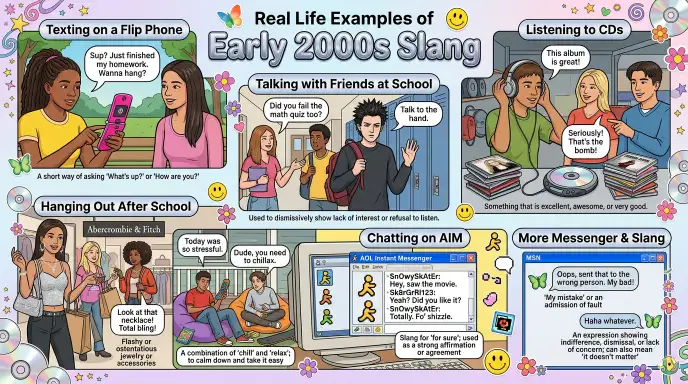
Example 1: Friends
“Are you coming to the party?”
“Fo’ shizzle. I’ll be there.”
Here, fo’ shizzle means “for sure” or “definitely.”
Example 2: Gaming
“You destroyed my score!”
“Yep. You got pwned.”
Here, pwned means completely defeated.
Example 3: Friendship
“Who are you going shopping with?”
“My BFF.”
BFF means “best friend forever.”
Example 4: Fashion
“Look at all that bling!”
The speaker is referring to flashy jewelry or accessories.
Example 5: Party
“The crowd was getting crunk.”
Here, crunk describes an energetic, wild party atmosphere.
These examples show why context matters. The words themselves do not always tell you the exact tone.
Early 2000s Slang on Different Platforms
The early 2000s did not have today’s social media environment. Communication was spread across texting, instant messaging, forums, gaming, and early social networks.
Texting
Text messages were often short because people typed on physical phone keypads. Abbreviations such as LOL, BRB, OMG, and BFF were useful because they reduced typing.
Gaming
Gaming communities developed expressions that focused on competition and skill. Pwned and newbie/noob are examples associated with this environment.
Forums and Chat Rooms
Forums and chat rooms encouraged short, informal communication. Users could develop inside jokes and expressions that later spread to other online communities.
Early Social Networking
Early social networks helped people communicate with friends online and gave informal language more places to spread. Research on MySpace, for example, has examined the communication patterns that developed within the platform.
Similar Slang from the 1990s and 2000s
Some expressions are difficult to place in one decade because slang does not suddenly disappear on January 1.
| Expression | Era connection | Meaning |
| Bling | Late 1990s–2000s | Flashy jewelry |
| Da bomb | Late 1990s–early 2000s | Excellent |
| Fo’ shizzle | Early 2000s | For sure |
| Crunk | Early–mid 2000s | Highly energetic |
| BFF | 2000s and beyond | Best friend forever |
| Pwned | Early internet/2000s | Defeated |
| Newbie | Internet era | New or inexperienced person |
| Home skillet | 1990s–2000s | Close friend |
This overlap is why it is better to describe these terms as popular during the early 2000s rather than claiming that every one was invented then.
If you’re researching older expressions too, your [90’s Slang] article would make a useful related internal link.
Why Does Early 2000s Slang Sound Dated?
Slang changes quickly because people often associate words with a specific generation, trend, show, song, or online community.
Some early 2000s expressions are still understood but are rarely used seriously today. Fo’ shizzle, home skillet, and da bomb can sound deliberately nostalgic.
Other terms survived more successfully. BFF, newbie, LOL, and OMG remain recognizable, although their frequency and tone have changed.
Online communities also helped some older expressions survive. Gaming communities, memes, and nostalgia content can bring older slang back for short periods.
Recent discussions from people remembering 2000s culture also show that terms such as pwned, epic fail, and bling are often viewed as strongly tied to that era.
Common Misunderstandings About Early 2000s Slang
“Every 2000s slang word started in 2000.”
Not true.
Many expressions existed before 2000 and became more popular during the decade. Bling is a good example. Its roots go back before the 2000s, while its mainstream popularity grew during the decade.
“All 2000s slang was internet slang.”
Not true.
Some expressions came mainly from music, spoken youth culture, or television. Others were strongly connected to gaming and online communication.
“If people still understand a word, it is still current slang.”
Not necessarily.
A term can remain understandable while becoming dated, nostalgic, or humorous.
For example, many people understand fo’ shizzle, but that does not mean it is normal modern workplace language.
“Slang belongs to one generation.”
Not always.
Words can move between age groups and communities. Some disappear, some survive, and some return through memes or nostalgia.
Why Do People Still Search for Slang from Early 2000s?
There are several reasons people look up these expressions today.
- They hear an old slang term in a movie or song.
- They are watching early 2000s TV shows.
- They are researching Y2K culture.
- They want to understand old text messages.
- They are writing a story set in the 2000s.
- They are interested in old internet culture.
- They want nostalgic social media content.
- They are comparing older slang with modern slang.
The search is not always about learning how to use the word. Often, people simply want to know what someone meant at the time.
That distinction matters because an old slang term may be useful for understanding history but awkward to use today.
When Should You Avoid Using Early 2000s Slang?
You should generally avoid strongly dated slang in formal situations.
Be careful with it in:
- Job applications
- Academic writing
- Professional emails
- Business reports
- Client communication
- Formal presentations
- Communication with people you do not know well
You should also avoid copying slang simply because it appears in an old movie or song. Some expressions may carry cultural meanings or associations that are not obvious from the word alone.
For casual conversations with friends, however, using an old expression as a joke or nostalgic reference is usually easy to understand.
Best rule: understand the context first, then decide if the expression fits.
Polite Alternatives to Dated Slang
If you want to express the same basic idea without sounding strongly retro, use modern or neutral wording.
| Dated expression | Neutral alternative |
| Da bomb | Excellent |
| Fo’ shizzle | Definitely |
| Home skillet | Friend |
| Crunk | Excited / energetic |
| Pwned | Defeated |
| Bling | Flashy jewelry |
| Newbie | Beginner / newcomer |
This is especially useful in school and workplace settings.
What Makes Early 2000s Slang Different?
One major difference is the mix of offline and online communication.
People were still using traditional forms of spoken slang, but they were also spending more time in digital spaces.
Instant messaging, online games, forums, and social networks gave people new places to create and spread informal language.
Research on internet slang shows that online communities can develop their own forms and patterns of language.
That combination helped make the early 2000s an interesting period for slang.
It was not quite the smartphone and TikTok era we know today. But it was also far beyond the mostly offline communication of earlier decades.
Frequently Asked Questions
What was popular slang in the early 2000s?
Popular expressions included bling, crunk, fo’ shizzle, da bomb, BFF, pwned, newbie, and home skillet. Their popularity varied by region, community, and platform.
What did “fo’ shizzle” mean?
Fo’ shizzle was a playful way to say “for sure” or “definitely.” It became strongly associated with Snoop Dogg and early 2000s hip hop culture.
What did “pwned” mean?
Pwned meant that someone had been completely defeated or dominated, especially in gaming or online competition.
What did “BFF” stand for?
BFF stands for “best friends forever.” It became especially common in texting and youth communication during the 2000s.
Is early 2000s slang still used?
Some terms are still used, while others mainly sound nostalgic. Words such as BFF, LOL, OMG, and newbie remain recognizable, while expressions such as home skillet and fo’ shizzle are much more dated.
Was “bling” invented in the early 2000s?
No. The term had roots in rap culture before the decade and became widely popular during the late 1990s and early 2000s.
Why did internet slang grow so much in the 2000s?
The growth of instant messaging, online gaming, forums, texting, and social networking created more spaces where people could communicate informally. This helped slang spread between online communities and everyday speech.
Conclusion
Slang from early 2000s reflects a period when music, television, texting, gaming, and early internet culture were strongly influencing everyday communication.
Expressions such as bling, crunk, fo’ shizzle, BFF, da bomb, and pwned each had different backgrounds and uses.
Some terms were created or popularized within specific cultural communities before reaching mainstream audiences.
Others grew mainly through gaming or online communication. That is why it is not accurate to treat every 2000s expression as if it had the same origin.
Many of these words now sound dated, but they remain useful for understanding old songs, movies, messages, games, and internet culture.
If you are using them today, context is key. Knowing what old slang means is often more important than trying to use it yourself.
Discover More Articles!
- Slang in Spain: Common Terms Explained
- TS Text Slang: Meaning, Uses & Examples
- Honey Slang: Meaning, Uses, Examples & More

Hi, I’m Chloe Parker. I write simple and practical articles about slang, grammar, spelling, vocabulary, and commonly confused words. My goal is to make English easier to understand through clear explanations and real-life examples. Whether you’re a student, writer, or English learner, I’m here to help you build confidence and improve your everyday English.