ole meaning slang can be confusing because “ole” is used in several different ways. You may see it in social media captions, sports chants, music, casual conversations, or phrases such as “good ole.” Depending on the context, it can sound friendly, playful, traditional, or energetic.
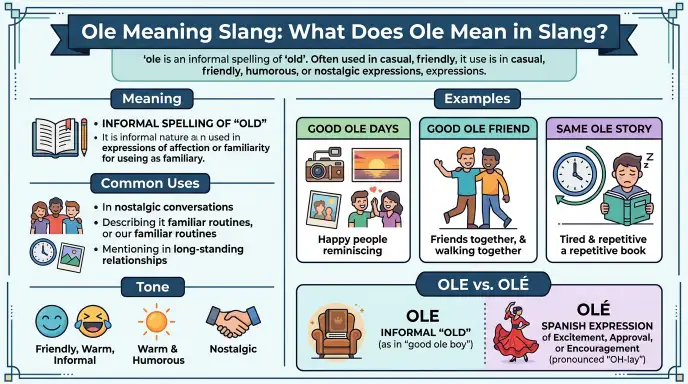
In many cases, ole is an informal spelling of “old.” It is often used to give a phrase a casual, humorous, or folksy feeling. However, “olé” with an accent is different. It is a Spanish exclamation commonly associated with excitement, especially during performances, dancing, or sports.
Knowing the difference between ole and olé helps you understand what someone actually means.
Quick Answer:
In slang and informal English, ole is often a casual or dialect style spelling of “old,” especially in phrases like “good ole.” Olé is a separate Spanish exclamation used to express approval or excitement.
What Does Ole Mean in Slang?
In informal English, ole is commonly used as a playful or nonstandard spelling of old.
It often appears in phrases such as:
- “good ole days”
- “good ole boy”
- “that ole house”
- “the same ole story”
- “my ole friend”
The spelling makes the expression sound more conversational. It can suggest familiarity, nostalgia, humor, or a relaxed speaking style.
For example:
“I miss the good ole days.”
Here, ole means essentially the same as old, but the spelling creates a more informal tone.
Ole Full Form and Definition
The ole full form in this slang usage is generally “old.”
However, ole is not a formal abbreviation. It is better described as an informal spelling or pronunciation based form of “old.”
For example:
Old → Ole
The change is often used to imitate casual speech or a particular regional style.
Important Difference: Ole vs. Olé
The words ole and olé should not automatically be treated as the same word.
| Term | Meaning | Language/Use |
| ole | Informal form of “old” | English slang/informal speech |
| olé | Exclamation of approval or excitement | Spanish |
| old | Standard English word | Formal and informal English |
The accent matters because olé has a different linguistic origin and meaning.
Is Ole Rude, Offensive, or Neutral?
Ole is usually neutral and informal.
It is not normally considered offensive. However, the tone can change depending on the phrase and context.
For example:
“Good ole dad is coming over.”
This sounds warm and familiar.
But:
“That same ole excuse again.”
This can sound annoyed or dismissive.
So, the word itself is generally harmless. The surrounding sentence determines the emotional tone.
Where Is Ole Commonly Used?
The informal spelling ole appears in several types of casual communication.
You may see it in:
- Social media posts
- Text messages
- Online comments
- Sports culture
- Music and entertainment
- Casual conversations
- Regional or dialect writing
- Humorous captions
- Nostalgic expressions
It is especially common in fixed phrases such as “good ole” and “same ole.”
It does not have to be internet slang. People used informal spellings like this long before modern social media existed.
Ole on Social Media
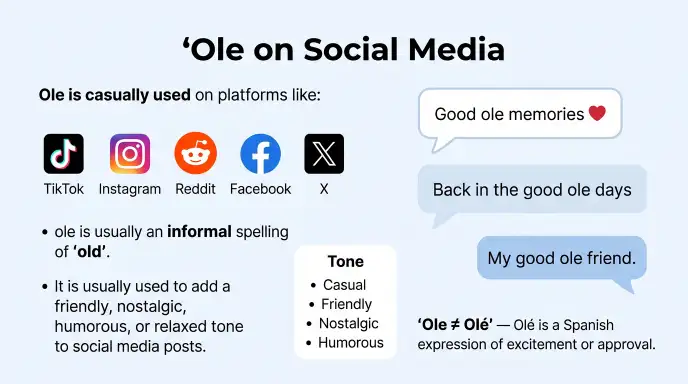
On platforms such as Instagram, TikTok, Facebook, Reddit, and X, people may use ole to make a caption sound relaxed, nostalgic, or humorous.
For example:
“Back in the good ole days.”
The phrase feels more casual than:
“Back in the good old days.”
Another example is:
“Just hanging out with my good ole friends.”
Here, ole adds a friendly and informal feeling.
Does Ole Have a Special TikTok Meaning?
Not usually.
Unlike newer internet abbreviations, ole does not have one special TikTok definition. Its meaning normally comes from the phrase in which it appears.
If you see “ole” in a TikTok caption, check the surrounding words before assuming it has a unique social media meaning.
Real Life Examples of Ole
Friendly Example
“My good ole friend came to visit today.”
Here, ole gives the sentence a warm and familiar tone.
Nostalgic Example
“I wish we could go back to the good ole days.”
The phrase expresses nostalgia for the past.
Casual Example
“Same ole routine every morning.”
Here, ole means “old” and suggests that the routine has not changed.
Humorous Example
“The good ole laptop finally stopped working.”
The informal spelling can make the sentence sound playful.
Annoyed Example
“Here we go with the same ole excuses.”
In this sentence, the phrase sounds irritated.
Social Media Example
“Good ole memories with the best people ❤️”
The word creates a relaxed and nostalgic feeling.
Ole in the Phrase “Good Ole”
One of the most common uses is “good ole.”
“Good ole” is an informal version of “good old.”
For example:
“Good ole Mom always knows what to say.”
It can express affection, familiarity, or nostalgia.
Another example:
“Nothing beats a good ole road trip.”
The phrase sounds casual and friendly.
Why Do People Write “Ole” Instead of “Old”?
The spelling often represents how old may sound in relaxed speech. It can also be used to create a folksy, humorous, or regional voice.
“Good old” is standard English.
“Good ole” is informal and stylistic.
Ole in “Good Ole Boy”
The phrase “good ole boy” is another well known expression.
A “good ole boy” can refer to a man associated with a traditional, rural, or small town culture, particularly in the American South.
However, the phrase can have different connotations.
It may be used positively to describe someone as friendly and down to earth. In other contexts, “good old boy” can refer to an informal network of people who help one another, sometimes in ways that suggest favoritism or exclusion.
Because of this, the phrase should be understood from context rather than treated as automatically positive.
Origin and Background of Ole
The informal spelling ole has a long history in English writing. It is often used to represent casual pronunciation of old.
English has many examples of informal spellings that imitate spoken language. Writers may change spelling to make dialogue or a character’s voice sound more natural.
Ole has therefore appeared in regional speech, songs, literature, advertising, and everyday informal writing.
It became especially familiar through expressions such as:
- “good ole days”
- “good ole boy”
- “same ole story”
- “that ole thing”
These phrases helped make ole recognizable as an informal alternative to “old.”
Ole vs. Old
The main difference is style rather than basic meaning.
| Feature | Old | Ole |
| Standard English | Yes | No |
| Informal | Yes | Yes |
| Meaning | Old | Usually “old” |
| Formal writing | Appropriate | Usually avoid |
| Casual speech | Common | Common as a stylistic spelling |
| Tone | Neutral | Casual, folksy, nostalgic, or playful |
Use old when you want standard spelling. Use ole when the informal style is intentional.
Ole vs. Olé
This is one of the most important distinctions.
Ole without an accent is commonly an informal spelling of “old.”
Olé with an accent is a Spanish interjection.
For example:
“Olé! What an amazing performance!”
Here, olé expresses enthusiasm or approval.
It is also strongly associated with Spanish speaking cultural contexts and with cheers at sporting events or performances.
So, if someone writes “ole” in a sentence such as “good ole friend,” they mean something very different from “olé!”
When Should You Avoid Using Ole?
Because ole is informal, it is not the best choice for formal or professional writing.
Avoid it when writing:
- Academic papers
- Business reports
- Formal emails
- Job applications
- Official documents
- Professional research
- Formal presentations
Instead of:
“The good ole method is still used.”
write:
“The traditional method is still used.”
Or simply:
“The good old method is still used.”
The standard spelling is clearer for formal audiences.
Polite and Standard Alternatives to Ole
If you want a more formal or neutral expression, use:
- old
- traditional
- former
- long standing
- familiar
- well established
The best choice depends on your sentence.
For example:
Casual:
“The good ole days.”
Standard:
“The good old days.”
More formal:
“Earlier times.”
Why Do People Use Ole?
People use ole for more than simple abbreviation.
It can change the feeling of a sentence.
1. To Sound Casual
“My good ole car is still running.”
2. To Create Nostalgia
“Those were the good ole days.”
3. To Sound Folksy
“That ole dog knows his way home.”
4. To Add Humor
“The ole computer finally gave up.”
5. To Match Spoken Language
The spelling can make written dialogue feel more like natural speech.
Impact of Using Ole in Communication
Using ole can make writing feel more personal and relaxed. It can suggest that the writer is speaking casually rather than following formal written English.
However, it can also make writing appear less polished if the reader expects standard English.
The key is audience.
For a social media caption, ole may work perfectly.
For a university paper, old is usually the better choice.
Is Ole Safe for Social Media?
Yes. Ole is generally safe and harmless slang.
It does not normally contain offensive or inappropriate content. The meaning depends on the phrase.
For example:
“Good ole memories ❤️”
is harmless.
But remember that olé has a different meaning from ole. If you are trying to use the Spanish exclamation, the accented spelling is more accurate.
Common Mistakes About Ole
Mistake 1: Thinking Ole Always Means Olé
It does not.
Ole and olé can have completely different meanings.
Mistake 2: Using Ole in Formal Writing
Ole is informal. Use old in most professional and academic writing.
Mistake 3: Assuming Ole Is Always Slang
It is often an informal spelling, but the context matters.
Mistake 4: Thinking Ole Has One Internet Meaning
Ole does not have one special social media definition. Its meaning usually comes from the phrase.
Comparison With Similar Informal Words
| Word/Phrase | Meaning | Tone |
| Ole | Informal “old” | Casual |
| Old | Standard form | Neutral |
| Olé | Expression of approval | Excited |
| Good ole | Informal “good old” | Friendly/nostalgic |
| Same ole | Informal “same old” | Casual, sometimes annoyed |
| Good old | Standard phrase | Neutral/familiar |
FAQs About Ole Meaning Slang
What does ole mean in slang?
In informal English, ole usually means “old.” It is often used to create a casual, folksy, humorous, or nostalgic tone.
What does ole stand for?
The ole full form in this slang usage is generally “old.” It is an informal spelling rather than a formal abbreviation.
Is ole a bad word?
No. Ole is generally neutral and harmless. Its tone depends on how it is used in a sentence.
What does “good ole” mean?
“Good ole” is an informal version of “good old.” It often expresses affection, familiarity, or nostalgia.
Is ole the same as olé?
No. Ole is often an informal spelling of “old,” while olé is a Spanish exclamation used to express approval or excitement.
Can I use ole in formal writing?
It is better to use old in formal writing. Ole is mainly suitable for casual, conversational, humorous, or stylistic writing.
Conclusion
The ole meaning slang is usually simple: in informal English, ole is a casual spelling of “old.” It often appears in expressions such as “good ole days,” “good ole friend,” and “same ole story.” Depending on the sentence, it can create a friendly, nostalgic, humorous, or slightly annoyed tone.
It is important not to confuse ole with olé. The accented Spanish word is an exclamation used to show enthusiasm or approval and has a different origin and meaning.
Overall, ole is best understood as an informal and stylistic form of “old,” not a universal internet abbreviation. It works well in casual conversations and social media, but standard “old” is usually the better choice for formal writing.
Read More About!
- What’s Up Spanish Slang: Meanings & Examples
- ETA Definition Slang: Meaning, Uses & Examples
- FLR Slang Meaning in Text: What Does FLR Mean?

Hi, I’m Chloe Parker. I write simple and practical articles about slang, grammar, spelling, vocabulary, and commonly confused words. My goal is to make English easier to understand through clear explanations and real-life examples. Whether you’re a student, writer, or English learner, I’m here to help you build confidence and improve your everyday English.