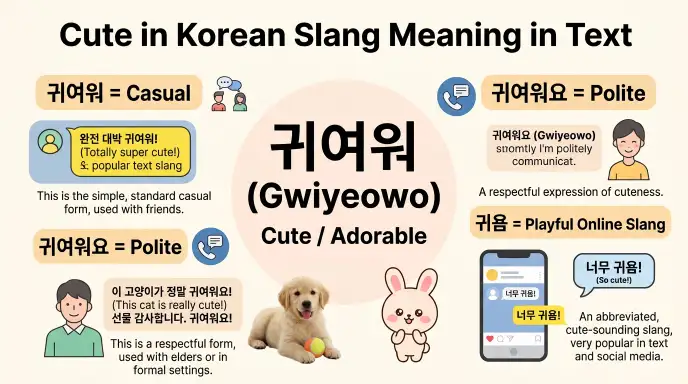
Cute in Korean slang can mean more than simply “adorable.” Korean speakers use several casual words to describe someone, something, or even a message as cute. These words can show affection, playfulness, excitement, or warmth.
People often search for cute in Korean slang because they see Korean words in K dramas, K pop content, TikTok videos, Instagram posts, games, and text messages.
Words like 귀여워 (gwiyeowo) are common in casual Korean. You may also see playful forms such as 귀욤 (gwiyom) online.
The right word depends on the situation. A word used with a close friend may sound too casual in a formal setting. Tone also matters when talking to someone older or someone you do not know well.
Quick Answer
The most common way to say “cute” in Korean is 귀여워 (gwiyeowo). It is a casual way to say “You’re cute,” “That’s cute,” or “So adorable.”
What Does Cute in Korean Slang Mean in Text?
In Korean texting, 귀여워 (gwiyeowo) is one of the most natural ways to say “cute.”
It comes from 귀엽다 (gwiyeopda), which means “to be cute.”
The form 귀여워 is casual. Friends, couples, and people with a close relationship can use it.
For example:
A: 이 강아지 너무 귀여워!
B: 진짜 귀여워!
This means:
A: This puppy is so cute!
B: It really is cute!
In texting, the word can also appear with extra letters or symbols. These changes make the message feel more playful.
Examples include:
- 귀여워 ㅋㅋ : So cute, haha
- 귀여워ㅠㅠ :So cute 😭
- 너무 귀여워 :So cute
- 완전 귀여워 :Totally cute
- 귀여워요 :Cute, in a more polite tone
The exact feeling depends on the message and relationship.
Cute in Korean Slang: Full Form and Basic Meaning
There is no special “full form” for 귀여워 because it is not an acronym.
It is a Korean word form.
| Korean | Romanization | Meaning | Tone |
| 귀엽다 | gwiyeopda | To be cute | Dictionary form |
| 귀여워 | gwiyeowo | Cute / You’re cute | Casual |
| 귀여워요 | gwiyeowoyo | Cute | Polite |
| 귀여운 | gwiyeoun | Cute | Used before a noun |
| 귀욤 | gwiyom | Cute / cuteness | Playful internet style |
If someone asks “What does cute mean in Korean slang?”, 귀여워 is usually the best starting point.
How to Say “You’re Cute” in Korean
If you want to tell someone they are cute, you can say:
너 귀여워.
Neo gwiyeowo.
You’re cute.
This is casual Korean.
You can also make it stronger:
너무 귀여워!
Neomu gwiyeowo!
You’re so cute!
Another casual option is:
진짜 귀여워!
Jinjja gwiyeowo!
You’re really cute!
Use these forms with friends or people you are close to.
For someone you do not know well, a polite form is safer:
귀여워요.
Gwiyeowoyo.
It’s cute / You’re cute.
The Korean language often changes based on social relationship. So choosing the right level of politeness is important.
Is “Cute” in Korean Slang Rude or Offensive?
No. Words such as 귀여워 are normally positive.
They are not rude or offensive by themselves.
However, context still matters.
Calling a close friend cute can sound friendly. Saying it to a stranger may feel personal. Saying it to an adult in a serious situation may also sound strange.
For example:
이 고양이 귀여워.
“This cat is cute.”
This is neutral and natural.
But:
너 진짜 귀여워.
“You’re really cute.”
This can sound affectionate or even flirty. The relationship between the speakers matters.
So, the word itself is not offensive. The situation can change how it feels.
Where Is Cute in Korean Slang Commonly Used?
You may see Korean words for “cute” in many casual online spaces.
Common places include:
- KakaoTalk messages
- Instagram comments
- TikTok
- YouTube comments
- K pop fan communities
- Gaming chats
- Discord
- Online forums
- Private messages
- Casual conversations
Korean internet users also play with spelling.
For example, 귀욤 is a cute and shortened internet style form related to 귀여움, meaning “cuteness.”
You may also see:
귀욤귀욤
This has a playful feeling. It can describe something that looks especially cute.
Online language changes quickly. Some forms are common among younger users or in specific online communities. Because of this, not every playful spelling should be used in formal Korean.
Real Life Examples of Cute in Korean Slang

1. Friendly Example
너 오늘 귀여워.
“너 today cute.”
Natural meaning:
You look cute today.
This can be friendly or affectionate.
2. Talking About a Pet
고양이 너무 귀여워!
Meaning:
The cat is so cute!
This is a very natural casual use.
3. Talking About Food
이 케이크 귀여워.
Meaning:
This cake is cute.
Korean speakers can use “cute” for objects, designs, food, characters, and other things.
4. Social Media Comment
너무 귀여워 ㅋㅋ
Meaning:
So cute haha.
The ㅋㅋ adds a light, laughing tone.
5. Emotional Reaction
아 너무 귀여워ㅠㅠ
Meaning:
Aww, so cute 😭
The ㅠㅠ is often used online to represent crying eyes. Here, it can show an emotional reaction to something adorable.
6. Gaming Context
A player may see a cute character and write:
캐릭터 너무 귀여워!
Meaning:
The character is so cute!
This is casual and natural in a gaming chat.
Cute Korean Slang: Common Variations
Korean speakers have several ways to express cuteness.
귀여워 :Gwiyeowo
This is the most useful casual form.
It can mean:
- You’re cute.
- That’s cute.
- It’s adorable.
The meaning comes from context.
귀여워요 :Gwiyeowoyo
This version is more polite.
It is useful when speaking with someone you are not close to. It can also sound respectful without being overly formal.
귀엽다 :Gwiyeopda
This is the dictionary form.
You may see it in Korean learning materials. In normal conversation, speakers usually change the form based on the sentence.
귀욤 :Gwiyom
This is a playful internet style form.
It has a cute and informal feeling. You are more likely to see it online than in formal writing.
귀여움 :Gwiyeoum
This means “cuteness” or “being cute.”
It is a noun form.
For example, someone may use it when talking about the overall cute quality of a person, character, animal, or object.
Comparison With Similar Korean Words
Not every Korean word connected with cuteness has the same meaning.
| Korean | Meaning | Typical Use |
| 귀여워 | Cute | People, animals, objects |
| 귀여워요 | Cute | Polite conversation |
| 귀욤 | Cuteness / cute | Playful online use |
| 사랑스러워 | Lovely / lovable | Affectionate description |
| 예뻐 | Pretty / beautiful | Appearance or design |
| 깜찍해 | Adorably cute | Small or charming things |
귀여워 vs 예뻐
귀여워 focuses on cuteness.
예뻐 usually means pretty or beautiful.
For example:
강아지 귀여워.
“The puppy is cute.”
그녀 예뻐.
“She is pretty.”
The two words can sometimes overlap. However, they do not always express the same feeling.
귀여워 vs 사랑스러워
사랑스러워 means something like “lovely” or “lovable.”
It can sound warmer and more affectionate.
귀여워 is usually more direct and casual.
Why Do People Use Cute Korean Slang?
People use cute expressions because they make messages feel more emotional.
A simple word such as 귀여워 can show a strong reaction without a long explanation.
Online, people often want messages to feel:
- Friendly
- Warm
- Playful
- Excited
- Affectionate
- Emotional
Korean texting also uses symbols and repeated letters to add emotion.
For example:
너무 귀여워!!!
feels more excited than:
귀여워.
Similarly:
귀여워 ㅋㅋ
sounds lighter and more playful.
When Should You Avoid Using It?
You should be careful with casual Korean when speaking to people you do not know well.
Avoid overly casual forms in:
- Job interviews
- Business emails
- Formal presentations
- Official documents
- Professional meetings
- Conversations with people who expect formal speech
Instead of using 귀여워, you may need a more polite expression.
For example:
귀여워요.
is more polite than:
귀여워.
For highly formal situations, Korean has even more respectful speech levels. The right choice depends on the relationship and setting.
Polite Alternatives
If you want to compliment something without sounding too casual, try:
귀여워요.
“It’s cute.”
You can also use:
정말 귀여워요.
“It’s really cute.”
Or:
정말 예뻐요.
“It’s really pretty.”
These forms are safer when you want to sound respectful.
Is Cute in Korean Slang Safe for Social Media?
Yes. Expressions such as 귀여워 are generally safe for normal social media use.
They are common in casual comments and messages.
Still, you should think about the person receiving the comment.
Calling someone’s pet cute is usually harmless.
Calling a stranger “cute” can feel more personal. It may even sound flirtatious in some situations.
A good rule is simple:
Use casual Korean with people who are comfortable with casual Korean.
For public comments, a polite form such as 귀여워요 can be a safer choice.
Friendly, Casual, and Social Media Examples
The meaning of cute in Korean slang can change slightly with tone. The same word may sound friendly in one message and affectionate in another.
Here are some useful examples.
Friendly Tone
고양이 진짜 귀여워!
Goyangi jinjja gwiyeowo!
“Your cat is really cute!”
This is a simple and friendly compliment.
Casual Texting
너무 귀여워 ㅋㅋ
Neomu gwiyeowo kkeokkeok
“So cute haha.”
The ㅋㅋ makes the message feel relaxed.
Affectionate Tone
오늘 왜 이렇게 귀여워?
Oneul wae ireoke gwiyeowo?
“Why are you so cute today?”
This can sound playful or affectionate. Between close friends or couples, it may also sound flirty.
Social Media Comment
아기 너무 귀여워요!
“Your baby is so cute!”
The 요 ending makes the comment more polite.
Gaming Context
이 캐릭터 너무 귀여워 ㅋㅋ
“This character is so cute haha.”
This works well in gaming chats and fan communities.
Korean Cute Slang in Text Messages
Texting gives people more freedom to play with language.
Korean users often add symbols, laughter, or emotional expressions to show their feelings.
For example:
- 귀여워 ㅋㅋ :So cute haha
- 귀여워ㅠㅠ :So cute 😭
- 너무 귀여워!!! :So cute!!!
- 진짜 귀여워 :Really cute
- 완전 귀여워 :Totally cute
- 귀욤 :Cute / cuteness, playful style
These forms are informal.
They are best for casual conversations and online spaces.
What Does “귀욤” Mean?
귀욤 (gwiyom) is a playful internet expression related to the idea of cuteness.
It is not the standard dictionary form for “cute.”
You may see it in:
- Social media posts
- Comments
- Memes
- Casual messages
- Online communities
It gives a message a softer and more playful feeling.
For example:
오늘 귀욤 폭발!
A natural English translation would be:
“Maximum cuteness today!”
The exact translation can change based on the context.
What Does “귀여움” Mean?
귀여움 (gwiyeoum) means “cuteness” or “being cute.”
It is different from 귀여워, which means “cute” in a casual sentence.
For example:
이 강아지의 귀여움은 최고야.
This means:
“This puppy’s cuteness is the best.”
You may see 귀여움 in captions, posts, and casual online discussions.
Does “Cute” Always Mean Romantic?
No.
This is an important point for Korean learners.
귀여워 does not automatically mean romantic interest.
People can use it for:
- Babies
- Animals
- Food
- Clothes
- Characters
- Friends
- Photos
- Decorations
- Funny behavior
- Romantic partners
For example:
이 가방 귀여워.
“This bag is cute.”
There is nothing romantic about this sentence.
However:
너 진짜 귀여워.
“You are really cute.”
can sound more personal.
The relationship, situation, and tone help determine the meaning.
Cute in Korean Slang vs Standard Korean
It is useful to separate standard Korean from internet slang.
귀엽다 is the standard dictionary form.
귀여워 is a common casual form used in everyday speech.
귀여워요 is a polite form.
귀욤 is more playful and internet oriented.
This means you do not need slang to say “cute” in Korean.
In fact, 귀여워 is often more useful for everyday communication than highly playful internet spellings.
Common Mistakes English Speakers Make
Learning Korean slang can be fun, but beginners often make a few mistakes.
Mistake 1: Using Casual Speech With Everyone
Do not assume that casual Korean is appropriate for every person.
귀여워 is informal.
With someone older or someone you do not know well, 귀여워요 may be a better choice.
Mistake 2: Thinking Every “Cute” Comment Is Flirty
A Korean speaker can say 귀여워 about a dog, phone case, dessert, or cartoon.
The word does not automatically carry romantic meaning.
Mistake 3: Treating Internet Spelling as Formal Korean
Forms such as 귀욤 are playful.
They are not the best choice for a formal email or professional message.
Mistake 4: Translating Every Word Literally
Korean and English do not always match word for word.
귀여워 can mean:
- That’s cute.
- You’re cute.
- It’s adorable.
- So cute.
The best English translation depends on what is being discussed.
How Tone Changes the Meaning
Tone is very important in Korean.
Compare these examples:
귀여워.
“Cute.”
This is simple and casual.
너무 귀여워!
“So cute!”
This sounds more excited.
귀여워요.
“It’s cute.”
This sounds more polite.
귀여워 ㅋㅋ
“So cute haha.”
This feels playful.
너 진짜 귀여워.
“You’re really cute.”
This can feel more personal.
The basic word stays the same, but the surrounding words change the feeling.
Comparison Table: Korean Words for Cute
| Expression | Romanization | Meaning | Tone |
| 귀엽다 | gwiyeopda | To be cute | Standard/dictionary |
| 귀여워 | gwiyeowo | Cute | Casual |
| 귀여워요 | gwiyeowoyo | Cute | Polite |
| 귀여운 | gwiyeoun | Cute | Before a noun |
| 귀여움 | gwiyeoum | Cuteness | Neutral/informal |
| 귀욤 | gwiyom | Cute/cuteness | Playful internet style |
| 사랑스러워 | sarangseureowo | Lovely/adorable | Warm and affectionate |
| 예뻐 | yeppeo | Pretty/beautiful | Casual |
When Should You Use “귀여워”?
Use 귀여워 when the setting is casual.
Good situations include:
- Talking with close friends
- Chatting with siblings
- Talking to a partner
- Commenting on cute animals
- Discussing K pop idols
- Talking about characters
- Casual gaming chats
- Informal social media conversations
For example:
이 사진 너무 귀여워!
“This photo is so cute!”
This sounds natural in a casual conversation.
When Should You Use “귀여워요”?
Use 귀여워요 when you want to sound polite.
It works well with people you are not close to.
For example:
강아지가 정말 귀여워요.
“The puppy is really cute.”
This is a polite and natural sentence.
It can also work in public social media comments when you want to avoid sounding too informal.
Why Do Korean Speakers Use Cute Expressions Online?
Online communication does not include facial expressions or voice tone.
Because of this, people often use extra language to show emotion.
A short message like:
귀여워.
can sound simple.
Adding:
너무 귀여워 ㅋㅋ
makes it more expressive.
Adding ㅠㅠ can show an emotional reaction.
Adding !!! can show excitement.
These small details help readers understand the writer’s mood.
Impact of Cute Slang on Communication
Cute expressions can make online communication feel warmer.
They can help show:
- Excitement
- Affection
- Humor
- Friendship
- Admiration
- Emotional reactions
However, slang can also create confusion.
A learner may use a very casual expression with someone who expects polite speech.
That is why understanding context is more important than memorizing one translation.
Is “귀여워” Safe to Use With Korean Friends?
Usually, yes.
If you have a casual relationship, 귀여워 is a normal expression.
Still, pay attention to how the other person speaks.
If they consistently use polite speech with you, responding in the same style may be more appropriate.
Language level is an important part of Korean communication.
When unsure, choose the polite form:
귀여워요.
It is generally safer than using a very casual form with someone you do not know well.
Popular Related Korean Expressions
If you are learning Korean slang, you may also come across these expressions.
너무
means “very” in many casual contexts.
너무 귀여워!
“So cute!”
진짜
means “really” and “seriously.”
진짜 귀여워!
“Really cute!”
완전
can mean “total” in casual speech.
완전 귀여워!
“Totally cute!”
ㅋㅋ
ㅋㅋ is a common Korean online laughter expression.
It is similar to “haha” or “lol,” depending on the context.
ㅠㅠ
ㅠㅠ looks like crying eyes.
People use it to show sadness or strong emotion. With 귀여워, it can express an emotional reaction to something adorable.
Frequently Asked Questions
What is the most common Korean slang for cute?
귀여워 (gwiyeowo) is one of the most common casual ways to say “cute” in Korean.
What does 귀여워 mean in English?
귀여워 can mean “cute,” “that’s cute,” or “so adorable,” depending on the context.
What does 귀욤 mean?
귀욤 is a playful internet style expression related to “cuteness.” It is informal.
Is 귀여워 romantic?
Not necessarily. It can describe people, animals, objects, food, characters, and many other things. Context determines if it sounds romantic.
Is 귀여워 polite?
No. 귀여워 is casual. 귀여워요 is the more polite form.
Can I use Korean cute slang on social media?
Yes. Expressions such as 귀여워 and 귀욤 can appear in casual social media posts and comments. Use the level of formality that fits the audience.
Final Takeaway
If you want a simple answer to cute in Korean slang, start with 귀여워 (gwiyeowo).
It is a common casual expression for saying that someone or something is cute.
For a polite situation, use 귀여워요 (gwiyeowoyo).
You may also see playful online forms such as 귀욤. These are more informal and should not be treated as standard formal Korean.
Remember that context matters. 귀여워 can describe a puppy, a character, a photo, a friend, or a romantic partner. The word itself does not always have a romantic meaning.
The safest approach is simple: use casual forms with people you know well, and choose polite forms when you are unsure.
That small difference can make your Korean sound much more natural.
Friendly Related Keywords
You can naturally use these related terms throughout the article:
- cute in Korean slang meaning
- cute Korean slang
- 귀여워 meaning
- 귀여워 meaning in English
- Korean word for cute
- how to say cute in Korean
- cute in Korean text
- Korean texting slang
- 귀욤 meaning
- Korean slang for adorable
- what does 귀여워 mean
- Korean cute expressions
Quick Reference: Cute in Korean
| Korean Expression | Meaning | Best For |
| 귀여워 | Cute / adorable | Close friends and casual chats |
| 귀여워요 | Cute / adorable | Polite conversations |
| 귀엽다 | To be cute | Dictionary form |
| 귀욤 | Cuteness / cute | Playful online posts |
| 귀여움 | Cuteness | Casual descriptions |
| 사랑스러워 | Lovely / lovable | Warm compliments |
| 예뻐 | Pretty / beautiful | People and things |
How to Remember 귀여워 Easily
If you are new to Korean, you do not need to memorize every variation at once.
Start with three forms:
귀엽다 = to be cute
귀여워 = cute, casual
귀여워요 = cute, polite
This simple pattern covers many everyday situations.
When you see 귀여워 in a Korean message, think:
“Cute!” or “That’s adorable!”
Then look at the rest of the sentence to understand exactly who or what is being described.
Conclusion
Cute in Korean slang is most commonly expressed with 귀여워 (gwiyeowo) in casual speech and texting. It comes from 귀엽다, the standard dictionary form meaning “to be cute.”
You may also see 귀여워요, which is more polite, and playful online forms such as 귀욤. These expressions are common in casual conversations, social media, fan communities, gaming chats, and messages.
The most important thing is context. 귀여워 is not automatically romantic or flirty. It can describe an animal, person, photo, outfit, character, food, or almost anything that looks adorable.
If you are talking with close friends, 귀여워 is a natural choice. If you are speaking with someone you do not know well, 귀여워요 is usually safer.
Understanding these small differences will help you use Korean cute expressions more naturally and avoid sounding too informal in the wrong situation.
Discover More About!
- British Slang for Weight Person Meaning in Text
- Slang in Spain: Common Terms Explained
- Slang for Family: Meaning, Popular Terms & Examples

Hi, I’m Chloe Parker. I write simple and practical articles about slang, grammar, spelling, vocabulary, and commonly confused words. My goal is to make English easier to understand through clear explanations and real-life examples. Whether you’re a student, writer, or English learner, I’m here to help you build confidence and improve your everyday English.