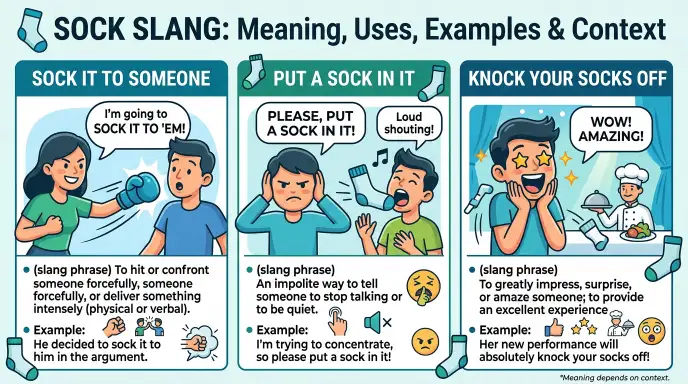
Sock slang usually refers to the informal use of “sock” as a verb meaning to hit or punch someone. In phrases such as “He socked him,” it means that someone struck another person, often with a punch.The word sock can also appear in other informal expressions. For example, “put a sock in it” means to stop talking or be quiet.
Because the meaning can change with the sentence, people often search for sock slang when they see the word used in a text, movie, social media post, or conversation.
This guide explains the main slang meanings of sock, where they come from, how people use them, and if they are rude.You will also see simple examples that show the difference between the ordinary meaning of sock and its slang uses. By the end, you should be able to understand sock slang without guessing from context.
Quick Answer
Sock slang most commonly means “to hit or punch someone.” For example, “He socked the guy” means “He punched the guy.” The word also appears in the expression “put a sock in it,” which means “be quiet” or “stop talking.”
What Does Sock Mean in Slang?
In slang, sock can work as a verb. When someone says that a person “socked” another person, they mean that the person hit or punched them.
Example
“He socked his opponent during the fight.”
Here, socked means hit or punched.
This use is different from the everyday noun sock, which means the clothing worn on your foot.
| Use | Meaning | Example |
| Regular noun | Clothing for your foot | “I need a clean sock.” |
| Slang verb | To hit or punch | “He socked him.” |
| Idiom | Tell someone to be quiet | “Put a sock in it.” |
The sentence usually makes the intended meaning clear.
Full Form or Meaning of Sock Slang
Sock is not an abbreviation, so it does not have a special “full form” like texting terms such as LOL or BRB.
When used as slang, its meaning depends on the expression:
- sock someone = hit or punch someone
- socked him/her = hit or punched him/her
- put a sock in it = be quiet or stop talking
- sock it to someone = confront, attack, or deliver something with force, depending on context
The exact tone can range from playful to aggressive.
Different Meanings of Sock Slang
The word sock has more than one informal use. These meanings should be kept separate because they are not interchangeable.
1. “Sock” Means to Hit or Punch
This is the clearest slang meaning.
Definition: To hit someone, especially with a strong punch.
Example:
“The boxer socked his opponent.”
The sentence describes a physical hit. You may see this meaning in older movies, sports writing, fiction, or casual speech.
It is informal, so hit or punched is usually better in formal writing.
2. “Put a Sock in It”
“Put a sock in it” is an informal idiom meaning “be quiet” or “stop talking.”
For example:
“You two have been arguing for ten minutes. Put a sock in it!”
This expression can sound humorous, old fashioned, or blunt. It is not normally a literal request for someone to put a sock into an object.
3. “Sock It to Me”
“Sock it to me” is another informal expression. Depending on context, it can mean “give it to me,” “show me what you have,” or “deliver it with force.”
It became strongly associated with popular American culture in the 1960s, including the TV show Rowan & Martin’s Laugh In.
Today, many people may recognize the phrase but may not use it in everyday conversation.
Where Is Sock Slang Commonly Used?
Sock slang is mainly found in casual speech, older expressions, entertainment, and informal writing.
You may encounter it in:
- Movies and TV shows
- Books and fiction
- Casual conversations
- Sports or fight related contexts
- Memes and jokes
- Social media posts
- Informal online communities
It is less common in professional communication.
Platform and Context Guide
| Context | How likely you are to see it | Tone |
| Texting | Medium | Casual |
| TikTok | Medium | Often humorous |
| Medium | Casual or joking | |
| Discord | Medium | Depends on the community |
| Medium | Informal | |
| Gaming chat | Medium | Casual |
| School writing | Low | Usually avoid |
| Workplace | Low | Better to use “hit” |
| Formal writing | Very low | Use clearer wording |
There is no special Snapchat, TikTok, or Discord meaning that automatically changes sock. The surrounding words still determine the meaning.
Is Sock Slang Rude, Offensive, or Harmless?
Sock slang is usually not a swear word or an offensive term. However, the meaning can involve violence when it means “hit” or “punch.”
For example:
“He socked me in the arm.”
This describes physical contact and may sound aggressive.
The phrase “put a sock in it” is different. It is not violent in the normal sense, but it can sound rude or bossy because you are telling someone to stop talking.
A playful friend might say it as a joke, but it may sound disrespectful if you say it to a teacher, manager, customer, or stranger.
Real Life Examples of Sock Slang
Seeing the word in real sentences is one of the easiest ways to understand it.
Friendly Conversation
“He tried to sock me after I stole his fries.”
Here, sock means hit or punch. The situation may be exaggerated as a joke.
Text Message
“If he keeps teasing me, I’m gonna sock him 😂”
The speaker may be joking, but the literal slang meaning is still hit.
Gaming
“That boss just socked me for half my health.”
In a game, socked can be used playfully to describe a strong attack.
Discord
“Bro, put a sock in it 😂”
This means stop talking. The laughing emoji can make the message feel more playful.
TikTok or Instagram
“When your little brother won’t stop talking, just put a sock in it.”
Here, the phrase is used humorously to mean be quiet.
Workplace
“He socked the other player.”
This could appear when discussing a sports match, but sock would still be informal. In a report, hit or punched would usually be clearer.
Origin and History of Sock Slang
The ordinary word sock has a much older history as a noun for foot clothing. The slang verb sock, meaning to hit or strike, developed later.
The exact path of the slang meaning is not completely certain. English has long used clothing and body related words in figurative ways, and sock came to be used informally for a forceful blow.
The expression “put a sock in it” is also an older British and American informal expression. Its exact origin is uncertain, so it is better not to claim a single confirmed source for the phrase.
The phrase “sock it to me” became especially well known in American popular culture during the 1960s. Its visibility grew through entertainment, which helped make the expression familiar to a wider audience.
Is Sock Slang Old or Modern?
The slang uses of sock are not new internet slang.
You may see them in older:
- Books
- Films
- TV shows
- Songs and popular culture
- British and American informal speech
That means sock slang can sometimes sound dated. Younger speakers may understand it but choose more common words such as hit, punch, or smack.
Similar Slang and Related Terms
Several informal words can describe hitting or striking someone.
| Word | Meaning | Tone |
| Sock | Hit or punch | Informal |
| Punch | Hit with a fist | Common |
| Smack | Hit or slap | Informal |
| Wallop | Hit hard | Informal, somewhat old fashioned |
| Whack | Hit or strike | Informal |
| Slap | Hit with an open hand | Common |
These words are not exact synonyms in every situation. Punch, for example, specifically suggests a blow with a fist, while whack can describe many types of hitting.
When Should You Avoid Using Sock Slang?
You can understand the expression without using it yourself.
Avoid sock as slang when you need clear, professional language, especially in:
- School assignments
- Academic writing
- Business emails
- Legal documents
- News reports
- Formal complaints
- Professional presentations
Instead of:
“He socked the other person.”
A formal sentence could say:
“He punched the other person.”
Likewise, instead of telling someone:
“Put a sock in it.”
Use:
“Please be quiet.”
or:
“Could you please lower your voice?”
These alternatives are clearer and more polite.
Polite Alternatives to “Put a Sock in It”
If you want someone to stop talking, your choice of words matters.
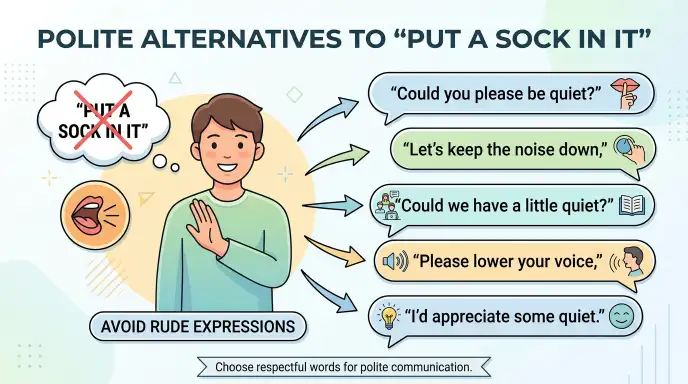
Casual but polite
- “Can you keep it down?”
- “Give it a rest.”
- “Can we have a little quiet?”
More polite
- “Could you please be quiet?”
- “Could we keep the noise down?”
- “Can we focus for a moment?”
Formal
- “Please keep your voice down.”
- “I would appreciate some quiet.”
- “Could we continue this conversation later?”
“Put a sock in it” is best understood as an informal expression, not as the most polite way to ask for silence.
Why Do People Use Sock Slang?
People use informal words like sock because they can make speech feel more colorful, funny, dramatic, or conversational.
The phrase may also fit a certain style or time period. For example, a character in an old movie might say “put a sock in it” because the expression matches the character’s voice.
Online, people may use older expressions ironically. A person might say:
“Put a sock in it, dude 😂”
The phrase sounds playful because it is less direct than simply saying “shut up,” while still telling someone to stop talking.
Common Misunderstandings About Sock Slang
Does sock always mean punch?
No. The normal meaning of sock is the item worn on your foot.
You need the sentence to know if sock is a noun or an informal verb.
Does “put a sock in it” mean anything about socks?
Usually, no. It is an idiom meaning be quiet or stop talking.
Is sock a bad word?
No. It is not normally considered profanity. Some uses can sound aggressive or rude because of their context.
Is sock modern internet slang?
Not really. The slang uses are older than modern social media. Online users may still use them, often for humor or emphasis.
Can I use sock slang at work?
You can understand it, but using it yourself is usually unnecessary. In professional communication, hit, punched, or a polite request for quiet is clearer.
Frequently Asked Questions
What does “sock” mean in slang?
In slang, sock can mean to hit or punch someone. For example, “He socked him” means “He punched him.”
What does “put a sock in it” mean?
“Put a sock in it” means “be quiet” or “stop talking.” It is an informal and sometimes humorous expression.
Is “sock” a swear word?
No. Sock is not normally a swear word. However, some uses can describe violence, while “put a sock in it” can sound rude.
Is sock slang still used today?
Yes, but some uses sound old fashioned or less common than words such as hit, punch, or be quiet. You are more likely to see some expressions in entertainment or joking speech.
What does “socked him” mean?
“Socked him” means “hit him” or “punched him.” The exact force or seriousness depends on the context.
What does “sock it to me” mean?
“Sock it to me” is an informal expression that can mean “give it to me” or “deliver it with force.” Its meaning depends on the situation, and the phrase can sound dated today.
Can I use sock slang with my teacher?
It is better to avoid slang such as “put a sock in it” when speaking to a teacher. A polite phrase like “Could we have some quiet?” is safer.
Conclusion
Sock slang is an informal use of the word sock, most commonly meaning to hit or punch someone. The word also appears in older expressions such as “put a sock in it,” meaning to be quiet, and “sock it to me,” an informal phrase that became widely known through American popular culture.
The key is context. If someone says, “He socked him,” they are probably talking about a punch or hit. If someone says, “Put a sock in it,” they are telling another person to stop talking.
These expressions are generally not offensive by themselves, but they can sound rude, aggressive, or old fashioned depending on how they are used. For school, work, and formal writing, clearer words are usually better.
Read More About!
- Boston Slang Terms: 25 Boston Words & Phrases
- Ole Meaning Slang: What Does Ole Mean in Slang?
- What Does ATM Mean Slang? Meaning in Text, Examples & Uses

Hi, I’m Chloe Parker. I write simple and practical articles about slang, grammar, spelling, vocabulary, and commonly confused words. My goal is to make English easier to understand through clear explanations and real-life examples. Whether you’re a student, writer, or English learner, I’m here to help you build confidence and improve your everyday English.