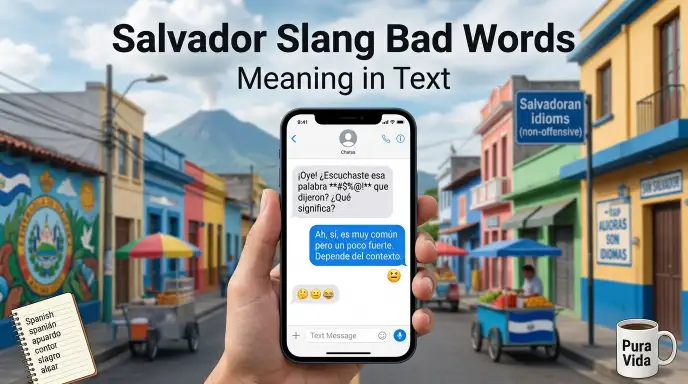
Salvador slang bad words usually refers to rude, vulgar, or insulting expressions used in Salvadoran Spanish, especially in casual speech. People often search for these words because they hear them in conversations, videos, music, social media, or messages and want to know if a word is joking, offensive, or seriously insulting.
Salvadoran Spanish has many regional expressions that can sound very strong to someone who is not familiar with them.
A word such as cerote may be an insult in one situation but a rough, friendly way to address a close friend in another. Maje can also mean “dude” or “idiot,” depending on tone and relationship.
Understanding these words is less about translating them word for word and more about understanding context, tone, and who is speaking to whom.
Quick Answer:
Salvador slang bad words are rude or vulgar expressions found in Salvadoran Spanish. Common examples include cerote, culero, pendejo, hijueputa, and puta, but their strength can change with context.
What Does Salvador Slang Bad Words Mean in Text?
The phrase “Salvador slang bad words” is not one specific slang term. It usually refers to offensive or vulgar words used in El Salvador.
Some are direct insults. Others are everyday slang that can become offensive depending on how they are used.
For example:
- Cerote :a vulgar insult that can also be used jokingly among close friends.
- Maje :“dude,” “man,” or “idiot,” depending on context.
- Pendejo :commonly used as an insult meaning “idiot” or “fool.”
- Culero :a strong insult in Salvadoran usage.
- Hijueputa :a very vulgar form related to “hijo de puta.”
- Puta :a vulgar and derogatory word, often referring to a alternative or used as an insult.
- Baboso :roughly “fool,” “idiot,” or someone acting foolish.
Not every Salvadoran slang word is a bad word. For example, cipote/cipota commonly means a child or young person in Salvadoran Spanish and is not inherently offensive in that regional meaning.
Salvador Slang Bad Words: Full Definition
There is no single “full form” for Salvador slang bad words because it describes a category rather than an abbreviation.
The phrase can include:
- Profanity
- Personal insults
- Vulgar expressions
- Derogatory names
- Strong expressions of anger
- Words that sound offensive outside their local context
Salvadoran Spanish has its own vocabulary and informal speech patterns. Some words are strongly connected with local culture, while others are shared across Central America.
The important point is that a slang word does not always have the same emotional meaning every time it is used.
A close friend may use a rough word as a joke. A stranger using the same word can make it sound aggressive.
Common Salvador Slang Bad Words
Here are some commonly encountered offensive or potentially offensive expressions. Their exact strength can vary by speaker and situation.
| Word | General meaning | Typical tone |
| Cerote | Jerk, idiot, vulgar insult | Strong; sometimes playful |
| Culero | A hole / unpleasant person | Strong |
| Pendejo | Idiot, fool | Insulting |
| Hijueputa | Very strong insult | Very vulgar |
| Puta | Vulgar/derogatory insult | Very offensive |
| Baboso | Fool, idiot | Mild to moderate |
| Maje | Dude, man, idiot | Context dependent |
| Huevón | Lazy person / fool | Informal to insulting |
| Malparido | Very strong insult | Highly offensive |
A useful source on Salvadoran Spanish lists several of these as offensive expressions, while also noting that words such as maje can vary in meaning.
1. Cerote
Cerote is one of the most recognizable strong slang words associated with El Salvador.
Its literal meaning is vulgar, referring to a piece of feces. In slang, however, it can be used as an insult similar to “jerk,” “idiot,” or “piece of crap.”
But there is an important cultural detail.
Among close friends, cerote can sometimes be used in a joking or familiar way. The relationship between the speakers can completely change how the word sounds.
For example:
“¡Qué ondas, cerote!”
Between close friends, this may function roughly like “What’s up, man?”
But:
“Sos un cerote.”
Said angrily, it becomes a serious insult.
That is why learners should not assume that every use of cerote has the same level of offensiveness.
2. Maje
Maje is another important Salvadoran slang word.
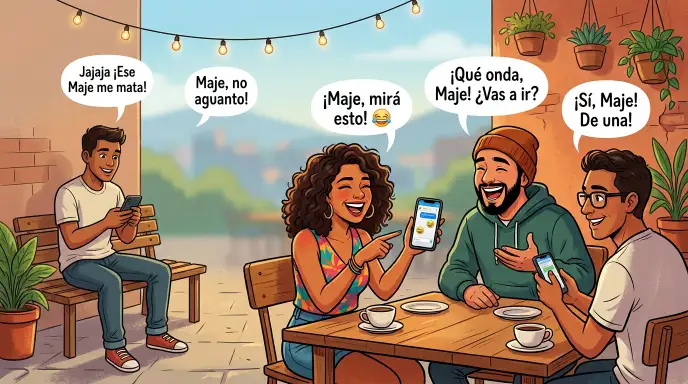
It can mean:
- Dude
- Man
- Mate
- Guy
- Fool
- Idiot
Its meaning depends heavily on tone and context. A Salvadoran speaker may use it casually when talking to a friend, while another sentence can make it clearly insulting.
Friendly example
“¿Qué ondas, maje?”
Meaning: “What’s up, man?”
Insulting example
“No seás maje.”
Meaning: “Don’t be an idiot.”
This makes maje different from a straightforward swear word. It can be perfectly normal in informal conversation but can also carry a negative meaning.
3. Pendejo
Pendejo is used in many Spanish speaking countries, but its exact meaning changes across regions.
In Salvadoran usage, it can refer to someone who is foolish, foolish, or acting badly. It can be an insult, although the strength depends on the situation. Sources on Spanish profanity also note that pendejo has different regional meanings across Latin America.
For example:
“No seas pendejo.”
This can mean:
“Don’t be an idiot.”
Because the word is widely recognized across Spanish speaking communities, it is not uniquely Salvadoran. However, its use and emotional force should still be understood within Salvadoran context.
4. Culero
Culero is a stronger insult and should be used carefully.
It can be directed at someone the speaker considers unpleasant, dishonest, cruel, or otherwise objectionable. Its exact English equivalent depends on context.
Unlike a casual word such as maje, this is much more likely to be understood as offensive.
If you are learning Salvadoran Spanish, it is better to recognize this word than to start using it casually.
5. Hijueputa
Hijueputa is a highly vulgar expression related to hijo de puta, literally connected to “son of a alternative.”
It is commonly understood as a strong insult in many Spanish speaking communities.
The word can appear during:
- Arguments
- Angry conversations
- Online gaming
- Social media comments
- Heated texting
- Strong emotional reactions
Because it is highly vulgar, it is not appropriate for formal communication.
6. Puta
Puta is another vulgar Spanish word that can be highly offensive.
Its literal use can refer to a alternative, but it is also used as an insult or as part of stronger expressions.
Because it can attack a person’s sexual reputation, it should be treated as particularly offensive when directed at someone.
Avoid using it with strangers, coworkers, teachers, customers, or in professional communication.
7. Baboso
Baboso is generally less severe than some of the stronger swear words.
Depending on context, it can mean:
- Fool
- Idiot
- Silly person
- Someone acting foolish
It can sometimes be used jokingly between people who know each other well.
Still, calling a stranger baboso can sound disrespectful.
Is Salvador Slang Rude, Offensive, or Neutral?
It depends on the word.
Some expressions are clearly vulgar. Others are only offensive in certain situations.
A simple way to understand them is:
Usually highly offensive
- Hijueputa
- Puta
- Malparido
- Strong uses of cerote
Often insulting
- Culero
- Pendejo
- Baboso
- Huevón
Context dependent
- Cerote
- Maje
The relationship between speakers matters a lot. Salvadoran slang can be informal and expressive, so a word that looks harsh in a dictionary may sound less aggressive among close friends.
Where Is Salvadoran Slang Commonly Used?
These expressions can appear in informal spoken Spanish and online communication.
You may encounter Salvadoran slang in:
- Text messages
- WhatsApp conversations
- TikTok videos
- Instagram comments
- Facebook posts
- YouTube videos
- Online gaming
- Discord chats
- Music and entertainment
- Casual conversations
However, seeing a word online does not automatically mean it is safe to repeat.
Social media often removes the relationship and tone that make a slang word understandable in face to face conversation.
Real Life Examples of Salvador Slang Bad Words
Friendly Context
“¿Qué ondas, maje?”
Meaning: “What’s up, dude?”
Here, maje is casual and familiar rather than strongly offensive.
Casual Context
“Ese maje vive por aquí.”
Meaning: “That guy lives around here.”
The word is being used informally to refer to a person.
Playful Context
“¡Sos un cerote!”
Among close friends, this can sometimes be teasing rather than a serious attack.
However, a learner should be careful because the same sentence can sound genuinely insulting when said angrily.
Argumentative Context
“No seas pendejo.”
Meaning: “Don’t be an idiot.”
This is clearly confrontational.
Gaming Context
A player might use strong Spanish profanity after losing a match or blaming another player.
In this setting, profanity may express frustration rather than a carefully considered personal insult. Even so, it can still violate a platform’s community rules.
Salvador Slang Bad Words vs Normal Slang
Not all Salvadoran slang is offensive.
Consider these examples:
| Salvadoran word | Meaning | Offensive? |
| Cipote/cipota | Child or young person | No, normally neutral |
| Chero/chera | Friend/buddy | Usually casual |
| Maje | Dude/person/idiot | Depends on context |
| Cerote | Vulgar insult/friendly address | Depends strongly on context |
| Bolo | Drunk | Can be descriptive or insulting |
| Casaca | Lie / story | Informal |
| Pendejo | Fool/idiot | Usually insulting |
| Culero | Strong insult | Offensive |
| Hijueputa | Very strong insult | Highly vulgar |
For example, cipote is normally a regional word for a child or young person in El Salvador. It is not a Salvadoran swear word.
This distinction is important because some words may look strange to outsiders without actually being offensive in El Salvador.
Origin and Background of Salvadoran Slang
Salvadoran Spanish has developed its own regional vocabulary over many years.
Informal Salvadoran speech is often associated with Caliche, a term used for local slang and informal language. Words such as maje and cerote are strongly associated with everyday Salvadoran speech.
Some expressions are shared with neighboring Central American countries. Others have developed special meanings in El Salvador.
This is why translating Salvadoran slang directly into English can be misleading.
For example, translating cerote only as its literal vulgar meaning misses the fact that close friends can use the word in a familiar way.
Why Do People Use These Words?
People use slang and profanity for many reasons.
To show friendship
Close friends sometimes use rough language because they feel comfortable with each other.
To express anger
Strong words can communicate frustration more quickly than neutral vocabulary.
To joke
Some insults are used playfully when both speakers understand the relationship.
To sound informal
Slang makes conversation feel less formal and more natural.
To show regional identity
Local vocabulary can help people express where they come from and connect with their community.
When Should You Avoid Salvador Slang Bad Words?
If you are learning Salvadoran Spanish, recognition is safer than imitation.
Avoid strong slang when speaking with:
- Teachers
- Employers
- Customers
- Older people you do not know well
- New acquaintances
- Government officials
- Professional contacts
- People you have just met
You should also avoid using strong insults in formal writing.
A word that sounds funny in a TikTok video may sound disrespectful when directed at a real person.
Polite Alternatives
If you want to sound casual without using offensive language, choose neutral expressions.
Instead of a strong insult, you can say:
- Amigo :friend
- Amigo mío :my friend
- Compañero :companion/colleague
- Muchacho :young man/boy
- Persona :person
- Dude/man in English when speaking English
For a neutral greeting, “¿Qué ondas?” is a useful Salvadoran style informal expression meaning roughly “What’s up?”
The safest approach is to learn the local expression first and then understand how native speakers use it before copying it.
Is Salvador Slang Safe for Social Media?
It depends on the platform, audience, and specific word.
Mild slang may be fine in casual conversations, but strong profanity can:
- Offend other users
- Trigger moderation systems
- Violate community guidelines
- Create misunderstandings
- Make a post appear aggressive
Even when a word is commonly used in El Salvador, people from other Spanish speaking countries may understand it differently.
This is especially important on global platforms such as TikTok, Instagram, YouTube, Reddit, and Discord.
Important Cultural Note
One of the biggest mistakes language learners make is assuming that all Spanish slang works the same everywhere.
It does not.
A word can be:
- Friendly in El Salvador
- Offensive in another country
- Neutral in one situation
- Vulgar in another
- Completely misunderstood by a learner
Cipote is a good example of regional differences. In El Salvador it commonly means “kid” or “young person,” while the word has vulgar meanings in some other Spanish speaking varieties.
The lesson is simple: always check the country, context, speaker, and tone.
FAQs About Salvador Slang Bad Words
What are common Salvador slang bad words?
Common offensive or potentially offensive expressions include cerote, culero, pendejo, hijueputa, puta, baboso, and huevón. Some, such as cerote and maje, can change meaning depending on context.
Is cerote a bad word in El Salvador?
Yes, cerote is vulgar and can be a strong insult. However, close friends may also use it jokingly or familiarly. Tone and relationship are very important.
What does maje mean in Salvadoran slang?
Maje can mean “dude,” “man,” or “guy,” but it can also mean “fool” or “idiot.” The intended meaning depends heavily on context and tone.
Is pendejo offensive in El Salvador?
Usually, yes. Pendejo can be used as an insult meaning someone is foolish or foolish. Its exact meaning and strength vary across Spanish speaking countries.
Is cipote a bad word in El Salvador?
Normally, no. In Salvadoran Spanish, cipote/cipota commonly refers to a child or young person. It is a regional everyday word rather than a swear word in that context.
Can I use Salvadoran bad words with friends?
Only if you understand the local context and know that the person is comfortable with that language. If you are not a native speaker, it is safer to recognize these words without using the strongest ones yourself.
Conclusion
Salvador slang bad words are an important part of understanding informal Salvadoran Spanish, but they should not all be treated as simple English translations.
Words such as cerote, maje, pendejo, culero, and hijueputa can carry very different levels of offense.
The most important factor is context. A word like maje can sound like “dude” among friends but become insulting in another sentence.
Cerote can also move from playful familiarity to a serious insult depending on tone and relationship.
If you are learning Salvadoran Spanish, focus first on understanding these expressions. Do not assume that a word is safe simply because you hear native speakers using it casually.
When in doubt, choose neutral language. Learning regional slang is useful because it helps you understand real conversations, but using offensive slang requires cultural awareness.
The best way to communicate naturally is to understand who is speaking, who is listening, where the conversation happens, and what tone the speaker intends.
Read More About!
- TLS Meaning Slang: What Does TLS Mean in Text?
- Flamer Slang: Meaning, Uses, Examples & Context
- Korean Texting Slang: Meaning & Examples

Hi, I’m Chloe Parker. I write simple and practical articles about slang, grammar, spelling, vocabulary, and commonly confused words. My goal is to make English easier to understand through clear explanations and real-life examples. Whether you’re a student, writer, or English learner, I’m here to help you build confidence and improve your everyday English.