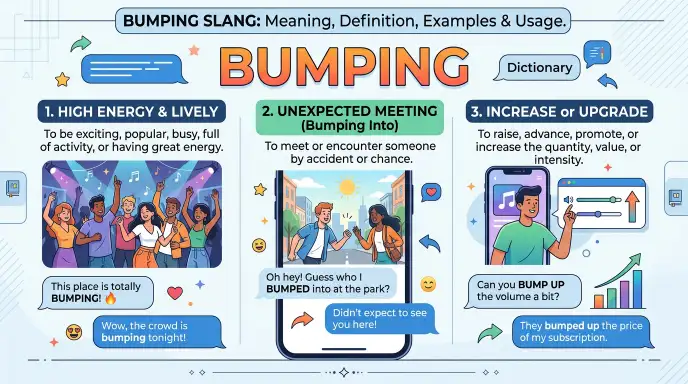
Bumping slang can have different meanings depending on the context. In casual speech and online conversations, “bumping” may describe promoting or bringing attention to something, while in other settings it can mean increasing activity, moving into something, or physically hitting something. The exact meaning depends on where you see the word.
If you searched for bumping slang, you may have seen it in a text, social media post, comment, song, gaming chat, or everyday conversation and wondered what the person meant. This guide explains the common slang uses in simple English.
You will learn what “bumping” means in slang, how people use it online, how context changes its meaning, if it is rude, and when another word may be clearer.
Quick Answer
Bumping slang usually means bringing attention to something, increasing activity, or moving something forward, depending on context. Online, someone may “bump” a post to make it visible again. In other casual uses, “bumping” can describe hitting something, increasing something, or joining an activity.
What Does Bumping Mean in Slang?
The word bumping comes from the verb “bump,” but slang uses can be more flexible than the literal meaning.
One common online use is bumping a post or message. This means posting or replying again so the original content gets attention.
For example:
“Bumping this because I still need an answer.”
Here, the person is not physically hitting anything. They are trying to move the post back into view.
Another casual use can describe increasing or adding to something.
For example:
“They’re bumping the price up.”
This means the price is being increased.
The meaning must be judged from the sentence around it.
Different Meanings of Bumping Slang
“Bumping” does not have just one slang definition. Here are some common contexts.
1. Bumping a Post
On forums, social media, or online communities, bumping a post means bringing an older post back to attention.
Example:
“Just bumping this thread in case anyone knows the answer.”
The user is posting again because they want more people to see the discussion.
2. Bumping Something Up
“Bumping” can also mean increasing or raising something.
Example:
“Can you bump the deadline by two days?”
In this sentence, the speaker wants the deadline moved.
Another example is:
“They bumped the price up after demand increased.”
This means the price was raised.
3. Bumping Into Someone
In casual speech, “bumping into” someone means meeting them unexpectedly.
Example:
“I bumped into Sarah at the mall.”
This is usually not internet slang. It is a common informal expression.
4. Bumping Into Something
The literal meaning is also common.
Example:
“I was walking too fast and bumped into the table.”
Here, “bumped” means physically hit something lightly.
5. Bumping Music
In casual language, people may say music is bumping when it sounds energetic, loud, or enjoyable.
Example:
“The speakers were bumping all night.”
This use is strongly connected with music and party language.
Where Is Bumping Slang Commonly Used?
You may see “bumping” in several types of conversations.
| Context | Possible meaning |
| Online forum | Bringing a post back to attention |
| Social media | Giving older content attention |
| Texting | Raising or increasing something |
| Everyday conversation | Meeting someone unexpectedly |
| Physical situation | Hitting something |
| Music | Playing with strong energy or volume |
| Gaming | Context dependent casual use |
The same word can therefore mean very different things.
Always read the full sentence before deciding what it means.
Bumping Slang in Text Messages
In texting, “bumping” often depends on what the person is talking about.
For example:
“Bumping this because you didn’t reply.”
The speaker is reminding the other person about an earlier message.
Another example:
“Can we bump the meeting to Friday?”
Here, “bump” means move or reschedule.
A short message can therefore be confusing without context.
Bumping on Social Media and Forums
One of the clearest online meanings is bumping a thread or post.
Older forums often used “bump” as a simple way to bring a discussion back to the top of a page. The idea is simple: new activity can make an older discussion more visible.
For example:
“Bump does anyone know how to fix this?”
The person is not giving a new answer. They are trying to get attention from other users.
Similar behavior can appear on different online platforms, although the exact rules depend on the site.
Is Bumping Slang Rude or Offensive?
Usually, bumping is not rude or offensive.
The tone depends on how it is used.
A simple “bump” on a forum may be harmless. But repeatedly bumping a post can annoy other users if a community has rules against unnecessary posts.
Similarly, saying:
“Can we bump this meeting?”
is usually casual and harmless.
However, professional writing may be clearer if you use words such as reschedule, move, increase, raise, or follow up.
Real Life Examples of Bumping Slang
Here are some natural examples.
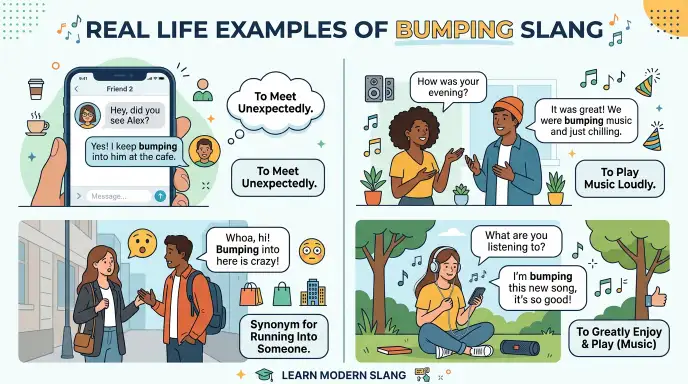
Example 1: Online Forum
Person A: “Does anyone know the answer to this?”
Person B: “Bumping this because I have the same problem.”
Here, “bumping” means bringing the discussion back to attention.
Example 2: Texting
“Can we bump our call to 4 PM?”
Here, it means moving the call to a later time.
Example 3: Everyday Conversation
“I bumped into my old teacher yesterday.”
Here, it means meeting someone unexpectedly.
Example 4: Music
“That playlist was bumping at the party.”
Here, it describes energetic or enjoyable music.
Example 5: Price
“The seller bumped the price up.”
Here, it means the seller increased the price.
Where Did the Slang Use Come From?
The different meanings of “bumping” come from the broader English word bump and its many established uses.
The online meaning of bumping a post developed from the idea of physically moving something upward or making it rise in position. On forums, a new reply could make an older discussion appear higher in a list.
Because online communities use different rules and customs, the exact history of the term varies by platform.
It is safer to describe “bump” as an established online forum expression rather than claim that one specific website invented it.
Bumping vs. Similar Slang
Several words can be close to “bumping,” but they are not always interchangeable.
| Term | Common meaning |
| Bumping | Bringing attention, moving something, or increasing it |
| Boosting | Helping something gain attention or reach |
| Pushing | Promoting or moving something forward |
| Raising | Increasing a level, price, or amount |
| Rescheduling | Moving an event to another time |
| Following up | Contacting someone again about an earlier matter |
The best replacement depends on the context.
When Should You Avoid Using Bumping?
You do not need to avoid the word completely. It is common and usually harmless.
However, avoid vague uses when clarity matters.
For example, instead of writing:
“We need to bump the meeting.”
in a formal email, you could write:
“We need to move the meeting to Thursday.”
This removes confusion.
You should also check community rules before repeatedly bumping posts on forums or discussion boards.
Polite Alternatives to Bumping
If you want to sound more professional, use a more specific word.
Depending on the meaning, you can say:
- Follow up
- Raise
- Increase
- Move
- Reschedule
- Promote
- Bring back to attention
- Remind
For example:
Casual: “Just bumping this.”
Professional: “I’m following up on my earlier message.”
The second version is clearer in a workplace setting.
Why Do People Say Bumping?
People use “bumping” because it is short and easy to understand in casual settings.
Online, a single word such as “bump” can tell other users that someone wants attention on an older post.
In conversation, “bump” can also make an idea sound casual:
“Let’s bump the meeting to tomorrow.”
The speaker means that the schedule should change.
Its usefulness comes from the fact that one short word can describe several types of movement or change.
Common Misunderstandings About Bumping
The biggest misunderstanding is assuming that “bumping” always has one slang meaning.
It does not.
For example:
“I bumped into Jake.”
does not mean the same thing as:
“I bumped the post.”
The first usually means an unexpected meeting. The second means bringing an online post back to attention.
Likewise:
“The music is bumping.”
has a completely different meaning.
Context is the key.
Frequently Asked Questions
What does bumping mean in slang?
Bumping can mean bringing attention to something, increasing or moving something, or describing energetic music. Its meaning depends on context.
What does bumping a post mean?
Bumping a post means posting or replying again to bring an older post or discussion back to attention.
Is bumping rude?
Usually, no. It is generally harmless, but repeated bumping can be annoying on communities that discourage unnecessary posts.
What does “bump” mean in texting?
In texting, “bump” may mean following up on something, moving a plan, or increasing something. The sentence determines the meaning.
Is bumping professional?
It can be understood in casual workplace chat, but clearer terms such as “follow up,” “move,” or “reschedule” are better for formal communication.
What does “bumping into someone” mean?
It usually means meeting someone unexpectedly.
Does bumping always mean hitting something?
No. The literal meaning can involve physical contact, but slang and informal uses can refer to attention, scheduling, increases, or music.
Conclusion
Bumping slang has several meanings, so context matters. Online, bumping a post usually means bringing an older discussion back to attention.
In other conversations, “bump” can mean moving or increasing something, meeting someone unexpectedly, or describing energetic music.
The easiest way to understand the word is to look at what comes before and after it. A phrase such as “bump the meeting” is about scheduling, while “bump this post” is about getting attention.
The word is generally harmless and common in casual communication. Still, professional writing often benefits from more specific alternatives such as follow up, reschedule, raise, increase, or promote.
Read More About!
- Korean Texting Slang: Meaning & Examples
- OMY Meaning Slang: What Does OMY Mean in Text?
- Sock Slang: Meaning, Uses, Examples & Context

Hi, I’m Chloe Parker. I write simple and practical articles about slang, grammar, spelling, vocabulary, and commonly confused words. My goal is to make English easier to understand through clear explanations and real-life examples. Whether you’re a student, writer, or English learner, I’m here to help you build confidence and improve your everyday English.