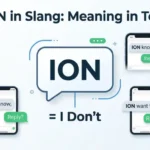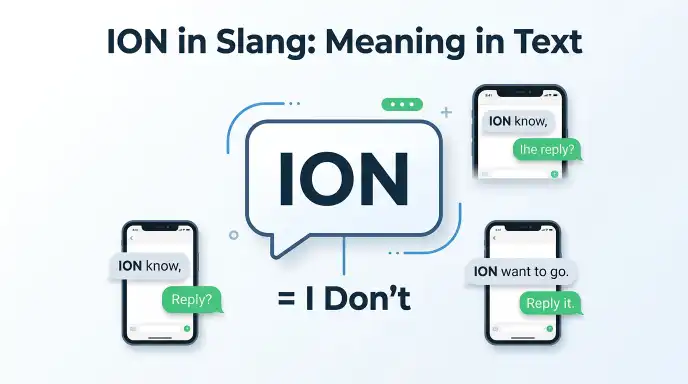
If you see “ion” in slang or text, it usually means “I don’t.” It is an informal spelling that reflects how “I don’t” can sound when spoken quickly.
You may see phrases like “ion know,” “ion care,” or “ion wanna go” in texts, Tik Tok comments, Instagram captions, Snapchat messages, and other casual chats.
The word can look confusing because ion is also a real science term, but context usually makes the meaning clear.
This guide explains what ion in slang means, how people use it, where the slang comes from, if it is rude, and when you should avoid using it. You’ll also see simple examples that show how it works in real conversations.
Quick Answer
ION usually means “I don’t” in texting and internet slang. It is a casual, phonetic spelling of the phrase and is mainly used in informal conversations.
For example, “ion know” means “I don’t know,” while “ion care” means “I don’t care.”
What Does ION Mean in Slang?
In slang, ion = I don’t.
It is not normally an acronym in this use. Instead, it is a written form based on the way “I don’t” may sound in fast, casual speech. People use it to make their messages feel relaxed and conversational.
| Slang | Standard English |
| ion know | I don’t know |
| ion care | I don’t care |
| ion want it | I don’t want it |
| ion think so | I don’t think so |
| ion remember | I don’t remember |
| ion like that | I don’t like that |
For example:
“Ion know what happened.”
This simply means:
“I don’t know what happened.”
The meaning is usually easy to understand when ion is followed by a verb or phrase that normally comes after “I don’t.”
Is ION an Abbreviation?
Not exactly.
When ion means “I don’t,” it is better described as a slang spelling or phonetic reduction rather than a traditional abbreviation such as “LOL” or “BRB.”
The spelling represents the sound of the phrase in casual speech. Wiktionary records this slang use as a reduction of “I don’t” and identifies it with African American Vernacular English (AAVE).
That distinction matters because people sometimes assume that every short slang term is an acronym. In this case, ion does not normally stand for three separate words.
Where Is ION Commonly Used?
ION is mainly used in informal digital communication. You may encounter it in:
- Text messages
- TikTok comments and captions
- Instagram comments and DMs
- Snapchat chats
- X posts and replies
- Discord conversations
- Group chats
- Memes
- Casual online communities
Its meaning usually stays the same across these platforms. What changes is the tone.
For example:
Text message:
“I feel like going out tonight.”
TikTok comment:
“ion even know what’s happening 😭”
Instagram DM:
“ion think that’s a good idea.”
Discord chat:
“ion wanna play rn.”
In each case, ion means “I don’t.”
ION on TikTok, Instagram, Snapchat, and Discord
The slang is especially useful in fast, casual conversations because it gives a message a spoken, relaxed feel.
ION on TikTok
On TikTok, you may see ion in captions, comments, memes, or replies.
Example:
“ion understand this trend 😭”
Meaning:
“I don’t understand this trend.”
ION on Instagram
On Instagram, it can appear in comments, Stories, captions, and private messages.
Example:
“I get the hype.”
This means:
“I don’t get the hype.”
ION on Snapchat
Snapchat conversations are often quick and informal, so slang spellings such as ion can fit naturally.
Example:
“I know yet.”
Meaning:
“I don’t know yet.”
ION on Discord
On Discord, ion may appear in casual gaming or community chats.
Example:
“I wanna queue again.”
Meaning:
“I don’t want to queue again.”
The slang is much less suitable for formal Discord communities, school announcements, or professional messages.
Is ION Rude or Offensive?
ION itself is not usually offensive. It is simply an informal way to write “I don’t.”
However, the full sentence and tone can make a message sound rude.
Compare:
“ion know lol”
with:
“I care what you think.”
The first may sound casual or unsure. The second can sound dismissive because “I don’t care” can already carry a strong tone.
So, do not judge the word ion by itself. Look at the whole sentence.
| Example | Likely tone |
| “ion know lol” | Casual |
| “ion think so” | Relaxed disagreement |
| “ion remember” | Neutral/casual |
| “ion wanna go” | Casual refusal |
| “ion care” | Can sound dismissive |
| “ion care what you think” | Potentially rude |
Real Life Examples of ION in Slang
Here are realistic examples of how people might use ion in everyday online conversations.
Example 1: Saying You Do Not Know
Friend: “What time does the movie start?”
You: “Ion know, check the app.”
Here, ion now means “I don’t know.”
Example 2: Showing a Preference
Friend: “Do you want pizza?”
You: “Ion really likes pizza.”
This means:
“I don’t really like pizza.”
Example 3: Saying No
Friend: “You coming with us?”
You: “Ion think so.”
This means:
“I don’t think so.”
Example 4: Showing Disinterest
Friend: “Did you see what they posted?”
You: “Ion care tbh.”
This means:
“I don’t care, to be honest.”
The tone can sound dismissive depending on the conversation.
Example 5: Casual Refusal
Friend: “You wanna play another round?”
You: “Ion wanna play anymore.”
Meaning:
“I don’t want to play anymore.”
Where Did ION Come From?
The slang ion is connected to the pronunciation of “I don’t” in casual speech. It is documented as a slang reduction associated with African American Vernacular English (AAVE).
The exact point at which people first began using the spelling online is difficult to establish with certainty.
Older user generated examples show the form appearing in online slang communities by the 2010s, including examples dating to 2012.
That does not mean the slang was invented by one website or one social media platform. Online writing helped spread a spelling that reflects an existing speech pattern.
Today, the form appears across many types of casual online communication.
Different Meanings of ION
Context matters because ion can mean different things outside slang.
1. ION = “I don’t”
This is the common slang meaning in casual texting.
Example:
“I know.”
Meaning:
“I don’t know.”
2. Ion in Science
In science, an ion is an atom or molecule with an electric charge because it has gained or lost electrons.
Example:
“The experiment produced a positive ion.”
This has nothing to do with internet slang.
3. ION = “In Other News”
Some online sources also use ION as an abbreviation for “In Other News.” However, this is a different use from lowercase ion meaning “I don’t.”
If someone writes:
“ION, did you hear about the new restaurant?”
they may be changing the subject with “In Other News.”
Because this use is less common in casual slang than ion = I don’t, context is important.
ION vs. “I Don’t”
The main difference is formality.
| Feature | ION | I don’t |
| Meaning | I don’t | I don’t |
| Style | Slang | Standard English |
| Tone | Casual | Neutral |
| Texting | Common in informal chats | Common everywhere |
| School work | Usually avoid | Appropriate |
| Workplace | Usually avoid | Appropriate |
| Formal writing | No | Yes |
If you are talking to friends, ion may sound natural.
If you are writing an email to a teacher, manager, client, or employer, use “I don’t.”
Similar Slang and Related Terms
Several slang forms can appear in similar conversations.
- iono :usually “I don’t know”
- idk :“I don’t know”
- idc :“I don’t care”
- iono :casual spelling of “I don’t know”
- nah :an informal way to say no
- naw :casual spelling of “no”
- fr :“for real”
- tbh :“to be honest”
These terms are not identical, though.
For example:
“idk” = I don’t know
while:
“ion know” = I don’t know
Both can express the same idea, but ion has a more speech like slang style.
When Should You Avoid Using ION?
Avoid ion when the message needs standard, professional English.
This includes:
- Job applications
- Business emails
- Professional reports
- School assignments
- Academic papers
- Messages to clients
- Formal requests
- Official documents
- Communication with someone who may not understand internet slang
For example, avoid:
“Ion know if I can attend the meeting.”
Use:
“I don’t know if I can attend the meeting.”
The second version is clear and professional.
You should also avoid using ion when you are unsure if the reader knows the slang. Slang works best when both people understand the same style of communication.
Polite Alternatives to ION
If you want to sound clear and polite, simply use standard English.
Instead of:
“Ion know.”
Try:
“I’m not sure.”
Instead of:
“Ion wanna go.”
Try:
“I don’t think I can go.”
Instead of:
“Ion care.”
Try:
“It’s not really important to me.”
Instead of:
“Ion think so.”
Try:
“I don’t think so.”
These alternatives work better when you want to avoid sounding too blunt.
Why Do People Use ION?
People use ion mainly because it feels natural in casual online speech.
It can:
- Make messages shorter.
- Reflect the way someone speaks.
- Create a relaxed tone.
- Add personality to a message.
- Fit the style of internet slang.
- Make a message feel less formal.
It is also a way for people to signal that they are speaking casually rather than writing formal English.
For many users, ion is not about saving a huge amount of typing time. It is more about voice and style.
Common Misunderstandings About ION
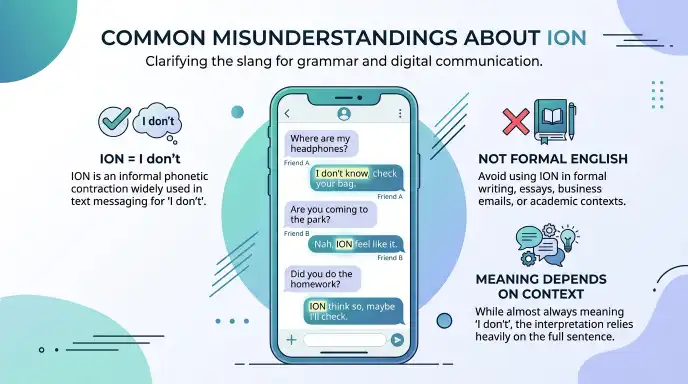
“ION is always a science word.”
No. In a casual text, ion can mean “I don’t.” In science, it refers to a charged atom or molecule.
“ION stands for I don’t.”
Not in the usual acronym sense. It is better understood as a slang or phonetic reduction of “I don’t.”
“ION means I don’t know.”
Not by itself.
Ion means “I don’t.” The words that follow complete the thought.
For example:
- “ion know” = I don’t know
- “ion care” = I don’t care
- “ion want it” = I don’t want it
“Using ION is always rude.”
No. The tone depends on the sentence and situation.
“Ion know” can be completely casual. “I care what you think” may sound dismissive.
“ION is appropriate everywhere.”
No. It is slang and should generally stay in informal communication.
Frequently Asked Questions
What does ION mean in slang?
ION usually means “I don’t.” It is a casual slang spelling used in texts, chats, and social media.
What does ION mean in text messages?
In text messages, ion usually means “I don’t.” For example, “ion know” means “I don’t know.”
Is ION an acronym?
Usually, no. When it means “I don’t,” it is a phonetic slang spelling rather than a traditional acronym.
What does “ion know” mean?
“Ion know” means “I don’t know.” It is a casual way to write the phrase in texts or online chats.
Is ION rude?
Not by itself. Ion is generally harmless slang, but phrases such as “ion care” can sound dismissive depending on the context.
Can I use ION at work?
It is best to avoid it in professional communication. Use “I don’t” instead.
What does ION mean on TikTok?
On TikTok, ion usually means “I don’t.” It can appear in captions, comments, and replies, especially in casual slang heavy conversations.
Does ION have another meaning?
Yes. In science, an ion is a charged atom or molecule. In some contexts, ION can also mean “In Other News.” Context tells you which meaning is intended.
Conclusion
ION in slang usually means “I don’t.” It is a casual, phonetic spelling used in texts, social media posts, comments, and online chats.
You might see “ion know,” “ion care,” “ion wanna,” or “ion think so.” The basic idea stays the same: replace “ion” with “I don’t” and the sentence becomes standard English.
The term is generally not offensive, but the sentence around it can affect the tone. It is also important not to confuse slang ion with the scientific term ion, which refers to a charged atom or molecule.
Use ion when you are intentionally writing in a casual style and the people you are talking to understand internet slang. For school, work, business, and other formal settings, “I don’t” is the safer and clearer choice.
Read More About!
- Flamer Slang: Meaning, Uses, Examples & Context
- Iowa Slang Meaning: What Does Iowa Slang Mean?
- Flex Definition Slang: Meaning, Examples & Usage

Hi, I’m Chloe Parker. I write simple and practical articles about slang, grammar, spelling, vocabulary, and commonly confused words. My goal is to make English easier to understand through clear explanations and real-life examples. Whether you’re a student, writer, or English learner, I’m here to help you build confidence and improve your everyday English.