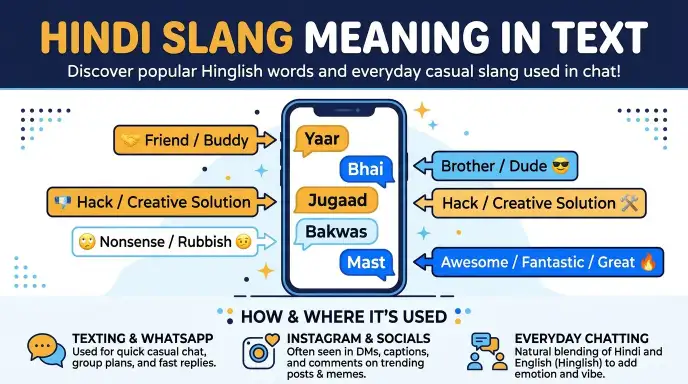
Hindi slang refers to informal words, phrases, and expressions used in casual Hindi conversations. These terms are common in texting, social media, friendships, movies, and everyday speech, but their meaning can change with context and tone.
People often search for Hindi slang because they come across short expressions online that do not translate naturally into English.
A word may sound harmless in one conversation but rude, funny, teasing, or disrespectful in another. Understanding the context helps you know what someone really means.
Hindi slang is also changing quickly. Younger speakers often mix Hindi with English, creating Hinglish expressions that are common on Instagram, WhatsApp, YouTube, Snapchat, Reddit, gaming chats, and other online spaces.
Quick Answer
Hindi slang means informal Hindi words or expressions used in relaxed, friendly, humorous, or sometimes rude communication. The exact meaning depends on the speaker, situation, region, and tone.
What Does Hindi Slang Mean in Text?
In text messages, Hindi slang usually makes conversations shorter, more relaxed, and more expressive. Friends may use slang to joke with each other, show excitement, complain, tease someone, or react to a situation.
For example, someone might write:
“Bhai, kya scene hai?”
Here, bhai literally means “brother,” but in casual speech it can mean bro, buddy, or friend. “Kya scene hai?” can mean something like “What’s going on?” or “What’s the plan?”
Another example is:
“Yaar, ye kya bakwas hai?”
Depending on the situation, yaar can mean “friend,” “mate,” or simply add an emotional, informal tone. Bakwas means “nonsense” or “rubbish.”
This shows why translating slang word for word does not always work. The surrounding conversation matters.
Is There a Full Form of Hindi Slang?
No. Hindi slang is not an abbreviation with one full form.
The phrase “Hindi slang” describes a broad group of informal expressions rather than one specific slang word. Individual expressions may have their own meanings, origins, or shortened forms.
Some common examples include:
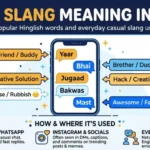
- Bhai :bro, buddy, or friend
- Yaar :friend, mate, or an emotional way to address someone
- Bakwas :nonsense or rubbish
- Jhakaas :excellent, awesome, or very cool
- Panga :trouble, conflict, or a risky situation
- Chill :relax; commonly used in Hinglish
- Fattu :a person seen as cowardly; can be insulting
- Jugad/Jugaad :a clever workaround or improvised solution
- Chindi :stingy, petty, or low quality in some contexts
- Bindass :carefree, confident, or unconcerned
Not every expression is used throughout all Hindi speaking communities. Regional speech, age, social group, and personal style can affect usage.
Common Hindi Slang Words and Their Meanings
Here are some widely recognized informal Hindi expressions and the general ideas they can convey.
| Hindi slang | Common meaning | Typical tone |
| Bhai | Bro, buddy | Friendly/casual |
| Yaar | Friend, mate | Friendly/emotional |
| Bakwas | Nonsense | Negative/casual |
| Jhakaas | Awesome, excellent | Positive/playful |
| Panga | Trouble, conflict | Casual |
| Jugaad | Clever workaround | Informal/positive |
| Bindass | Carefree, confident | Positive |
| Fattu | Coward | Insulting |
| Chindi | Stingy/petty | Negative |
| Lafda | Trouble, messy situation | Informal |
| Mast | Great, fun, excellent | Positive |
| Pataka | Attractive person | Playful; can be objectifying |
The same word can feel different depending on who says it and why.
Is Hindi Slang Rude or Offensive?
Some Hindi slang is completely harmless, while other expressions can be insulting or offensive. There is no single rule that applies to every slang word.
For example, bhai is often friendly. A person may use it with a close friend even when they are not related.
By contrast, words used to call someone a coward, foolish, cheap, or unattractive can become insulting when directed at a person.
Tone is especially important. A close group of friends may use a word jokingly that would sound disrespectful when said to a stranger.
Before using unfamiliar Hindi slang, consider:
- Who are you talking to?
- Are you close friends?
- Is the conversation public or private?
- Is the expression commonly accepted in that group?
- Could the word insult someone’s appearance, character, family, or background?
When you are unsure, standard Hindi or polite Hinglish is safer.
Where Is Hindi Slang Commonly Used?
Hindi slang appears in many informal communication settings.
Texting and Messaging
Friends often use slang in WhatsApp messages, SMS, and group chats. Informal words make messages feel more natural and personal.
For example:
“Bhai kal kya plan hai?”
This sounds much more casual than a formal Hindi sentence.
Instagram and Social Media
Hindi slang is frequently used in captions, comments, memes, and replies. Short slang expressions can make posts feel more relatable.
Expressions such as bhai, yaar, mast, and lafda may appear in casual online conversations, although usage varies by community.
YouTube and Short Form Video
Creators may use Hindi slang to sound conversational and connect with viewers. Comedy, entertainment, gaming, and reaction content often contains informal expressions.
Gaming Chats
Indian gamers may mix Hindi and English while communicating quickly.
For example:
“Bhai, left se aa raha hai!”
The sentence combines informal Hindi with a gaming situation. This kind of Hinglish is common in casual gaming communication.
Reddit and Online Communities
Hindi and Hinglish can appear in discussions where Indian users communicate informally. However, slang differs greatly between communities, so one word may not have exactly the same meaning everywhere.
Hindi Slang vs. Hinglish
Hindi slang and Hinglish slang are related but not identical. Hinglish combines Hindi and English, often within the same sentence.
For example:
“Bhai, chill kar.”
This combines bhai, a Hindi informal address, with the English word chill and the Hindi verb kar.
Another example:
“Aaj ka plan kya hai?”
A speaker may naturally mix this with English:
“Aaj ka plan kya hai, bro?”
This type of language switching is common in informal communication.
| Type | Example | Meaning |
| Informal Hindi | Bhai, kya hua? | Bro, what happened? |
| Hinglish | Chill kar, bhai. | Relax, bro. |
| Standard English | What happened? | Direct English |
| Formal Hindi | Aapko kya hua? | What happened to you? |
Real Life Examples of Hindi Slang
The following examples show how tone can change the meaning of informal expressions.
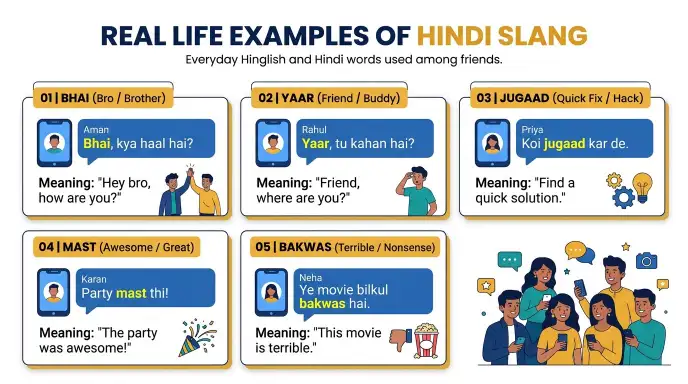
Friendly Example
“Bhai, tu aaj mast lag raha hai!”
Here, bhai creates a friendly tone. Mast means something like great, cool, or excellent.
Casual Example
“Yaar, aaj bahut kaam hai.”
Here, yaar adds an informal and emotional tone. The speaker is casually complaining about having a lot of work.
Humorous Example
“Kya jugaad lagaya hai!”
This can praise someone’s clever or improvised solution.
Argumentative Example
“Bakwas mat kar.”
This is much harsher. It means roughly “Don’t talk nonsense.” It may sound rude during an argument.
Social Media Example
“Bhai, kya scene hai? 😂”
The laughing emoji makes the message feel playful, although the exact meaning still depends on the conversation.
Gaming Example
“Bhai, cover de!”
In a game, this can mean “Bro, give me cover/protect me.” The expression is informal and depends on the gaming context.
Hindi Slang and Regional Differences
One important thing to remember is that Hindi slang is not identical everywhere.
Hindi is spoken across a large and diverse area, and informal vocabulary can differ between cities, states, generations, and social groups.
A word that is familiar in Mumbai may not be equally common in Delhi, Lucknow, Jaipur, or another Hindi speaking region.
Bollywood and social media also spread certain expressions far beyond their original communities.
This means a slang dictionary should avoid treating every informal Hindi expression as universal.
If someone tells you that a particular Hindi slang word means something different from what you have seen online, both uses may exist in different contexts.
Hindi Slang and Bollywood
Indian films, television, music, and online entertainment have played an important role in spreading informal expressions.
Some expressions become widely recognized because they are repeated in popular movies or songs. However, popularity in entertainment does not necessarily mean that everyone uses the expression in everyday speech.
A movie character may use a phrase for humor, drama, or characterization. Real life speakers may use the same expression less often or with a slightly different tone.
This is why it is useful to distinguish popular media language from ordinary everyday usage.
Why Do People Use Hindi Slang?
People use slang for several practical and social reasons.
To Sound More Casual
Slang can make a message feel relaxed instead of formal.
To Show Friendship
Words such as bhai and yaar can signal familiarity and closeness.
To Add Humor
Informal expressions often make jokes and memes more entertaining.
To Express Emotion
Slang can communicate excitement, frustration, surprise, annoyance, or affection quickly.
To Fit Into a Social Group
Certain expressions become part of the language used by a particular age group, online community, workplace, gaming group, or friend circle.
To Make Communication Feel Natural
Many native speakers naturally switch between formal language and slang depending on the situation.
Common Misunderstandings About Hindi Slang
One common mistake is assuming that every slang word has one fixed translation.
For example, yaar can mean “friend,” but it may also simply be used as an emotional form of address. Translating it mechanically as “friend” every time can make the sentence sound unnatural.
Another mistake is assuming that informal words are automatically offensive. Many slang terms are harmless among friends.
The opposite mistake is also possible. A person may see a slang word used jokingly online and assume it is safe to use with everyone. That is not always true.
Context, relationship, audience, and tone all matter.
When Should You Avoid Hindi Slang?
Avoid unfamiliar or potentially offensive slang when communicating in formal or sensitive situations.
This includes:
- Job interviews
- Professional emails
- Academic assignments
- Formal presentations
- Speaking with someone you do not know well
- Customer service conversations
- Official documents
- Situations involving people who may not understand the expression
Even harmless slang can sound too casual in a professional setting.
For formal communication, use standard Hindi or clear English instead.
Polite Alternatives to Hindi Slang
If you are learning Hindi, you do not need to avoid informal language completely. Instead, learn when to switch between casual and polite speech.
For example:
| Casual | More neutral/polite approach |
| Bhai, kya hua? | Aapko kya hua? |
| Bakwas mat karo. | Aisi baat mat kijiye. |
| Chill kar. | Pareshan mat ho. |
| Kya scene hai? | Kya plan hai? |
| Panga mat le. | Behas ya pareshaani se bachiye. |
The best alternative depends on the exact situation and relationship.
Is Hindi Slang Safe for Social Media?
Most everyday Hindi slang is not inherently unsafe for social media. However, some slang can be insulting, vulgar, sexually suggestive, or abusive.
Social platforms also have rules against certain forms of harassment and abusive behavior. A word that is acceptable between close friends may be inappropriate when directed at another person publicly.
Before posting slang publicly, ask if the expression could:
- Harass another person
- Target someone’s identity or background
- Become sexually inappropriate
- Be interpreted as a threat
- Cause unnecessary conflict
- Violate a platform’s community rules
Using casual language is usually less risky when the meaning is clear and the audience understands it.
Hindi Slang vs. Standard Hindi
Slang and standard language serve different purposes.
Standard Hindi is generally preferred for formal writing, education, official communication, and situations where clarity matters most.
Hindi slang is more common in casual conversations, friendships, entertainment, memes, texting, and informal online communities.
Neither style is automatically better. The appropriate choice depends on the situation.
Frequently Asked Questions
What is Hindi slang?
Hindi slang is informal vocabulary and expressions used in casual Hindi communication. It can be friendly, humorous, emotional, or insulting depending on the word and context.
What does Hindi slang mean in texting?
In texting, Hindi slang usually refers to informal Hindi or Hinglish expressions used to make messages shorter, more relaxed, expressive, or friendly.
Is Hindi slang the same as Hinglish?
No. Hindi slang refers to informal Hindi expressions, while Hinglish combines Hindi and English. The two often overlap in everyday online communication.
Is Hindi slang rude?
Not always. Some expressions are friendly or harmless, while others can be insulting or vulgar. Tone and context determine how a word is received.
Where is Hindi slang used?
Hindi slang is commonly found in casual speech, texting, messaging apps, social media, entertainment, gaming chats, and conversations among friends.
Can I use Hindi slang with native speakers?
Yes, but learn the context first. Some slang is widely understood, while other expressions may be regional, age specific, vulgar, or outdated. Start with neutral informal expressions until you understand the social setting.
Conclusion
Hindi slang is a broad and constantly changing part of informal Hindi communication. It can make conversations sound friendly, funny, emotional, or relaxed, especially in texting, social media, gaming, and conversations between friends.
There is no single “Hindi slang full form” because the term describes many different informal expressions. Words such as bhai, yaar, mast, bakwas, panga, jugaad, and bindass can have different tones and meanings depending on how they are used.
The most important rule is simple: look at the context before interpreting or using slang. A phrase that sounds funny among friends may sound rude in a professional conversation.
If you are learning Hindi, understanding slang alongside standard Hindi can help you follow real conversations more naturally.
Just remember that regional differences, age, relationships, and online communities can all affect how an expression is understood.
See Related Terms!

Hi, I’m Chloe Parker. I write simple and practical articles about slang, grammar, spelling, vocabulary, and commonly confused words. My goal is to make English easier to understand through clear explanations and real-life examples. Whether you’re a student, writer, or English learner, I’m here to help you build confidence and improve your everyday English.