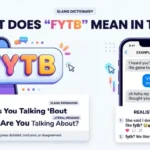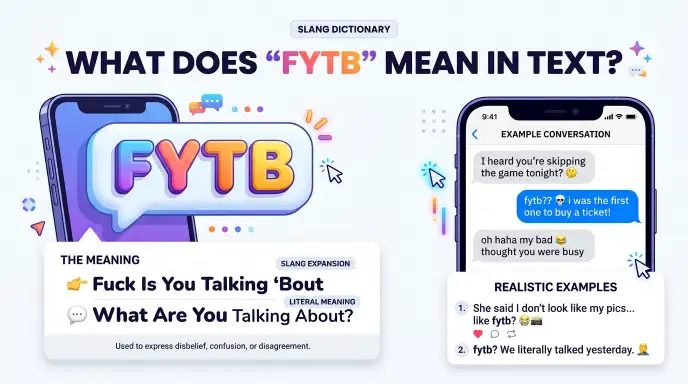
FYTB usually means “Fuck You Talking ’Bout?” in text messages and online conversations. It is a slang abbreviation used to express confusion, disbelief, surprise, or disagreement with something someone has said. In simpler English, it means “What are you talking about?”
If someone sends you FYTB in a text, they may be questioning your statement or reacting to something they find hard to believe. The tone can be playful between friends or aggressive during an argument.
People commonly search for what FYTB means in text after seeing it in a message, TikTok comment, Snapchat conversation, or social media post.
In this guide, you’ll learn its full meaning, different uses, real chat examples, possible origins, and when it is appropriate to use.
Quick Answer: What Does FYTB Mean?
FYTB stands for “Fuck You Talking ’Bout?” It is an informal and vulgar internet abbreviation used to question something someone has said.
It can express confusion, disbelief, disagreement, or surprise. Depending on the conversation, it may sound funny and playful or rude and confrontational.
What Does FYTB Mean in Text Messages?
FYTB is a shortened version of the expression “Fuck You Talking ’Bout?” The word ’bout is an informal way of saying about.
People use it when they hear something confusing, unbelievable, or incorrect. Instead of typing a complete question, they use four letters to react quickly.
For example:
Friend 1: You said you were going to quit school.
Friend 2: FYTB? I never said that!
Here, the second person uses FYTB to question the first person’s statement.
Depending on the situation, it can communicate several feelings:
- Confusion: You do not understand what someone means.
- Disbelief: You find someone’s statement hard to believe.
- Disagreement: You think someone is saying something incorrect.
- Surprise: Someone tells you something unexpected.
- Defensiveness: You feel someone has accused you unfairly.
FYTB is stronger than a normal question because it contains profanity. It is best understood as an informal reaction rather than a polite way to ask for clarification.
What Is the Full Form of FYTB?
The commonly documented slang expansion of FYTB is:
F :Fuck
Y :You
T :Talking
B :Bout
Together, the letters represent “Fuck You Talking ’Bout?”
In everyday English, you can understand it as:
- What are you talking about?
- What do you mean?
- What are you saying?
- Are you serious?
- How does that make sense?
The abbreviation is not suitable for every situation. Its profanity gives it a stronger tone than expressions such as WYM (What You Mean?) or WTF (What the F?).
Different Meanings and Tones of FYTB
FYTB generally expresses confusion or disbelief, but the speaker’s intention can change depending on the situation.
Here are some common ways people use it.
FYTB to Show Confusion
Someone may use FYTB when they cannot understand another person’s statement.
Example:
Friend 1: The meeting is happening at midnight.
Friend 2: FYTB? Who schedules a meeting that late?
The second person is surprised and confused by the information.
FYTB to Show Disbelief
FYTB can also be used when someone says something that sounds unbelievable.
Example:
Person 1: I finished the entire project in one hour.
Person 2: FYTB 😭 No way!
Here, the sender is showing disbelief in a humorous way.
FYTB to Disagree With Someone
Sometimes, people use this abbreviation to challenge a statement they believe is wrong.
Example:
Friend 1: You never help me with anything.
Friend 2: FYTB? I helped you yesterday!
The reply shows disagreement and frustration.
FYTB as a Playful Reaction
Close friends may use FYTB jokingly when someone says something funny or unexpected.
Example:
Friend 1: I’m going to buy a private island next week.
Friend 2: FYTB 😂 Take me with you!
The laughing emoji makes the response feel more playful than aggressive.
Where Is FYTB Commonly Used?
FYTB appears in informal digital communication. People may use it in private messages, comments, and online discussions.
Its meaning stays similar across platforms, but the tone depends on the conversation.
| Platform | How FYTB Is Used |
| Snapchat | Quick reactions in private chats |
| TikTok | Comments expressing disbelief or confusion |
| Replies to surprising posts or messages | |
| Casual conversations with friends | |
| Discord | Informal reactions in group chats |
| Text messages | Questions, arguments, and jokes |
FYTB on Snapchat
On Snapchat, FYTB may appear in direct messages between friends. Someone might send it after receiving an unexpected message or hearing a surprising story.
For example:
Friend: I saw you at the mall yesterday.
You: FYTB? I was at home!
It shows that you are questioning what your friend said.
FYTB on TikTok
On TikTok, users may write FYTB in comments or replies when reacting to unusual videos, surprising opinions, or unbelievable statements.
For example:
Someone commented: “I can run faster than a professional athlete.”
Another user replies: “FYTB 💀”
The reply expresses disbelief or playful disagreement.
FYTB on Instagram
Instagram users may use FYTB in comments, story replies, or direct messages.
For example:
Friend: You look completely different in that old picture.
You: FYTB 😂 That’s my school photo!
Here, the abbreviation adds a joking reaction to the conversation.
FYTB on WhatsApp and Discord
In WhatsApp chats, FYTB can appear during everyday conversations with friends and family.
On Discord, it may be used in gaming chats, community discussions, or casual conversations when someone makes an unexpected statement.
However, it is not appropriate for professional or formal discussions on either platform.
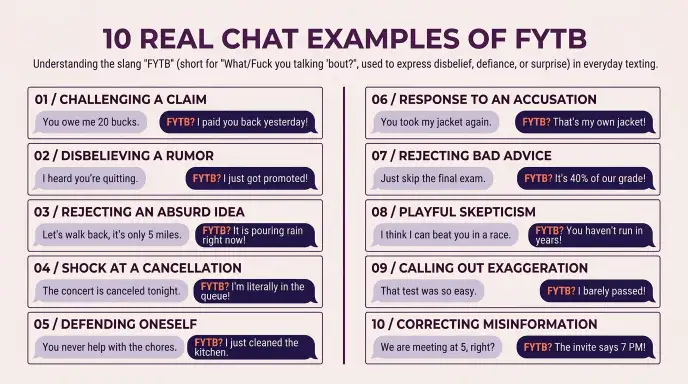
10 Real Chat Examples of FYTB
These examples show how FYTB can appear in different conversations. They demonstrate confusion, humor, surprise, and disagreement.
Example 1: Questioning a Statement
Alex: You said you hate pizza.
Sam: FYTB? Pizza is my favorite food!
Example 2: Showing Surprise
Mia: I just bought a new car.
Lily: FYTB 😭 Which one?
Example 3: Friendly Teasing
Jake: I’m the best gamer in this group.
Chris: FYTB 😂 You lost five matches yesterday.
Example 4: During an Argument
Tom: You told everyone my secret.
Ryan: FYTB? I didn’t tell anyone!
Example 5: Reacting to a Joke
Emma: I’m becoming a millionaire tomorrow.
Sophie: FYTB 💀 Tell me your secret!
Example 6: Expressing Disbelief
Noah: I watched ten movies last weekend.
Liam: FYTB? That’s a lot!
Example 7: Correcting Someone
Olivia: You missed the entire class.
Ella: FYTB? I was sitting in the front row.
Example 8: Social Media Conversation
User 1: This is the best song ever made.
User 2: FYTB 😂 Have you heard the other album?
Example 9: Gaming Conversation
Player 1: I won that match without any help.
Player 2: FYTB? We carried the whole team!
Example 10: Reacting to Unexpected News
Ava: My little brother got a new phone today.
Maya: FYTB! That’s actually exciting.
These examples show that FYTB does not always mean someone is seriously angry. The relationship between the speakers and the surrounding messages help explain the intended tone.
Is FYTB Rude or Offensive?
Yes, FYTB can be considered rude or offensive because its full form contains the F word.
However, the level of offense depends on the situation and the people involved.
Here is how its tone can change:
| Situation | Possible Tone |
| Talking with close friends | Playful |
| Reacting to a surprising message | Disbelief |
| Disagreeing with someone | Defensive |
| During an argument | Aggressive |
| Talking to strangers | Potentially offensive |
| Workplace conversation | Inappropriate |
Some friends use profanity casually without intending to hurt anyone. However, someone who does not know you well may interpret FYTB as an insult or an aggressive response.
It is always better to consider your audience before using it.
Where Did FYTB Come From?
FYTB comes from the informal spoken expression “Fuck You Talking ’Bout?” It follows a common pattern in internet slang where people shorten longer expressions into initials to make texting faster.
There is no reliably established date or individual credited with inventing FYTB.
Online examples show that the abbreviation was already being used in social media conversations by the early 2010s. For example, a user submitted an Urban Dictionary entry dated November 2013.
Wiktionary also records FYTB as an internet slang and text messaging initialism used to indicate confusion.Today, it can appear in online comments, private messages, and casual conversations.
It is important not to confuse its documented general usage with a precise origin story. There is not enough reliable evidence to identify a particular social media platform or generation as its starting point.
FYTB vs. Similar Texting Abbreviations
Several other texting abbreviations express confusion, surprise, or disagreement. However, their meanings and tones are different.
| Abbreviation | Full Form | Meaning |
| FYTB | Fuck You Talking ‘Bout? | Confusion or disbelief |
| WYM | What Do You Mean? | Asking for clarification |
| WTF | What The F? | Surprise or confusion |
| WTH | What The Heck? | Surprise or frustration |
| IDK | I Don’t Know | Showing uncertainty |
| SMH | Shaking My Head | Disappointment or disbelief |
FYTB is more aggressive than WYM because it contains profanity. If you want to ask someone a simple question without sounding rude, WYM is usually a better choice.
When Should You Avoid Using FYTB?
Although FYTB is common in some informal online conversations, it is not suitable for every audience.
Avoid using it in these situations:
- Professional emails: It can sound disrespectful to coworkers or managers.
- School assignments: Slang abbreviations are generally unsuitable for formal writing.
- Conversations with teachers: Use respectful and clear language instead.
- Talking to strangers: They may misunderstand your intention.
- Serious discussions: Profanity can make an already difficult conversation worse.
- Family conversations: Some family members may find the expression offensive.
If you are unsure how someone will react, choose a more polite expression.
Polite Alternatives to FYTB
If you want to express confusion or disbelief without using profanity, several alternatives can help.
| Alternative | Meaning |
| WYM? | What do you mean? |
| What are you talking about? | Asking for clarification |
| Seriously? | Expressing surprise |
| Are you sure? | Questioning information |
| I don’t understand. | Showing confusion |
| Can you explain that? | Politely requesting details |
For example:
Instead of writing:
“FYTB? I never said that!”
You can write:
“What do you mean? I never said that.”
The second version communicates the same basic message without sounding aggressive.
Why Do People Use FYTB?
People use FYTB because it is a quick way to react to something unexpected or confusing.
There are several reasons behind its use:
Faster communication: Typing four letters is quicker than writing a complete expression.
Strong emotions: The abbreviation adds emphasis to a reaction.
Casual conversations: Friends may use it as part of their normal texting style.
Humor: It can make a funny or surprising reaction feel more expressive.
Online culture: Shortened expressions are common in comments, group chats, and social media conversations.
However, not everyone uses it in the same way. Some people use FYTB jokingly, while others use it to challenge or criticize someone.
Common Misunderstandings About FYTB
People sometimes misunderstand FYTB because it is short and contains no explanation of the sender’s intention.
Here are a few common mistakes:
Thinking it always means anger: FYTB can express playful disbelief as well as frustration.
Assuming it is polite: Its full form contains profanity, so it can sound offensive.
Confusing it with WYM: Both can question someone’s statement, but FYTB has a much stronger tone.
Ignoring the conversation: The surrounding messages, punctuation, and emojis help explain the sender’s meaning.
Assuming every sender has the same intention: Two people can use the same abbreviation with different emotions.
The best way to understand FYTB is to read the entire conversation rather than focusing on the four letters alone.
Frequently Asked Questions
What does FYTB stand for in texting?
FYTB stands for “Fuck You Talking ‘Bout?” It is an informal expression used to question something or show confusion and disbelief.
What does FYTB mean from a guy?
When a guy sends FYTB, he is usually questioning something you said or expressing surprise. It does not automatically indicate anger or romantic interest. The conversation helps explain his intention.
Is FYTB a bad word?
FYTB contains the F word, which is considered profanity. It can sound rude or offensive, especially when used with strangers or during serious conversations.
Does FYTB mean what are you talking about?
Yes. FYTB is a vulgar, informal way of asking “What are you talking about?” It can also express disbelief or disagreement.
Can I use FYTB with friends?
Yes, you can use it with close friends if they are comfortable with profanity. However, avoid using it with people who may find the expression disrespectful.
Is FYTB appropriate for work?
No. FYTB is not suitable for professional communication because it contains profanity. Use “What do you mean?” or “Could you clarify that?” instead.
What is the difference between FYTB and WYM?
WYM means “What You Mean?” and is generally a neutral way to ask for clarification. FYTB contains profanity and usually sounds more forceful or confrontational.
Conclusion
FYTB means “Fuck You Talking ‘Bout?” and is commonly used in texting and internet conversations to express confusion, disbelief, surprise, or disagreement.
Its tone depends on the situation. Close friends may use it jokingly, while people in an argument may use it to show frustration or challenge someone’s statement.
Remember that FYTB contains profanity, so it is best reserved for informal conversations with people who understand your communication style. If you want to sound polite, use WYM or simply ask, “What do you mean?”
Similar Slang Terms!
- What FYP Means in Text: Meaning, Examples & Social Media Use
- FYM Meaning in Text: Common Uses, Contexts & Examples

Hi, I’m Chloe Parker. I write simple and practical articles about slang, grammar, spelling, vocabulary, and commonly confused words. My goal is to make English easier to understand through clear explanations and real-life examples. Whether you’re a student, writer, or English learner, I’m here to help you build confidence and improve your everyday English.