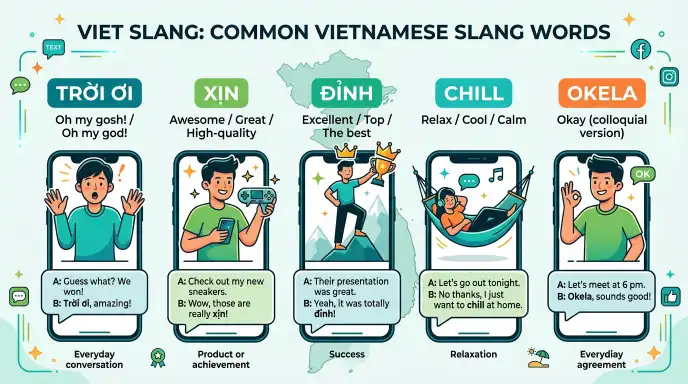
Viet slang usually means informal Vietnamese words, expressions, abbreviations, and internet phrases used in casual conversations. If you see Vietnamese comments on TikTok, Facebook, Zalo, Instagram, Discord, or in group chats, you may notice words that do not make sense when translated literally.
That is because slang often gives an old word a new meaning. Vietnamese speakers also shorten words when texting or mix Vietnamese with English and other languages. Young people especially use slang to sound playful, casual, funny, or connected to online culture.
Some Vietnamese slang is harmless and friendly. Other expressions can be rude or vulgar, so knowing the tone is just as important as knowing the translation.
Quick Answer:
Viet slang refers to informal Vietnamese words and expressions used in everyday speech, texting, and online communication. Its meaning can change depending on the speaker, situation, and context.
What Does Viet Slang Mean in Text?
In text messages, Vietnamese slang can include shortened Vietnamese words, creative spellings, internet expressions, borrowed English terms, and phrases whose slang meaning differs from their literal meaning.
For example:
- k / ko = không = no/not
- dc / đc = được = okay, can, or possible
- ib = inbox/private message
- rep = reply
- nyc = người yêu cũ = ex boyfriend or ex girlfriend
- ntn = như thế nào = how
- g9 = goodnight
- crush = someone you like romantically
- thả thính = to flirt or attract someone’s attention
- sống ảo = acting for social media or caring heavily about online appearance
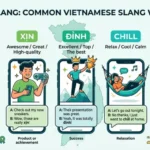
- đỉnh = awesome, excellent, or top tier
Vietnamese texting has a long tradition of shortening common words. Wiktionary, for example, lists Vietnamese messaging forms such as k, ko, mk, mn, ny, vs, and rùi.
The important point is that not every shortened word is technically “slang.” Some are simply texting abbreviations.
In everyday online language, however, people often group both under the broader idea of internet slang.
Common Vietnamese Slang Words and Their Meanings
Here are some useful examples of modern Vietnamese slang.
| Viet slang | Meaning | Typical tone |
| ngầu | cool | Casual |
| xịn | high quality, cool | Casual |
| đỉnh | amazing, excellent | Positive |
| gấu | boyfriend/girlfriend | Playful |
| thả thính | flirt, drop hints | Playful |
| sống ảo | live for online appearances | Teasing/critical |
| toang | ruined, gone wrong | Casual |
| bó tay | I give up | Casual |
| ăn hành | suffer, get beaten/troubled | Humorous |
| lầy | silly, funny, shamelessly playful | Informal |
| ngáo | weird, spaced out | Teasing |
| gato | jealous | Casual |
| vãi | very/extremely; an emphatic reaction | Vulgar/casual |
| trời ơi | oh my gosh | Casual |
| bá đạo | badass, unusually impressive | Informal |
Meanings can shift between communities, regions, generations, and situations, so a literal translation is not always enough.
Current Vietnamese slang guides describe terms such as gấu, thả thính, sống ảo, đỉnh, and xỉu as common youth oriented expressions.
Is Viet Slang Rude or Offensive?
Not all Vietnamese slang is rude.
Some words are simply playful:
- ngầu :cool
- xịn :high quality or impressive
- đỉnh :amazing
- lầy :playfully silly
- gấu ;romantic partner
Other expressions can be vulgar. For example, vcl is a common online abbreviation derived from a vulgar phrase and is used to show strong surprise, frustration, or disbelief. It is better avoided in professional or formal communication.
There are also stronger Vietnamese swear word abbreviations such as đm. These should not be treated like harmless texting shortcuts because they contain profanity.
A simple rule
If you are unsure about a slang term, understand it before using it.
A word that sounds funny in a social media comment may be inappropriate when speaking to an older person, teacher, customer, manager, or stranger.
Where Is Viet Slang Commonly Used?
Vietnamese slang appears in many informal spaces.
Social Media
TikTok, Facebook, Instagram, and YouTube comments are major places where new expressions spread. Youth slang can become popular quickly because users repeat phrases from viral videos, memes, songs, and online creators.
Texting
Messaging apps use many abbreviations because shorter words save time.
Examples include:
- k = không
- ko = không
- ntn = như thế nào
- kb = không biết
- đc = được
- ib = inbox
Vietnamese texting guides identify these types of shortcuts as common informal messaging forms.
Gaming
Gamers may use slang to react quickly to wins, losses, mistakes, or impressive plays. Terms such as gà can have special meanings in gaming contexts, including describing someone who plays poorly.
Group Chats
Friends often use slang to make conversations shorter and more humorous. The tone can be much more relaxed than in formal Vietnamese writing.
Real Life Examples of Viet Slang
The best way to understand slang is to see how context changes the meaning.
Friendly Example
A: “Bộ đồ này ngầu quá!”
B: “Haha, cảm ơn!”
Here, ngầu means cool. It is a positive compliment.
Casual Example
A: “Tối nay đi chơi không?”
B: “Ok, đi!”
This is a simple informal exchange. Short forms and casual language are common between friends.
Social Media Example
Comment: “Món này đỉnh thật!”
Here, đỉnh means something like amazing, excellent, or top tier.
Flirting Example
“Anh ấy đang thả thính cô ấy.”
This means that he is flirting with her or trying to attract her attention. Literally, thả thính is connected with “dropping bait,” but its modern slang meaning relates to flirting.
Gaming Example
“Tao gà quá!”
Here, gà can be used to describe someone who is not good at a game.
Frustrated Example
“Kế hoạch toang rồi.”
Toang means that something has gone badly wrong or is ruined.
Viet Slang Texting Abbreviations
Vietnamese internet language is not only about slang words. Abbreviations are also very important.
| Abbreviation | Vietnamese | Meaning |
| k / ko | không | no/not |
| kb | không biết | don’t know |
| ntn | như thế nào | how |
| đc | được | okay/can |
| ib | inbox | private message |
| rep | reply | respond |
| nyc | người yêu cũ | ex |
| g9 | goodnight | goodnight |
| cmt | comment | comment |
| vs | với | with |
Some of these forms are older and established texting shortcuts, while others are strongly associated with internet culture.
Where Does Vietnamese Slang Come From?
Vietnamese slang does not have one single origin.
It can develop from:
- Existing Vietnamese words
- Abbreviations
- Wordplay
- Internet culture
- Popular music
- Memes and viral content
- Borrowed foreign words
- Gaming and fandom communities
Vietnamese slang can also repurpose ordinary words. For example, gà literally means “chicken,” but slang usage can describe a promising talent or someone who is poor at a game, depending on context.
Borrowed words are another part of Vietnamese slang. Vietnamese has slang influenced by languages including English and French, among others.
Viet Slang vs. Vietnamese Texting Abbreviations
These two ideas overlap, but they are not exactly the same.
| Feature | Vietnamese slang | Texting abbreviation |
| Main purpose | Express an informal idea | Save typing time |
| Meaning | Can change from literal meaning | Usually shortens an existing phrase |
| Example | thả thính | ko |
| Common online? | Yes | Yes |
| Can it be humorous? | Often | Sometimes |
| Always informal? | Usually | Usually |
For example, sống ảo is a slang expression describing behavior connected with online appearances, while ko is simply a shortened form of không.
Why Do People Use Viet Slang?
People use Vietnamese slang for several reasons.
It Feels More Natural
Friends do not always communicate in textbook language. Slang makes conversations feel relaxed and personal.
It Saves Time
Short forms such as k, ko, and ib are faster to type.
It Shows Group Identity
Slang can signal that someone understands a particular online community, generation, fandom, or social group.
It Adds Emotion
A normal sentence may sound neutral. Slang can make the same idea funny, dramatic, exciting, or sarcastic.
It Follows Internet Trends
TikTok, memes, music, gaming, and viral posts can introduce new expressions very quickly. Vietnamese slang is especially dynamic in online youth culture.
When Should You Avoid Viet Slang?
Avoid slang when the situation requires formal or respectful language.
This includes:
- Job interviews
- Business emails
- Official documents
- Academic writing
- Customer service
- Formal presentations
- Communication with people you do not know well
You should also be careful with slang when speaking to older Vietnamese people. Some expressions are strongly associated with younger generations or online communities.
Most importantly, avoid vulgar slang unless you completely understand the relationship and context.
Polite Alternatives to Vulgar Viet Slang
If you want to communicate naturally without sounding rude, choose neutral Vietnamese instead.
For example, instead of using a strong swear abbreviation, you can use a neutral reaction such as:
- trời ơi :oh my gosh
- ôi :oh
- thật à? :really?
- không thể tin được :unbelievable
- mình không biết :I don’t know
The exact choice depends on the situation, but neutral language is the safer option when you are learning Vietnamese.
Common Mistakes When Using Viet Slang
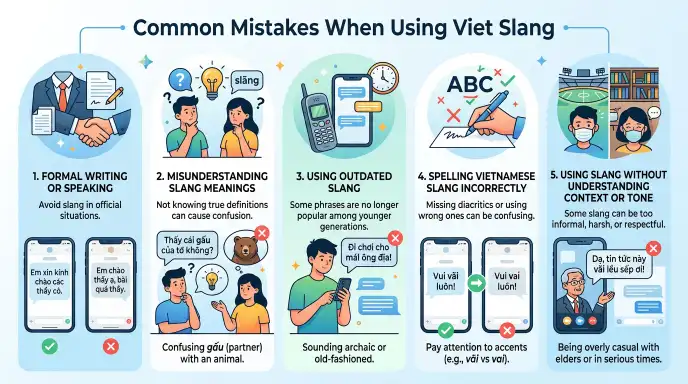
1. Translating Every Word Literally
Slang often has a figurative meaning.
For example, thả thính is not normally understood simply by translating each word. In modern slang, it refers to flirting or trying to attract someone’s attention.
2. Using Slang in Formal Situations
A phrase that works in a friend group may look careless in a business message.
3. Assuming Every Abbreviation Is Universal
Vietnamese texting shortcuts can vary by generation and community.
4. Ignoring Tone Marks
Vietnamese is tonal, and tone marks can be important for meaning. Slang may sometimes omit marks in casual typing, but learners should not assume that tone marks are unimportant.
5. Copying Profanity Without Understanding It
Some Vietnamese abbreviations hide vulgar expressions. Always check the full meaning before repeating them.
Is Viet Slang Safe to Use on Social Media?
Generally, mild Vietnamese slang is fine for casual social media, especially when talking with friends or commenting in informal communities.
However, safety depends on the specific expression.
A harmless word such as ngầu is very different from a vulgar abbreviation such as vcl or đm. Some slang can also sound insulting depending on who receives it.
When posting publicly, neutral or positive slang is usually the better choice.
Frequently Asked Questions
What does viet slang mean?
Viet slang generally refers to informal Vietnamese expressions, internet language, texting shortcuts, and playful words used in casual communication.
What is a common Vietnamese slang word?
Common examples include ngầu for “cool,” đỉnh for “amazing,” gấu for a romantic partner, and thả thính for flirting.
What does “thả thính” mean?
Thả thính means flirting or trying to attract someone’s romantic interest. Its literal wording relates to dropping bait, creating a playful metaphor for attracting someone.
What does “sống ảo” mean?
Sống ảo describes living for online appearances or presenting an idealized version of life on social media.
Is Vietnamese slang rude?
Some Vietnamese slang is completely harmless, while other expressions are vulgar or insulting. You need to consider the specific word, relationship, and situation.
Can I use Vietnamese slang with native speakers?
Yes, but start with mild expressions and use them in casual settings. If you are unsure about a phrase, learn its tone and context before using it.
Conclusion
Viet slang is an important part of modern Vietnamese communication. It includes casual expressions, playful phrases, internet language, and texting abbreviations.
Some terms are easy to understand, while others have meanings that are very different from their literal translations.
Words such as ngầu, xịn, and đỉnh can make casual conversations more expressive, while expressions such as thả thính and sống ảo show how Vietnamese slang reflects modern relationships and social media culture. Texting shortcuts such as k, ko, ib, and ntn also make online conversations faster.
The key is context. Vietnamese slang can sound friendly among close friends but inappropriate in formal situations.
Some expressions are also vulgar, so they should not be copied without understanding their full meaning.
If you are learning Vietnamese, understanding slang can help you follow real conversations, social media comments, memes, and messages much more easily.
Related Slang!
- Korean Texting Slang: Meaning & Examples
- Michigan Slang Words: Meaning, Terms & Examples
- Sherm NYC Slang: Meaning, Examples & Usage

Hi, I’m Chloe Parker. I write simple and practical articles about slang, grammar, spelling, vocabulary, and commonly confused words. My goal is to make English easier to understand through clear explanations and real-life examples. Whether you’re a student, writer, or English learner, I’m here to help you build confidence and improve your everyday English.