Concha meaning Spanish slang can vary by country and context, from a harmless literal meaning to a vulgar slang term.
In some Spanish-speaking regions, concha is used in casual or offensive expressions, including “la concha de tu madre.”
In this guide, you’ll learn what concha means in Spanish slang, its regional uses, examples, and when to avoid it.
In standard Spanish, concha commonly means “shell” or “seashell,” but in parts of Latin America it can also be vulgar slang for the vulva or female genitals. In some places, it can also describe someone’s nerve or shamelessness.
If you saw concha in a Spanish text, comment, meme, or social media post, the surrounding words and the speaker’s country are important. The word can be completely ordinary in one situation and highly offensive in another.
Quick Answer
Concha literally means “shell” or “seashell” in Spanish. As slang in several Latin American countries, it can be a vulgar term for the vulva and may appear in strong insults such as “la concha de tu madre.”
What Does Concha Mean in Spanish Slang?
The slang meaning of concha changes by region.
The most important slang use is as a vulgar word for the vulva or female genitals. The Association of Academies of the Spanish Language (ASALE) records this meaning in several countries, including Guatemala, Colombia’s northern region, Ecuador, Peru, Bolivia, Chile, Paraguay, Argentina, and Uruguay.
English translations vary depending on how the word is being used. Because the slang sense is vulgar, translations may use words such as “pussy” or “cunt,” although the exact English equivalent depends on the sentence and regional context.
However, concha is not automatically slang every time someone says it.
For example:
La tortuga tiene una concha muy dura.
This means:
“The turtle has a very hard shell.”
Here, concha has its normal literal meaning.
That is why translating the word by itself can be misleading.
Concha Has More Than One Meaning
The word can have several meanings in Spanish.
| Meaning | Typical context | Tone |
| Shell or seashell | Nature, animals, beach | Neutral |
| Outer shell or covering | Objects or animals | Neutral |
| Sweet bread | Mexico | Neutral |
| Nerve or shamelessness | Some Latin American varieties | Informal |
| Vulva/female genitals | Several Latin American varieties | Vulgar |
| Strong insult in certain phrases | Parts of Latin America | Very vulgar |
ASALE records concha as “vulva” in a number of Latin American varieties. SpanishDictionary also lists the slang genital meaning and notes that it is considered extremely offensive in that usage.
This range of meanings explains why concha meaning Spanish slang cannot be reduced to one translation.
Is Concha a Bad Word?
It can be, but not always.
When concha refers to a shell, seashell, or another ordinary meaning, there is nothing offensive about it.
The situation changes when concha is being used as vulgar slang for female genitals. In that context, it can be considered a strong swear word. SpanishDictionary labels this meaning extremely offensive, while ASALE marks the anatomical slang sense as vulgar.
For example:
Encontré una concha en la playa.
This means:
“I found a seashell on the beach.”
There is no vulgar meaning here.
But a phrase such as:
¡La concha de tu madre!
belongs to a very different category. It is a highly vulgar expression used in several Latin American varieties, often as an insult, an expression of anger, or an outburst of frustration.
ASALE records this phrase with meanings connected to serious insult, anger, and annoyance in countries including Ecuador, Bolivia, Chile, Argentina, and Uruguay.
What Does “La Concha de Tu Madre” Mean?
“La concha de tu madre” is one of the most recognizable vulgar expressions containing concha.
Literally, the phrase refers to “your mother’s vulva,” but a literal translation does not fully explain how the phrase functions in everyday speech.
Depending on the country and situation, it can be used as:
- A very strong insult
- An angry outburst
- An expression of frustration
- A reaction to something going badly
- A harsh way of telling someone to go away
The Argentine terminology archive defines concha as a popular vulgar term for the vagina, while ASALE records la concha de tu madre as an expression of serious insult and, in some regions, anger or annoyance.
For example, someone who drops their phone and cracks the screen might use the phrase as an angry reaction to the situation. It does not necessarily mean they are literally talking about someone’s mother.
Because the phrase is very vulgar, it should not be treated like a casual Spanish equivalent of “oh no.”
Concha Meaning in Argentina
In Argentina, concha is well established as vulgar slang for the female genital area.
The University of Buenos Aires’ terminology archive lists concha in Argentine popular speech with the meaning of vagina and connects the term to Argentine lunfardo and popular vocabulary.
Argentina also has several expressions built around the word.
For example:
La concha de tu madre
can be used as a strong insult or angry expression.
Another expression may direct someone “a la concha de tu madre,” which functions as an extremely rude way of telling someone to go away.
Argentine slang sources document these uses in connection with anger, blame, and telling someone to leave.
So if you encounter concha in Argentine social media, a literal translation of “shell” may miss the intended meaning.
Concha Meaning in Chile
In Chile, concha can also have a vulgar anatomical meaning.
It appears in strong Chilean profanity and in expressions derived from phrases such as “concha de tu madre.”
ASALE records the phrase as a vulgar expression of insult and anger in Chile. The intensity depends on the situation, relationship between speakers, and exact phrase.
A word used jokingly among close friends can have a different social effect from the same word directed at a stranger. Even so, learners should treat the slang meaning as vulgar rather than safe everyday vocabulary.
Concha Meaning in Peru and Other Countries
The slang meaning also appears in other parts of Latin America.
ASALE records concha as a vulgar word for the vulva in countries including Peru, Bolivia, Chile, Paraguay, Argentina, and Uruguay, along with several other regional varieties.
The phrase “la concha de tu madre” is also documented in countries such as Peru, Bolivia, Ecuador, Colombia, Paraguay, Uruguay, Argentina, and Chile, although its exact frequency and force can vary.
This regional variation matters because Spanish is spoken across many countries, and slang does not have one universal meaning.
Concha in Mexico: Another Important Meaning
Mexico provides an especially useful example of why context matters.
In Mexican Spanish, una concha can refer to a popular sweet bread. SpanishDictionary lists this as a Mexican regionalism describing a bun or pastry.
So:
Compré una concha en la panadería.
can mean:
“I bought a concha pastry at the bakery.”
This is completely different from the vulgar slang meaning.
Mexico also has the literal “shell” meaning, so seeing concha in a Mexican conversation does not automatically mean someone is using profanity.
The safest approach is to look at the complete sentence.
Concha Can Also Mean “Nerve” or “Shamelessness”
Another regional use is connected to audacity, nerve, cheek, or shamelessness.
For example:
¡Qué concha la tuya!
can express the idea:
“You’ve got some nerve!”
SpanishDictionary lists this colloquial Latin American use as “nerve,” while Collins gives “nerve” or “cheek” for the relevant regional sense.
This meaning is especially important because it is neither the ordinary “shell” meaning nor the sexual meaning.
A learner who sees concha in a sentence about someone’s behavior should therefore avoid immediately assuming that it refers to anatomy.
Real Life Examples of Concha
Here are examples showing how the meaning changes with context.
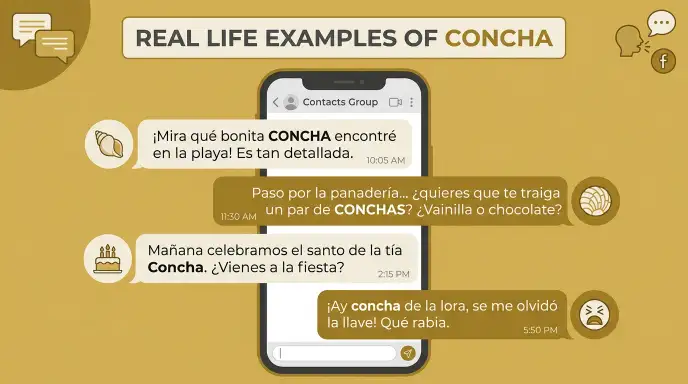
1. Neutral: Shell
La concha de la tortuga es muy resistente.
Meaning: “The turtle’s shell is very strong.”
This is an ordinary use.
2. Neutral: Seashell
Encontramos una concha junto al mar.
Meaning: “We found a seashell by the sea.”
Again, there is nothing vulgar about this sentence.
3. Mexican Food
Compré una concha para el desayuno.
Meaning: “I bought a concha pastry for breakfast.”
In Mexican Spanish, this can refer to the sweet bread.
4. Informal: Nerve
¡Qué concha tienes para decir eso!
Depending on the regional variety, this can convey the idea:
“You’ve got some nerve saying that!”
This use relates to audacity or shamelessness.
5. Vulgar Anatomical Slang
Esa palabra puede referirse a la concha.
In a slang context, concha may refer to female genitalia. This usage is vulgar and should not be treated as polite vocabulary.
6. Angry Outburst
¡La concha de tu madre!
This is a highly vulgar expression that can function as an insult or an angry/frustrated exclamation in several Latin American varieties.
How to Tell Which Meaning Is Intended
If you see concha online, ask yourself a few simple questions.
Look at the surrounding words
Words about beaches, turtles, shells, or animals usually point toward the literal meaning.
Words involving insults, anger, or profanity may indicate slang.
Consider the country
Regional usage is especially important with Spanish slang.
A Mexican speaker may be talking about a pastry, while an Argentine or Chilean speaker may be using a vulgar expression.
Look at the tone
A calm sentence about food or nature is likely to use a normal meaning.
An angry comment containing concha may have a very different meaning.
Check the complete phrase
Do not translate isolated slang words without looking at the sentence around them.
For example, “concha de tu madre” has a very different function from “concha de mar.”
Is Concha Used on TikTok, Instagram, Reddit, or in Texting?
Yes, vulgar Spanish expressions containing concha can appear in informal online communication, including comments, memes, chats, and social media posts.
However, online use does not make the word automatically acceptable.
People may use profanity to express:
- Anger
- Surprise
- Frustration
- Humor
- Shock
- Insults
- Strong reactions
The meaning can also change depending on if someone is joking with friends or attacking another person.
Because online comments often lack voice tone and facial expression, sarcasm can be difficult to identify.
A phrase that sounds playful between close friends may sound aggressive when directed at someone unfamiliar.
Is Concha Safe to Use on Social Media?
That depends on the meaning and context.
The ordinary meanings of concha, such as “shell,” are generally safe. The meaning of Mexican food is also ordinary.
The vulgar slang meaning is different.
If you are learning Spanish and do not know the audience or regional variety, avoid using concha as slang. A word that is understood as profanity in one community may create an awkward or offensive impression.
This is particularly important in:
- Professional posts
- School assignments
- Workplace communication
- Messages to strangers
- Formal writing
- Public facing content
Understanding a swear word is useful. Using it correctly is a separate skill.
When Should You Avoid Using Concha?
Avoid the vulgar slang use when you are:
- Speaking with people you do not know well
- Writing formally
- Talking to teachers or employers
- Communicating in professional settings
- Traveling and unsure about local slang
- Writing for a mixed international audience
- Trying to sound polite
If you simply want to talk about a seashell, use concha in its ordinary context.
If you want to talk about anatomy in a medical or respectful setting, use appropriate anatomical vocabulary instead of vulgar slang.
Polite Alternatives
The best alternative depends on what you actually mean.
If you mean shell, simply use:
concha
There is no need for a slang alternative.
If you mean female anatomy in a medical or neutral context, use a standard anatomical term such as:
vulva
If you want to express frustration, choose a neutral phrase instead of profanity. For example:
Qué mala suerte. :“What bad luck.”
Qué problema. :“What a problem.”
No puede ser. :“It can’t be.”
These expressions communicate frustration without using a strong insult.
Concha vs. Similar Spanish Slang
Several Spanish slang words can refer to female anatomy, but they are not interchangeable in every country.
| Word | General use | Regional note |
| Concha | Shell; vulgar term for vulva in some regions | Strongly regional |
| Vulva | Anatomical term | Neutral/medical |
| Chucha | Can be vulgar slang for female genitals | Meaning varies by country |
| Chocha | Can be vulgar slang | Regional usage varies |
| Concha de tu madre | Strong vulgar insult/exclamation | Used in several Latin American varieties |
The key point is that Spanish slang varies greatly by country. A word that is common in Argentina may sound unusual or have another meaning somewhere else.
Why Do People Use Concha as Slang?
Like many slang terms, concha can serve several social purposes.
People may use it to show strong emotion without giving a literal description of what they mean.
In an insult, the expression can intensify anger.
Among friends, profanity can sometimes be used humorously or casually.
In online conversations, slang can also make a message feel more informal or emotionally intense.
However, the same expression can be interpreted very differently by another person. That is why context, relationship, and region matter so much.
Common Misunderstandings About Concha
“Concha always means a vulgar word.”
Not true. The normal Spanish meaning is shell, and the word has other regional meanings as well.
“Concha always means vagina.”
Not necessarily. In some contexts it means shell, seashell, or even a Mexican pastry.
“Everyone who speaks Spanish uses concha the same way.”
No. Spanish slang differs considerably between countries and regions.
“La concha de tu madre is a literal reference every time.”
Not necessarily. It can function as a fixed vulgar insult or angry expression rather than a literal statement about someone’s mother. Regional dictionaries and language references document these figurative uses.
“It is safe because people use it online.”
Online frequency does not make a vulgar expression polite or appropriate.
Frequently Asked Questions
What does concha mean in Spanish slang?
In several Latin American varieties, concha is vulgar slang for the vulva or female genital area. In standard contexts, however, it commonly means “shell” or “seashell.”
Is concha a swear word?
It can be. When used as vulgar slang for female genitals, it is considered offensive or vulgar. But concha also has completely ordinary meanings, including “shell.”
What does la concha de tu madre mean?
It is a highly vulgar Spanish expression used in several Latin American countries as a strong insult or an expression of anger and frustration. The exact force varies by region and context.
Does concha mean shell in Spanish?
Yes. Concha commonly means “shell,” “seashell,” or a similar outer covering. This is a normal, non vulgar meaning.
Does concha mean something different in Mexico?
Yes. In Mexico, concha can also refer to a popular sweet bread or pastry. It can therefore appear in completely ordinary conversations about food.
Should I use concha when speaking Spanish?
Use it carefully. The literal meaning is ordinary, but the slang meaning can be highly vulgar. If you are unsure about the regional context, avoid using the slang sense.
Conclusion
Concha meaning Spanish slang depends heavily on context and region. The word normally means “shell” or “seashell,” but in several Latin American varieties it is also a vulgar term for the vulva.
It can appear in strong expressions such as “la concha de tu madre,” which may express anger, frustration, or a serious insult.
There are also regional meanings that have nothing to do with profanity. In Mexico, for example, concha can refer to a sweet bread, while in parts of Latin America it can describe someone’s nerve or shamelessness.
The safest way to understand the word is to consider the complete sentence, the speaker’s country, and the tone of the conversation.
Knowing these differences can help you understand Spanish slang without accidentally using an offensive expression in the wrong setting.
Discover More Slang!

Hi, I’m Chloe Parker. I write simple and practical articles about slang, grammar, spelling, vocabulary, and commonly confused words. My goal is to make English easier to understand through clear explanations and real-life examples. Whether you’re a student, writer, or English learner, I’m here to help you build confidence and improve your everyday English.