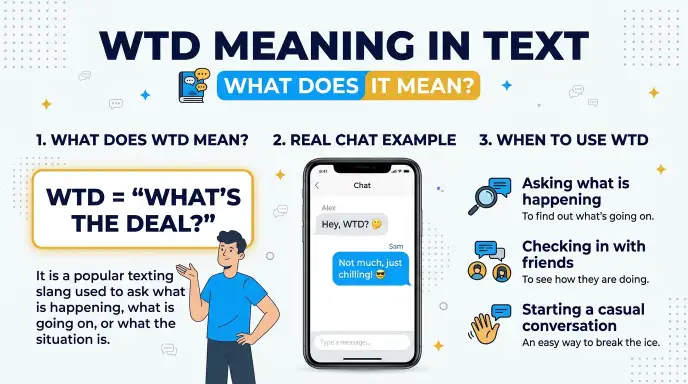
WTD usually means “What To Do?” in casual texting. People use it when they want advice, need an idea, or are unsure about what to do next. In some conversations, WTD can also mean “What’s The Deal?”
You may see WTD in text messages, group chats, TikTok comments, Snapchat messages, Instagram DMs, WhatsApp chats, and other casual online conversations. The exact meaning depends on the words around it and what the conversation is about.
For example, someone might text, “Plans got canceled, WTD?” They are probably asking, “What should we do?” But if someone writes, “WTD with the new schedule?” they may be asking, “What’s the deal with the new schedule?”
That is why context matters. WTD is short, fast, and useful, but the same three letters can sometimes point to different meanings.
WTD Meaning in Text
The most common meaning of WTD in text is “What To Do?”
It is an informal abbreviation people use when they want to know what action they should take, what activity they should choose, or what should happen next.
For example:
“My plans got canceled. WTD?”
This means:
“My plans got canceled. What should I do?”
WTD can also be used when two or more people are deciding on a plan:
“We’re free tonight. WTD?”
Here, the meaning is closer to:
“What should we do tonight?”
In casual internet communication, WTD is best understood as an abbreviation or texting shorthand rather than formal English. It helps people communicate quickly without typing the full question.
Quick Answer
| Term | Meaning | Type | Tone |
| WTD | What To Do? | Text abbreviation | Casual |
| WTD | What’s The Deal? | Informal shorthand | Casual/curious |
| WTD | Week to date | Business abbreviation | Professional |
The “What To Do?” meaning is the safest starting point when WTD appears in an ordinary conversation between friends. Recent online references also identify this as a common texting use, while noting that “What’s The Deal?” can appear depending on context.
WTD as “What To Do?”
People commonly use WTD when they:
- Need advice
- Feel unsure about their next step
- Want a suggestion
- Have free time
- Need help making a decision
- Want to make plans
- Are dealing with an unexpected problem
For example:
“I have nothing planned tonight, WTD?”
The sender may simply be asking for an activity or plan.
Another example:
“I missed the bus. WTD now?”
Here, the sender wants advice about what to do next.
The abbreviation does not always translate into one exact sentence. Depending on the conversation, it may mean “What should I do?”, “What should we do?”, or “What can I do next?”
WTD as “What’s The Deal?”
A second informal interpretation of WTD is “What’s The Deal?”
This meaning is more likely when someone wants an explanation, update, or clarification.
For example:
“WTD with the new rules?”
This can mean:
“What’s the deal with the new rules?”
Another example is:
“You’ve been quiet all day. WTD?”
Depending on the conversation, the sender may be asking what is going on.
This use is less straightforward than “What To Do?” That is why you should always read the surrounding message before deciding what WTD means. Some online slang references list both interpretations, although sources vary on which one they consider the main meaning.
WTD Is Not Always About Slang
It is also worth remembering that WTD can have meanings outside casual texting.
For example, in business or financial reporting, WTD can mean “week to date.” In that setting, it has nothing to do with internet slang.
A report might say:
“WTD sales are up 8%.”
That means sales measured from the beginning of the current week up to the reporting point.
So if you see WTD in a spreadsheet, work report, or financial discussion, do not automatically assume it means “What To Do?”
The surrounding context is always the best clue.
Where People Use WTD
WTD is mainly useful in informal digital communication. It can appear on many social and messaging platforms.
WTD on TikTok
On TikTok, WTD may appear in comments, direct messages, captions, or conversations between users.
For example:
“No plans this weekend, WTD?”
The person is likely asking for an activity or suggestion.
A comment such as:
“Everyone left early. WTD?”
could also be asking what should happen next.
TikTok conversations often move quickly, so short abbreviations can fit naturally into casual comments and messages.
However, WTD does not have one special TikTok only definition. Its meaning still depends on context.
WTD on Snapchat
Snapchat is another place where short texting abbreviations are common.
Someone might send:
“I’m bored 😭 WTD?”
This probably means:
“I’m bored. What should I do?”
Or:
“WTD tonight?”
could be a quick way of asking about plans.
Because Snapchat messages are often casual and conversational, WTD can sound natural between friends who already understand texting shorthand.
WTD on Instagram
On Instagram, you might see WTD in DMs, comments, or group conversations.
For example:
“Movie plans fell through. WTD?”
The sender may want another idea.
In a different conversation:
“WTD with that new post?”
could potentially mean “What’s the deal with that new post?”
Again, the surrounding words tell you which interpretation makes sense.
WTD on WhatsApp
WhatsApp conversations often include abbreviations because people use the app for quick everyday communication.
A friend might write:
“We’re all free Saturday. WTD?”
This is most naturally understood as:
“What should we do on Saturday?”
Another person might reply:
“Let’s grab food.”
WTD can therefore help start a conversation about plans without sounding overly formal.
WTD in SMS or Text Messages
Traditional SMS texting is another common setting for abbreviations.
For example:
“It’s raining and the game got canceled. WTD?”
The sender wants to know what to do instead.
A short message like this works because the recipient already knows the situation.
That is one of the main reasons people use abbreviations. They do not need to type every word when the context is already obvious.
Real Chat Examples of WTD
Here are 10 realistic examples showing how WTD can appear in everyday conversations.
Example 1: Making Plans
A: Everyone is free tonight.
B: Nice. WTD?
A: Let’s get something to eat.
Here, WTD means “What should we do?”
Example 2: Being Bored
A: I’m so bored right now.
B: Same 😭 WTD?
A: Movie?
Here, WTD is a casual request for an activity.
Example 3: A Canceled Plan
A: The concert got canceled.
B: Seriously? WTD now?
A: We could go to the mall.
The abbreviation means “What should we do now?”
Example 4: Asking for Advice
A: I accidentally sent the email to the wrong person.
B: Oh no. WTD?
A: I think I should send a correction.
Here, WTD asks for advice about the next step.
Example 5: Choosing Between Options
A: We can order pizza or burgers.
B: WTD?
A: Pizza sounds better.
The sender is asking what choice they should make.
Example 6: Weekend Plans
A: You free Saturday?
B: Yeah.
A: WTD?
B: Beach if the weather is good.
Here, WTD means “What should we do?”
Example 7: Asking About a Situation
A: They changed the meeting time again.
B: WTD with this schedule?
A: No idea. They just sent an update.
In this example, WTD can be understood as “What’s the deal?”
Example 8: Asking About Someone’s Behavior
A: He hasn’t replied all day.
B: WTD with him?
A: Maybe he’s busy.
Here, WTD is asking about the situation rather than directly asking what action to take.
Example 9: A Problem
A: My laptop just stopped working.
B: WTD?
A: I’m going to restart it.
The sender is asking what to do next.
Example 10: Group Chat
A: Nobody has made plans yet.
B: WTD tonight?
C: Dinner and a movie?
A: Works for me.
Here, WTD is simply a quick way to get group planning.
These examples show why context is important. The same abbreviation can be connected to planning, advice, uncertainty, or a request for clarification.
How to Reply When Someone Says “WTD”
If someone sends you “WTD?”, your reply depends on what they mean.
If they are asking what to do, you can simply suggest something.
Funny Replies
- “Survive, obviously 😂”
- “Eat first. Decisions later.”
- “Become famous. Seems reasonable.”
- “Sleep. It solves everything 😂”
Funny replies work best with friends who already have a playful texting style.
Casual Replies
- “Wanna grab food?”
- “Movie?”
- “Let’s go somewhere.”
- “Maybe just chill tonight.”
- “How about coffee?”
These are natural when WTD is about making plans.
Friendly Replies
- “We could go for a walk.”
- “How about dinner together?”
- “I’m open to anything.”
- “Want me to suggest a few ideas?”
These replies keep the conversation easy and positive.
Neutral Replies
If you are not sure what the person means, you can ask:
- “What do you mean?”
- “Do you mean what should we do?”
- “What are you asking about?”
- “What’s going on?”
A clarification is better than confidently answering the wrong question.
Is WTD Rude or Offensive?
WTD is generally not rude or offensive when it means “What To Do?”
It is normally a casual abbreviation used between friends, classmates, family members, or people who are comfortable with informal online communication.
For example:
“WTD tonight?”
is simply a casual question about plans.
The tone can change depending on the conversation, though.
For example:
“WTD with you?”
could sound annoyed or confrontational if the surrounding conversation is already tense.
That does not necessarily mean WTD itself is offensive. The attitude usually comes from the context, punctuation, previous messages, and relationship between the people.
Is WTD Safe for School?
It is generally harmless in a casual message between students.
However, you should not assume that every teacher or school communication system considers internet abbreviations appropriate for formal writing.
For an assignment, essay, report, or official school email, write the full phrase instead.
Is WTD Appropriate at Work?
It depends on the meaning and the workplace.
If you are chatting casually with a coworker, abbreviations may be normal.
But in a professional email, report, presentation, or formal document, it is clearer to write:
“What should we do next?”
instead of:
“WTD?”
If WTD means “week to date” in a business report, however, that is a different and established professional abbreviation.
Who Uses WTD?
WTD is most useful among people who are familiar with texting and internet shorthand.
It can be used by:
- Teenagers
- Young adults
- Gen Z users
- Millennials
- Social media users
- Online gaming communities
- Friends in group chats
- People who regularly use texting abbreviations
Although slang is often associated with younger users, adults can use WTD too. There is no strict age requirement.
The important factor is communication style.
Someone who frequently uses abbreviations such as IDK, IDC, IMO, BRB, WYD, WBU, and WBY may understand WTD immediately.
Someone who rarely uses internet shorthand may not know what it means.
WTD and Gen Z Usage
Gen Z users are highly familiar with compressed digital language, but WTD should not automatically be considered an exclusively Gen Z term.
People from different age groups use texting shorthand every day.
What matters more is if the person is comfortable with informal online communication.
How Often Does WTD Appear Online?
WTD is recognizable in online slang, but it is not as universally understood as extremely common abbreviations such as IDK or BRB.
That means context becomes especially important.
If you are writing for someone who may not know the abbreviation, using the full phrase can prevent confusion.
Origin of WTD
There is no single, clearly documented origin for the texting use of WTD.
Like many internet abbreviations, it fits into the broader development of shortened digital language. Texting encourages people to compress familiar phrases, especially when the meaning can be understood from context.
The “What To Do?” interpretation is a natural shortening of an everyday question. Instead of typing:
“What should I do?”
or:
“What should we do?”
a person can use WTD when the context already explains the question.
Internet forums, messaging apps, social media, and group chats have all helped spread this kind of shorthand.
The exact point when WTD became popular is difficult to establish, and different sources may give different interpretations or usage histories.
Recent references consistently discuss “What To Do?” as a common texting meaning, while also recording “What’s The Deal?” as another informal use.
So it is better not to claim that one specific person, app, or social media platform invented WTD.
How to Tell Which WTD Meaning Someone Means
When you see WTD, look at the conversation instead of guessing from the letters alone.
Look at the Topic
If the conversation is about plans, choices, or problems, “What To Do?” is likely.
“The restaurant is closed. WTD?”
The sender wants another option.
If the conversation is about a confusing situation, “What’s The Deal?” may fit better.
“WTD with the new rule?”
The sender wants an explanation.
Read the Previous Message
The message immediately before WTD can provide a major clue.
Person A: “Our flight was canceled.”
Person B: “WTD?”
This clearly points toward “What should we do?”
But:
Person A: “They suddenly changed the entire schedule.”
Person B: “WTD with that?”
This is more likely asking about the situation.
Look at the Words Around WTD
A phrase like:
“WTD tonight?”
usually relates to plans.
A phrase like:
“WTD with him?”
can be asking what is going on with a person.
This is not an absolute rule, but it can help.
Consider the Platform
A casual Snapchat message and a financial spreadsheet obviously require different interpretations.
The platform and setting can help you eliminate meanings that do not fit.
WTD Comparison Table
| Term | Meaning | Type | Usage | Popularity |
| WTD | What To Do? | Text abbreviation | Advice, plans, next steps | Common in casual chats |
| IDK | I Don’t Know | Text abbreviation | Showing uncertainty | Very common |
| IDC | I Don’t Care | Text abbreviation | Showing indifference | Very common |
| IMO | In My Opinion | Text abbreviation | Giving an opinion | Common |
| BRB | Be Right Back | Text abbreviation | Temporarily leaving a chat | Common |
WTD is different from these abbreviations because it is usually a question about an action or situation.
IDK tells someone that you do not know.
IDC says that you do not care.
IMO introduces an opinion.
BRB tells someone you will return shortly.
WTD generally asks what should happen next.
WTD vs. IDK
“IDK” = I don’t know.
“WTD?” = What should I do?
They can appear together:
“IDK WTD.”
This means:
“I don’t know what to do.”
WTD vs. IDC
“IDC” means “I don’t care.”
“WTD?” asks for a decision, idea, or next step.
They communicate very different attitudes.
WTD vs. IMO
“IMO” means “In my opinion.”
“WTD?” is a question about what to do.
Someone might use both:
“IMO we should leave. WTD?”
WTD vs. BRB
“BRB” means “Be right back.”
It tells the other person that the sender is temporarily leaving.
WTD instead asks for an action, plan, or explanation.
Real World Usage Example
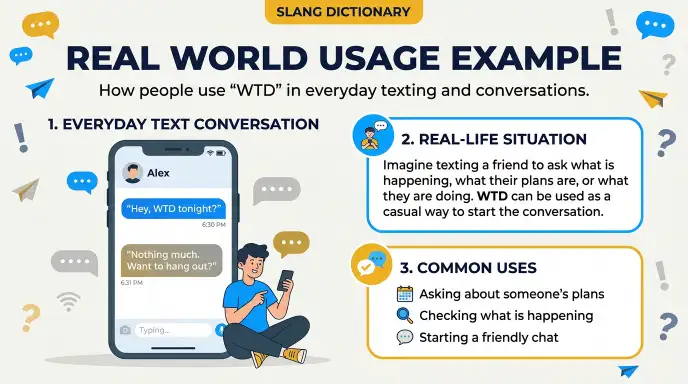
Imagine a group of friends planning to meet on Saturday.
One person says:
“The movie we wanted to see is sold out.”
Another friend replies:
“WTD?”
The person is not asking what WTD stands for. They are asking:
“What should we do?”
The group might then suggest another movie, restaurant, park, or activity.
Now consider a different situation.
Someone says:
“The company changed our schedule again.”
A coworker replies:
“WTD with this schedule?”
Here, the person is likely asking:
“What’s the deal with this schedule?”
The two conversations use the same three letters but communicate different ideas.
That is the main lesson with WTD: context determines meaning.
When Should You Avoid Using WTD?
WTD works best in casual conversations, but there are situations where writing the full phrase is better.
Avoid using WTD when:
- Writing a formal email
- Submitting a school assignment
- Writing a professional report
- Talking to someone who may not understand texting slang
- Giving important instructions
- Communicating about a serious or sensitive issue
- You need to avoid ambiguity
Instead of:
“WTD?”
you could write:
“What should we do?”
That is longer, but it is immediately clear.
Abbreviations are useful when both people understand them. When clarity matters more than speed, the full phrase is usually the better choice.
Frequently Asked Questions
What does WTD mean in text messages?
WTD most commonly means “What To Do?” It is used when someone wants advice, needs an idea, or is asking what should happen next.
What does WTD mean on TikTok?
On TikTok, WTD usually has the same casual meaning as in texting: “What To Do?” Depending on the context, it can also mean “What’s The Deal?”
Is WTD slang?
WTD is best described as an informal texting abbreviation or internet shorthand. It is commonly used in casual digital communication rather than formal writing.
Is WTD rude or offensive?
Usually, no. WTD is generally neutral and harmless when it means “What To Do?” However, tone depends on the surrounding conversation.
How should you reply to WTD?
If someone means “What To Do?”, you can suggest an activity or next step. For example, reply with “Movie?”, “Want to grab food?”, or “Let’s figure it out.”
Can WTD mean “What’s The Deal?”
Yes. In some informal conversations, WTD can mean “What’s The Deal?” This interpretation is more likely when someone is asking about a situation, person, change, or explanation.
Does WTD mean “Week to Date”?
Yes, in business and financial contexts, WTD can mean “week to date.” This is different from the casual texting meaning.
What is “WTD tonight?” mean?
Usually, “What should we do tonight?” It is commonly used when someone wants to make plans or asks for an activity suggestion.
What does “IDK WTD” mean?
“IDK WTD” usually means “I don’t know what to do.” IDK means “I don’t know,” while WTD means “what to do.”
Is WTD used by Gen Z?
Gen Z users may use WTD as part of casual online shorthand, but the abbreviation is not limited to Gen Z. Anyone familiar with texting abbreviations can use or understand it.
Conclusion
WTD usually means “What To Do?” in casual text messages and online conversations. People use it when they need advice, want an idea, are making plans, or are unsure about their next step.
For example, “Plans got canceled, WTD?” means “What should we do?” The abbreviation can make a message shorter and more casual.
WTD can also mean “What’s The Deal?” when someone is asking for an explanation or trying to understand a situation. In business settings, it may have a completely different meaning, such as “week to date.”
The best way to understand WTD is to look at the conversation around it. If the topic is plans or decisions, think “What To Do?” If someone is asking about a confusing situation, “What’s The Deal?” may make more sense.
WTD is fine for casual texting, Snapchat, Instagram, TikTok, WhatsApp, and group chats. For school, work, or formal writing, however, it is usually better to write the complete question.
Related Slang Words!

Hi, I’m Chloe Parker. I write simple and practical articles about slang, grammar, spelling, vocabulary, and commonly confused words. My goal is to make English easier to understand through clear explanations and real-life examples. Whether you’re a student, writer, or English learner, I’m here to help you build confidence and improve your everyday English.