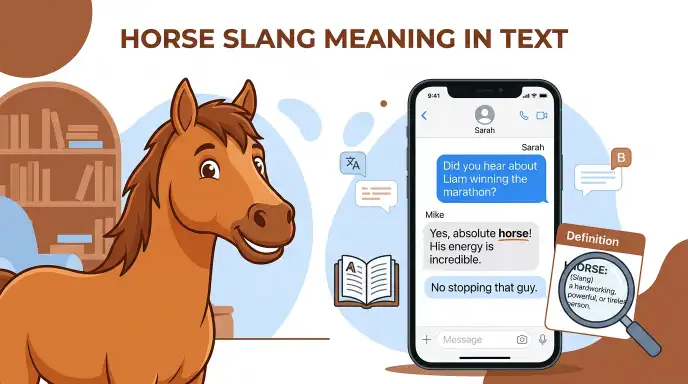
Horse slang meaning can change depending on the situation, the speaker, and the conversation.
While a horse is an animal, the word can also have different meanings in informal speech, online discussions, sports, and certain communities.
People may search for this term after seeing it in a social media post, reading a comment, or hearing someone use it in a conversation.
In some contexts, a horse can describe a strong or hardworking person. In others, it may refer to a large amount of something, a particular substance, or a specific activity.
Understanding the surrounding conversation is important because the word does not have one universal slang definition. Its meaning can also vary by region and community.
Quick Answer
The horse slang meaning depends on context. It can describe someone strong or hardworking, refer to a large amount of something, or carry a specialized meaning in particular communities.
What Does Horse Mean in Slang?
In informal English, horse can have several meanings beyond the animal itself. The exact meaning depends on how the word is used and who is using it.
Here are some possible interpretations:
- Strength or power: Someone may use a horse figuratively to describe a strong or powerful person.
- Hard work or endurance: The word can suggest that someone works hard or has great stamina.
- A large amount: In some expressions, horse may refer to something unusually large.
- Specialized slang: In certain communities, the word can have meanings connected to drugs, sports, gambling, or other activities.
Not every use of horse is slang. Sometimes people are simply talking about the animal, horse racing, riding, or another literal subject.
For example:
Person A: “He works like a horse.”
Person B: “Yeah, he never seems to stop!”
Here, the expression compares the person’s hard work to the strength and endurance associated with horses. It is not a literal statement about the animal.
Different Meanings of Horse in Slang
The following sections explain several ways the word can be used informally. Remember that these meanings are not interchangeable, and some are much more context specific than others.
Horse as a Symbol of Strength
Horses are often associated with physical power, speed, and endurance. Because of these qualities, people sometimes use the word figuratively when describing someone who appears strong or capable.
For example:
- “That guy is a horse!”
- “She’s a real workhorse.”
- “We need someone with the strength of a horse for this job.”
The first example might describe a physically powerful person, depending on the conversation. The second uses the established word workhorse to describe someone or something dependable that performs a lot of work.
Tone: Usually casual, complimentary, or humorous, although calling someone a horse can sound awkward or insulting in some situations.
Horse as a Description of Hard Work
The expression “work like a horse” is a familiar English idiom. It means to work very hard, often for a long time.
For example:
Friend A: “How did you finish the whole project in one day?”
Friend B: “I worked like a horse all afternoon.”
The speaker means they put in a great deal of effort.
This expression is not limited to texting or social media. It is also used in everyday speech and informal writing.
Important distinction: The expression is an established idiom rather than a new internet abbreviation. If someone uses it in a message, its meaning generally remains the same.
Horse as a Reference to Something Large
In some informal expressions, a horse is associated with a large size. For example, people sometimes use the phrase a horse of a different color to mean a different matter or situation.
Example:
“My first assignment was easy, but the final exam was a horse of a different color.”
This means the final exam was a different and more difficult situation.
The phrase is an idiom, not a literal reference to an animal. Its meaning comes from the complete expression rather than the word horse alone.
Other size related uses may depend on regional speech or a particular group. It is best not to assume that every use of horse refers to size.
Horse in Drug Related Slang
In some drug related contexts, horse is used as a slang term for heroin.
For example, someone discussing drug terminology might use the word in a conversation about illegal substances.
This meaning is very different from the expressions about strength or hard work. It is also not necessarily the meaning intended when someone uses horse in an ordinary conversation.
If you encounter the term in a message, forum, or discussion involving drugs, consider the surrounding words before deciding what the speaker means.
Horse in Sports and Gambling
The word horse also appears in sports, especially horse racing. In these situations, it may refer to a racing horse or be part of a discussion about betting and race results.
For example:
- “Which horse won the race?”
- “I’m watching the horses at the track.”
- “That horse was the favorite to win.”
These examples are generally literal rather than slang.
Some communities may use horse related expressions in more specialized ways. Their meanings depend on the activity being discussed, so it is important not to interpret every occurrence as internet slang.
Is Horse a Rude or Offensive Word?
Horse is generally a neutral word, but its tone depends on how it is used.
When people discuss animals, horse racing, or familiar expressions, the word is usually harmless.
However, using a horse to describe another person can sometimes sound rude, especially if the comment concerns their appearance, body size, behavior, or intelligence.
Consider these examples:
Friendly use:
“You worked like a horse to finish that project!”
This is usually a compliment about someone’s effort.
Potentially insulting use:
“You’re such a horse.”
Without more context, this could sound like an insult rather than praise.
Drug related use:
In a conversation about heroin, the word has a specific meaning that may be sensitive or concerning.
The safest approach is to consider the relationship between the speakers, the subject of the conversation, and the tone in which the word appears.
Where Is Horse Slang Commonly Used?
The word horse appears in many settings, but its meaning differs across them.
Texting and Private Messages
People may use horse related expressions in everyday text messages to describe hard work, strength, or a difficult situation.
Example:
A: “Did you finish all those orders?”
B: “Yes, I’ve been working like a horse since morning.”
Here, the speaker is emphasizing how hard they have worked.
Instagram and TikTok
On visual social media platforms, horses can appear in captions, comments, memes, and videos.
For example, a creator might describe someone as a workhorse after showing them completing a demanding task.
However, not every use on Instagram or TikTok represents a special internet slang meaning. Many posts use the word literally or as part of a familiar expression.
Reddit and Discord
On discussion platforms such as Reddit and Discord, the meaning depends heavily on the community.
A horse related comment in a gaming discussion may differ from one in a sports channel, an animal community, or a discussion about drugs.
Before interpreting the term, look at the topic of the conversation and any replies that clarify its meaning.
Everyday Conversations
Horse related expressions are also common in spoken English.
For example, people might say “work like a horse” when discussing a busy day or use “a horse of a different color” to describe a completely different situation.
These expressions are not restricted to younger people or social media users.
Real Life Examples of Horse Slang
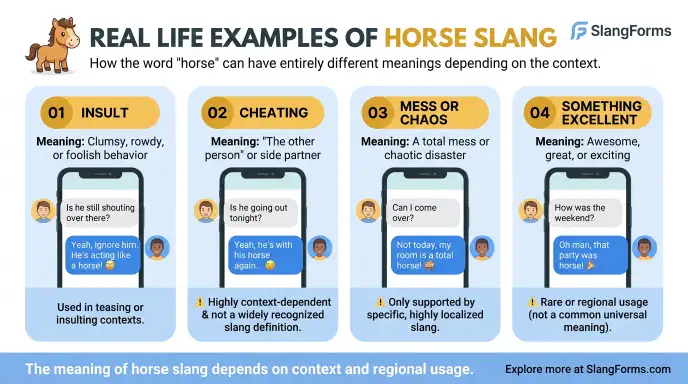
The following examples show how horse related language may appear in different conversations. Some illustrate established idioms, while others demonstrate possible figurative uses.
Friendly Examples
Example 1
Alex: “You helped everyone finish the project.”
Sam: “I was working like a horse yesterday!”
Meaning: Sam is saying they worked very hard.
Example 2
Mia: “How do you carry all those boxes?”
Leo: “I’ve got the strength of a horse!”
Meaning: Leo is joking about being strong.
Casual Texting Examples
Example 3
A: “Are you still at work?”
B: “Yep. Working like a horse today.”
Meaning: The person has been working hard.
Example 4
A: “Was the second interview difficult?”
B: “The first one was easy. The second was a horse of a different color.”
Meaning: The second interview was a completely different situation.
Humorous Examples
Example 5
Friend A: “You cleaned the whole house in two hours?”
Friend B: “I turned into a workhorse today!”
Meaning: The person is joking about how much work they completed.
Example 6
A: “How did you finish that much homework?”
B: “No breaks, no distractions. Just horse level effort!”
Meaning: The speaker is humorously comparing their effort to a horse’s strength and endurance.
This last example is an invented, playful expression rather than a widely established slang phrase.
Context Specific Examples
Example 7
A: “Which horse are you picking for the race?”
B: “I’m still looking at the results.”
Meaning: The conversation concerns horse racing, not necessarily slang.
Example 8
A: “What does horse mean in this discussion?”
B: “They’re using it as a term for heroin.”
Meaning: The word is being used in a drug related context.
These examples show why it is important to examine the whole conversation before deciding what horse means.
Horse Slang vs. Similar Words
Horse related expressions sometimes overlap with words that describe effort, strength, or reliability. However, these terms have different meanings.
| Word or Expression | Meaning | Example |
| Horse | An animal; sometimes used figuratively | “He’s strong like a horse.” |
| Workhorse | A person or machine that performs a lot of work reliably | “She’s the workhorse of our team.” |
| Beast | Informal term for someone impressive, powerful, or highly skilled | “He’s a beast on the basketball court.” |
| Machine | Informal description of someone who works or performs consistently | “She finished ten tasks without stopping. She’s a machine.” |
| Powerhouse | A person or organization with great strength, influence, or ability | “That team is a powerhouse.” |
| Work like a horse | To work extremely hard | “I’ve been working like a horse all week.” |
These expressions are not exact synonyms. For instance, calling someone a beast can be praised in a sports context, while calling someone a workhorse emphasizes effort and reliability.
What Is the Origin of Horse Slang?
The word horse has a long history in the English language. Its literal meaning refers to the familiar domesticated animal.
Many figurative expressions developed from qualities traditionally associated with horses, such as strength, endurance, and their role in transportation and agricultural work.
For example, “work like a horse” reflects the association between horses and demanding physical labor. Similarly, workhorse is commonly used for a dependable person, machine, or system that performs a large amount of work.
Other meanings developed within particular communities. Drug related slang and expressions connected to sports or gambling have different histories and should not automatically be treated as part of the same linguistic tradition.
There is no single origin date for every use of horse as slang. The history depends on the specific expression or meaning being discussed.
Why Do People Use Horses in Slang?
People often use figurative language because it makes communication more expressive and memorable.
Horse related expressions can help speakers communicate several ideas:
- To emphasize effort: “I worked like a horse” sounds more vivid than “I worked hard.”
- To describe strength: Comparing someone to a powerful animal can make a description more expressive.
- To add humor: A playful comparison can make a conversation more entertaining.
- To communicate quickly: Familiar expressions allow people to convey an idea without explaining it in detail.
- To use community specific language: Certain groups use specialized terms that make sense within their own conversations.
The meaning still depends on context. A phrase that sounds funny among friends may be inappropriate in a professional setting.
When Should You Avoid Using Horse as Slang?
Although horse is not generally offensive, some uses can be misunderstood or sound disrespectful.
Consider avoiding figurative descriptions of people when:
- You do not know if the other person will find the comparison funny.
- The expression could be interpreted as a comment about someone’s appearance or body.
- You are writing a formal email, school assignment, or professional document.
- The word appears to have a sensitive or drug related meaning that you do not intend.
- The phrase may confuse someone who is unfamiliar with the expression.
In professional communication, clearer alternatives are often better.
For example, instead of saying “She works like a horse,” you could write “She works extremely hard.”
Instead of calling someone a horse to suggest strength, you could say “He’s very strong” or “She’s physically powerful.”
These alternatives communicate the intended meaning without creating unnecessary confusion.
Is Horse Safe to Use on Social Media?
The word horse itself is generally suitable for ordinary social media posts, captions, and conversations.
For example, using “working like a horse” in a post about a busy day is unlikely to cause confusion for most English speakers familiar with the expression.
However, the surrounding content matters. In a drug related discussion, horse may refer to heroin. A comment about another person’s appearance could also be interpreted as insulting.
Keep these points in mind:
- Use the word according to its intended meaning.
- Consider how your audience might interpret it.
- Avoid using animal comparisons to mock or embarrass people.
- Explain specialized meanings when your audience may not recognize them.
- Remember that platform rules depend on the complete content, not just one word.
In short, horse is generally a neutral word, but its meaning and suitability depend on the context.
Frequently Asked Questions
What does horse mean in slang?
Horses can describe strength or endurance, appear in expressions about hard work, or have specialized meanings in certain communities. The intended meaning depends on the conversation.
Does horse mean a strong person?
It can be used figuratively to suggest strength, but this is not a universal slang definition. The surrounding words help determine if the speaker means it as a compliment, a joke, or an insult.
What does “work like a horse” mean?
“Work like a horse” is an established English expression meaning to work extremely hard, often for a long period.
Does horse mean heroin?
Yes. In some drug related contexts, horse is a slang term for heroin. It can also have completely unrelated meanings in ordinary conversations.
Is horse a bad word?
Generally, no. Horse is a neutral word, but using it to describe a person may sound insulting depending on the situation. Its drug related meaning may also make it sensitive in certain discussions.
Is horse slang used on TikTok and Instagram?
Horse related expressions may appear in captions, comments, videos, and memes on both platforms.
However, the word does not have one universal social media meaning, and many uses are literal rather than slang.
Conclusion
The horse slang meaning depends on the context in which the word appears. It can suggest strength, endurance, or hard work, as in the expression “work like a horse.” In other situations, it may refer to horse racing or have a specialized meaning, including a drug related use.
When you see a horse in a text message, social media post, or online discussion, pay attention to the surrounding words and the topic being discussed.
The most important rule is simple: do not assume that horse has the same meaning in every conversation. Understanding the context will help you interpret the word correctly and use it appropriately in your own communication.
Related Slang!
- NFS Slang: Meaning in Text
- Bumping Slang: Meaning, Definition, Examples & Usage
- Sherm NYC Slang: Meaning, Examples & Usage

Hi, I’m Chloe Parker. I write simple and practical articles about slang, grammar, spelling, vocabulary, and commonly confused words. My goal is to make English easier to understand through clear explanations and real-life examples. Whether you’re a student, writer, or English learner, I’m here to help you build confidence and improve your everyday English.