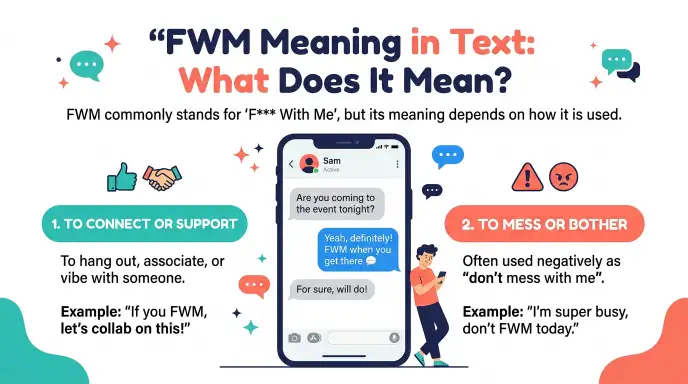
FWM usually means “f” with me” in text messages and online slang. Depending on the conversation, it can mean “hang out with me,” “support me,” “associate with me,” or “mess with me.” The exact meaning depends on the context and the relationship between the people chatting.
You may see FWM in text messages, Instagram captions, Snapchat stories, TikTok comments, and WhatsApp chats. People often use it because it is short and expresses a casual, confident, or playful message.
However, FWM can have more than one meaning. Sometimes, it shows friendship or interest. In other situations, it can sound like a challenge or a warning. Understanding the conversation helps you know what the sender really means.
If someone sends you FWM and you are unsure how to respond, this guide explains its common meanings, real chat examples, social media uses, and the situations where you should avoid using it.
FWM Meaning in Text
FWM is a slang abbreviation for “f* with me.”** The phrase can sound strong because it contains profanity, but its meaning changes with the situation.
In casual conversation, it often means that someone wants you to spend time with them, connect with them, support them, or become closer to them.
For example:
Friend A: You should FWM this weekend.
Friend B: Bet! What are we doing?
Here, the sender is asking the other person to hang out. The message sounds casual and friendly.
In another conversation, the phrase may have a different meaning:
Person A: Don’t FWM if you’re just going to lie to me.
Person B: I’m being honest with you.
In this example, the sender is warning someone not to play games or treat them badly.
Is FWM Slang or an Abbreviation?
FWM is internet slang written as an abbreviation. It is commonly used in informal digital communication, especially when people want to type quickly or express themselves casually.
Unlike formal abbreviations used in business or education, FWM is associated with everyday speech and informal expressions. Because its full form contains profanity, it is important to consider your audience before using it.
What Does FWM Mean in Everyday Chat?
The meaning of FWM can change according to the message.
Here are its common interpretations:
- Hang out with me: Someone wants to spend time with you.
- Connect with me: Someone wants to build a friendship or relationship.
- Support me: Someone wants you to stand by them or support what they do.
- Associate with me: Someone is talking about being connected to them or their social circle.
- Mess with me: Depending on the tone, someone may be warning you not to bother or disrespect them.
These meanings are related to the same slang phrase, but they are not interchangeable in every situation. Always read the surrounding message before deciding what the sender means.
Where People Use FWM
FWM appears in different forms of online communication. Its meaning usually stays similar, but the tone can change depending on the platform and the conversation.
FWM on TikTok
On TikTok, FWM may appear in captions, comments, videos, and song related posts. Someone might use it to show confidence, promote their work, or invite people to support them.
For example:
Caption: If you FWM, show some love to my new video.
The creator is asking people who support them to engage with their content.
It can also appear in jokes, relationship discussions, and videos about friendship. The surrounding content helps explain if the expression is playful, serious, or confrontational.
FWM on Snapchat
On Snapchat, people may use FWM in private messages, stories, and captions.
For example:
Message: FWM later if you’re free.
The sender is asking the other person to connect or hang out later.
Since Snapchat conversations are often casual, the abbreviation may appear between friends or people who know each other well. However, it can sound inappropriate if the recipient dislikes profanity.
FWM on Instagram
On Instagram, FWM may appear in captions, direct messages, comments, or music related posts.
For example:
Caption: Real ones FWM even when things get tough.
Here, the person is referring to people who support them and remain loyal during difficult times.
The expression may also be used to invite people to check out a page, support a creative project, or connect socially. Its meaning depends on the caption and the relationship between the people involved.
FWM on WhatsApp
WhatsApp users may use FWM in personal chats, group conversations, and status updates.
For example:
Friend A: We’re going out tonight. FWM if you want to come.
Friend B: Sounds good. What time?
In this context, the sender is inviting the other person to join the group.
Among close friends, the phrase may feel natural and relaxed. In a professional group or a conversation with someone you barely know, it may be too informal.
FWM in SMS Text Messages
FWM can also appear in ordinary SMS messages. People use it when they want to keep a message short and direct.
For example:
Message: FWM after work if you want to talk.
The sender wants the recipient to contact them or spend time with them after work.
Remember that text messages do not always communicate tone clearly. If the message seems aggressive or confusing, asking the sender what they mean is often the best approach.
Real Chat Examples of FWM
The following examples show how FWM can be used in different everyday situations.
1. Inviting a Friend
A: We’re going to get something to eat tonight.
B: Nice, who’s coming?
A: FWM if you’re free.
Meaning: The sender is inviting the other person to join them.
2. Asking Someone to Hang Out
A: What are you doing tomorrow?
B: Nothing much.
A: FWM then. We can watch a movie.
Meaning: The sender wants to spend time with the other person.
3. Showing Support
A: I just released my first song.
B: That’s great!
A: If you FWM, go listen to it.
Meaning: The sender is asking people who support them to listen to their music.
4. Talking About Loyalty
A: You stayed around when things got difficult.
B: Of course.
A: That’s how I know you FWM.
Meaning: The speaker believes the other person genuinely supports or cares about them.
5. Making a Social Media Request
A: I posted a new video.
B: I’ll check it out.
A: Appreciate everyone who FWM.
Meaning: The creator is thanking people who support their content.
6. Setting a Boundary
A: Why did you tell everyone my business?
B: I didn’t mean any harm.
A: Don’t FWM if you can’t respect my privacy.
Meaning: The sender is telling the other person not to associate with them if they cannot respect their boundaries.
7. Flirting Casually
A: You never text me first.
B: Maybe you should text me more.
A: So, you want me to FWM?
Meaning: Depending on their relationship, the phrase may suggest interest in talking or spending more time together.
8. Asking for Company
A: I’m bored at home.
B: Same here.
A: FWM if you want to go for a drive.
Meaning: The sender wants the other person to join them.
9. Responding to Disrespect
A: Why are you always making jokes about me?
B: I thought you were okay with it.
A: Don’t FWM like that again.
Meaning: In this context, the sender is telling the other person to stop bothering or disrespecting them.
10. Showing Confidence
A: I finally started my own business.
B: That’s a big step!
A: If you FWM, support the launch.
Meaning: The sender is asking friends or followers to support their business.
These examples demonstrate why context matters. In one message, FWM can be an invitation. In another, it can express loyalty, request support, or set a boundary.
How to Reply When Someone Says FWM
Your response should match the sender’s meaning and your relationship with them. If you understand the message, you can respond naturally without using the same slang.
Funny Replies
Use these when you are joking with a friend:
- “What’s the plan, boss?”
- “Depends. Are snacks included?”
- “You first!”
- “What’s in it for me?”
- “Let me check my very busy schedule.”
These replies work best when the conversation is friendly and the other person is clearly joking.
Casual Replies
If someone is inviting you to hang out, you could say:
- “Sure, what’s up?”
- “I’m down.”
- “What time?”
- “Maybe later.”
- “Send me the details.”
These responses keep the conversation relaxed and straightforward.
Friendly Replies
If the sender is talking about friendship or support, you might reply:
- “You already know!”
- “I’ve got your back.”
- “Of course, I’m here for you.”
- “Always supporting you.”
- “Let’s catch up soon.”
Choose a response that honestly reflects how you feel. You do not need to promise support or friendship if you are uncomfortable doing so.
Neutral Replies
If you are unsure what the sender means, try:
- “What do you mean?”
- “Can you explain?”
- “Are you asking me to come over?”
- “Do you mean hang out?”
- “I’m not sure I understand.”
A simple question can prevent confusion, especially when the expression sounds aggressive or has more than one possible meaning.
Is FWM Rude or Offensive?
FWM can be rude or offensive because its full form contains profanity. However, people sometimes use the phrase casually with close friends, and it does not always express anger.
The important factors are the context, tone, relationship, and audience.
When FWM Is Usually Casual
Among friends who regularly use slang, FWM may sound normal.
For example, “FWM this weekend” can simply mean that someone wants to hang out.
A social media creator might also use the phrase to ask followers for support. In such cases, the expression may be confident or informal rather than hostile.
When FWM Can Sound Aggressive
The phrase may sound confrontational when someone uses it during an argument.
For example:
“Don’t FWM if you’re going to disrespect me.”
Here, the speaker is setting a boundary and warning the other person to stop behaving badly.
It can also sound threatening or intimidating when paired with aggressive language. If you receive a message that makes you feel unsafe, do not assume it is harmless slang simply because it is written as an abbreviation.
Is FWM Safe to Use at School or Work?
It is generally better to avoid FWM in formal settings.
Because the full phrase contains profanity, it may be unsuitable for:
- School assignments and presentations
- Emails to teachers or managers
- Job applications
- Professional meetings
- Business messages
- Conversations with people you do not know well
Instead of writing “FWM this weekend,” you could say “Let me know if you want to hang out this weekend.”
The alternative communicates the same friendly invitation without using profanity.
Who Uses FWM?
FWM is used in informal conversations, especially among people who are familiar with internet slang and casual speech.
However, there is no single age group or community that owns the expression.
Do Gen Z Users Say FWM?
Some Gen Z users use FWM in text messages, social media captions, and conversations with friends. It can fit the short, casual style often found in online communication.
However, it would be inaccurate to claim that every Gen Z user understands or uses it. People have different communication styles, and slang varies by community.
Do Millennials Use FWM?
Some millennials also use FWM, particularly in music related conversations, social media posts, and everyday messages.
People may learn the phrase through friends, popular songs, or online culture rather than from a specific age group.
Where Is FWM Most Common?
FWM may appear in:
- Private text conversations
- Instagram captions and direct messages
- Snapchat chats and stories
- TikTok videos and comments
- WhatsApp messages
- Music lyrics and fan discussions
- Informal conversations among friends
Its actual frequency varies by platform and community. It is best understood as an informal slang expression rather than a universal abbreviation that everyone uses.
Origin of FWM
FWM comes from the informal English phrase “f*** with me.” The expression existed in spoken language before it became common in digital messaging.
The original phrase has several related meanings. Depending on how it is used, it can refer to associating with someone, spending time together, supporting someone, bothering someone, or challenging someone.
As text messaging and social media grew, people began shortening familiar expressions to save space and communicate quickly. FWM fits this pattern because it turns a longer phrase into three letters.
The abbreviation is also used in music and online culture, where casual speech, confidence, loyalty, and confrontational language often appear in lyrics and captions.
However, there is no single confirmed origin date for the abbreviation in internet slang. It is safer to describe it as a shortened form of an existing informal expression than to assign it to one particular platform or creator.
FWM vs. IDK, IDC, IMO, and BRB
FWM, IDK, IDC, IMO, and BRB are all used in informal digital communication, but their meanings are different.
| Term | Meaning | Type | Typical Usage | Popularity |
| FWM | F*** with me | Slang abbreviation | Inviting someone, expressing support, or setting a boundary | Used in some informal social circles |
| IDK | I don’t know | Abbreviation | Showing uncertainty or a lack of information | Widely recognized |
| IDC | I don’t care | Abbreviation | Expressing indifference | Widely recognized |
| IMO | In my opinion | Abbreviation | Sharing a personal view | Common in online discussions |
| BRB | Be right back | Abbreviation | Saying you will return shortly | Common in chats and messages |
FWM vs. IDK
FWM is related to connecting with someone, showing support, or telling someone not to bother you. IDK simply means “I don’t know.”
Example:
A: Do you want to come with us?
B: IDK. I’ll let you know.
Here, the reply expresses uncertainty rather than an invitation or warning.
FWM vs. IDC
IDC means “I don’t care.” It usually expresses a lack of interest or concern.
FWM does not automatically mean that someone does not care. Its meaning depends on the phrase and the context.
FWM vs. IMO
IMO means “in my opinion.” It introduces a personal view.
For example, “IMO, that movie was great” means the speaker is sharing an opinion.
FWM is not used to introduce an opinion. It has a different purpose.
FWM vs. BRB
BRB means “be right back.” People use it when they temporarily leave a conversation.
FWM may be used to invite someone to connect or to express a warning, so the two abbreviations are not interchangeable.
Real World Usage Example
Imagine that Maya has started posting videos of her artwork on Instagram. She wants her friends to see her latest project and share their feedback.
She sends a message to a friend:
“Just posted my new art video. If you FWM, check it out!”
In this situation, Maya is asking someone who supports her to watch the video. She is using the expression casually, not threatening anyone.
Now imagine a different situation. Two friends are arguing because one of them keeps making disrespectful comments.
One friend says:
“Don’t FWM if you’re going to keep talking to me like that.”
Here, the meaning changes. The speaker is telling the other person not to associate with them or continue bothering them in that way.
Both examples use the same abbreviation, but the tone and purpose are different. This is why you should read the whole message before interpreting FWM.
Common Mistakes People Make About FWM
Learning the abbreviation is only the first step. Understanding how people use it can help you avoid common misunderstandings.
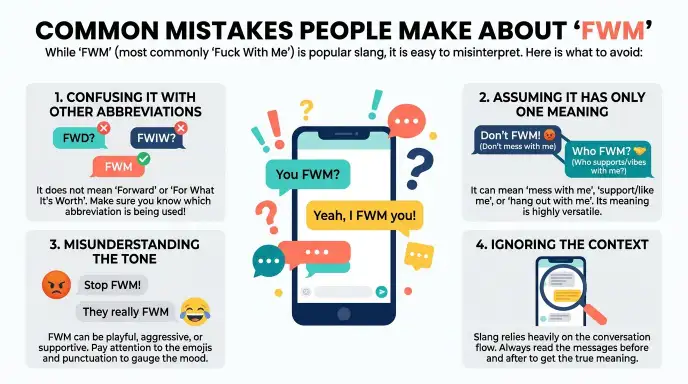
Assuming It Always Means “Hang Out With Me”
FWM can be an invitation, but it does not always mean that someone wants to meet in person.
In some conversations, it means “support me” or “associate with me.” In a tense exchange, it may refer to bothering or disrespecting someone.
Thinking It Is Always Friendly
The expression can be friendly among people who know each other well. However, it can also sound aggressive, depending on the wording and tone.
Do not assume that every message containing FWM is a joke or a friendly invitation.
Using It With Everyone
Not everyone is comfortable with profanity. A close friend may understand your tone, while a teacher, manager, or new acquaintance may find the expression inappropriate.
Consider your audience before using it.
Confusing FWM With Other Abbreviations
FWM is different from terms such as WYA, WYD, IDK, and IDC.
For example, WYA usually means “where are you at?” and WYD usually means “what are you doing?” FWM has its own meaning and should be interpreted in context.
Frequently Asked Questions
What does FWM mean in text messages?
FWM usually means “f” with me.” Depending on the context, it can mean hang out with me, support me, associate with me, or stop messing with me.
What does FWM mean on TikTok?
On TikTok, FWM may be used in captions, comments, and videos to express support, invite people to connect, or communicate confidence. The exact meaning depends on the content.
Is FWM slang?
Yes. FWM is an informal slang abbreviation based on the phrase “f*** with me.” It is commonly associated with casual conversations and online communication.
Is FWM rude or offensive?
It can be. The full phrase contains profanity, so it may offend some people. Among close friends, it may be used casually, but it is generally best avoided in formal or professional settings.
How should you reply to FWM?
Your reply depends on the sender’s intention. If they are inviting you to hang out, you could say “Sure, what’s the plan?” If you are unsure what they mean, ask them to explain.
Does FWM mean someone likes you?
Not necessarily. It may suggest that someone wants to spend time with you or build a connection, but it does not automatically indicate romantic interest. Look at the broader conversation.
Can FWM be used in a professional message?
It is better to avoid it in professional communication because its full form contains profanity. Use clearer alternatives such as “Let’s connect” or “Let me know if you want to meet.”
Does FWM have more than one meaning?
Yes. Its interpretation depends on the situation. It may express an invitation, support, social connection, or a warning not to bother someone.
Conclusion
FWM usually stands for “f” with me” in text messages and online slang. It can be used to invite someone to hang out, show support, express a connection, or tell someone to stop behaving disrespectfully.
You may encounter it on TikTok, Snapchat, Instagram, WhatsApp, and in ordinary text messages. The phrase is informal and contains profanity, so it is best suited to casual conversations with people who understand your communication style.
The most important thing to remember is that context determines the meaning. Read the entire message, consider your relationship with the sender, and ask for clarification if you are unsure.
If you want to avoid profanity, you can use alternatives such as “hang out with me,” “support me,” or “let’s connect.” These phrases are clearer and more appropriate in many situations.
More Slang Meanings!

Hi, I’m Chloe Parker. I write simple and practical articles about slang, grammar, spelling, vocabulary, and commonly confused words. My goal is to make English easier to understand through clear explanations and real-life examples. Whether you’re a student, writer, or English learner, I’m here to help you build confidence and improve your everyday English.