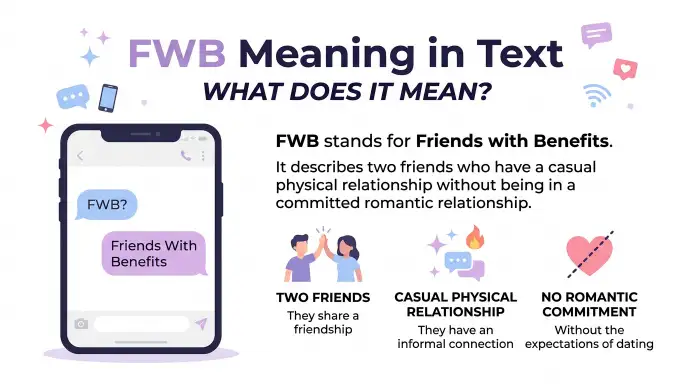
FWB means “Friends With Benefits” in text messages. It describes two people who are friends and have a physical or sexual relationship without being in a traditional romantic relationship. The exact meaning depends on the conversation and the people involved.
You may see FWB in text messages, Instagram DMs, Snapchat chats, TikTok comments, dating apps, and online discussions about relationships. People often use it when talking about dating, friendship, attraction, or relationship expectations.
For example, someone might text, “We’re just FWB, nothing serious.” This usually means they enjoy spending time together and have a physical connection but are not officially a romantic couple.
If you have seen this abbreviation and wondered what it means, you are not alone. Understanding FWB can help you follow conversations, recognize relationship terms, and avoid misunderstandings when someone uses it in a message.
FWB Meaning in Text
FWB stands for Friends With Benefits. It is an abbreviation commonly used in conversations about relationships and dating.
In simple words, FWB describes two people who share a friendship and also have a physical or sexual relationship.
They may care about each other as friends, but they do not necessarily consider themselves boyfriend and girlfriend or partners in a committed romantic relationship.
The word “benefits” in this expression refers to the physical or sexual side of the relationship. It does not usually mean money, gifts, or financial rewards.
Is FWB Slang, an Acronym, or an Abbreviation?
FWB is an abbreviation formed from the first letters of the words “Friends With Benefits.” It is also commonly described as an acronym in everyday discussions about texting slang.
People use it because writing three letters is quicker than typing the entire phrase.
For example:
Full phrase: We are friends with benefits.
Text message: We are FWB.
Both communicate the same general idea, although the exact boundaries of the relationship can differ from one situation to another.
FWB is informal language. It is most appropriate in casual conversations, dating discussions, and online spaces where people are comfortable discussing relationships.
What Does FWB Mean in Everyday Conversations?
The meaning is generally the same across texting and social media, but the situation can affect how you understand it.
Consider these examples:
- “He said we’re FWB.” This suggests that he describes the relationship as friends with benefits.
- “Are you two FWB?” This asks if two people have that kind of relationship.
- “I’m not looking for FWB.” This means the person does not want a casual physical relationship of this kind.
- “We were FWB for a while.” This indicates that the arrangement happened in the past.
One important point is that FWB does not automatically mean the two people have no feelings for each other. One or both people might develop romantic feelings, while others may prefer to keep the relationship casual.
The abbreviation describes a general type of relationship, not every emotion or agreement between the people involved.
Where Do People Use FWB?
FWB appears in many digital conversations, particularly when people discuss dating, attraction, and relationship choices.
The abbreviation does not have a completely different meaning on every platform. However, the context can help you understand why someone used it.
FWB Meaning on TikTok
On TikTok, FWB may appear in videos about modern dating, relationship advice, personal experiences, and discussions about casual relationships.
For example, a creator might post a video saying:
“Things I learned from being in an FWB situation.”
Here, the creator is discussing personal experiences involving a friends with benefits arrangement.
You might also see the abbreviation in comments such as:
- “I could never do FWB.”
- “FWB situations can get complicated.”
- “Communication is important in an FWB relationship.”
These comments express different opinions about casual relationships.
Remember that a TikTok video may describe one person’s experience rather than a rule that applies to everyone.
The abbreviation itself does not tell you if a particular arrangement is healthy, successful, or emotionally difficult.
FWB Meaning on Snapchat
Snapchat users may use FWB in private messages, conversations with friends, or discussions about dating.
For example:
Person A: “Are you and Jake dating?”
Person B: “No, we’re FWB.”
In this conversation, the second person explains that the relationship is not a traditional romantic partnership.
Because Snapchat conversations are often informal, people may use short abbreviations instead of writing complete explanations.
If someone sends you “FWB?” they might be asking if you are interested in that kind of arrangement. However, the meaning depends on the conversation that came before it.
If you are unsure, asking what the person means is better than making assumptions.
FWB Meaning on Instagram
On Instagram, FWB may appear in direct messages, comments, relationship related posts, and discussions about dating.
For example:
Person A: “So, are you two official?”
Person B: “Not really. We’re FWB.”
The reply suggests that the two people have a physical connection but do not identify as a committed romantic couple.
Someone might also use the abbreviation when discussing personal boundaries or explaining what kind of relationship they want.
For example:
“I’m looking for a serious relationship, not FWB.”
This message makes the person’s preference clear.
FWB Meaning on WhatsApp
WhatsApp users may use FWB when discussing relationships with friends or communicating privately with someone they are dating or interested in.
Example:
Friend A: “What happened between you and Sam?”
Friend B: “We decided to stay at FWB.”
This means they chose to continue their connection as friends with benefits rather than enter a traditional romantic relationship.
The abbreviation can also appear in longer discussions about feelings, expectations, and if a casual arrangement is working for both people.
Since WhatsApp is used for both personal and professional communication, the appropriateness of the term depends on the conversation. It is generally intended for informal, personal discussions rather than workplace messages.
FWB Meaning in SMS and Text Messages
In regular SMS conversations, FWB is a short way to refer to friends with benefits.
For example:
“Are you looking for a relationship or FWB?”
The sender is asking if the other person wants a committed romantic relationship or a more casual arrangement.
Another example:
“FWB isn’t for me.”
This means the person does not want that type of relationship.
In texting, abbreviations can save time, but they can also create confusion when someone is unfamiliar with them. If the meaning matters, a short explanation can prevent misunderstandings.
Real Chat Examples of FWB
The following examples show how people might use FWB in everyday conversations. Each example includes a short explanation so you can understand the meaning.
Example 1: Asking About a Relationship
A: “Are you and Alex together?”
B: “No, we’re FWB.”
Meaning: They have a friends with benefits arrangement rather than identifying as a traditional romantic couple.
Example 2: Explaining Relationship Preferences
A: “What are you looking for right now?”
B: “Nothing serious, maybe FWB.”
Meaning: The person is interested in a casual arrangement rather than a committed romantic relationship.
Example 3: Rejecting a Casual Arrangement
A: “Would you ever consider being FWB?”
B: “No, I prefer dating seriously.”
Meaning: The person does not want a friends with benefits relationship.
Example 4: Talking to a Friend
A: “Why aren’t you two dating?”
B: “We agreed to keep it FWB.”
Meaning: They have chosen not to pursue a traditional romantic relationship.
Example 5: Discussing Feelings
A: “I think I caught feelings for him.”
B: “But I thought you were FWB?”
Meaning: One person may be developing romantic feelings despite the casual nature of the arrangement.
Example 6: Asking for Clarification
A: “She said she wants us to be FWB.”
B: “Did you ask what that means to her?”
Meaning: The conversation highlights the importance of understanding what both people expect.
Example 7: Setting Boundaries
A: “I don’t want a serious relationship right now.”
B: “Would FWB be something you’d consider?”
Meaning: One person is asking if the other is open to a casual arrangement.
Example 8: Ending the Arrangement
A: “Are you still seeing Chris?”
B: “No, we stopped being FWB.”
Meaning: Their friends with benefits arrangement has ended.
Example 9: Discussing a Social Media Post
A: “What did that FWB post mean?”
B: “I think they’re talking about casual relationships.”
Meaning: The abbreviation refers to friends with benefits in an online discussion.
Example 10: Wanting Something Different
A: “He asked if I wanted to be FWB.”
B: “What did you say?”
A: “I told him I’m looking for a committed relationship.”
Meaning: The person politely explains that their relationship goals are different.
These examples show that FWB usually refers to the same general idea, but the surrounding conversation determines if someone is asking a question, explaining a relationship, setting a boundary, or describing a past experience.
How to Reply When Someone Says FWB
Your response depends on what the other person means and how you feel about the situation. You do not have to agree to anything simply because someone asks.
Here are some possible replies for different situations.
Casual Replies
If you want to keep the conversation relaxed, you could say:
- “Oh, you mean friends with benefits?”
- “Got it. Thanks for explaining.”
- “Okay, I understand what you mean.”
- “So, nothing serious?”
- “That makes sense.”
These responses acknowledge the meaning without suggesting that you agree to the arrangement.
Friendly Replies
If you want to be respectful and friendly, try:
- “Thanks for being honest about what you want.”
- “I appreciate you explaining it.”
- “It’s good to be clear about expectations.”
- “I understand. Everyone wants something different.”
- “Let’s make sure we’re on the same page.”
These replies work when you want to keep communication open and avoid unnecessary tension.
Funny Replies
If the conversation is lighthearted and both people are comfortable joking, you might say:
- “First, let me understand the terms and conditions!”
- “Relationship vocabulary is getting complicated.”
- “Can we start with explaining the basics?”
- “My dictionary needs an update!”
- “That’s a new abbreviation for me.”
Use humor carefully. Relationship conversations can be personal, and a joke may not be appropriate if someone is discussing their feelings seriously.
Neutral Replies
If you are unsure how you feel, a neutral response can give you time to think.
Examples include:
- “What exactly do you mean by FWB?”
- “Can you explain what you’re looking for?”
- “I’d like to think about that.”
- “What would that arrangement involve?”
- “I’m not sure that’s what I want.”
These replies help you understand the other person’s expectations before making a decision.
If You Are Not Interested
You can decline clearly without being rude.
For example:
- “Thanks, but I’m not interested in that kind of relationship.”
- “I’d rather keep things as friends.”
- “I’m looking for something more serious.”
- “I don’t think we’re looking for the same thing.”
- “That arrangement isn’t right for me.”
You do not need to provide a long explanation for your decision. Respectful communication means both people can express what they want and accept the other person’s answer.
Is FWB Rude or Offensive?
FWB is not usually an insult or a swear word. It is an informal abbreviation for a type of relationship.
However, the phrase refers to a physical or sexual relationship, so it can be sensitive depending on the audience and situation.
Is FWB Safe to Use in Text Messages?
FWB is generally understandable in conversations about dating and relationships, especially when both people are familiar with the term.
It may not be appropriate when speaking to someone who is uncomfortable discussing sexual relationships or when the topic is unrelated to the conversation.
Before using the abbreviation, consider who will read your message and if they understand what you mean.
Is FWB Appropriate at School or Work?
FWB is generally not suitable for formal school assignments, professional emails, workplace presentations, or official documents.
Although the abbreviation is widely understood in some social circles, it refers to a personal relationship and may be inappropriate in professional settings.
For schoolwork or formal writing, explain the phrase in full only when it is relevant to the topic.
For example, a report about modern dating terminology may discuss friends with benefits relationships in a neutral, educational way.
In everyday workplace conversations, it is usually better to avoid discussing someone’s private relationships unless the topic is relevant and everyone is comfortable.
Can FWB Offend Someone?
The abbreviation itself is not generally offensive, but the way it is used can upset someone.
For example, calling two people FWB without knowing their relationship may feel intrusive. Using the term to pressure someone into a physical relationship is also inappropriate.
The important distinction is between discussing a relationship respectfully and making assumptions about another person’s private life.
Who Uses the Term FWB?
FWB is used by people discussing relationships, dating preferences, and casual connections. It appears in text messages, online discussions, dating related content, and conversations between friends.
There is no single age group or community that exclusively uses the term.
Do Gen Z Users Say FWB?
Some Gen Z users use FWB in texting and social media conversations, particularly when discussing modern dating.
However, the abbreviation is not limited to Gen Z. Adults from different generations may recognize or use it, especially if they are familiar with online dating terminology.
It is more accurate to think of FWB as a relationship abbreviation used in various online and offline social settings rather than a term belonging to one generation.
Which Platforms Use FWB Most?
The abbreviation can appear on several platforms, including:
- TikTok: Relationship discussions, personal stories, and dating related videos.
- Snapchat: Private messages and casual conversations.
- Instagram: Direct messages, comments, and relationship posts.
- WhatsApp: Personal chats and discussions with friends.
- Dating apps: Conversations about relationship preferences and expectations.
- SMS: Regular text messages between people who know each other.
The exact frequency varies by community and conversation. Seeing FWB on one platform does not mean it is used equally often everywhere.
Is FWB Still Used Online?
FWB remains a recognizable abbreviation in discussions about casual relationships and dating.
Its use can vary depending on the platform, audience, and current online trends. It may be familiar to people who regularly discuss relationships online, while others may need to ask what it means.
If you encounter it in an unfamiliar conversation, the phrase “friends with benefits” is the most common interpretation in a dating or relationship context.
Origin of the Term FWB
The expression “friends with benefits” describes a relationship that combines friendship with physical intimacy without necessarily involving a committed romantic partnership.
The exact first use of the phrase is difficult to establish with certainty. It would be inaccurate to claim that one particular social media platform invented it.
The expression became recognizable through everyday conversations, popular culture, entertainment, and discussions about relationships. The abbreviation FWB offers a shorter way to refer to the full phrase.
How Did FWB Become Popular Online?
As text messaging, online forums, social networks, and dating apps became common, users developed habits of shortening familiar expressions.
FWB fits this pattern because it is easy to type and recognize once someone knows the meaning.
Online discussions about dating have also made relationship terminology more visible. People may encounter FWB while reading comments, watching videos, browsing dating profiles, or talking with friends.
However, the abbreviation does not have one universal meaning in every possible context. The topic of the conversation remains important.
Does FWB Have a Different Meaning in Other Contexts?
In conversations about dating, FWB almost always refers to “friends with benefits.”
In other contexts, an abbreviation can sometimes have a specialized meaning, such as an organization name or an internal workplace term. Those uses depend on the setting.
If the message is clearly about relationships, attraction, or dating, “friends with benefits” is the most likely interpretation.
FWB vs. IDK, IDC, IMO, and BRB
FWB, IDK, IDC, IMO, and BRB are all abbreviations used in digital communication. However, they have different meanings and purposes.
FWB describes a relationship arrangement, while the others communicate uncertainty, indifference, an opinion, or a temporary absence.
| Abbreviation | Meaning | Type | Common Usage | Popularity |
| FWB | Friends With Benefits | Relationship abbreviation | Discussing casual relationships | Recognizable in dating related conversations |
| IDK | I Don’t Know | Texting abbreviation | Expressing uncertainty | Widely recognized in everyday texting |
| IDC | I Don’t Care | Texting abbreviation | Expressing indifference | Common in casual digital conversations |
| IMO | In My Opinion | Texting abbreviation | Sharing a personal viewpoint | Common in online discussions |
| BRB | Be Right Back | Texting abbreviation | Indicating a short absence | Widely recognized in casual chats |
Popularity descriptions are general, not based on a measured ranking.
FWB vs. IDK
FWB means “Friends With Benefits,” while IDK means “I Don’t Know.”
Example:
A: “Do you know if they’re dating?”
B: “IDK. They might be FWB.”
In this example, IDK expresses uncertainty, while FWB describes the possible relationship.
FWB vs. IDC
FWB describes a relationship arrangement. IDC means “I Don’t Care.”
Example:
A: “Are they FWB?”
B: “IDC about their relationship.”
The second person is saying that they do not care about the situation. The two abbreviations serve entirely different purposes.
FWB vs. IMO
FWB refers to friends with benefits. IMO means “In My Opinion.”
Example:
A: “Do you think FWB can work?”
B: “IMO, it depends on the people involved.”
Here, IMO introduces a personal opinion about the subject.
FWB vs. BRB
FWB describes a type of relationship, while BRB means “Be Right Back.”
Example:
A: “I need to explain what FWB means.”
B: “BRB, someone is at the door.”
BRB tells the other person that the sender will return shortly. It has no direct connection to relationship terminology.
Understanding these differences can make online conversations easier to follow, especially when several abbreviations appear in the same chat.
Real World Usage Example
Imagine two friends, Jamie and Taylor, have known each other for several months. They enjoy spending time together and have agreed to a physical relationship, but neither has committed to being in a traditional romantic partnership.
When a mutual friend asks Jamie if they are dating, Jamie replies:
“We’re FWB right now.”
The friend understands that Jamie and Taylor have a friends with benefits arrangement.
Later, Jamie realizes that they want a committed relationship. Taylor, however, prefers to keep things casual. They discuss their feelings and decide if continuing the arrangement is right for both of them.
This example illustrates an important point: FWB describes the general relationship arrangement, but it does not explain the people’s individual feelings or expectations.
Two people may understand the abbreviation but still have different ideas about exclusivity, emotional commitment, communication, or the future.
That is why clear conversations matter more than the label itself.
What Should People Understand About an FWB Arrangement?
The term does not automatically establish a complete set of rules. People may have different expectations about what their relationship involves.
If two adults are considering this type of arrangement, they should communicate honestly about boundaries, consent, safer sex, exclusivity, and emotional expectations.
Both people should feel free to say yes, no, or change their minds. Neither person should feel pressured to participate.
It is also important to recognize that feelings can change. A casual arrangement may remain casual, develop into a romantic relationship, or end. The abbreviation cannot predict which outcome will occur.
These considerations are more useful than assuming that every FWB relationship works in exactly the same way.
Common Misunderstandings About FWB
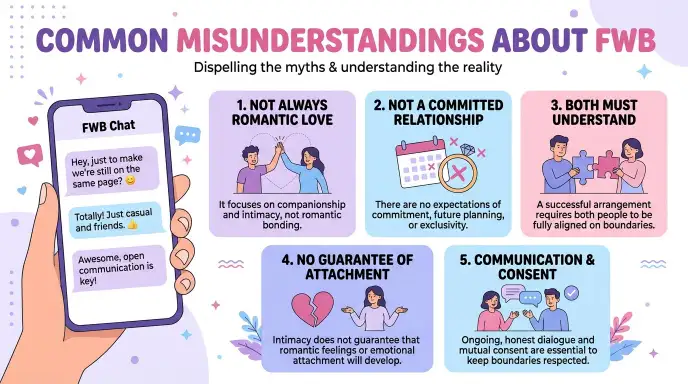
People sometimes misunderstand FWB because the abbreviation is short and the relationships it describes can differ.
Here are a few common misconceptions.
Misunderstanding 1: FWB Means Boyfriend and Girlfriend
Not necessarily. FWB usually describes a connection that includes friendship and physical intimacy without a traditional committed romantic relationship.
However, every relationship is different, so it is best not to assume more than the people involved have explained.
Misunderstanding 2: People in an FWB Relationship Cannot Have Feelings
This is incorrect. People can develop romantic feelings in many kinds of relationships, including casual ones.
FWB does not guarantee that either person will remain emotionally detached.
Misunderstanding 3: FWB Always Means the Relationship Is Secret
No. Some people keep their personal relationships private, while others may discuss them openly with trusted friends.
The abbreviation does not tell you if the relationship is public or private.
Misunderstanding 4: Agreeing to FWB Means Agreeing to Everything
No. Consent is specific and can be withdrawn. Agreeing to one type of relationship does not mean someone has agreed to every activity or expectation.
Both people should respect each other’s boundaries and decisions.
Misunderstanding 5: FWB Is Always a Bad Relationship Choice
The abbreviation alone does not determine if a relationship is suitable for the people involved.
What matters is if the adults involved communicate honestly, respect each other, understand the arrangement, and freely agree to it.
People have different relationship goals, and those differences should be respected.
Frequently Asked Questions
What does FWB mean in text messages?
FWB means “Friends With Benefits.” It usually describes friends who also have a physical or sexual relationship without necessarily being in a committed romantic partnership.
What does FWB mean on TikTok?
On TikTok, FWB generally means “Friends With Benefits.” It may appear in dating videos, relationship discussions, personal stories, and comments about casual relationships.
Is FWB slang?
Yes. FWB is an informal abbreviation commonly used in texting, online discussions, and dating related conversations.
Is FWB rude or offensive?
FWB is not usually considered an insult or swear word. However, it refers to a personal relationship and may be inappropriate in formal settings or conversations with people who are uncomfortable discussing the subject.
How should you reply to FWB?
Your reply depends on the situation. You could ask, “What do you mean by FWB?” if you need clarification. If someone is proposing an arrangement, you can explain if you are interested or politely decline.
Does FWB mean dating?
Not necessarily. FWB usually describes a relationship involving friendship and physical intimacy without the usual expectations of a committed romantic partnership. The people involved may define their arrangement differently.
Can FWB turn into a serious relationship?
Yes, it can happen. People may develop romantic feelings and decide to pursue a committed relationship. However, this is not guaranteed, and both people need to communicate honestly about what they want.
Does FWB mean friends forever?
No, not in the usual texting context. FWB generally stands for “Friends With Benefits.” The intended meaning can depend on context, but friends forever is not the standard interpretation of this abbreviation.
Is FWB appropriate for school or work?
It is generally better to avoid FWB in formal schoolwork, professional emails, and workplace communication unless the topic specifically requires it. It is an informal relationship term.
What is the difference between FWB and a situationship?
FWB generally describes a friendship that includes physical intimacy without necessarily involving a committed romantic relationship.
A situationship is an unclear or undefined romantic or dating connection. The two can overlap, but they do not mean exactly the same thing.
Conclusion
FWB means “Friends With Benefits” in text messages and online conversations. It usually describes two people who share a friendship and a physical or sexual relationship without necessarily being in a committed romantic partnership.
You may see FWB on TikTok, Snapchat, Instagram, WhatsApp, dating apps, and in everyday text messages. People use it to describe relationships, discuss dating preferences, or explain what they want from a connection.
The abbreviation itself is not usually rude, but it refers to a personal subject and may not suit every audience or setting.
If someone uses FWB in a message, consider the surrounding conversation before deciding what they mean. If they are discussing a possible relationship with you, ask questions, communicate your expectations, and respect each other’s boundaries.
Understanding FWB helps you follow modern texting slang while remembering that a short abbreviation cannot explain every detail of a person’s relationship.
More Slang Meanings!

Hi, I’m Chloe Parker. I write simple and practical articles about slang, grammar, spelling, vocabulary, and commonly confused words. My goal is to make English easier to understand through clear explanations and real-life examples. Whether you’re a student, writer, or English learner, I’m here to help you build confidence and improve your everyday English.