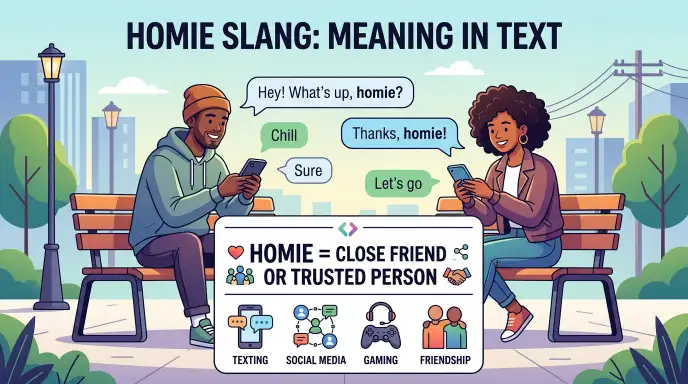
Homie slang is a casual way to refer to a close friend, trusted person, or someone you feel connected to. You may see “homie” in texts, social media posts, comments, music, gaming chats, or everyday conversations.
People often search for homie slang meaning because the word can sound different depending on who says it and how it is used.
In most modern conversations, calling someone “homie” is friendly. It can be similar to saying “friend,” “buddy,” “bro,” or “my guy.” It does not always mean the person literally comes from the same neighborhood or hometown.
The word is especially common in informal American English and has roots in terms such as homeboy and homegirl. Today, its use is much broader.
Quick Answer
“Homie” is slang for a close friend, trusted companion, or someone you consider part of your group. It is usually friendly and informal.
What Does Homie Mean in Text?
In text messages, homie usually means “close friend” or “friend.” It can also be used as a friendly way to address someone.
For example:
“What’s up, homie?”
This simply means something like:
“What’s up, friend?”
The meaning depends on the relationship between the people. If two close friends use “homie,” it can show trust and familiarity. Someone may also use it jokingly with a person they are not very close to.
Unlike some slang terms, homie does not normally have a hidden or complicated meaning in texting. The basic idea is friendship, familiarity, or solidarity.
Homie Slang Full Form
Homie does not have a traditional full form like an acronym. It is a shortened slang word rather than initials.
The word is commonly connected with homeboy and homegirl. Modern dictionaries describe homie as a short form of these terms, referring to a person from your hometown or neighborhood or, more broadly, a close friend. So, if someone asks “What does homie stand for?”, the simplest answer is:
Homie = an informal term for a close friend or homeboy/homegirl.
It is not normally written as H O M I E with a separate meaning for each letter.
Is Homie Rude or Offensive?
Usually, homie is not rude or offensive. It is generally a friendly, informal word.
However, context matters. Slang can sound natural between friends but strange or forced in a formal situation.
Friendly use
“Thanks for helping me, homie!”
This sounds warm and appreciative.
Casual use
“Hey homie, you coming tonight?”
This is a relaxed way to address a friend.
When it may sound awkward
“Good morning, homie. I would like to discuss the quarterly report.”
The word does not fit the professional tone of the sentence.
It is also important to understand that homie has cultural roots in American urban speech and African American and Latino communities.
Because of those roots, people should use the word naturally and respectfully rather than trying to imitate a particular ethnic or cultural identity.
Where Is Homie Commonly Used?
You can encounter homie in many informal settings, including:
- Text messages
- Instagram comments and captions
- TikTok comments
- Snapchat messages
- Reddit discussions
- Discord chats
- Gaming conversations
- YouTube comments
- Casual conversations
- Music and entertainment
It is mainly associated with informal American English, although many English speakers outside the United States recognize the word.
Cambridge describes homie/homey as mainly U.S. slang and explains that it can refer to someone from your hometown or neighborhood or to a close friend.
Online, the word can be used even when the people involved have never lived in the same place. Its meaning has broadened from a local connection to a general expression of friendship.
Homie vs. Homey: Are They the Same?
This can be confusing because homie and homey can refer to the same slang idea.
As slang nouns, both spellings can mean a close friend or homeboy/homegirl. Cambridge lists homey as a spelling variant of homie, while Merriam Webster also lists homie as a variant of the noun homey. But homey has another completely different meaning when used as an adjective.
For example:
“The restaurant feels very homey.”
Here, homey means comfortable, cozy, or like home.
So the context is important.
| Term | Meaning | Example |
| homie | Close friend | “That’s my homie.” |
| homey | Close friend; variant spelling | “My homey is coming over.” |
| homey | Cozy or comfortable | “This room feels homey.” |
| homeboy | Close male friend or friend from the same area | “He’s my homeboy.” |
| homegirl | Close female friend or friend from the same area | “She’s my homegirl.” |
| bro | Friend, brother, or male acquaintance | “Thanks, bro.” |
| buddy | Friend or casual acquaintance | “Hey buddy!” |
The Origin and Background of Homie
The modern slang homie is generally understood as a shortened form of homeboy or homegirl.
Etymonline records homie as slang from the 1970s and identifies it as a shortened form of homeboy. It also notes an earlier, separate use of the same form in New Zealand slang, so the history of the spelling is not completely simple.
The older term homeboy was used in African American vernacular in the 1940s for a person from one’s hometown.
Over time, related expressions developed meanings connected with friendship and close social relationships.
The term later became strongly associated with American urban and hip hop culture. As slang traveled through music, movies, television, and popular culture, homie became familiar to a much wider audience.
Today, the word is often used simply to mean “close friend.”
Because slang changes over time, the modern meaning does not always match its older social or geographic meaning.
Real Life Examples of Homie Slang
The easiest way to understand homie slang is to see how tone changes with context.
1. Friendly Example
“Thanks for picking me up, homie.”
Meaning: Thanks, my friend.
Tone: Warm and friendly.
2. Casual Text Example
“Yo homie, what are you doing later?”
Meaning: Hey friend, what are you doing later?
Tone: Very casual.
3. Showing Support
“You got this, homie!”
Meaning: You can do it, friend!
Tone: Encouraging and supportive.
4. Gaming Example
“My homie just carried the whole team.”
Meaning: My friend performed extremely well and helped the team win.
Tone: Casual and playful.
5. Social Media Example
“Proud of my homie!”
Meaning: Proud of my friend.
Tone: Positive and supportive.
6. Playful Example
“Bro, you really ate the last slice, homie?”
Meaning: A joking complaint toward a friend.
Tone: Playful, depending on the relationship.
7. Argumentative Example
“Listen, homie, I’m not doing that.”
Here, homie does not automatically make the sentence friendly. The speaker’s tone can make it sound challenging or confrontational.
Lesson: The word itself is usually friendly, but tone and context can change how it feels.
Why Do People Say Homie?
People use homie because it creates a sense of familiarity.
Instead of simply saying “friend,” the word can sound more relaxed and personal. It may suggest that the person is trusted or part of your social circle.
Common reasons people use it include:
- To show friendship
- To sound casual
- To show familiarity
- To express support
- To create a relaxed tone
- To address a close friend
- To show group connection
For example, “Thanks, friend” is understandable but can sound more formal or unusual in some situations. “Thanks, homie” feels more relaxed.
Homie in Social Media and Texting
On social media, homie is often used in short comments, captions, memes, and friendly messages.
You might see:
“My homie finally graduated!”
or:
“That’s my homie right there.”
The word can also appear in gaming communities and group chats where people use informal language.
It is generally safe for ordinary social media conversations because it is not normally a vulgar or offensive term. Still, using slang does not guarantee that every audience will like it.
For example, a professional LinkedIn post, school assignment, business email, or formal presentation usually calls for standard language instead.
When Should You Avoid Using Homie?
You do not need to avoid the word completely, but it is better to consider your audience.
Avoid or limit homie when:
- Writing a formal email
- Applying for a job
- Writing an academic assignment
- Speaking in a formal business setting
- Communicating with someone you do not know well
- Writing official documents
- Addressing someone who prefers formal language
Instead, use words such as friend, colleague, classmate, teammate, or acquaintance, depending on the situation.
The key is not that homie is a bad word. It is simply informal slang.
Homie vs. Bro vs. Buddy vs. Friend
These words overlap, but they can create slightly different feelings.
| Slang | Typical meaning | Tone |
| Homie | Close friend or trusted person | Casual, friendly |
| Bro | Friend, male friend, or familiar person | Very casual |
| Buddy | Friend or acquaintance | Casual, often friendly |
| Pal | Friend | Casual, sometimes old fashioned |
| Dude | Person, friend, or man | Very casual |
| Friend | Person you have a friendly relationship with | Neutral |
| Homeboy | Close male friend or person from the same area | Casual, culturally specific |
These terms are not always interchangeable. For example, friend is neutral enough for many situations, while homie is much more informal.
Is Homie Gender Neutral?
Yes. In modern usage, homie can be used for people of different genders.
Historically, terms such as homeboy and homegirl were more gender specific. Homie is commonly used as a general term for a friend without requiring the person to be male or female.
For example:
“She’s my homie.”
This simply means:
“She’s my close friend.”
Does Homie Mean Someone From Your Hometown?
It can, but not necessarily.
The older meaning was more closely connected to someone from the same hometown, neighborhood, or local community. Modern usage has expanded.
Today, you can call someone your homie even if you met them online, at school, at work, or through gaming.
The important idea is usually friendship or familiarity, not a shared home address.
Is Homie Safe to Use on Social Media?
Yes, homie is generally safe and harmless in ordinary social media use.
It is a common informal term for a friend. It is not normally a swear word or slur.
Still, social media has many different audiences. A word that sounds natural in a gaming chat may not fit a professional account or formal announcement.
When in doubt, use friend or another neutral word.
Common Mistakes About Homie
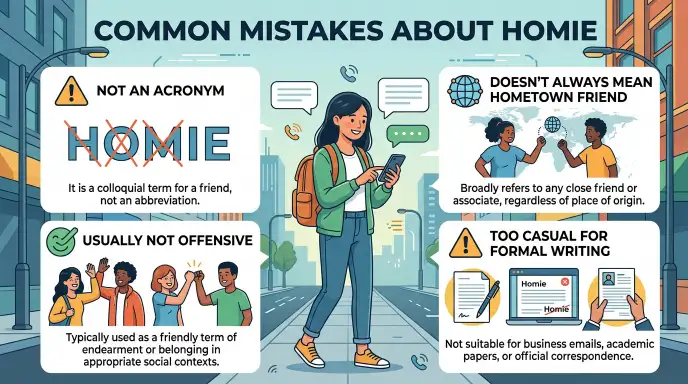
Mistake 1: Thinking it is an acronym
Homie is not normally an acronym. It is a slang word.
Mistake 2: Assuming it always means a person from your hometown
Modern usage often simply means close friend.
Mistake 3: Thinking homie is offensive
The word is generally friendly and informal. However, tone and cultural context still matter.
Mistake 4: Confusing slang “homey” with the adjective “homey”
“Homey” can mean a close friend, but it can also mean cozy or comfortable.
Mistake 5: Using it in every situation
Homie is casual slang. It is not the best choice for formal writing or professional communication.
FAQs About Homie Slang
What does homie mean in text?
Homie means a close friend, trusted friend, or familiar person. In a text, it is usually a casual and friendly way to address someone.
Is homie a bad word?
No. Homie is generally not a bad word. It is informal slang and is normally used in a friendly way.
What is the full form of homie?
Homie does not have an acronym style full form. It is commonly understood as a shortened form of homeboy or homegirl.
Is homie the same as friend?
Usually, yes. However, homie sounds more casual and familiar than the neutral word “friend.”
Can I call a girl homie?
Yes. Homie can be used for a friend of any gender. The word is commonly used as a gender neutral casual term.
What is the difference between homie and homey?
As slang nouns, homie and homey can both mean a close friend. But homey can also be an adjective meaning cozy or comfortable, as in “a homey room.”
Conclusion
Homie slang is a casual term for a close friend, trusted companion, or familiar person. It is usually friendly and relaxed, making it common in texts, social media, gaming chats, and everyday conversations.
The word developed from expressions such as homeboy and homegirl, which were connected to people from the same hometown, neighborhood, or community. Over time, homie became more widely used to mean simply a close friend.
The safest way to understand “homie” is to look at the context. Saying “Thanks, homie” to a friend sounds warm and casual, while using it in a formal business email may sound out of place.
So, if you see “homie” in a text, the most likely meaning is simple: “friend,” “close friend,” or “my guy.” The exact feeling depends on the relationship, tone, and situation.
Read More About!
- Helicopter Slang: Meaning, Uses & Examples
- Korean Texting Slang: Meaning & Examples
- OMY Meaning Slang: What Does OMY Mean in Text?

Hi, I’m Chloe Parker. I write simple and practical articles about slang, grammar, spelling, vocabulary, and commonly confused words. My goal is to make English easier to understand through clear explanations and real-life examples. Whether you’re a student, writer, or English learner, I’m here to help you build confidence and improve your everyday English.